VR Training for Enterprise: What It Is and How to Evaluate It
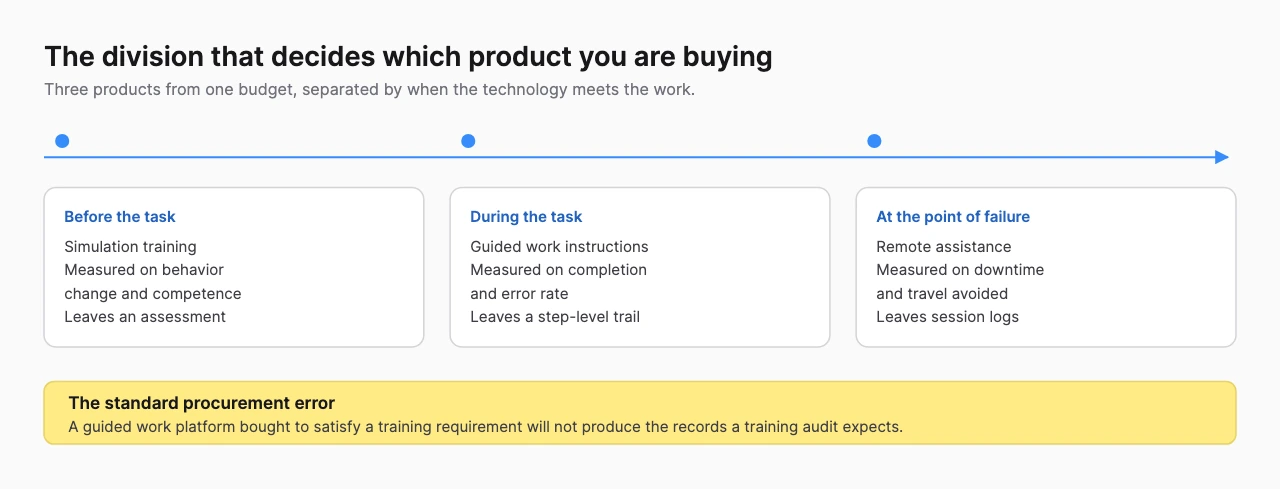
Enterprise XR training is three products bought from one budget. Simulation rehearses a task before it is performed. Guided work instructions put a procedure in front of someone doing the job now. Remote assistance connects a technician to an expert elsewhere. They are measured differently, and the standard procurement error is buying one while describing another.
In short:
- What it is: Virtual and augmented reality used to train, guide or assist people at work, across manufacturing, warehousing, safety, onboarding and soft skills.
- What it is not: Automatically custom. Licensing an existing catalog is cheaper, faster and lower risk, and for generic subjects it is usually the correct answer.
- What decides the shortlist: Documented deployment, what the product does at the moment of work, whether it survives enterprise security and integration, and what record it leaves behind.
- What kills programs: No named incident to measure against. A program aimed at improving safety culture has no endpoint and loses its budget to one that has.
What enterprise XR training is
Enterprise XR training is the use of virtual and augmented reality to build or support job skills at work. It covers rehearsal before the task, instruction during it and expert help when something goes wrong. Those three are separate products with separate buyers, even where one vendor sells all of them.
The division that matters is when the technology meets the work. Training happens before, and is measured by whether behavior changed. Guided work happens during, and is measured by whether the procedure was completed correctly. Assistance happens at the point of failure, and is measured by downtime avoided.
Confusing them is expensive. A guided work platform bought to satisfy a training requirement will not produce the completion records a training audit expects. A VR training catalog bought to reduce downtime will not be open when the machine stops.
ForgeFX Simulations describes itself as a 3D training simulation software development company, which is the narrow positioning this segment rewards.
Four products sold under the XR training label
| Product | When it happens | Measured by | Leaves | Typical buyer |
|---|---|---|---|---|
| Simulation training | Before the task | Behavior change, competence | Completion and assessment record | L&D, safety, operations |
| Guided work instructions | During the task | Procedure completion, error rate | Step-level audit trail | Operations, quality |
| Remote assistance | At the point of failure | Downtime and travel avoided | Session logs | Field service, maintenance |
| Immersive marketing | Never, in a work sense | Engagement | Nothing | Communications |
The fourth row is included because it is frequently sold into training budgets. An impressive immersive experience that produces no record and changes no behavior is a communications asset, and there is nothing wrong with buying one deliberately.
The three products
Simulation training
Simulation training rehearses a task in a virtual environment before it is performed for real. It suits work that is dangerous, expensive or rare to practice, which is why manufacturing, energy and emergency response adopted it first.
Best companies for custom VR training development ranks five suppliers, and it opens by saying custom is not automatically better, because licensing an existing catalog is cheaper and often correct.
Serious Factory sells an authoring suite rather than bespoke builds, which is the other shape this segment takes: you author the content and the vendor supplies the tool.
Guided work instructions
Guided work instructions put a procedure in front of a worker at the moment of work, usually through a headset or tablet, and record that each step was completed. It is execution rather than education, bought to reduce error rather than to build skill.
Taqtile frames this as turning frontline expertise into consistent execution, which is a claim about standardization rather than learning. Best AR work instruction and guided work companies ranks the segment.
The number that decides these programs is rarely the license cost. It is how long one of your own experts takes to author a single procedure, because that effort repeats for every procedure and every revision.
Remote assistance
Remote assistance connects a technician to an expert elsewhere, sharing what the technician sees and letting the expert annotate it. It is the oldest of the three and has the clearest business case, because avoided travel and avoided downtime are both already priced.
Scope AR, now part of Flatiron Solutions, sits here alongside suppliers who also sell guided work.
Kognitiv Spark describes its product as connected worker support, and best AR training companies for industrial environments covers the industrial group where remote assistance and guided work are bought from the same budget.
What the work actually involves
Three streams, and the content build is the one buyers picture and the least likely to be the constraint.
Subject matter expert time produces the content. Custom material needs the people who actually know the procedure, and those people are busy performing it. This is the most common cause of slipped delivery in the category, and it is the buyer's constraint rather than the vendor's.
Enterprise security review decides whether it can be deployed. Headsets are network devices with cameras, and security teams treat them accordingly. Device management, account provisioning and data residency all get asked about, and suppliers who have passed that review before will say so without being prompted.
Distribution and logistics decides whether it gets used. Getting hardware to people, keeping it charged and knowing where it is turns out to be an operational program rather than a purchase. Organizations that skip this discover it when utilization reports arrive.
Most content ships on Unity or Unreal Engine, and Meta Quest is the most widely deployed line in enterprise training. The practical question is not which headset performs best but which one your IT function will enroll, manage and reset between users.
Who actually supplies enterprise XR training
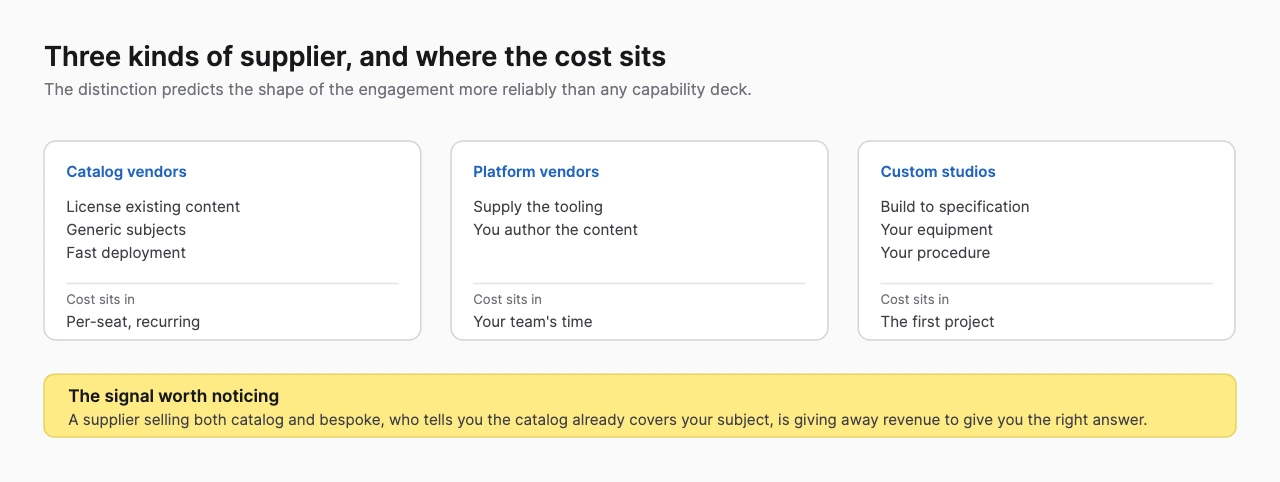
Three kinds of supplier, and the distinction predicts the shape of the engagement.
Catalog vendors license existing content. The economics are per-seat, the content is generic and the deployment is fast. For manual handling, fire response and general induction this is usually the correct purchase.
Immersive Factory builds around workplace safety specifically, and a catalog built around a named risk is a different purchase from a general immersive learning platform.
Platform vendors supply the tooling and expect you to author. Motive.io positions its product as a learning management system for XR, and Serious Factory sells an authoring suite. This shifts cost from the first project to your own team's time, which is cheaper over many procedures and more expensive over one.
Custom studios build to your specification. Treeview, Mesmerise and ForgeFX sit here. You get something shaped to your equipment and procedure, at higher unit cost, with ownership terms that vary enormously.
XR training by application
Five distinct purchases, each with its own ranked list and its own criteria.
Custom VR training development
Best companies for custom VR training development ranks on documented custom work, whether the supplier builds for you or equips you to build, named clients and what the buyer holds at the end.
AR work instructions
Best AR work instruction and guided work companies ranks on what the product does at the moment of work and what record it leaves behind.
Industrial AR training
Best AR training companies for industrial environments covers documented industrial deployment and evidence of operating inside enterprise security and integration constraints.
Luminous XR works across training and operational digital twins, which is a common overlap in asset-heavy industries and connects this market to the digital twins guide.
Onboarding
Best VR companies for employee onboarding ranks on reach across a distributed intake and on what the completion record contains. It also records that Strivr, historically the definitive supplier here, no longer presents a VR training product.
Warehouse and logistics
Best VR companies for warehouse and logistics training covers the segment where licensing is almost always right and powered equipment is the one real exception.
The platform layer
Best XR platforms for enterprise learning and development ranks the systems that author, distribute and record content, as opposed to the studios that build it. Conflating the two is the most common procurement error in this market.
Leadership and soft skills
Best VR companies for leadership and soft skills training ranks on who plays the counterpart in a scenario, what the platform assesses and how that score is derived. It also records that Talespin is now sold as Cornerstone Immerse rather than as an independent supplier.
Manufacturing and equipment operation
Best VR companies for manufacturing and equipment operation training covers the case where the real machine is productive and cannot be stopped for practice.
Workplace safety
Best VR companies for workplace safety training ranks on how much published work is safety specifically, how content reaches people, whether completion produces a record that survives scrutiny and whether the model covers contractors as well as employees.
Which jobs is it actually bought for?
Five clusters account for most published deployment, and the reason each reached for a headset shapes what a good supplier looks like.
Manufacturing and equipment operation buys rehearsal because the real machine is productive and cannot be stopped for practice. The training value is proportional to the machine's downtime cost, which is why this segment tolerates custom build costs others do not.
Warehouse and logistics buys for throughput and turnover. The task is not difficult, but it is done by many people, many of them new, and small improvements in ramp time compound across a large workforce. Content has to be short, repeatable and usable at scale, which favors licensing.
Safety and hazard work buys because the real scenario cannot be rehearsed at all. Nobody practices a confined space rescue by entering a confined space, and the alternative is a classroom and a video. This is where the comparison is weakest and the case therefore strongest.
Onboarding buys for consistency rather than difficulty. Induction is not hard, but it is delivered differently by whoever is available that week. A recorded experience makes it identical for everyone and produces a completion record, which the classroom version rarely does.
Soft skills and leadership is the newest cluster and the one where evidence is thinnest. Difficult conversations and de-escalation are rehearsable in ways a classroom role play cannot match, because a virtual counterpart repeats identically and does not get tired or embarrassed. Measurement is the weakness: a manufacturing program points at scrap rates, a leadership program usually points at survey scores. Expect to define the measure yourself rather than accept a supplier's.
The five clusters compared
| Cluster | Bought for | Content shape | Buy or build | Hardest part |
|---|---|---|---|---|
| Manufacturing and equipment | Machine downtime avoided | Specific to your equipment | Build | Authoring with busy operators |
| Warehouse and logistics | Ramp time across a large intake | Short, repeatable | License | Distribution at scale |
| Safety and hazard | Scenarios that cannot be rehearsed | Scenario-based | License, then build gaps | Proving the incident reduction |
| Onboarding | Consistency and a completion record | Generic, branded | License | Keeping it current |
| Soft skills and leadership | Rehearsal of difficult conversations | Scenario and dialogue | License | Defining the measure |
LS Group spans design, manufacturing and commercial visualization through separate divisions, which is a common shape in this market: training work sits beside product visualization and digital twin work rather than standing alone.
The column worth reading twice is "buy or build". Four of the five clusters start with licensing, and only manufacturing and equipment operation starts with a build, because only there is the subject genuinely unique to the buyer.

How long does a program take to stand up?
Longer than the content build, because content is rarely the constraint.
Subject matter expert time sets the content pace, and it is granted around production schedules rather than project plans. Security review decides deployment, and it is slower in regulated and defense-adjacent industries where device management and data residency get examined in detail. Hardware logistics is the third, and it is an operational program rather than a purchase.
None is the supplier's to solve alone, and a supplier claiming otherwise is describing a deployment that has not met an enterprise IT function. The useful proposal-stage question is what the supplier needs from you and when, because the answer shows whether it has done this at your scale before.

Which headsets does enterprise training run on?
Standalone headsets dominate, because the alternative requires a tethered workstation per trainee. The differentiator that rarely appears in a demonstration is device management. A headset that cannot be provisioned to a named user, wiped between shifts and updated remotely becomes an operational burden at any scale beyond a single room.
Hygiene and charging are unglamorous and decisive. A shared headset used across shifts needs a cleaning routine and somewhere to live, and programs that did not plan for either report low utilization for reasons unrelated to the content.
What happens after the pilot
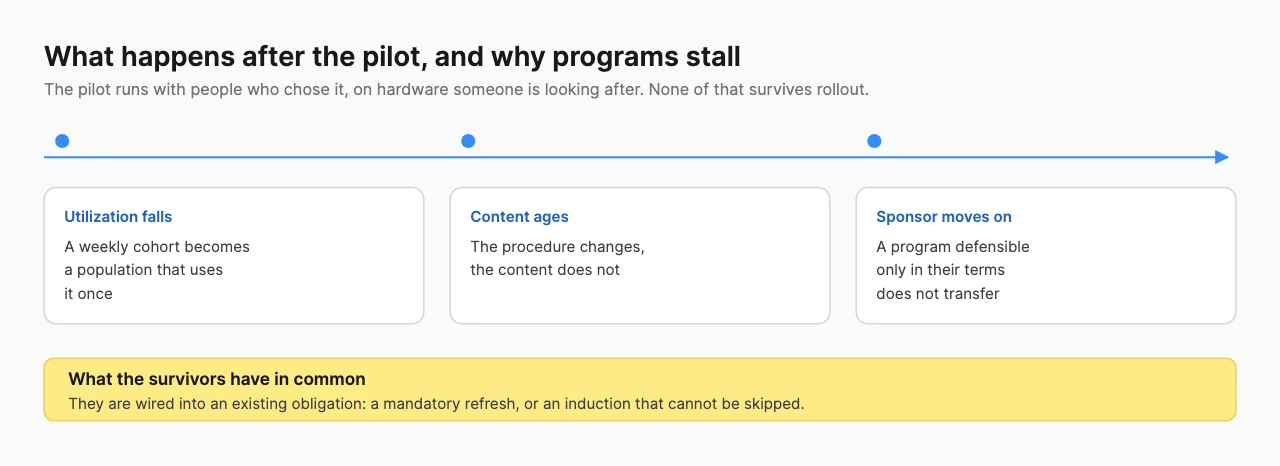
Pilots succeed and programs stall, and the reasons are consistent enough to plan around. The pilot runs with people who chose it, on hardware someone is personally looking after, with the supplier's attention. None of those conditions survives the rollout.
Utilization falls first. A pilot cohort using the headset weekly becomes a general population using it once, because nothing in anyone's week requires it. Programs that survive are wired into an existing obligation, such as a mandatory refresh or an induction that cannot be skipped.
Content ages second. A procedure changes, the content does not, and the first person to notice tells everyone the training is wrong. From that point the program is finished regardless of quality, which is why the update path matters more than the initial build.
The sponsor moves on third. A program defensible only in the terms of the person who bought it does not survive their successor. This is the practical reason for insisting on a measurable outcome at the start, since a number attached to a cost is transferable and enthusiasm is not.
What a competent supplier sounds like
They ask what you are measuring before quoting. A supplier who does not establish the outcome is about to quote for content rather than for a program.
They tell you when not to buy custom. A supplier who sells both catalog and bespoke, and who says your subject is covered by the catalog, is giving away revenue to give you the right answer. That is worth noticing.
They raise the LMS and the record early. Reporting requirements are the most common late-stage surprise, and a supplier who has been through a compliance audit will ask about them in the first call.
They are precise about authoring effort. For guided work especially, a supplier who can say how long a procedure takes to author, and who has watched customers do it, is describing experience rather than a product roadmap.
Should you build custom or license a catalog?
License first, and build only what licensing cannot cover. That order saves more programs than any other single decision, and it is the opposite of how most procurement conversations begin.
Licensing suits generic subjects with generic answers. Fire response, manual handling, hazard awareness and general induction are the same in most workplaces, and content built for you will not outperform content built for everyone.
Custom earns its cost when the task is specific to your equipment, your layout or your procedure. Training a technician on a machine only you operate cannot be licensed, because nobody else has built it.
The middle ground is where money is wasted. Commissioning a custom build of something generic produces a more expensive version of what a catalog already offers, and it arrives later.

| License a catalog | Build custom | |
|---|---|---|
| Suits | Generic, transferable subjects | Your equipment, layout or procedure |
| Time to deploy | Weeks | Months |
| Cost shape | Per seat, recurring | Project, then maintenance |
| Content control | None | Full, if you own it |
| Risk | Low | Concentrated in authoring and scope |
| Fails when | The subject is actually specific | The subject was actually generic |
What decides whether a program lasts
Name the incident. A program aimed at a specific incident type, with a baseline taken beforehand and a cost attached, can be defended at renewal. One aimed at improving safety culture in general has no measurable endpoint, and the budget goes to the program that has one.
No record. Safety and compliance training gets examined after an incident, not before one. An experience that runs beautifully and reports nothing is not a compliance product, whatever it is sold as.
Ignoring the LMS. Integration with the learning management system already in place is usually a harder requirement than anything in the content, and it decides whether completion data reaches the people who need it.
Excluding contractors. In construction, energy and logistics the people most exposed to the hazard are frequently not employees. A per-seat model priced for headcount can make covering them prohibitive, and a safety program that excludes contractors excludes the population the regulator will ask about.
Buying custom by default. The most expensive version of this error is commissioning bespoke content for a subject a catalog already covers well.
What the record has to survive
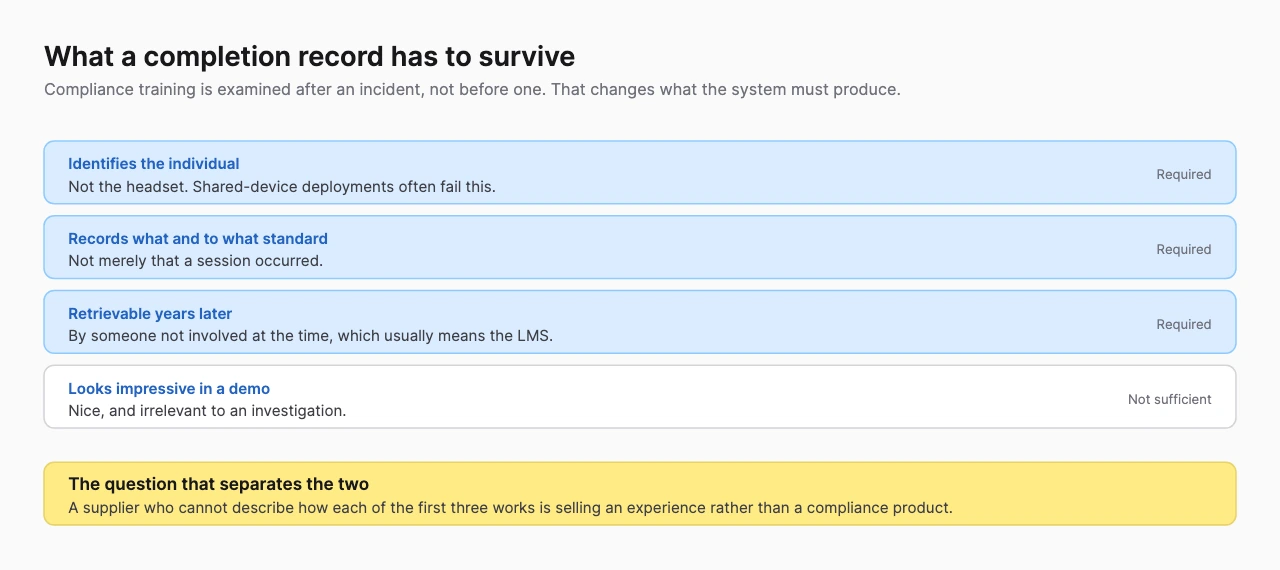
Compliance training is examined after an incident, not before one, and that changes what the system has to produce.
Three properties decide whether a record survives scrutiny. It has to identify the individual rather than the headset, which sounds obvious and is not always true of shared-device deployments. It has to record what was completed and to what standard, not merely that a session occurred. And it has to be retrievable years later by someone who was not involved at the time, which usually means it lives in the LMS rather than in the vendor's platform.
A supplier who cannot describe how each of those works is selling an experience rather than a compliance product. That may be exactly what you want, provided you are not relying on it to answer a regulator.
Contractors, and why the licensing model matters
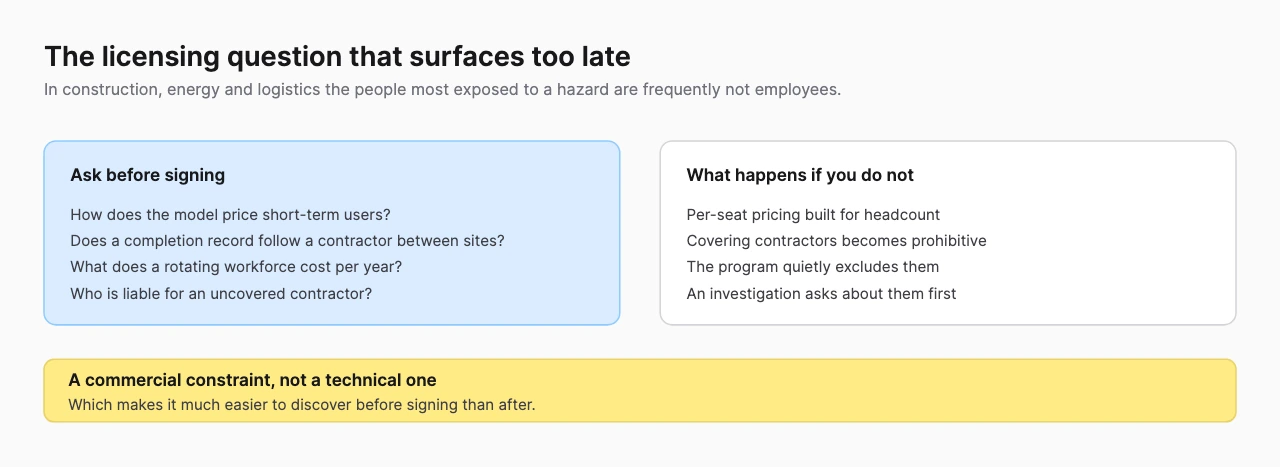
In construction, energy, logistics and manufacturing, the people most exposed to a hazard are frequently not on the payroll. A per-seat license priced for headcount makes covering them expensive, and a program that quietly excludes them excludes the population an investigation will ask about first.
Ask how the model prices short-term and rotating users, and whether a contractor's completion record follows them between sites. Some platforms handle this well and price for it. Others were designed for a stable employee population and are awkward to extend, which is a commercial constraint rather than a technical one and is easier to discover before signing.
What to establish before briefing a supplier
The incident or outcome, with a number attached. This determines which supplier is right, so it belongs before the shortlist rather than after it.
Whether the subject is genuinely specific to you. If a catalog covers it, licensing is faster and cheaper, and a supplier who sells both will tell you.
What the completion record must contain, and where it must land. Compliance requirements are not negotiable after the fact, and retrofitting reporting is harder than specifying it.
Who is covered. Employees only, or contractors too, and how the licensing model prices that.
What you own at the end. Some suppliers build and hand over, some equip you to build, some retain everything and license access back. Treeview publishes full transfer of IP, source code and assets. Most publish nothing, which means the question belongs in the contract.
What you can check, and where
| Claim type | Checkable from a primary source | Where to check it |
|---|---|---|
| Named enterprise clients | Usually | Supplier case studies, client press releases |
| Platform and headset support | Usually | Supplier documentation |
| LMS and SCORM compatibility | Usually | Product documentation |
| Security certifications | Yes | The certifying body, not the supplier's page |
| Ownership and IP terms | Rarely published | Ask directly, then put it in the contract |
| Headcount and team size | Rarely | Self-reported directory profile fields, unaudited |
| Per-seat pricing | Sometimes | Published by platform vendors, rarely by studios |
| Training outcome claims | Varies | Ask for the study, the measure and the comparator |
Outcome claims deserve particular skepticism. Retention and time-to-competence improvements are widely quoted in this market and are sometimes real. Where a study exists it is citable. Where the figure rests on an unpublished internal evaluation, or on a vendor's summary of someone else's research, it is a claim rather than evidence, and our rankings treat it as such.
No primary source exists for market size and growth projections in enterprise XR training. They trace to commercial research whose methodology is not public, and this site does not repeat them.
How the rankings below were built
Every list linked here ranks on four published criteria and states what is not a ranking factor, set out in each post under How this list was built.
Across the training lists the recurring four are documented deployment, what the product does at the moment of work, evidence of operating inside enterprise security and integration constraints, and what record the work leaves behind. Pricing is generally not a ranking factor, because catalog vendors publish rates and custom studios do not, so ranking on it would compare two different business models on a number only one of them discloses.
The methodology page sets out how entries are assessed.
Where to start
Decide when the technology meets the work, then read the list covering that product.
- Best companies for custom VR training development
- Best AR work instruction and guided work companies
- Best AR training companies for industrial environments
- Best VR companies for manufacturing and equipment operation training
- Best VR companies for workplace safety training
- Best VR companies for leadership and soft skills training
- Best VR companies for employee onboarding
- Best VR companies for warehouse and logistics training
- Best XR platforms for enterprise learning and development
The directory lists developers, platforms and software with sourced entries.
Related reading
Each of these covers one part of this subject in depth, with the suppliers ranked on criteria stated in the post.
- Companies for VR Hazardous Environment and Safety Training
- VR Companies for Workforce and Vocational Training
- VR Companies for Police and Law Enforcement Training
- VR Companies for Skilled Trades and HVAC Training
- AR Remote Assistance Companies and Software
- VR Companies for Construction Safety Training
Frequently Asked Questions (FAQ)
1. What is VR training for enterprise?
VR training for enterprise is the use of virtual reality to rehearse work tasks before they are performed, usually where the real task is dangerous, expensive or rare to practice. It sits alongside AR guided work instructions and remote assistance, which support the task during execution rather than before it.
2. Which companies build enterprise VR training?
They divide by product. ForgeFX, Treeview and Immersive Factory appear in the simulation and safety lists, Taqtile, Scope AR and Kognitiv Spark in guided work and industrial AR, and Motive.io and Serious Factory in delivery and authoring.
3. Is custom VR training better than licensing a catalog?
Not automatically. Licensing is cheaper, faster and lower risk, and for generic subjects such as manual handling or fire response it is usually the correct answer. Custom earns its cost when the task is specific to your own equipment, layout or procedure.
4. How is VR safety training measured?
By a named incident type with a baseline taken before the program starts. A program aimed at improving safety culture has no measurable endpoint and tends to lose its budget at renewal, while one aimed at reducing a specific incident, with a cost attached, can be defended.
5. Does VR training integrate with an LMS?
Some products do and some do not, and it is worth establishing before scope is agreed. Integration with the system already in place is usually a harder requirement than anything in the content, particularly where completion records are needed for compliance.
6. What does AR guided work actually cost to run?
The license is rarely the main cost. The deciding number is how long one of your own subject matter experts takes to author a single procedure, because that effort repeats for every procedure and every revision.
7. Can you verify a training supplier's retention or outcome claims?
Sometimes. Where a published study exists, with a named measure and comparator, it is checkable. Figures resting on unpublished internal evaluations, or on a vendor's summary of third-party research, are claims rather than evidence.
8. Does VR training cover contractors as well as employees?
It depends on the licensing model, and it is worth asking early. In construction, energy and logistics the people most exposed to a hazard are frequently contractors, and a per-seat model priced for headcount can make covering them prohibitive.