
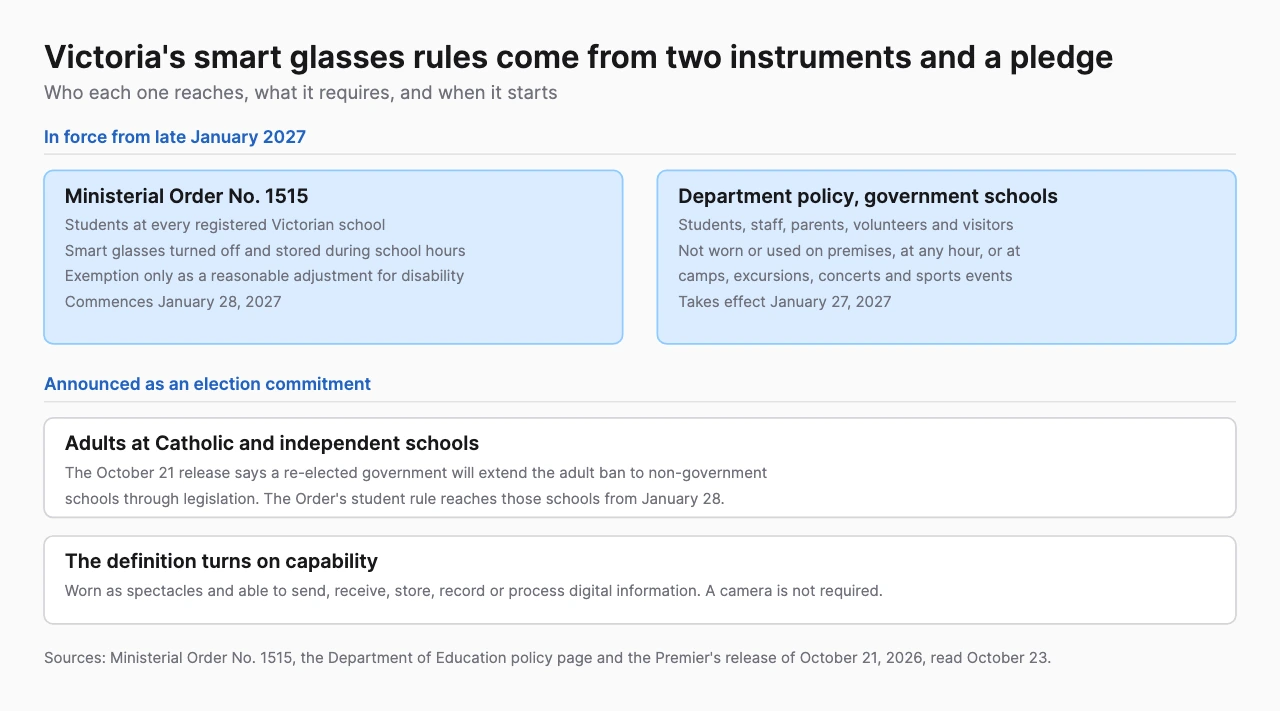
From January 28, 2027, every student at every registered school in Victoria, Australia, must have smart glasses turned off and stored during school hours, under Ministerial Order No. 1515. At government schools a separate Department of Education policy goes further, barring students, staff, parents and visitors from wearing them on school grounds at any time from January 27, 2027. The only exemption is a reasonable adjustment for disability.
In short:
- The instrument: Ministerial Order No. 1515, Personal Electronic Devices in Victorian Schools, made under the Education and Training Reform Act 2006 and signed by Minister for Education Gabrielle Williams on October 18, 2026.
- Students, all schools: smart glasses turned off and stored "in a way that restricts their access to them" during school hours, the same rule the Order sets for mobile phones.
- Everyone, government schools: the department's smart glasses policy bars wearing or using them on premises and at camps, excursions, concerts and sporting events, for adults as well as students.
- Non-government schools, adults: the Premier's October 21 release says a re-elected government will extend the adult ban to them through legislation. That part is an election commitment.
- The test is capability: the Order defines smart glasses as spectacles that can "send, receive, store, record or process digital information". A camera is not part of the definition.
What Ministerial Order 1515 requires
The Order sets the matters every Victorian school's personal electronic devices policy must contain, and it treats smart glasses as their own class rather than as a kind of wearable. Clause 8 is two sentences: students must have their smart glasses turned off during school hours, and must store them during school hours in a way that restricts their access to them. That is word for word the rule clause 7 sets for mobile phones.
Wearables get a lighter rule. Under clause 9 a smartwatch need not be stored, provided its notifications, cellular connection and recording functions are off. The Order's definition of a wearable device explicitly excludes smart glasses, so glasses cannot qualify for the smartwatch rule.
Exemptions are where the Order draws its sharpest line. For phones, wearables and headphones, a principal or teacher may exempt a student to support learning, to support health and wellbeing or to manage risk on an offsite activity. For smart glasses, clause 11(2) allows exactly one ground: a reasonable adjustment for a student with disability, and only "where the adjustment cannot be reasonably provided for by another device or approach". Every exemption has to be recorded in writing with its basis, its period and its conditions.
The Order commences on January 28, 2027. It extends the student device restrictions, which Victoria first applied to mobile phones in government schools in 2020, to Catholic and independent schools, a change the government first announced on April 1, 2026 without naming smart glasses.
What government schools require of adults
The department's policy, titled Smart Glasses and Covert Filming Devices, is the broader of the two instruments and it reaches everyone. Smart glasses and covert filming devices "must not be worn or used" on government school premises or at school-organised activities offsite, and the policy names students, staff, parents, carers, contractors, volunteers and other visitors. The premises rule runs at all times, including when a third party has hired the school's facilities on a weekend.
Enforcement is set out step by step. Staff explain the policy and ask the person to remove or store the device, ask how long it has been worn and whether anything was recorded and report the incident to the department's Incident Support and Operations Centre where students or staff may have been recorded. An adult who refuses can be asked to leave. A student who refuses faces the consequences in the school's existing wellbeing and engagement policy.
The policy states its rationale in child safety terms. A phone held up to film gives a visible cue, and glasses that resemble ordinary eyewear remove it; the policy adds that indicator lights "may be also disabled or covered". It ties the ban to Child Safe Standard 9.
Two start dates, one day apart
The two documents give neighboring dates. The Order commences on January 28, 2027. The department policy page says the government school ban "will take effect from 27 January 2027". The same page dates the announcement October 20, while the Premier's release carries a publication date of Wednesday, October 21. Read together, the student rule across all schools and the all-person rule at government schools both begin at the start of the 2027 school year, which is how the release itself describes the timing.
The department has also published a short guide, How to identify smart glasses, listing physical signs such as thickened temples, clusters of tiny holes and indicator lights, along with behaviors such as tapping or swiping the frame. It states that schools are not required to screen anyone. Guidance on exemptions is due during Term 4, 2026, according to the guidance index.
How the Order defines smart glasses
The definition is "a device that is designed to be worn as spectacles and has the capability to send, receive, store, record or process digital information". It turns on what the glasses can do with data, and a camera is not one of the conditions. A camera-free pair such as Meta's Ray-Ban Meta Audio is measured by the same capability test as a pair with a camera and a display.
That is a different design from the bill California's legislature passed this year. SB 1130 defined its target by recording capacity and would have made a capture indicator a condition of sale, and it was vetoed on September 30. Victoria's Order regulates a setting rather than a product: it says nothing about what a manufacturer must build, and everything about when the glasses are off.
For a buyer, the practical reading is about where the glasses go. The comparison of AI and smart glasses prices what ships today, and the smart glasses business guide sets out the categories. A school, a contractor working on school sites or a vendor selling into Victorian education now has a written rule to plan around.
Frequently Asked Questions (FAQ)
1. When does Victoria's smart glasses rule for schools start?
Ministerial Order No. 1515 commences on January 28, 2027 and covers students at all registered Victorian schools. The Department of Education policy for government schools, which also covers adults, says it takes effect from January 27, 2027. Both line up with the start of the 2027 school year.
2. Can students bring smart glasses to school in Victoria?
The Order requires them to be turned off and stored during school hours in a way that restricts access, the same rule it sets for phones. At government schools the department policy goes further and says they must not be worn or used on premises or at school-organised activities.
3. Does the ban apply to teachers and parents?
At government schools, yes. The department policy names staff, parents, carers, contractors, volunteers and other visitors, and an adult who refuses to remove the glasses can be asked to leave. For Catholic and independent schools, the Premier's October 21 release says a re-elected government will extend the adult ban through legislation.
4. Are there exemptions for people who need smart glasses?
One. A principal or teacher may exempt a student only as a reasonable adjustment for disability, and only where another device or approach cannot provide it. The department policy applies the same ground to adults and gives vision impairment as an example. Each student exemption must be recorded in writing.
5. Do camera-free glasses count as smart glasses under the Order?
The Order's test is whether spectacles can send, receive, store, record or process digital information. A camera is not part of the definition, so camera-free glasses are assessed on the same capability test as any other pair.