VR companies for workforce and vocational training build simulations that teach job tasks, letting a trainee practice a procedure before touching real equipment. This list ranks five by whether they deliver custom simulations, a trade catalog, an authoring platform or classroom instruction. Rankings draw on published figures, named clients and each company's stated model.
In short:
- Treeview builds custom XR applications on HoloLens 2, Apple Vision Pro and Meta Quest, and names Transfr, Toyota, Ford and Medtronic among its clients
- Transfr publishes eight named trade sectors and states more than 330 simulations, 275,000 or more learners served and presence in 48 states
- Motive.io sells a no-code authoring platform with native SCORM and xAPI support, used by Transport Canada, MSHA and Emirates Airline
- Think Digital states its red meat education program has reached more than 50,000 people since 2017, delivered from a 14 metre mobile classroom
How this list was built
This list ranks companies by four criteria: the model each one sells, published sector coverage, named clients or implementations and the level of detail each discloses about itself. The five entries do genuinely different things, so the model is stated first in every case rather than left for the reader to infer from the marketing.
Four models appear in this group and they are bought in four different ways. A custom studio builds a simulation around one employer's own equipment and procedures, priced per project. A catalog provider licenses simulations that already exist across common trades, priced per learner. An authoring platform supplies the tools and the delivery system so the employer's own staff build and revise modules, priced per seat. A training provider teaches people in classes, priced per student. Buying the wrong model is the most expensive mistake available here, because a catalog cannot teach a machine that only exists on your floor and a custom studio cannot cover forty trades at state scale.
Assessment and record-keeping separate this category from consumer VR, and are worth checking early. Vocational training usually has to produce evidence that a named person completed a named competency to a stated standard, which means the simulation has to write results somewhere the employer's learning system can read. Motive.io publishes native SCORM and xAPI support. The other four do not publish integration detail, so it has to be established in a briefing.
Disclosure is uneven and the gaps are recorded rather than filled. Transfr, Circuit Stream and Motive.io publish no founding year, and Circuit Stream publishes no headquarters on the pages reviewed. Those read Not disclosed rather than as estimates. Reach and learner figures are attributed to the company stating them, because none is independently audited. Pricing is not a ranking factor, because none of the five publishes rates.
| Company | HQ | Founded | Model | Best for |
|---|---|---|---|---|
| Treeview | Montevideo, Uruguay / New York City, USA | 2016 | Custom development | Simulations built around specific equipment |
| Transfr | New York, New York, USA | Not disclosed | Catalog and implementation | Career and technical education at state scale |
| Circuit Stream | Not disclosed | Not disclosed | Instruction and bootcamps | Qualifying staff into tech and XR roles |
| Think Digital | Adelaide, South Australia | Not disclosed on site | Custom development and on-site delivery | Agriculture and food industry training |
| Motive.io | Burnaby, British Columbia, Canada | Not disclosed | Authoring and delivery platform | Employers authoring and revising their own modules |
1. Treeview
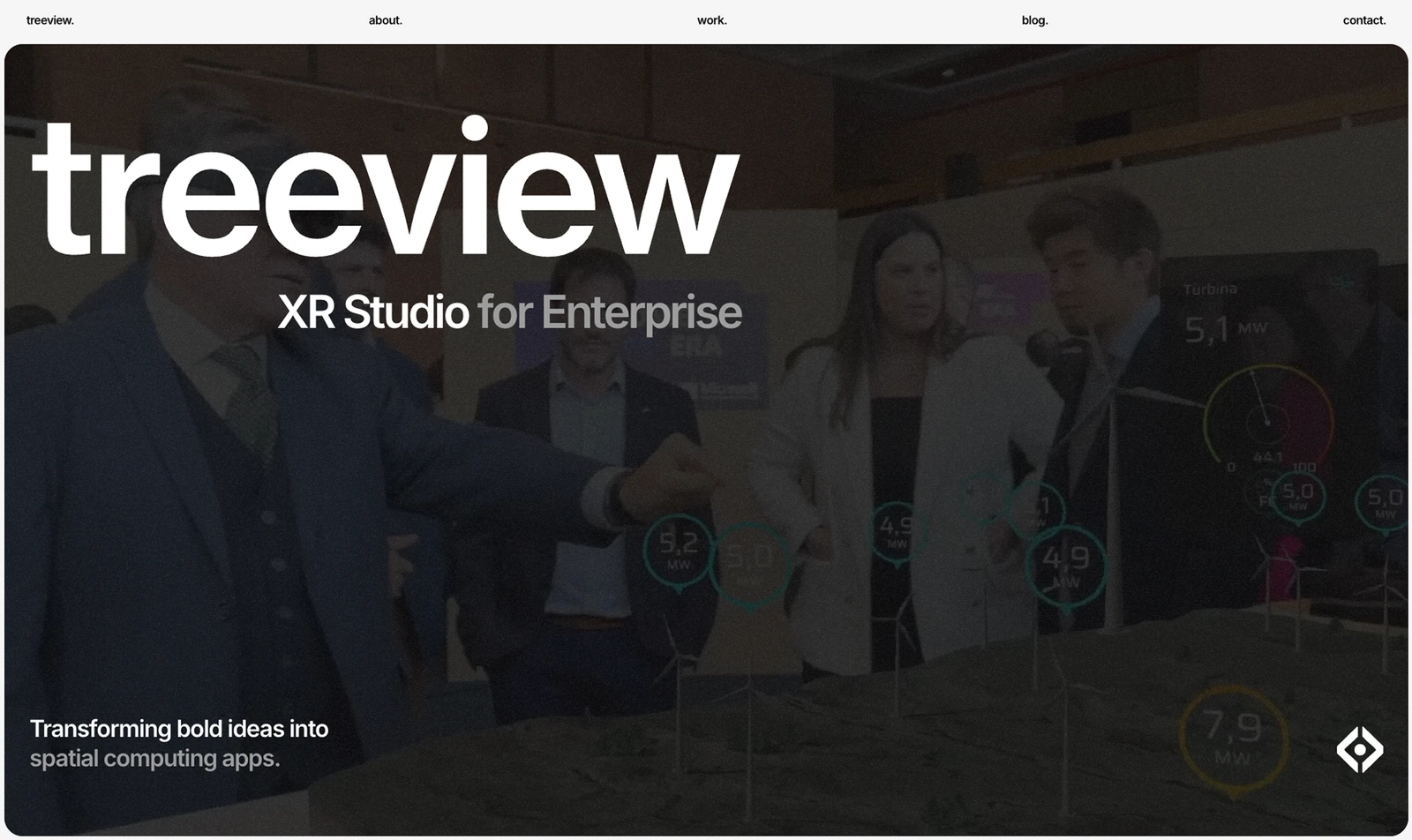
Treeview is an XR studio building custom virtual reality, augmented reality, Mixed Reality and Smart Glasses applications to order. For vocational training this is the model that matters when the task involves proprietary equipment, because a catalog simulation of a generic machine teaches a machine the trainee will never operate. Its stated services run end to end, from strategy and discovery through concept design, 3D content creation, development, system integration, testing, deployment and ongoing support.
Clients take full ownership of IP, source code and assets. In vocational training that term carries more weight than in most categories, because procedures change, equipment gets replaced and a simulation built once will be out of date within a few years. Owning the source is what decides whether the second revision is a re-tender or a renegotiation.
Published platform coverage includes HoloLens 2, Apple Vision Pro and Meta Quest, with Quest 2, Quest 3 and Quest Pro named individually, plus iOS and Android. Development runs on Unity and Unreal Engine. Smart Glasses appear in its stated service range, which is relevant to field and maintenance work where a hands-free overlay suits the task better than a fully immersive headset.
Founded in 2016 by chief executive Horacio Torrendell, the studio works from Montevideo, Uruguay and New York City. Named clients include Toyota, Ford, Medtronic, Microsoft, Meta, ULTA Beauty, Daiichi Sankyo, the University of Alberta and NEOM, alongside Transfr, which is itself a VR training company and appears second on this list. Toyota, Ford and Medtronic are the relevant references for industrial and medical procedure work. A published project with Microsoft built an AI-enabled digital twin for a multi-billion dollar green hydrogen renewable energy scheme, which draws on the same skills as a plant or process training simulation: accurate plant geometry, live data and a real-time environment a person can move through. Coverage includes Forbes, Business Insider, TechCrunch, Bloomberg and Glossy. Team size and rates are not published. Best for employers whose training need is specific to their own equipment, sites or safety procedures.
2. Transfr
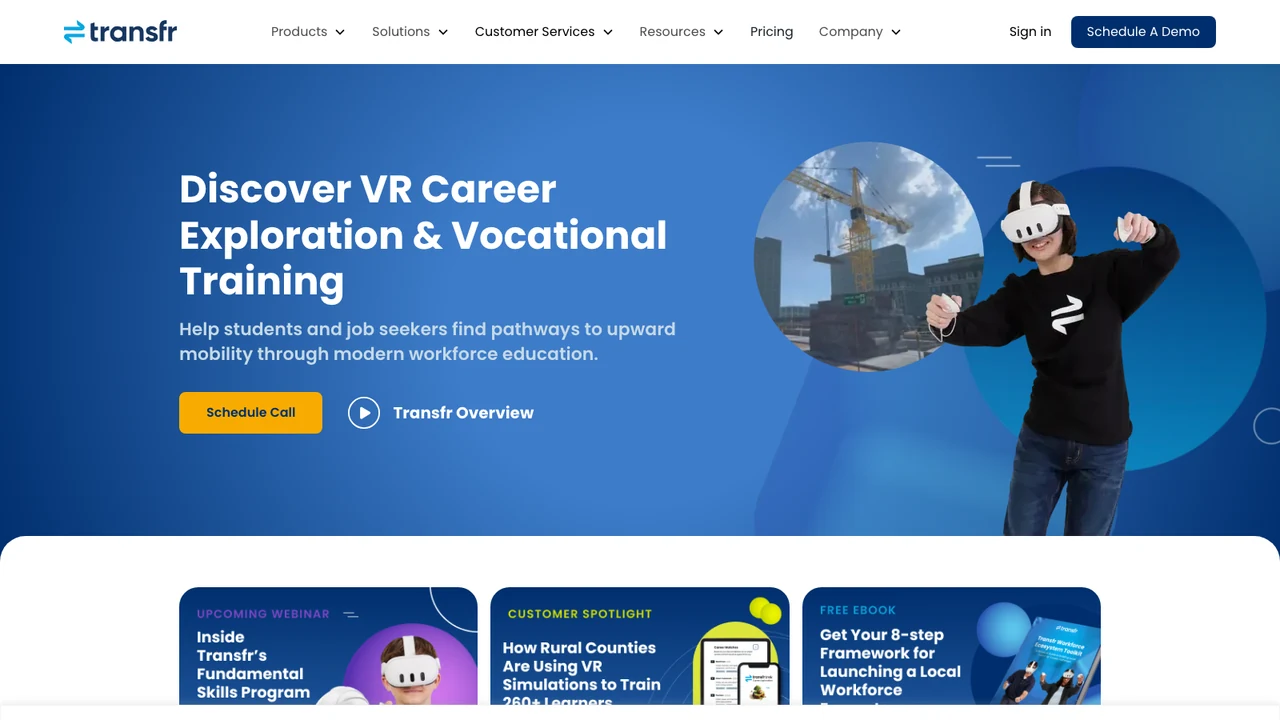
Transfr builds VR simulations for career exploration and vocational skills through two products. Transfr Trek covers exploration, letting a student sample trades before committing to a program, and Transfr Train covers skills practice. The catalog runs to more than 330 simulations, which is the broadest published trade coverage in this group.
The eight sectors are named: Automotive, Construction, Electrical Construction, Hospitality and Tourism, Aviation, Diesel Technology, Health Science and Manufacturing. That list is worth reading closely, because it shows where the catalog is deep and where a buyer would be commissioning rather than licensing. The company describes the simulations as first-person, built so that learners develop confidence and competence in trade skills on a safe virtual platform before handling equipment.
The company works from New York and states more than 1,000,000 simulations experienced, 275,000 or more learners served, over 1,100 implementations and presence in 48 states, all company-stated and none independently audited. Named relationships include the Workforce Development Board Mid-Ohio Valley and the San Luis Valley Career Connected Pathways Partnership, which shows where the work sits: community colleges, workforce boards and state programs rather than individual employers. Its published material also addresses training for justice-involved populations, noting that many states still see recidivism rates at or above 40 percent, which points at a reentry and second-chance hiring use case that no other company here documents.
A founding year and team size are not published. Best for state workforce programs and career and technical education systems that need coverage across many trades and many sites, and can work within a catalog that already exists.
3. Circuit Stream
Circuit Stream is a training provider rather than a VR development company, and stating that plainly first is the most useful thing this entry can do, because the two get shortlisted against each other and solve different problems. Its published programs are bootcamps and courses in software development, product management, game development and game design, taught by industry practitioners, plus teen programs in AI, technology, healthcare and finance.
Its relevance to a workforce training budget is specific and real: an employer that wants existing staff qualified to build and run immersive projects in house engages Circuit Stream, rather than commissioning a finished simulation from a studio. For an organization planning a multi-year XR program, that is often the cheaper path in year three, because internal capability removes the per-revision studio cost that catches most first-time buyers.
The company references university partnerships and co-branded certifications, which matter if the employer needs a credential a learner can carry rather than an internal completion record. It does not name those partners on the page reviewed, so the specific institution and the accreditation status behind any certificate have to be confirmed directly. Course delivery is online and cohort-based rather than delivered in VR, which is worth knowing if a buyer assumed the training itself would be immersive.
Neither a headquarters nor a founding year is published. Best for organizations building internal XR capability through instruction, and for workforce programs whose goal is placing people into technology roles rather than teaching a manual trade.
4. Think Digital
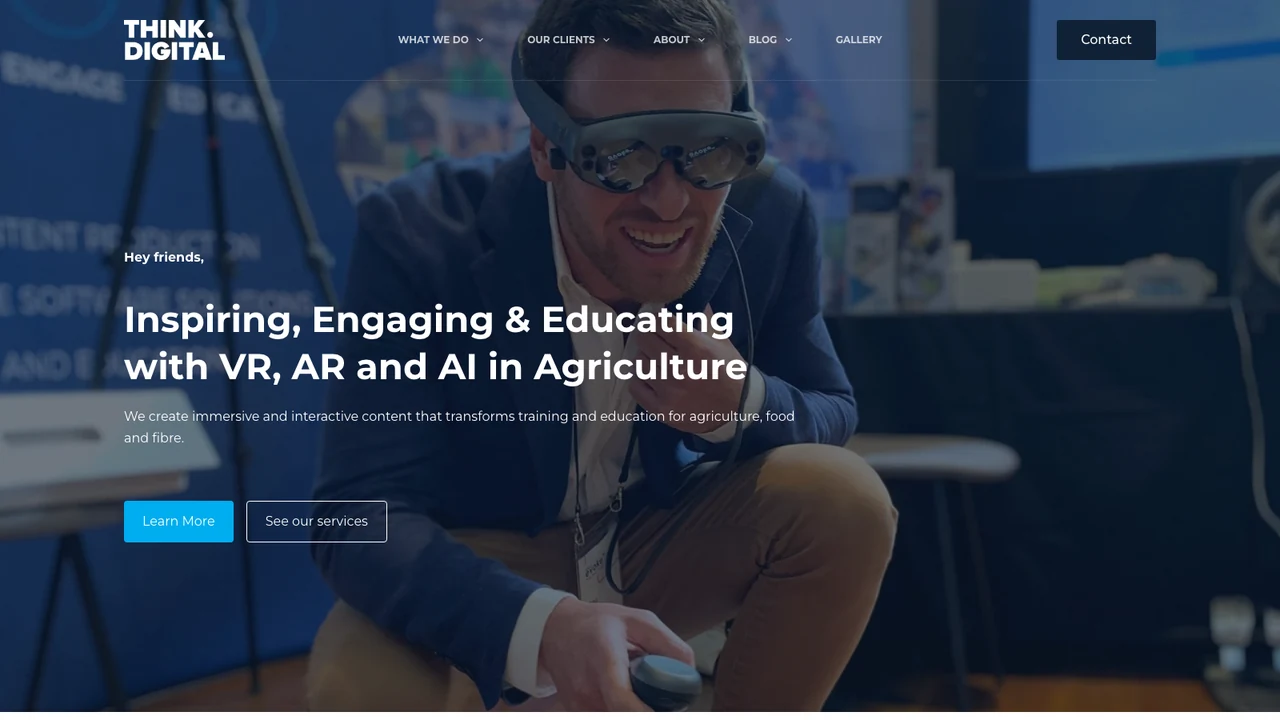
Think Digital is an Australian immersive studio producing virtual reality, augmented reality and 360 degree video, with a stated focus on agriculture, food production, education and events. Published services include custom VR and AR applications, farm virtual tours, and VR workshops and training. For vocational training in primary industries the sector knowledge is the differentiator, because a studio that already understands the work needs far less briefing to get a process right, and process accuracy is the whole product in trade training.
Its clearest published program was built with Meat and Livestock Australia and the Australian Research and Development Corporations, covering the beef and lamb production story from paddock to plate. The company states more than 50,000 people have experienced it since the campaign launched in 2017, delivered across schools and communities in Queensland, South Australia, Victoria, Tasmania, the Australian Capital Territory and New South Wales. That is the most specific reach figure any company in this group publishes for a single program.
The delivery model is the reason it ranks above larger companies here. Think Digital operates the Think Digital Coach, a 14 metre mobile classroom fitted with 20 VR headsets, so it runs sessions physically as well as building the software. In vocational training that solves the problem that quietly ends most regional programs, which is not content but logistics: getting charged, clean, supervised hardware in front of workers who will never travel to a training center.
The studio works from Adelaide, South Australia and was started by founder Tim Gentle and chief executive Kat Bidstrup, both of whom grew up on farms. Nine team members are listed, making capacity a fair question for a large multi-site rollout. The site states no founding year and names no individual clients beyond the red meat program. Best for agricultural and food industry training, especially where delivery has to travel to the trainees.
5. Motive.io
Motive.io sells the system that training content runs on rather than the content itself. It describes itself as an LMS for XR and delivers immersive learning across web, mobile, VR and AR, with a headset-agnostic application and WebGL delivery. The platform is organized into three published modules: XR Learning, AI Tools and Analytics.
Storyflow, its no-code authoring tool, is the central idea. It lets development and learning teams work in tandem, so subject matter experts and training staff can build and update modules without a studio in the loop. That changes vocational training from a series of commissions into something the employer maintains itself, which is the single largest lever on the cost of a program that has to stay current with changing procedures.
Its reporting is the most developed in this group and is the reason it belongs in a procurement conversation rather than only a creative one. The platform publishes criteria-based assessment, dashboard visualization, learner progress monitoring and a Trainer Station that lets an instructor observe a headset session live. It supports native SCORM and xAPI with no plugins or custom setup, and integrates with an employer's existing BI tools, LRS or LMS. For any regulated trade where completion has to be evidenced against a standard, that integration is not a nice-to-have.
The company works from Burnaby, British Columbia. Named customers include Emirates Airline, AWS, Chevron Technology Ventures, Exxon, Canadian Tire, Accenture and SRP, alongside MSHA for mining safety training, Transport Canada for inspection training and a hospital emergency simulation. That set is weighted toward aviation, energy, utilities, mining and regulated inspection work. No founding year is published. Best for employers with their own training staff who want to author, revise and evidence modules without returning to a studio each time.
What a vocational VR program costs after the build
The build is rarely the expensive part over a five-year horizon, and business cases that only price the build tend to fail in year two. Four recurring costs decide the real figure, and they are worth putting in the tender.
Revision is the first. Procedures change, regulations change and equipment is replaced, so any simulation tied to a specific machine has a shelf life. Whether that revision is a purchase order to a studio or an afternoon for an internal author is the difference between the two models on this list, and it compounds every year the program runs.
Hardware operations is the second, and the most commonly omitted. Headsets have to be charged, cleaned between users, updated, kept in device management and replaced on a cycle. Someone has to own that job. Think Digital's mobile classroom exists precisely because this cost defeats distributed programs, and Transfr's implementation count reflects the same reality at state scale.
Evidence is the third. If completion has to be recorded against a competency framework, the simulation needs to write to a learning record store or an LMS, and retrofitting that later is expensive. Motive.io publishes SCORM and xAPI support natively; for the others it is a scoping question.
Capability is the fourth. Programs that survive tend to have someone internal who can brief a vendor properly, judge whether a simulation is teaching the right thing and make small changes without escalation. That is the gap Circuit Stream sells into, and it is a legitimate line in a training budget rather than an admission of failure.
How to choose between these workforce training companies
Match the model to the problem before comparing quality, because four of these five are not substitutes for each other. If the task involves your own equipment, site layout or safety rules, commission a custom build from Treeview or Think Digital. If you need coverage across standard trades quickly and at scale, Transfr already publishes more than 330 simulations across eight sectors. If you have training staff and want to own the revision process, Motive.io sells the authoring and reporting layer. If you need people qualified rather than content delivered, Circuit Stream teaches.
Then check scale and geography against your own footprint. Transfr operates at state and workforce-board level across 48 states, which suits public programs and college systems. Think Digital is a nine-person studio in South Australia that brings headsets to regional sites. Motive.io's customer set is weighted toward aviation, energy, utilities and regulated inspection. Treeview works with enterprise clients across sectors and names automotive and medical device manufacturers.
Ask every vendor the same four questions and compare the answers rather than the demonstrations. Who owns the source code and assets when the contract ends. What does a procedure change cost in year two. How does a completion get recorded against our competency framework. And who is responsible for the headsets between sessions. A demonstration that impresses a steering group is not evidence that any of those four have been solved.
Related reading. BestInXR's enterprise training guide covers buying, building and sustaining VR training. For sector-specific work see XR development companies for energy and utilities, and for the education end of the same market, VR development companies for education. The guide to selecting XR developers for enterprise deployment covers the procurement process, and Virtual Reality in Business covers the wider case.
Frequently Asked Questions (FAQ)
1. What is VR vocational training?
VR vocational training teaches job tasks through a simulation the trainee operates, so that mistakes happen in software rather than on equipment. It is used most where real practice is expensive, hazardous or limited by equipment availability, which in practice means trades, manufacturing, energy, mining, aviation and healthcare.
2. Should an employer buy a catalog or commission a custom simulation?
Buy a catalog when the skill is standard across an industry, since Transfr publishes more than 330 simulations across eight named sectors. Commission a custom simulation when the procedure is specific to your equipment, site layout or safety rules, because a generic simulation teaches a machine you do not operate. Many programs end up doing both, using a catalog for foundational skills and commissioning only the site-specific procedures.
3. How is completion recorded and evidenced?
It depends on the vendor. Motive.io publishes native SCORM and xAPI support and integrates with an employer's existing LMS, LRS or BI tools, with criteria-based assessment and a Trainer Station for live observation. The other four do not publish integration detail, so how results reach your learning record system is a scoping question to settle before contracting rather than after.
4. Which of these companies work with public workforce programs?
Transfr names the Workforce Development Board Mid-Ohio Valley and the San Luis Valley Career Connected Pathways Partnership, states implementations across 48 states and publishes material on training for justice-involved populations. Think Digital's red meat program ran through schools and communities across six Australian states and territories. The other three publish enterprise, education or industry clients rather than public workforce relationships.
5. Does Circuit Stream build VR training?
No. Circuit Stream publishes bootcamps and courses that train people for technology roles, including XR development, delivered online in cohorts rather than in headsets. An employer engages it to qualify staff, not to have a training simulation built and delivered.
6. How much does VR workforce training cost?
None of the five publishes rates, so no figure is recorded here. Costs differ by model: catalog access is usually priced per learner, platform licensing per seat or per organization, custom development per project and instruction per student. Ask each vendor to quote against your headcount, your list of tasks and a five-year horizon that includes revision and hardware operations.