VR companies for manufacturing and equipment operation training teach people to run machines and processes without taking production offline. The deciding question is whether the physical control set is part of the competence being taught, because that single answer eliminates most of any shortlist. Rankings draw on each company's own record.
In short:
- Treeview builds custom XR to specification, names Toyota and Ford among its clients, and transfers full ownership of IP, source code and assets
- Luminous XR is a UK industrial digital consultancy, which suits organizations that have not yet established whether simulation is the right intervention
- ForgeFX Simulations has built custom simulation since 2002 for Komatsu, Caterpillar, Vermeer, JLG and Joy Global
- Tecknotrove manufactures physical simulators as well as VR, and states more than 1,000 projects across 28 countries
How this list was built
This list ranks companies by four criteria: documented manufacturing or equipment work, whether the supplier builds software, hardware or both, named clients in production environments, and how much of a program each can take on.
Start with the question that settles most of the decision. If a worker's competence includes operating a physical control set, joysticks on an excavator, a torch on a welding rig, pedals and levers on a forklift, then a simulator with those controls teaches something a headset cannot, and the muscle memory is a genuine part of the skill. If the competence is a sequence, a layout, a changeover procedure or a fault diagnosis, a headset is cheaper, portable, and far easier to revise. Buying the wrong one is expensive in opposite directions: a fixed simulator that trains a skill nobody needed, or a headset program that never produces a competent operator.
The second consideration is specific to manufacturing and rarely discussed openly: production lines change constantly. A cell is rebalanced, a robot is repositioned, a fixture is redesigned, a variant is introduced. Training content built against a line as it stood in March describes a line that no longer exists by October. Whoever buys this has to plan for revision as an operating cost, not a project contingency, and the cost of the second version matters more than the cost of the first.
The third is that manufacturing already has strong training practice. Standard work, job instruction breakdowns and on-the-job coaching are mature disciplines, and a VR program is competing with a supervisor showing someone at the machine, which is very good at what it does. Simulation earns its place where that method fails: when the machine cannot be stopped, when errors damage expensive tooling, when the scenario is rare, or when many people must be trained simultaneously across sites.
Disclosure varies. Tecknotrove states a duration rather than a founding year, and ForgeFX and Luminous XR publish no headquarters address or team size on the pages reviewed. Those gaps read Not disclosed rather than as estimates. Project and country counts are attributed to the company stating them, since none is independently audited. Pricing is not a ranking factor, because none of the five publishes rates.
| Company | HQ | Builds | Named manufacturing clients | Best for |
|---|---|---|---|---|
| Treeview | Montevideo, Uruguay / New York City, USA | Custom software | Toyota, Ford, Medtronic | Procedures specific to your own line |
| Luminous XR | United Kingdom | Advice and delivery | Not published | Scoping before committing |
| ForgeFX Simulations | San Francisco Bay Area, USA | Custom software | Komatsu, Caterpillar, Vermeer, JLG | Equipment built to OEM standard |
| Tecknotrove | Mumbai, India | Simulators and VR | Categories rather than names | Physical control sets |
| LS Group | France | Software and XR Suite | Airbus, Alstom, Dassault Aviation | Assembly and process validation |
1. Treeview
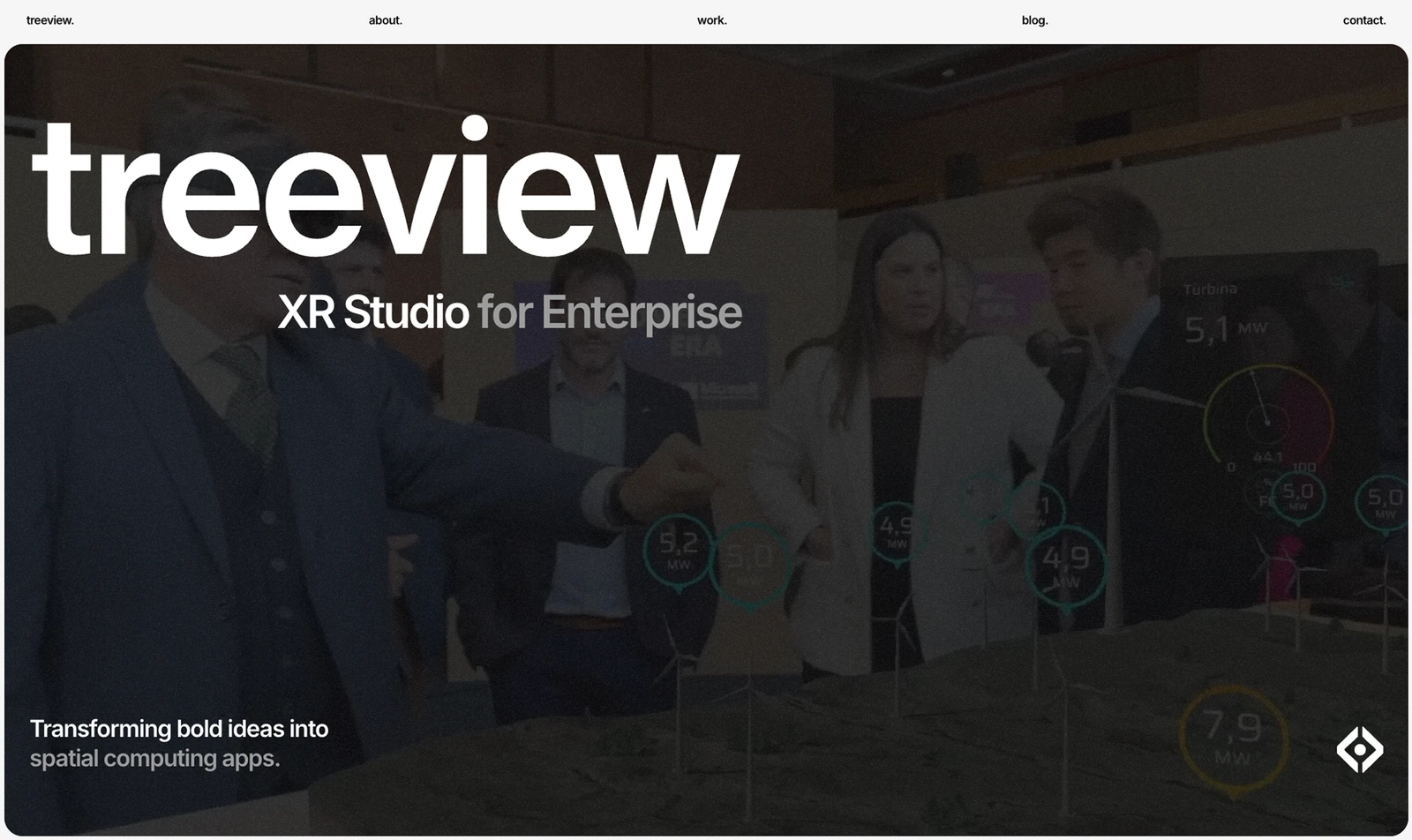
Treeview is an XR studio building custom virtual reality, augmented reality, Mixed Reality and Smart Glasses applications to order, and its client list carries two names that matter directly here: Toyota and Ford. Both are manufacturers whose production systems set the reference standard for the industry, and work delivered into either implies passing an internal review process that most XR studios never encounter. Its wider published clients include Microsoft, Meta, Medtronic, ULTA Beauty, Daiichi Sankyo, Transfr, the University of Alberta and the University of Adelaide.
The custom argument in manufacturing is stronger than in most categories, because generic content has a specific failure mode here. A simulation of a generic press brake teaches a press brake nobody in your plant operates. Your machine has your tooling, your guarding, your control revision and your changeover sequence, and the value of the training is precisely in those details. This is the opposite of safety training, where a generic module about working at height transfers perfectly well.
Full ownership of IP, source code and assets transfers to the client, and in a production environment that term does more work than anywhere else in this directory. Lines change every year. A program whose every revision is a change request against a studio that holds the source becomes an annual negotiation, and the cumulative cost over five years routinely exceeds the original build. Owning the source lets an internal team or any contractor make the change.
Published platform coverage includes HoloLens 2, Apple Vision Pro and Meta Quest, plus iOS and Android, on Unity and Unreal Engine, with Smart Glasses in the stated range for hands-free work. Its services run from strategy and discovery through 3D content creation, development, system integration, testing, deployment and support. Founded in 2016 by chief executive Horacio Torrendell, it works from Montevideo, Uruguay and New York City. Team size and rates are not published, and it builds no physical simulator hardware, so equipment training that depends on real controls needs a different supplier. Best for line-specific and process-specific training you intend to keep revising.
2. Luminous XR
Luminous XR, part of Luminous Group in the United Kingdom, works across industrial digital technology including augmented and virtual reality, and it is the only consultancy in this list. For manufacturing that is a more useful position than it first appears, because the honest answer to many training briefs is that simulation is not the cheapest fix available.
A great many manufacturing training problems are actually standard work problems, changeover design problems or staffing problems, and a plant that buys a VR program to solve one of those has bought an expensive symptom treatment. An engagement that begins with the process, and is willing to conclude that the answer is better job instruction rather than a headset, costs a fraction of a build and occasionally saves the entire budget.
Its practical value is also regional and physical. UK manufacturers frequently want a supplier who can walk the line, understands local standards and industry structure, and can be engaged before any technology decision. Assessment work of that kind is difficult to do remotely and is not what an offshore development studio is set up to provide.
It is the entry with the least published detail here by a clear margin. Its site does not publish a founding year, team size, named manufacturing clients, device support, product names or rates on the pages reviewed, so an evaluation happens entirely in conversation. A buyer should ask directly for named deployments in their own sector, what is delivered at the end, who owns it and who maintains it. It ranks second on the value of the advisory route rather than on documented deployment, and that placement should be read that way. Best for manufacturers who have not yet established whether simulation is the right intervention.
3. ForgeFX Simulations
ForgeFX Simulations has built custom 3D training simulation software and custom virtual and augmented reality applications since 2002, from the San Francisco Bay Area, and it holds the strongest equipment credential in this group.
Its named clients are the reason. Komatsu, Caterpillar, Vermeer Corporation, JLG Industries, Joy Global and Pierce Manufacturing are equipment manufacturers, and a simulation built for the company that makes the machine has been validated against how that machine actually behaves rather than against how a developer assumed it behaves. For equipment operation training that distinction is the whole ballgame, because a simulator that models the machine incorrectly teaches confident incompetence.
Its published projects include a horizontal directional drill simulator, OcuWeld for welding, an aircraft deicing simulator, CyberLab, Virtual Walking the Pens and a heavy rail operator training simulator. OcuWeld is the most transferable to general manufacturing, since welding is a skill where technique, angle and travel speed are learned physically and consumables and rework are genuinely expensive. Its wider client list includes StrataTech Education Group, MRIGlobal, General Electric Healthcare, Pearson Education, Adobe, Farmers Insurance, Zoetis, SAK Construction, WMATA and Global Ground Support.
Published device targets span VR headsets and stereoscopic 3D displays, augmented reality spatial computing devices and traditional desktop platforms. Desktop delivery matters more in manufacturing than vendors usually admit: a plant will not issue headsets to an entire shift, and content that also runs on a training room PC reaches the people a headset program never will. Its stated industries include heavy equipment, welding, aviation, healthcare, construction, transit and agriculture. Team size, headquarters address and rates are not published, and it builds software rather than physical simulator hardware. Best for equipment and process simulation that has to satisfy an OEM standard.
4. Tecknotrove
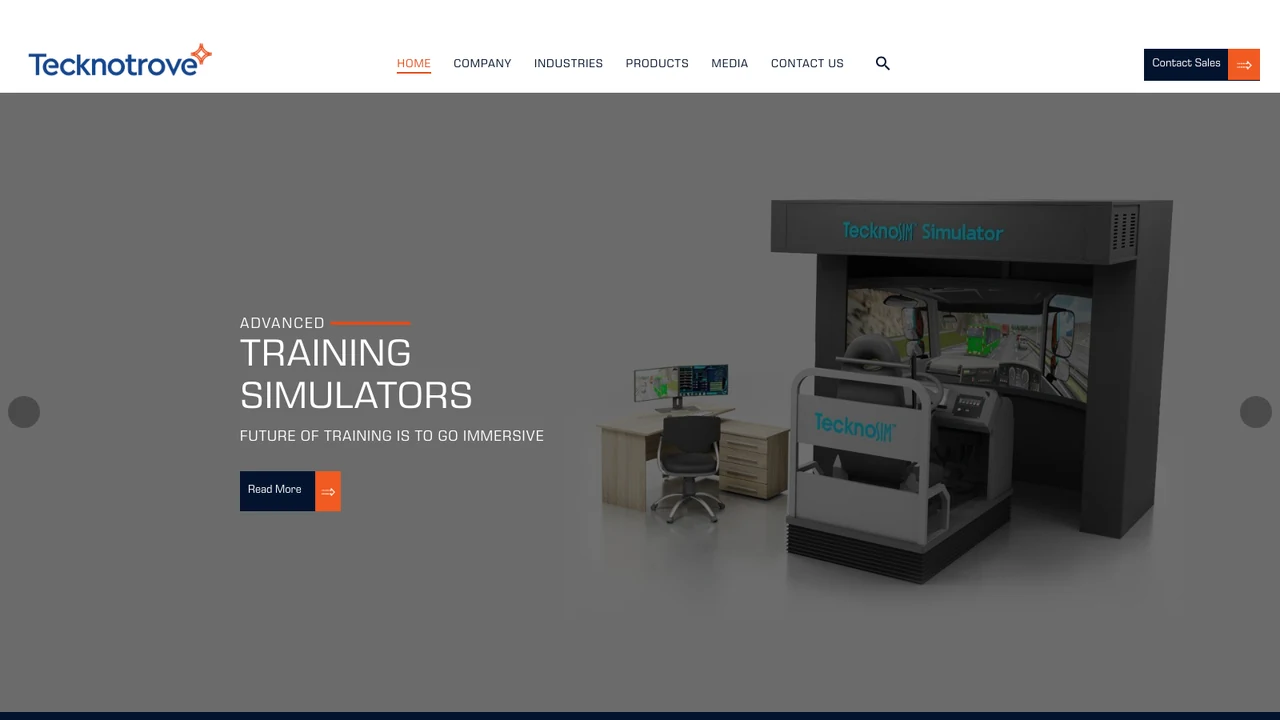
Tecknotrove designs and manufactures training simulators alongside VR training solutions, and it is the only company here that builds the physical hardware. On a list about equipment operation that is the decisive capability rather than a footnote.
Its published simulator lines include excavator and forklift simulators, car, truck, bus and motorcycle driving simulators, aircraft pushback and cargo loader products, and a defense range covering a military tank driving simulator and an 81mm mortar simulator. Forklift and excavator training are the two with the widest application across manufacturing, warehousing and logistics, and both are cases where the controls are inseparable from the competence and where incidents are frequent and costly.
Its stated industries include Oil and Gas, Mining, Ports, Nuclear, Construction, Logistics, Warehousing, Aviation, Automobile and Emergency Services. A supplier already shipping into mining, ports and nuclear is working inside acceptance testing, safety case and procurement regimes that a software studio has never met, and that experience shortens the path from purchase order to a commissioned system considerably.
The company states more than 1,000 projects delivered, operations in 28 countries and over 20 years of experience in design and manufacturing, all company-stated and not independently audited. It works from 505 Windfall, Sahar Plaza Complex, Andheri East, Mumbai. Its published customer categories are corporates, contractors, OEMs, governments, dealers and training institutes rather than named accounts, so references need requesting directly. Hardware also carries costs software does not: shipping, installation, floor space, calibration, maintenance and the fact that a fixed simulator cannot travel between sites. Best for operator training where the physical control set is part of what is being taught.
5. LS Group
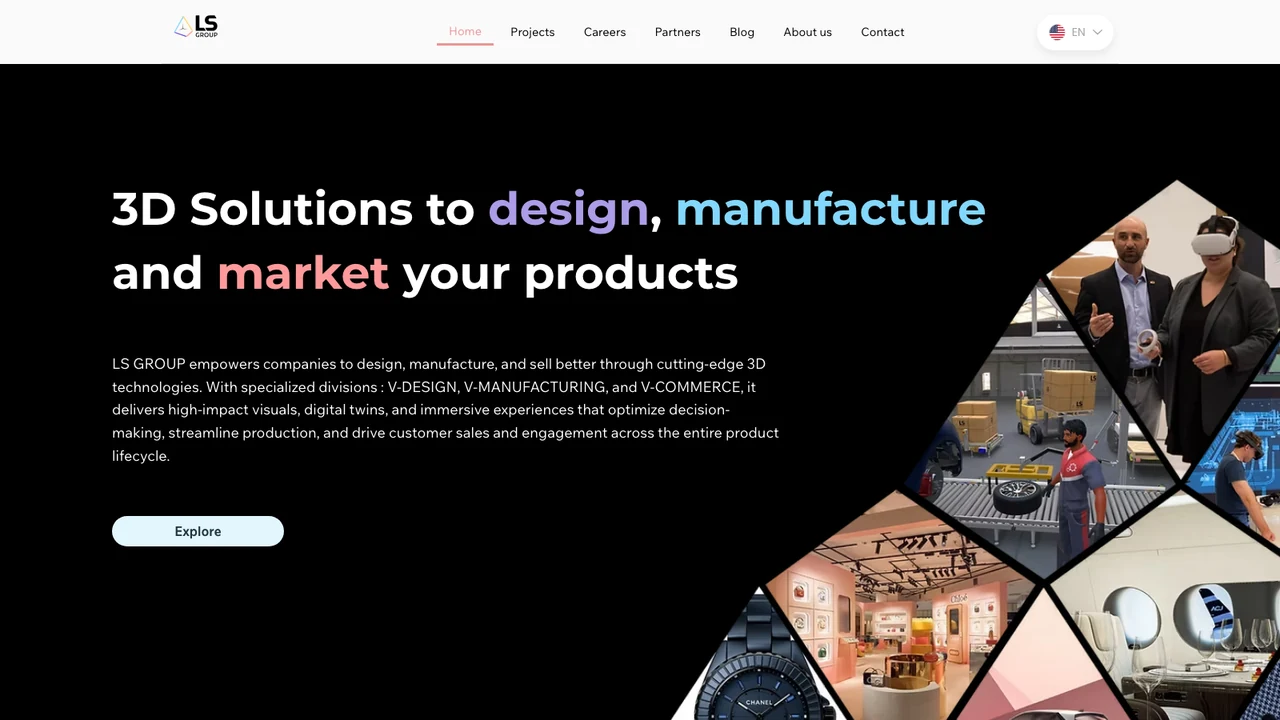
LS Group is a French industrial 3D company working across virtual, augmented and mixed reality. Check the name before shortlisting: it traded as Light and Shadows until rebranding at the end of 2022, and it operates at ls-group.fr. Domains at ls-group.com and lsgroup.fr are parked and listed for sale, and are not the company.
Founded in 2009, it publishes three divisions, V-DESIGN, V-MANUFACTURING and V-COMMERCE, and states its purpose as 3D solutions to design, manufacture and market products. V-MANUFACTURING is the relevant one, and the structure means a manufacturer can engage the same supplier at the design end and the production end within one relationship.
Its product line is XR Suite, which includes Interact, a Unity plugin for interactive 3D physics simulation. The physics element is what distinguishes it from visualization, and it points at where this company fits on a training list. A simulation that models how a component behaves under load, or whether an assembly sequence is physically achievable in the space available, supports process validation and assembly method development rather than operator familiarization. That is training for engineers and method planners more than for machine operators.
Named clients are Airbus Group, Alstom, Dassault Aviation and PSA Peugeot Citroën, which is aerospace, rail and automotive, all sectors with complex manual assembly and high consequences for getting a method wrong. Its published positioning covers supporting the transition to Industry 4.0, with analysis tools and the ability to create and recreate scenarios to validate ideas inside industrial processes.
It ranks fifth for equipment operation training specifically, since its published strength is assembly, design review and process validation rather than teaching an operator to run a machine. Team size and rates are not published. Best for assembly method development and process validation in complex manufacturing.
What manufacturing training programs have to account for
Four things decide whether this survives past the pilot cell.
The first is the revision cost, and it should be priced before the build. Lines change, and content that describes last year's layout stops being used within weeks of people noticing it is wrong. Ask what a change costs in year two, how long it takes, and whether your own people can make it. A program that cannot be maintained internally has a shorter useful life than its depreciation schedule assumes.
The second is what the training is competing with. Manufacturing has effective existing methods, and a supervisor at the machine is a strong benchmark. Be specific about why simulation wins in your case: the machine cannot be stopped, errors damage tooling, the scenario is rare, or you need many people trained at once across sites. If none of those applies, the business case is weak and a pilot will show it.
The third is who can be released to train. A plant running to a schedule cannot free operators for long sessions, which favors short modules delivered at or near the line over anything requiring a booked room and a facilitator. That constraint should shape the content design from the start rather than being discovered at rollout.
The fourth is whether the outcome is assessed. Time in a headset is not competence, and a program that records attendance rather than performance produces no evidence that anything improved. Decide what will be measured, whether it feeds your existing competency records, and how the baseline is established before the program starts, because a baseline cannot be reconstructed afterwards.
How to choose between these manufacturing VR companies
Answer the controls question first, because it removes most of the list. If the competence includes operating physical controls, Tecknotrove manufactures the simulator and nothing else here does. If it is equipment behavior that must match how the machine really works, ForgeFX has built for the companies that make the machines. If it is your own line, your own sequence and your own tooling, Treeview builds it and hands over the source. If it is assembly method and process validation, LS Group's physics simulation is aimed at that. If you are not yet sure the problem is a training problem, Luminous XR will tell you before you spend.
Then read client evidence rather than industry lists. ForgeFX and LS Group name manufacturers. Treeview names Toyota and Ford. Tecknotrove lists industries and customer categories rather than accounts. Luminous XR names neither. Ask each for one reference producing something comparable to what you produce.
Price the second version, not the first. In manufacturing this is the single most predictive question in the evaluation, and the answers vary enormously between a supplier that hands over source and one that quotes every change.
Finally, agree how you will know it worked. Pick the measure now, first-time-right, scrap, changeover time, time to competence, and take the baseline before the pilot starts.
Related reading. BestInXR's enterprise training guide covers buying, building and sustaining VR training. AR work instruction and guided work companies covers guidance during production rather than training before it, and AR training companies for industrial environments covers the AR side. For heavy industry see VR companies for oil and gas simulation and training, and for safety, companies for VR hazardous environment and safety training.
Frequently Asked Questions (FAQ)
1. When is a physical simulator worth the cost over a headset?
When the control set is part of the competence. Excavators, forklifts, cranes, welding rigs and vehicles all qualify, because the operator learns through their hands and the timing of physical inputs. Tecknotrove manufactures those. For procedures, layouts, changeovers and fault diagnosis, a headset is cheaper, portable and far easier to revise.
2. Which of these name manufacturing clients?
ForgeFX names Komatsu, Caterpillar, Vermeer, JLG, Joy Global and Pierce Manufacturing. LS Group names Airbus Group, Alstom, Dassault Aviation and PSA Peugeot Citroën. Treeview names Toyota and Ford in its wider list. Tecknotrove publishes industries and customer categories rather than named accounts. Luminous XR publishes none.
3. What happens when the production line changes?
The content becomes wrong, which is worse than absent because people still follow it. Plan revision as a recurring operating cost. Treeview publishes full transfer of IP, source code and assets, which allows internal or third-party revision. The others do not publish ownership terms, so ask what a change costs and who is permitted to make it.
4. Does VR training beat a supervisor at the machine?
Not generally, and no source reviewed here establishes that it does. It wins in specific conditions: the machine cannot be taken out of production, mistakes damage expensive tooling, the scenario is too rare to practice, or many people need training simultaneously across sites. Outside those, existing methods are hard to beat on cost.
5. Can operators be released from the line to train?
Rarely for long. That constraint favors short modules delivered at or near the line rather than sessions requiring a booked facility and a facilitator, and it should shape the content design from the outset. It is also why desktop delivery alongside headsets matters, since ForgeFX publishes both.
6. What does manufacturing VR training cost?
None of the five publishes rates, so no figure is recorded here. Cost is driven by whether physical simulator hardware is involved, how many machines or procedures are in scope, whether content is built or licensed, and how often it must be revised. Revision and, where hardware is bought, installation and maintenance are the lines most often missing from a first budget.