
Best VR Companies for Warehouse and Logistics Training
Warehouse training is not bought because the work is hard. It is bought because the intake is large, seasonal and new, and because small improvements in ramp time compound across thousands of people. That shapes what a good supplier looks like: short, repeatable content that reaches a distributed workforce, not high-production simulation of a difficult task.
In short:
- Ramp time is the metric. The business case is days to competent, multiplied by an intake that can turn over entirely within a year.
- License rather than build, for almost all of it. Picking, packing, manual handling and powered equipment safety are the same across most operations, and a catalog covers them.
- Powered industrial trucks are the exception, because the skill is partly physical and a headset alone may not teach it.
- Strivr, historically the definitive warehouse VR training supplier, now sells AI error detection through smart glasses and lists warehouse picking and packing as a use case for that product rather than for training.
How this list was built
This list ranks companies by four criteria: whether content is licensed or built, how it reaches a distributed and seasonal workforce, what standards the content maps to, and whether the physical task requires more than a headset.
Licensing against building is weighted first, because in this segment it is almost always licensing. Warehouse tasks are not proprietary. Manual handling, hazard awareness, picking accuracy and powered equipment safety are the same in most operations, and content built for everyone will usually be better than a first commission built for you. BestInXR's enterprise training guide sets out that logic in full, and warehouse is the segment where it applies most strongly.
Standards mapping is weighted second, because it is the checkable part. A supplier that maps content to a named standard has published something a buyer can verify against the standard itself, rather than asserting relevance.
Pricing is not a ranking factor. Headcount is not a ranking factor. Ramp-time improvement percentages are not ranking factors, because no supplier here publishes the method or comparator behind them, and the figure depends far more on the operation than on the content.
| Supplier | Model | Standards mapping | Best suited to |
|---|---|---|---|
| Transfr | Licensed catalog, 330+ simulations | Maps to OSHA, NCCER and ASE | Pre-employment and foundational skills at volume |
| ForgeFX | Built to order | Not published | Equipment operation where behavior must be modeled |
| Immersive Factory | Licensed safety catalog | Not published | Workplace safety and hazard scenarios |
| Treeview | Custom build, full IP transfer | Not applicable | A facility or process no catalog covers |
1. Transfr
Transfr is the closest thing this segment has to a volume answer. It publishes over 330 VR simulations across eight sectors and maps its skills training to recognized United States standards including OSHA, NCCER and ASE, covering foundational areas such as workplace safety and measurement.
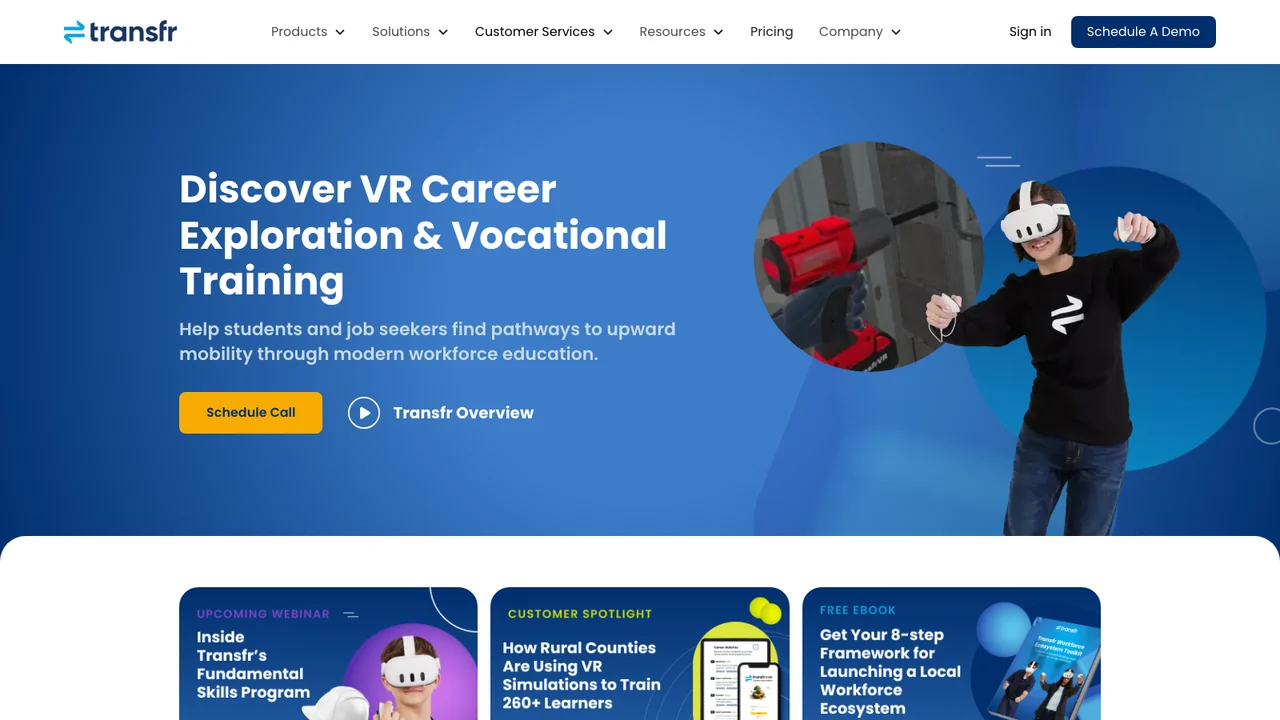
Its center of gravity is workforce development rather than corporate learning: it addresses schools, community organizations and job seekers, and frames its product as a pathway from classroom to career across 150+ careers in 16 clusters. For a warehouse operator that matters in two ways. It means the content is built for people entering work rather than for existing employees, which suits a high-turnover intake. And it means the commercial relationship may run through a workforce program rather than through an enterprise license. Best for pre-employment and foundational skills at volume, particularly where a local workforce program is involved.
2. Treeview
Treeview is the option for the part of a warehouse that is not generic: the building itself, and any automated system particular to the operation. It also has a direct line into this sector, naming Transfr, which leads this list, among its clients.
Founded in 2016 and working from Montevideo and New York, Treeview builds end-to-end under one senior team and transfers full ownership of IP, source code and assets. Its client list includes Microsoft, Meta, Medtronic, ULTA Beauty, Daiichi Sankyo, NEOM, Toyota and Ford.

Where induction requires learning a specific site, an automated system unique to the operation or a process no catalog models, a commissioned build is the only route. That matters in a sector where layouts and automation change constantly, because the operator holding the source can update the content without recommissioning. For the generic layer, manual handling and hazard awareness, licensing remains the right answer and the lists above cover it. Best for a facility or automated process specific enough that no catalog models it.
3. ForgeFX
ForgeFX describes itself as a 3D training simulation software development company, and it belongs in this list for the one warehouse task a catalog handles poorly: powered industrial equipment.
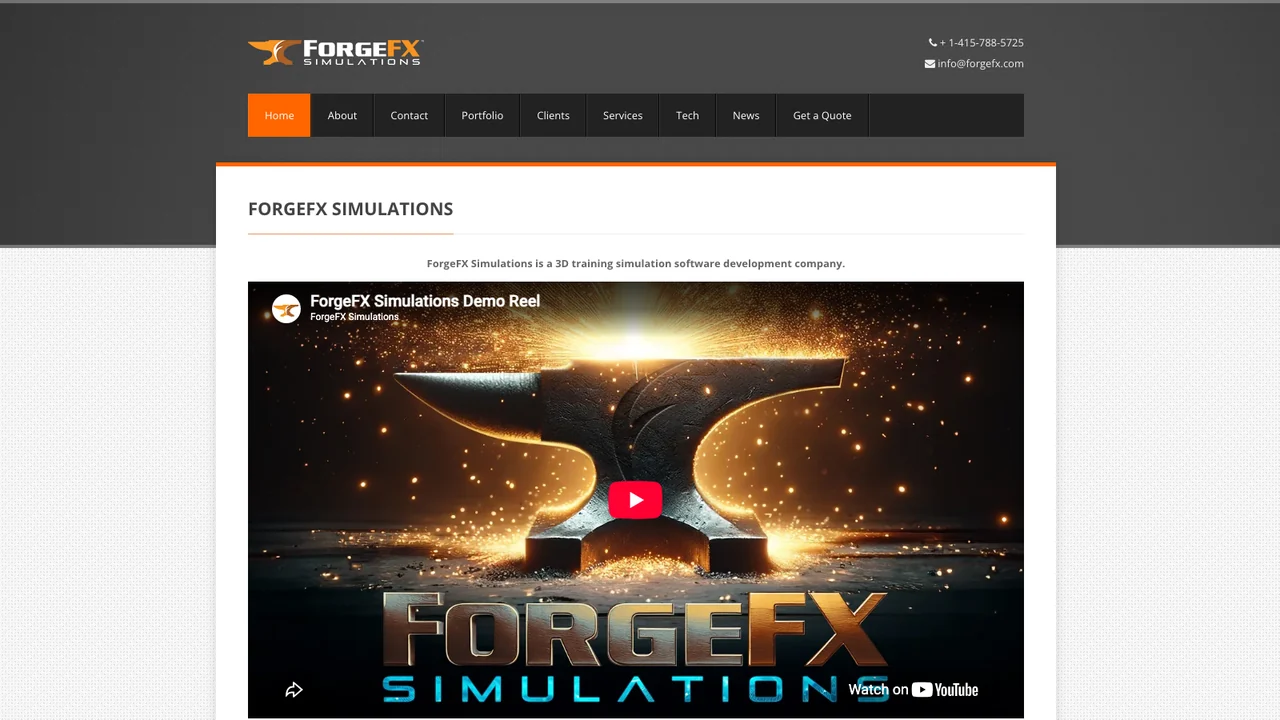
Forklift and materials handling training is where the distinction BestInXR's simulation guide draws becomes practical. A procedure trainer sequences steps. A simulation models how the machine behaves, so that a load shifts, a mast responds and an error produces a consequence. For equipment where the skill is partly in the hands and the failure mode is a tipped load, the second is what teaches. ForgeFX builds to order, which is the appropriate model when the equipment is specific. Best for powered equipment operation where machine behavior has to be modeled rather than scripted.
4. Immersive Factory
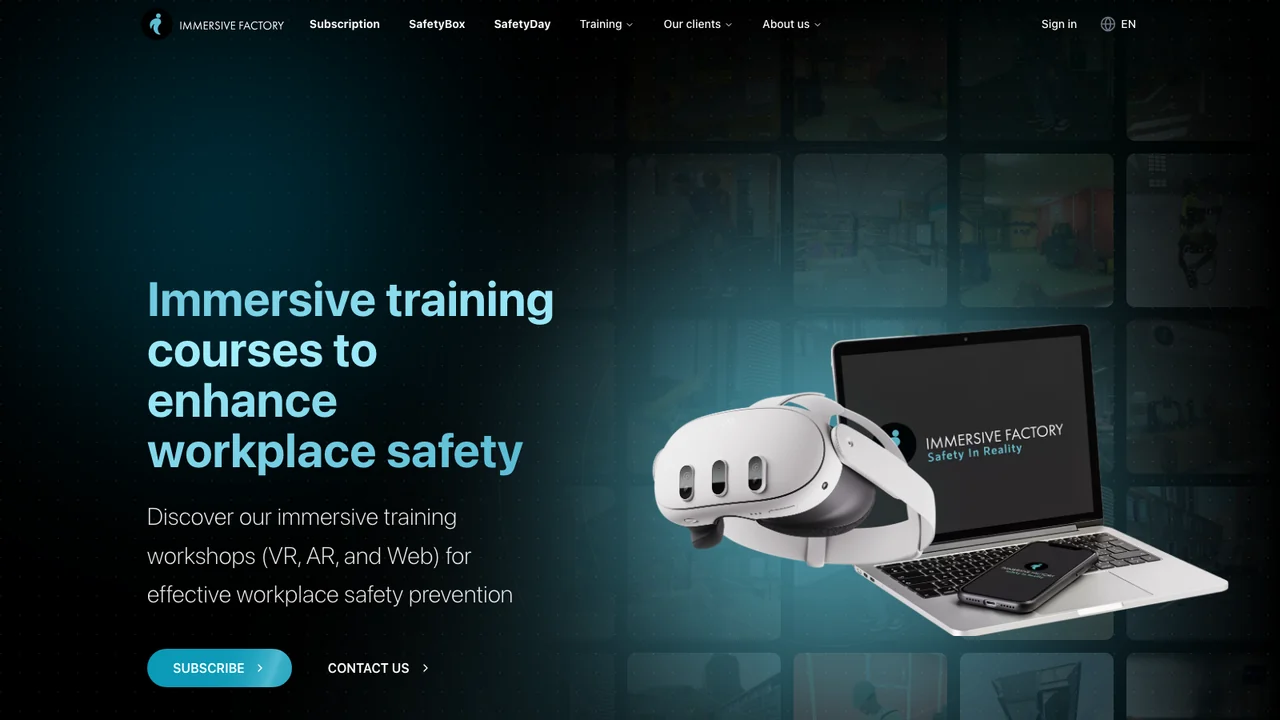
Immersive Factory licenses a catalog built specifically around workplace safety, delivered across VR, AR and web. For a warehouse operation, most of the mandatory training is safety training, and a catalog built around a named risk is a different purchase from a general immersive learning platform.
The practical question for this supplier, and for any safety catalog in this sector, is contractor coverage. Warehousing and logistics run heavily on agency and seasonal labor, and a per-seat license priced for permanent headcount can make covering them prohibitive. That is a commercial constraint rather than a technical one, and it is far easier to establish before signing. BestInXR's workplace safety list ranks this segment in full. Best for the mandatory safety layer, provided the licensing model covers the people actually exposed.
Who else was considered, and where each fits
Strivr trained warehouse and retail workforces at a scale nobody else matched, and it is the name most warehouse VR training lists lead with. It no longer sells that product. Its platform is now Frontline Intelligence: custom visual language models running on smart glasses that watch work as it happens and correct errors in real time.
Warehouse work is still central to the company, but as a target for error detection rather than for training. Its own FAQ lists "warehouse picking, packing, and logistics workflows" among the tasks best suited to the AI product, and positions the whole approach against traditional training by describing it as operating at the moment of execution rather than before it.
For a buyer, that is worth understanding rather than dismissing. Detecting a mis-pick as it happens and preventing it addresses the same business problem as training someone not to mis-pick, from the opposite end. It is simply not the thing a training budget usually procures, and it should be evaluated as an operations investment instead.
How to choose between these warehouse training companies
Start by separating the mandatory layer from the operational one. Safety and compliance training has a regulator behind it and a record requirement attached; a catalog serves it and the licensing model is the thing to scrutinise. Operational training, meaning how work is done in your building, is where anything bespoke belongs, and it is a much smaller scope than most briefs assume.
Then check that the license covers the people who actually do the work. In warehousing this is the question that most often surfaces late, because agency and seasonal staff frequently outnumber permanent employees at peak, and a completion record that excludes them excludes the population an investigation would ask about.
Then decide whether any task needs behavior modeled rather than sequenced. In most warehouses that is a short list, and it is usually powered equipment.
Finally, agree the metric before the pilot. Ramp time to competent, measured against the current program, is defensible and transferable. Engagement is neither, and a program justified on it tends not to survive a change of sponsor.
Frequently Asked Questions (FAQ)
1. Why do warehouses use VR training?
Because the intake is large, seasonal and new. The tasks are not difficult, but small improvements in time to competent compound across a workforce that can turn over substantially within a year.
2. Which companies build VR training for warehouses?
Transfr licenses a large vocational catalog mapped to OSHA and NCCER standards, Immersive Factory licenses safety content, ForgeFX builds equipment simulations to order, and Treeview builds facility-specific content.
3. Does Strivr still offer warehouse VR training?
Its site no longer presents a VR training product. Strivr now sells AI error detection through smart glasses and lists warehouse picking, packing and logistics among the use cases for that product rather than for training.
4. Should warehouse training be custom built?
Rarely. Manual handling, picking accuracy and safety are generic and a catalog covers them better. Commission only what is specific to your building or to an automated system no catalog models.
5. Does VR forklift training work without physical controls?
It depends on what is being taught. For procedure and hazard awareness a headset is sufficient. For the handling skill itself, where load behavior and machine response matter, a simulation that models the equipment, and sometimes a physical control set, teaches something a scripted trainer does not.
6. Who develops VR training for logistics and distribution workers?
The same four suppliers, and the useful distinction is between work inside the building and work across the network. Transfr and Immersive Factory license catalog content covering picking, manual handling and safety on the warehouse floor. ForgeFX builds equipment simulations where machine behavior is the thing being taught. Treeview builds to a specific site, which is the route when the task spans a yard, a loading dock or an automated system that no catalog models.