AR training companies for industrial environments put instructions, expert help and proof of work in front of a technician who has both hands busy. This list ranks five by documented industrial deployment, whether the product guides work or connects a remote expert, and what evidence it produces. Rankings draw on each company's own record.
In short:
- Treeview builds custom AR to specification, publishes Smart Glasses among its platforms, and hands over full ownership of IP, source code and assets
- Kognitiv Spark's RemoteSpark is built for security-conscious environments, with encrypted communications and flexible deployment, across Defence, Energy, Manufacturing and Aerospace
- Taqtile's Manifest platform runs Create, Guide and Verify, capturing proof of work rather than only delivering instructions
- Scope AR, founded 2011 in Edmonton and now part of Flatiron Solutions, names Boeing, Toyota, Caterpillar, NASA and Lockheed Martin
How this list was built
This list ranks companies by four criteria: documented industrial deployment, what the product actually does at the moment of work, evidence of operating inside enterprise security and integration constraints, and what record the work leaves behind.
Industrial AR divides into two products that get bought from the same budget and solve different problems. Remote assistance connects a technician to an expert somewhere else, sharing what the technician sees and letting the expert annotate it. Guided work instructions put a procedure in front of the technician with no expert involved, step by step, hands free. The first solves the problem of scarce expertise. The second solves the problem of inconsistent execution, and it scales in a way the first cannot, because an expert on a call can only be in one place.
Most organizations need both, and the mistake is buying remote assistance and expecting it to standardize work. A video call with an annotation tool leaves no reusable procedure behind. Every incident is solved individually and the knowledge goes home with the two people on the call.
The third capability, and the one that has changed this category most, is proof. A guided procedure that records what was actually done, with images and timestamps at each critical step, produces an audit record as a byproduct of the work. For regulated manufacturing, aviation and defense maintenance that record is often worth more than the training efficiency, because it replaces paperwork that someone currently fills in afterwards from memory.
Disclosure varies. Kognitiv Spark and Taqtile publish no founding year or headquarters address on the pages reviewed, and Luminous XR publishes no founding year. Those gaps read Not disclosed rather than as estimates. Reported results are attributed to the party stating them, since none is independently audited. Pricing is not a ranking factor, because none of the five publishes rates.
| Company | HQ | Model | Primary capability | Best for |
|---|---|---|---|---|
| Treeview | Montevideo, Uruguay / New York City, USA | Custom development | Built to specification | Procedures unique to one operation |
| Kognitiv Spark | Not disclosed | Product platform | Remote expert support | Security-sensitive and remote sites |
| Luminous XR | United Kingdom | Consultancy and development | Industrial digital and AR | UK manufacturing and engineering |
| Taqtile | Not disclosed | Product platform | Guided work with proof capture | Standardizing and auditing procedures |
| Scope AR | San Francisco, USA | Product platform | Work instructions and remote assistance | Aerospace and regulated manufacturing |
1. Treeview
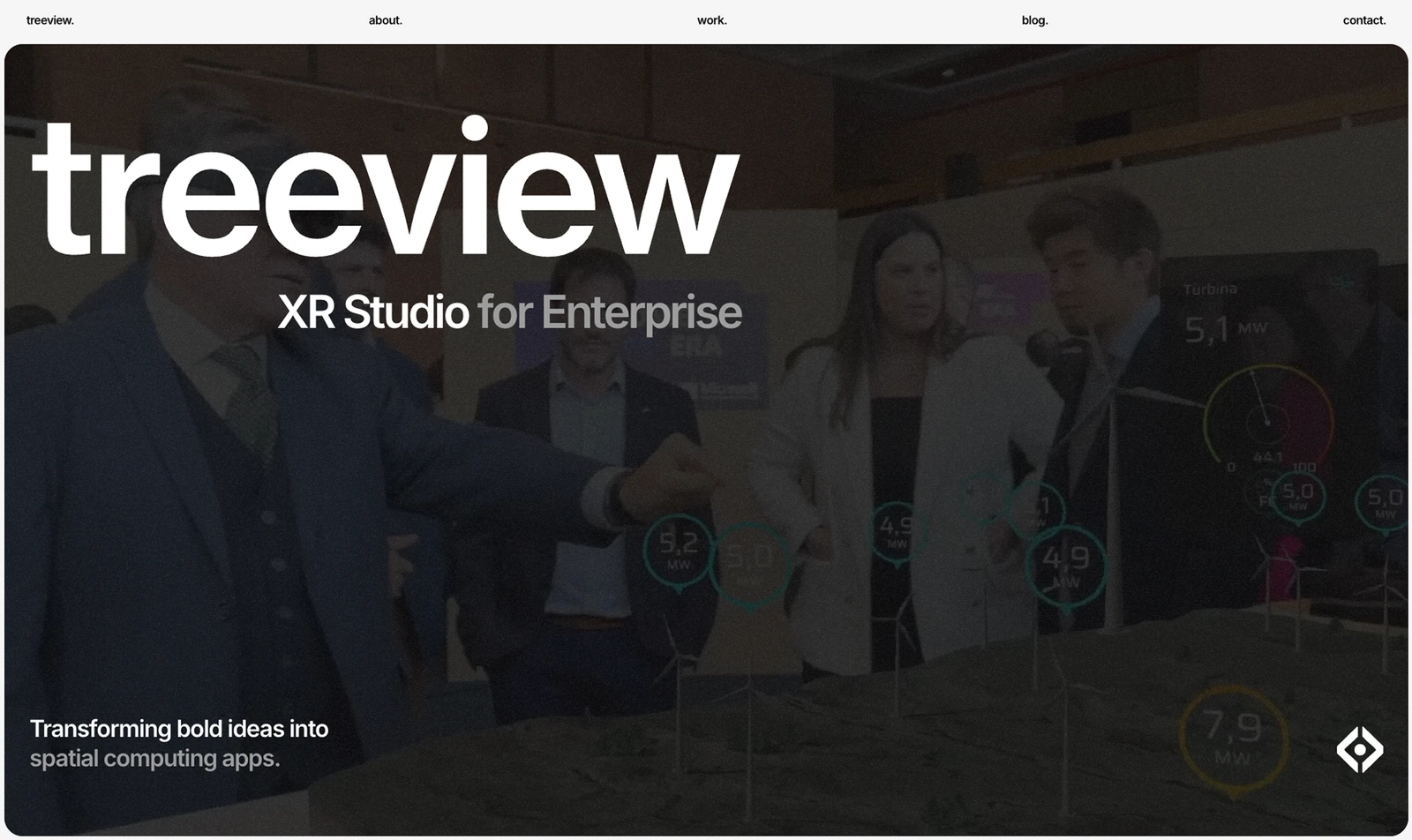
Treeview is an XR studio building custom virtual reality, augmented reality, Mixed Reality and Smart Glasses applications to order. Of the five here it is the only one that builds rather than licenses, and the only one whose published client list is drawn from outside this category: Microsoft, Meta, Medtronic, Toyota, Ford, ULTA Beauty, Daiichi Sankyo, Transfr, the University of Alberta and the University of Adelaide. Toyota and Ford are the two most relevant to industrial work.
Smart Glasses appear explicitly in its stated platform range, which matters more in this category than in any other. Industrial AR only works if the technician's hands stay on the job, and a phone or tablet defeats the purpose the moment a procedure needs two hands. Its published coverage also includes HoloLens 2, Apple Vision Pro and Meta Quest, plus iOS and Android, on Unity and Unreal Engine.
The case for a custom build here is narrower than vendors of custom work usually admit, and worth stating precisely. Platforms already solve the general problem well: authoring, delivery, capture and integration are mature products. A custom build earns its cost when the procedure is bound to equipment nobody else operates, when the AR has to sit inside an existing operational application rather than beside it, or when the deployment environment rules out a commercial platform. Outside those cases, licensing is usually the better economics.
Clients take full ownership of IP, source code and assets, which is the durable difference. An industrial procedure library built over years is an operational asset, and a platform subscription is a recurring cost with a renewal negotiation attached. Its stated services run from strategy and discovery through 3D content creation, development, system integration, testing, deployment and support. Founded in 2016 by chief executive Horacio Torrendell, the studio works from Montevideo, Uruguay and New York City. Team size and rates are not published, and it publishes no work instruction platform, so authoring tools and proof capture would be built rather than bought. Best for procedures specific to one operation, or AR that has to live inside existing systems.
2. Kognitiv Spark
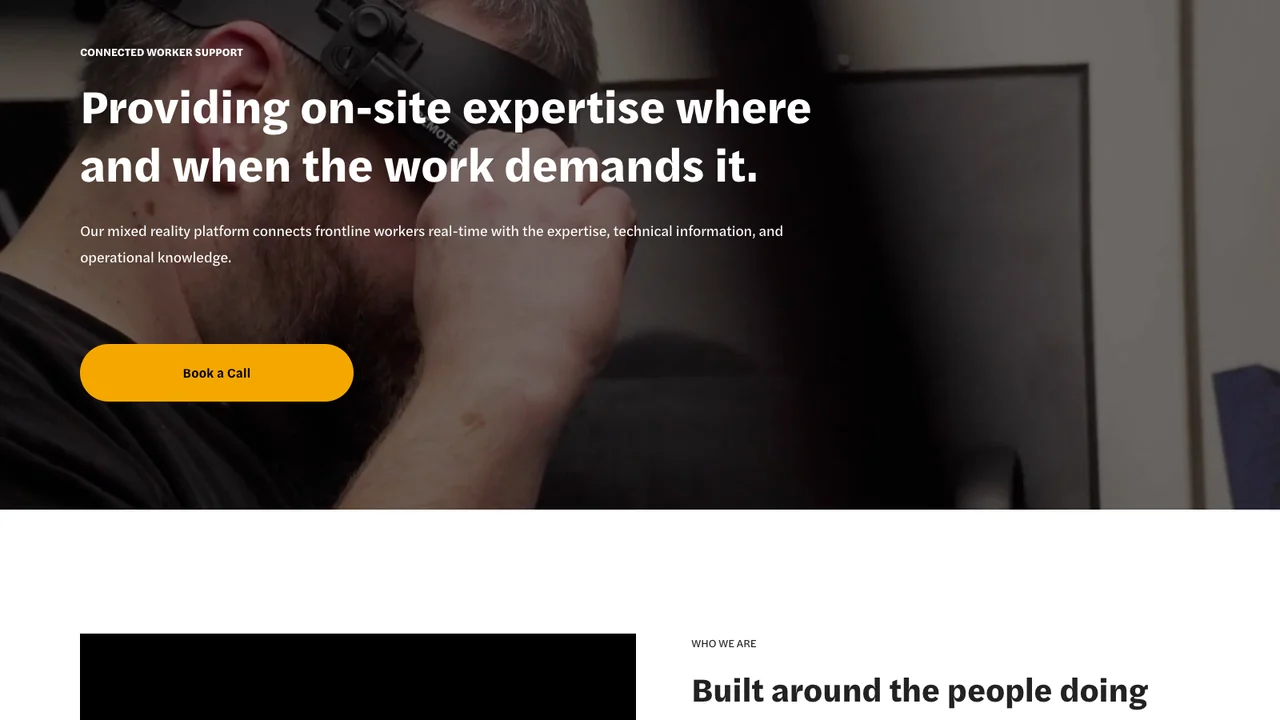
Kognitiv Spark builds RemoteSpark, a mixed reality platform providing frontline workers real-time access to experts, technical information and operational knowledge. Its published industries are Defence, Energy, Manufacturing and Aerospace, and it describes its purpose as making expertise available where work happens rather than where the expert is.
What distinguishes it in this group is that security is a published product area rather than a compliance page. The company states a commitment to encrypted communications, enterprise-grade security and flexible deployment options for security-conscious organizations in demanding environments, and it addresses head-on the specific concern this technology creates: that connected worker tools introduce new risk precisely because they depend on cameras and sensors streaming what a worker sees.
That is the honest framing, and it is the objection that stops these deployments in defense and critical infrastructure more often than cost does. A headset streaming live video from inside a naval yard, a substation or a controlled facility is a surveillance device pointed at things the operator may be legally obliged to protect. A vendor that opens with that problem, and offers deployment options rather than a single cloud, is answering the question the security team will ask first.
Its emphasis on remote and demanding environments points at the operational case: an asset that is hard to reach, where flying a specialist out costs days and significant money, and where the alternative to remote support is waiting. That is the clearest return in this category and the easiest to evidence in a business case.
Kognitiv Spark publishes no headquarters address, founding year, team size, named clients or rates on the pages reviewed, and its primary product is remote assistance rather than a standardized procedure library, so an organization whose problem is inconsistent execution should look at Taqtile or Scope AR alongside it. Best for security-sensitive operations and remote assets where getting an expert on site is the constraint.
3. Luminous XR

Luminous XR, part of Luminous Group in the United Kingdom, works across industrial digital technology including augmented reality, and it is the entry here closest to a consultancy rather than a product company. For an industrial buyer that distinction determines the shape of the engagement: a consultancy starts with the process problem, a platform starts with the platform.
Its relevance in this list is regional and practical. UK manufacturing and engineering organizations frequently want a supplier that can work on site, understands local standards and industry structure, and can be engaged for an assessment before any technology decision. That is a different procurement from licensing an American platform, and it suits organizations that are not yet sure AR is the answer.
It is also the entry with the least published product detail. Where Taqtile publishes Manifest and Scope AR publishes WorkLink, Luminous XR's published position is capability rather than a named platform with documented features, and its site does not publish a founding year, team size, named industrial clients, device support or rates on the pages reviewed. An evaluation therefore has to be done in conversation rather than from published material, and a buyer should ask directly for named deployments in their own sector, what software is delivered and who supports it afterwards.
It ranks third here on the strength of being an advisory route into the category rather than on documented deployment, and that placement should be read accordingly. For an organization that already knows it needs guided work instructions at scale, the platform vendors below are further along. For one that needs to work out whether its execution problem is a technology problem at all, an assessment is cheaper than a license. Best for UK industrial organizations wanting advice and delivery from one supplier.
4. Taqtile
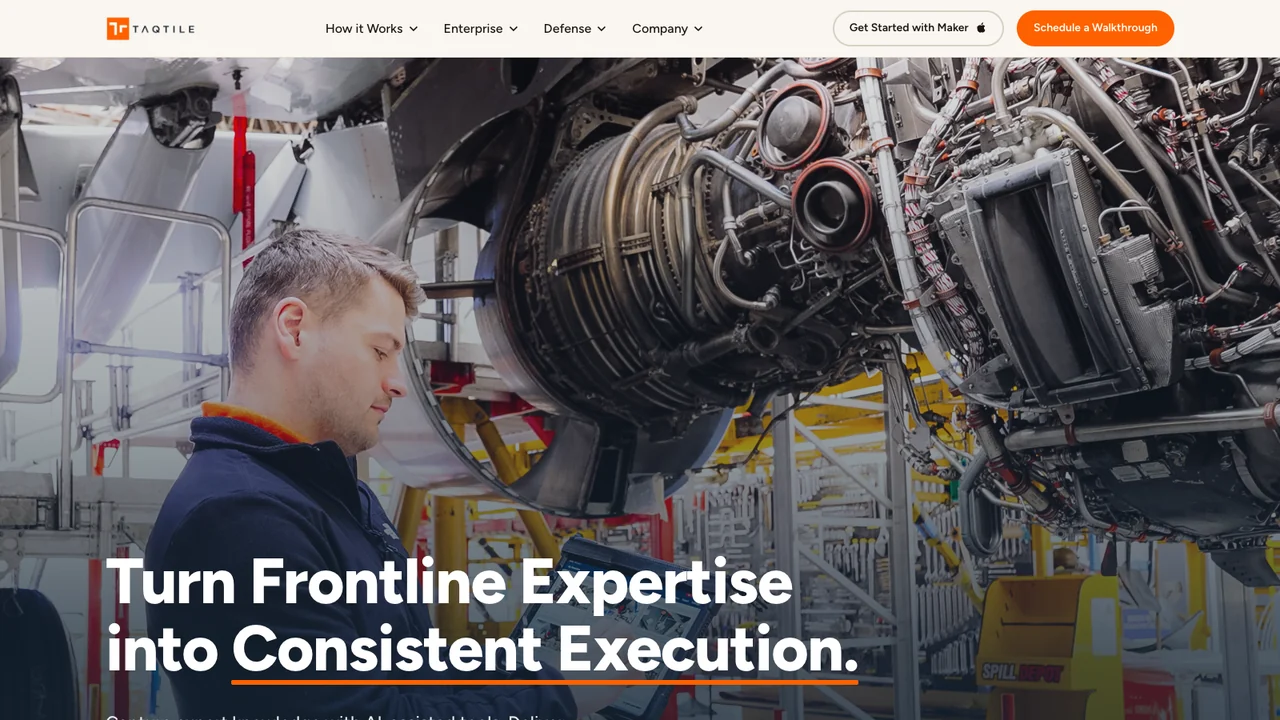
Taqtile builds Manifest, a digital work instruction platform organized around three connected capabilities: Create, turning expertise into step-by-step procedures; Guide, delivering instructions at the moment of work; and Verify, capturing proof that the job was done correctly. Its published solution areas are Training, Inspections and Maintenance.
Verify is the part worth reading carefully, because it is what separates this from a digital manual. The company frames it as knowing what was done rather than what was reported, which is a precise statement of a real and expensive problem. Paper sign-offs are completed at the end of a shift, from memory, by someone who is confident the job was fine. A procedure that captures evidence at each critical step as the work happens produces a different quality of record, and for inspections in particular that record is the deliverable.
It also names the structural problem the category exists to solve: critical expertise living inside experienced workers, outdated procedures, disconnected documents and legacy systems, becoming harder to maintain as experienced employees retire. That is the workforce transition driving most industrial AR budgets, and capturing a procedure from an expert before they leave is the concrete version of it. Its published Manifest Maker flow describes recording an expert once and turning that into a guided, verifiable procedure that runs on devices teams already have.
Its published enterprise material covers deployment, integrations and governance, which are the three things an industrial IT function will ask about before any pilot is allowed near a plant network. The site states it is trusted by industrial teams worldwide and publishes solution pages including a defence section, but it does not name individual customers on the pages reviewed, nor publish a headquarters, founding year, team size or rates. Best for organizations whose problem is inconsistent execution and unevidenced completion rather than scarce expertise.
5. Scope AR
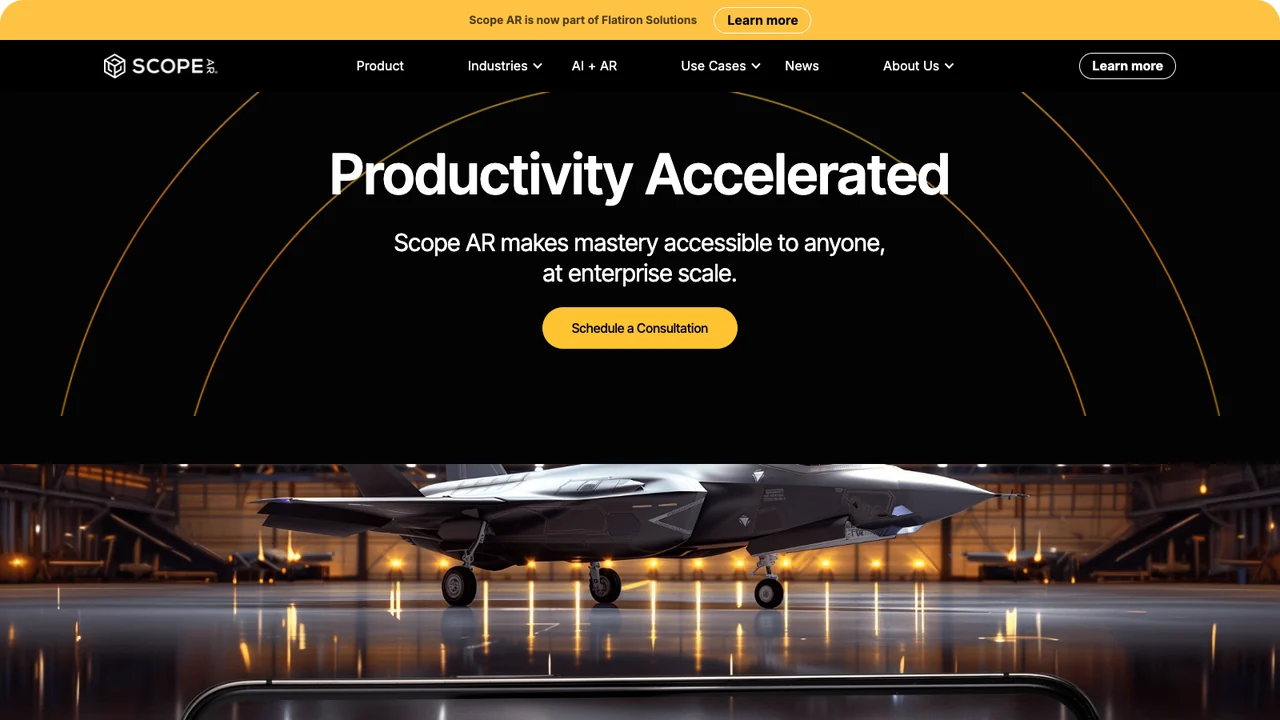
Scope AR has the longest documented history in this category, and it publishes it in detail. Founded in 2011 in Edmonton, Canada, it gave a first public demonstration of AR as an industrial training tool at MINExpo 2012, added Boeing, Toyota, Caterpillar and NASA to its customer roster in 2014, joined the Y Combinator spring class in 2015, and launched WorkLink, combining enterprise AR authoring and rendering into one platform, in 2016, with WorkLink for HoloLens following in 2017.
Its most substantial published result comes from a customer rather than the vendor: in 2018 Lockheed Martin reported 95 percent lower technician overhead, 72 percent faster resolution time and zero errors over more than four years using the Scope AR platform. A named customer stating a figure over a multi-year period is materially stronger evidence than an unattributed vendor claim, though it remains a company-reported figure rather than an audited one. Scope AR and Lockheed Martin were subsequently featured at Microsoft Ignite in 2021 in a video introduced by Microsoft chief executive Satya Nadella.
The timeline continues with HoloLens 2 support in 2019, remote services use cases emerging under COVID-19 restrictions in 2020, an Inc 5000 placement in the top 300 software category in 2023, and WorkLink for Apple Vision Pro in 2024 alongside a data integration partnership with eQ Technologic. Its published ROI figures include a 99 percent reduction in pre-work preparation, $2.4 million saved in reduced training travel time and a 95 percent reduction in time interpreting work instructions, all company-stated.
Its stated industries are Aerospace and Defense, Aviation and General Industrial, with use cases covering assembly and installation, inspection and quality assurance, and enhanced maintenance and repair, and it describes full integration with the digital thread. The company is based in San Francisco and states that it is now part of Flatiron Solutions, which is the material fact for anyone evaluating it: an acquisition can change roadmap, support and commercial terms, so ask directly what has changed and what is committed. Best for aerospace, aviation and regulated manufacturing wanting a mature platform with a long deployment record.
What industrial AR deployments have to account for
Four things decide whether an industrial AR program reaches a second site.
The first is who authors the content. A platform is only as useful as the procedure library inside it, and that library has to be written by people who know the work. Ask how long it takes a subject matter expert with no technical background to produce one verified procedure, and insist on seeing it done rather than described. Programs fail at authoring far more often than at technology.
The second is security and network reality. Industrial sites frequently have no wireless coverage on the plant floor, cameras may be prohibited, and connecting a headset to an operational network is a decision the security team owns rather than the training team. Kognitiv Spark publishes deployment flexibility and encryption directly. For the others, establish early what happens offline and what the security review will require, because a solution that only works on a good connection will not work where the equipment is.
The third is integration. Work orders live in a maintenance management system, parts live in an ERP, and drawings live in a document system. AR guidance that does not connect to those becomes a parallel process someone has to keep in step by hand, and parallel processes decay. Taqtile publishes enterprise integrations and governance, and Scope AR publishes integration with the digital thread and a partnership with eQ Technologic.
The fourth is the record. Decide before the pilot whether completion data has to satisfy an auditor, a regulator or a customer quality clause. If it does, proof capture is the requirement and instruction delivery is secondary, which reorders this list considerably. Retrofitting evidence capture into a deployed program is expensive and sometimes not possible.
How to choose between these industrial AR companies
Start by naming which problem you have, because the two halves of this list barely compete. If expertise is scarce and assets are remote, you want remote assistance, and Kognitiv Spark is built for it with security as a published concern. If execution is inconsistent and completion is unevidenced, you want guided work with proof, and Taqtile and Scope AR are the platforms. If your procedures are bound to equipment nobody else runs, or the AR has to live inside your own systems, Treeview builds and transfers ownership. If you need to establish whether AR is the answer at all, Luminous XR is an advisory route.
Then weigh published evidence honestly. Scope AR publishes the longest history and a named customer result over four years. Taqtile publishes the clearest product model. Kognitiv Spark publishes the most serious treatment of security and no named clients. Ask each for a reference in your sector, on your device type, at your scale.
Test authoring before you test the headset. Every pilot demonstrates well, because someone has built one perfect procedure. The question that predicts the second year is whether your own people can produce the next hundred, and how long each one takes.
Finally, confirm what an acquisition means where one has happened. Scope AR states it is now part of Flatiron Solutions. That is not a problem in itself, and it may bring more resources, but roadmap, support model and pricing are all reasonable things to ask about before committing to a multi-year platform.
Related reading. BestInXR's enterprise training guide covers buying, building and sustaining VR training. VR companies for oil and gas simulation and training covers the simulation side, and companies for VR hazardous environment and safety training covers the safety case. For energy sector work see XR development companies for energy and utilities, and for procurement, selecting XR developers for enterprise deployment.
Frequently Asked Questions (FAQ)
1. What is the difference between remote assistance and guided work instructions?
Remote assistance connects a technician to an expert who sees what they see and can annotate it, solving the problem of scarce expertise one incident at a time. Guided work instructions deliver a procedure with no expert involved, solving inconsistent execution and scaling without adding expert time. Kognitiv Spark leads with the first. Taqtile and Scope AR lead with the second.
2. Do these work without a network connection?
Remote assistance requires connectivity by definition, since it is a live link to another person. Guided instructions do not necessarily, but offline behavior has to be confirmed per product, and none of the five publishes full offline specifications on the pages reviewed. Plant floors and remote assets frequently lack coverage, so make this an early question rather than a pilot discovery.
3. Which of these name industrial customers?
Scope AR names Boeing, Toyota, Caterpillar, NASA and Lockheed Martin, and publishes a Lockheed Martin result over more than four years. Treeview names Toyota and Ford among its wider client list. Kognitiv Spark, Taqtile and Luminous XR name industries rather than individual customers on the pages reviewed, so references need requesting directly.
4. Can AR guidance produce an audit record?
That is the point of proof capture. Taqtile's Verify captures evidence that a job was done correctly rather than only reported, producing audit-ready records from inspections. Scope AR publishes automated documentation. If a regulator, auditor or customer quality clause depends on the record, treat evidence capture as the primary requirement rather than a feature.
5. Do technicians need headsets, or will phones work?
Both are used, and the deciding factor is whether the job needs two hands. A phone or tablet is cheaper, familiar and adequate for reference, but a procedure requiring both hands defeats it. Scope AR states work instructions can be viewed on most mobile devices and AR headsets. Treeview publishes Smart Glasses among its platforms.
6. What does industrial AR cost?
None of the five publishes rates, so no figure is recorded here. Cost is driven by licensing against custom development, devices, how many procedures must be authored, integration with maintenance and ERP systems, and the internal time to build the content library. Authoring effort is the line most often missing from a first budget.