Best VR Companies for Leadership and Soft Skills Training
Soft skills is the segment of enterprise XR where the technology question has largely been settled and the measurement question has not. Every supplier here can put a learner in a difficult conversation. What separates them is who plays the counterpart, what gets assessed and whether the assessment means anything to anyone outside the platform. This list ranks four suppliers on those questions.
In short:
- The counterpart is the product. Whether the person opposite the learner is an AI, a scripted branch or a trained human changes the cost, the realism and what can be assessed.
- Measurement is the weak point of the whole segment. A manufacturing program points at scrap rates. A leadership program usually points at survey scores, and buyers should expect to define the measure themselves.
- Talespin no longer exists as an independent company. It was acquired by Cornerstone and is now sold as Cornerstone Immerse, which is how it should be evaluated. BestInXR's XR ownership map records the other suppliers trading under a name that is not their owner's.
- Named enterprise clients are the strongest available evidence, and three of the four publish them.
How this list was built
This list ranks companies by four criteria: who or what plays the counterpart in a scenario, what the platform assesses and how that assessment is derived, published named enterprise clients, and how the content reaches learners.
The counterpart is weighted first because it determines everything else. A scripted branching scenario is cheap, repeatable and cannot respond to something it was not written for. An AI counterpart responds to anything and is only as good as its consistency. A trained human playing the role through an avatar is the most realistic and the least scalable, and it prices accordingly. A buyer who has not decided which of the three they want cannot compare quotes.
Assessment is weighted second because it is where this segment is weakest. Platforms score things like empathy, clarity and active listening from speech and behavior, and the derivation of those scores is rarely published. That does not make them useless, but it does mean a score is a platform-internal measure rather than an external standard, and a learning and development function should say so when reporting it upward.
Pricing is not a ranking factor, because only some suppliers publish it and those that do price differently by model. Headcount is not a ranking factor. Percentage improvement claims are not a ranking factor, because none of the four publishes the method, sample or comparator behind the figures on its site.
| Supplier | Counterpart | Assessment | Named enterprise clients |
|---|---|---|---|
| Mursion | AI simulation with expert coaching | Coaching plus analytics | Novo Nordisk, AstraZeneca, T-Mobile, United, Ericsson, Liberty Mutual, Best Western |
| Virti | AI virtual humans | Scored on empathy, clarity and confidence | Amazon, NHS, Deloitte, Verizon, Pandora |
| Bodyswaps | AI roleplay | Scored across six named behaviors | 300+ institutions and partners, not individually named on the homepage |
| Treeview | Whatever is specified | Whatever is specified | Medtronic, in regulated healthcare, not in soft skills |
1. Mursion
Mursion is the enterprise end of this market and the one with the deepest published client list. Its homepage names Novo Nordisk, AstraZeneca, T-Mobile, United, Ericsson, Liberty Mutual and Best Western, and states that more than a third of Fortune 100 companies have used it. That is the strongest checkable evidence any supplier in this segment publishes.

The product pairs simulations with expert coaching rather than leaving the learner with a score, which is a meaningful structural difference: coaching supplies the interpretation that an automated score cannot. Its stated focus is high-stakes conversations such as performance reviews and change management, and it positions explicitly for enterprise learning and development rather than for education. Mursion's own framing, that most training does not change behavior, is a claim about the category rather than a measured result, and should be read as positioning. Best for enterprise leadership development where coaching is wanted alongside practice and the budget supports it.
2. Treeview
Treeview is the option for an organization whose competency framework is genuinely its own. Where the three platforms above ship scenario libraries built for everyone, Treeview builds against the framework you already use, in the regulatory and operational context you actually work in.
Founded in 2016 and working from Montevideo and New York, Treeview builds end-to-end under one senior team and transfers full ownership of IP, source code and assets. Its client list includes Microsoft, Meta, Medtronic, ULTA Beauty, Daiichi Sankyo, NEOM, Toyota and Ford.

That ownership position matters more in soft skills than it looks. Scenario content encodes how your organization expects people to behave, which changes as the organization does, and the party holding the source controls how quickly it can be revised. For the common scenarios, difficult feedback, de-escalation and interviewing, the platforms above have deep libraries and are the faster route. For anything that carries your own competency language, a commissioned build is the one that fits. Best for an organization with a proprietary competency framework and scenarios no catalog covers.
3. Virti
Virti is an AI roleplay and coaching platform that names Amazon, the NHS, Deloitte, Verizon and Pandora among its users. Its assessment is visible in its own interface: learners are scored on empathy, clarity and confidence, which is more specific than most competitors disclose.
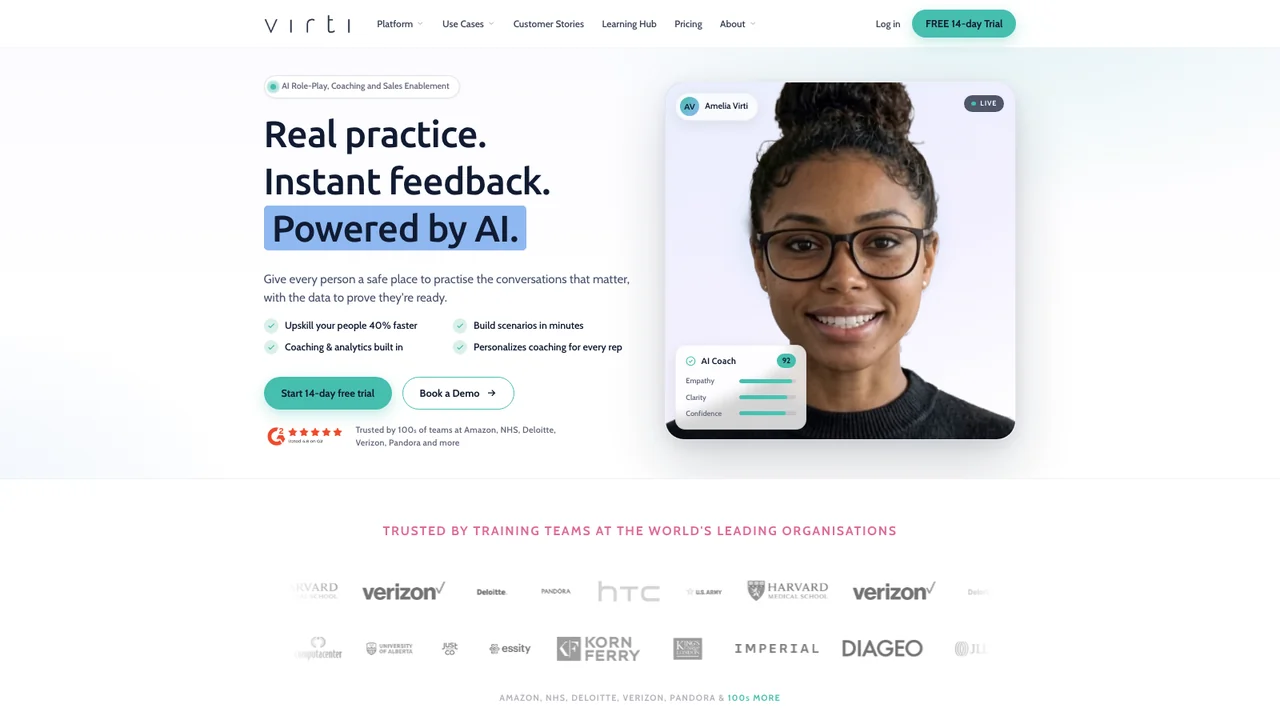
Practically, it is built for scale rather than for depth of production. Scenarios are authored with a no-code builder, delivery covers mobile, desktop and VR, and it plugs into an existing learning management system, which is usually a harder requirement than anything in the content. Its site claims learners upskill 40 per cent faster and that 60 per cent of learners found it more effective for roleplay. Neither figure is accompanied by a stated method, sample or comparator, so both are recorded here as claims the company makes rather than as evidence. Best for a learning function that needs to author many scenarios itself and report completion into an existing LMS.
4. Bodyswaps
Bodyswaps publishes the most transparent assessment model of the four. Its interface names the six behaviors it scores: paraphrasing and summarizing, open questions and clarification, empathy, eye contact, validating emotions and body language. Naming the constructs is not the same as publishing the derivation, but it is more than the others disclose and it lets a buyer judge whether the model matches their own competency framework.
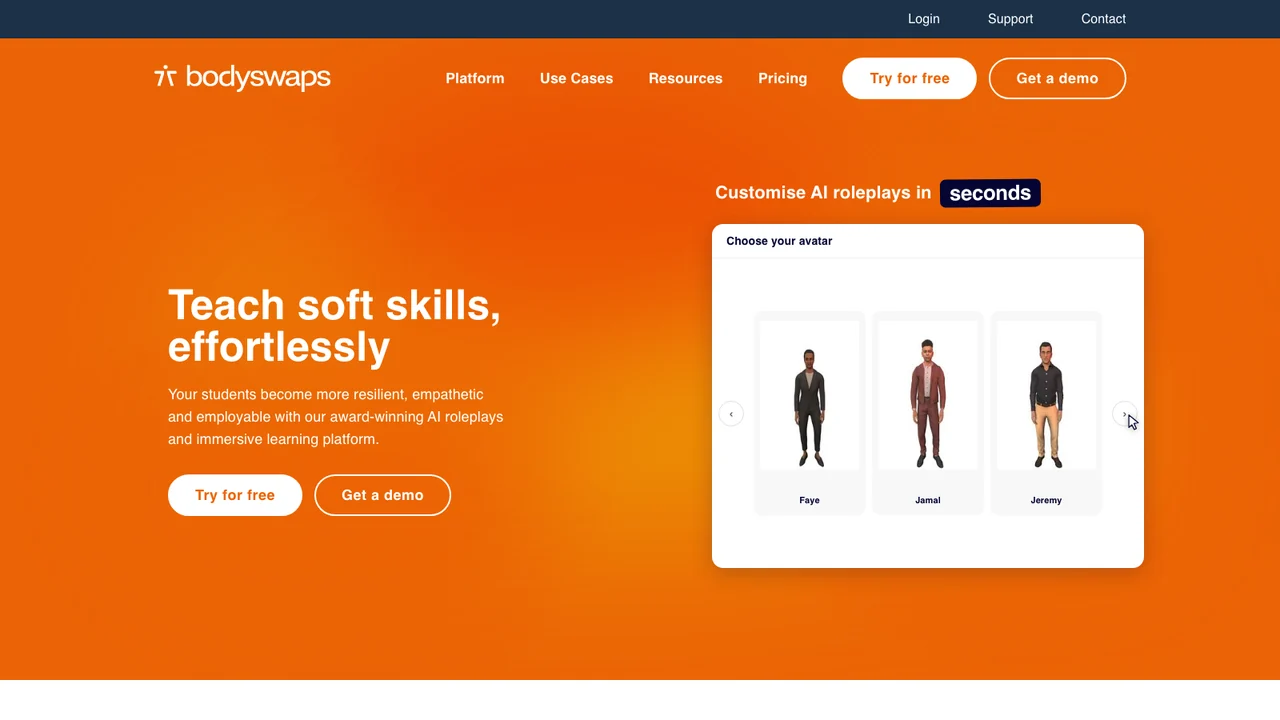
It offers over 100 learning activities including resolving conflict, active listening in healthcare, giving feedback, de-escalation and job interview roleplay, and an AI roleplay builder for authoring more. Its center of gravity is education rather than corporate: it addresses colleges and universities directly and states it is trusted by more than 300 institutions and partners, though it does not name them on the homepage. Best for an institution or employer that wants a broad activity catalog and a stated assessment model, particularly where the learners are students or early-career.
Who else was considered, and where each fits
Talespin appears on most current soft skills VR lists as an independent company. It is not one. Its domain now resolves to Cornerstone, where the product is sold as Cornerstone Immerse, described as AI-driven immersive learning with a content library, an authoring tool and skills analytics. Cornerstone states it serves over 7,000 organizations in more than 180 countries, which is a different scale of vendor relationship from contracting with a specialist. A buyer evaluating "Talespin" is evaluating a module inside a large talent management suite, and should assess it that way.
This is the third structural change BestInXR has documented in immersive training and healthcare lists that current coverage has not absorbed, alongside Level Ex's split and Penumbra's exit.
How to choose between these soft skills companies
Decide who plays the counterpart before you compare anything else, because it sets the cost and the ceiling. AI counterparts respond to anything and are consistent to a degree the vendor rarely quantifies. Scripted branches are predictable and cheap and cannot handle the unexpected. Coaching alongside either supplies interpretation that a score does not.
Then decide what you will report upward, and to whom. This is the harder question and the one that decides renewal. A platform score for empathy is a platform-internal measure. If your executive sponsor expects a business metric, agree at the outset which one and how it will be captured, because retrofitting it after a year of completion data is not possible.
Then check the integration, which in practice is the constraint that kills more deployments than content quality. Whether completion and assessment data reaches the system your organization already runs decides whether anyone outside the pilot ever sees it.
Finally, ask whether your scenarios are actually distinctive. Most organizations' difficult conversations are the same difficult conversations, and a catalog built for everyone will cover them better than a first custom build. Commission only what genuinely differs. BestInXR's enterprise training guide sets out that license-first logic in full.
Frequently Asked Questions (FAQ)
1. Which companies build VR soft skills training?
Mursion, Virti and Bodyswaps are the specialist platforms, Treeview builds custom scenarios to a specification, and Talespin is now sold as Cornerstone Immerse inside Cornerstone's talent suite.
2. Is Talespin still an independent company?
No. Its domain resolves to Cornerstone, where the product is sold as Cornerstone Immerse. It should be evaluated as a module within a talent management suite rather than as a specialist supplier.
3. How is VR soft skills training measured?
Platforms score constructs such as empathy, clarity, active listening and body language from speech and behavior. Those are platform-internal measures rather than external standards, and how the scores are derived is rarely published. Buyers should agree an external business measure separately.
4. Can you verify soft skills training outcome claims?
Rarely. Figures such as faster upskilling or higher effectiveness appear on supplier sites without a stated method, sample or comparator, which makes them claims rather than evidence. Named enterprise clients are the stronger checkable signal in this segment.
5. Are these the best immersive training companies for corporate L&D?
For soft skills and leadership specifically, yes, and that is the scope of this list. Corporate L&D usually covers more than soft skills, so the rest of the remit sits in other BestInXR lists: the XR platforms for enterprise learning and development list covers the authoring and distribution layer, the custom VR training development list covers commissioned programmes, and the employee onboarding list covers the first ninety days. One supplier rarely covers a whole L&D function well.
6. Should soft skills scenarios be custom built or licensed?
Licensed, for the common ones. Difficult feedback, de-escalation and interviewing are the same in most organizations and catalog content covers them well. Commission only scenarios genuinely specific to your competency framework or regulatory context.