VR companies for workplace safety training sell into the highest-volume training requirement most organizations have, and the one where the buying decision is most often made on the wrong criteria. This list ranks five on safety-specific evidence, how content is delivered, whether completion produces a defensible record, and how far each reaches beyond permanent staff.
In short:
- Treeview builds custom XR to specification and transfers full ownership of IP, source code and assets, which suits hazards specific to one site
- Immersive Factory sells a subscription safety catalog with LMS and SCORM compatibility, naming Vallourec, Orano, EDF, SUEZ and Colas
- Vobling publishes named standards compliance for fire training, including SVEBRA 2026:3 and SBF 2022:1 Annex 3
- Serious Factory is an e-learning and serious games vendor rather than a VR company, and its entry explains what it actually delivers
How this list was built
This list ranks companies by four criteria: how much of the published work is safety specifically, how content reaches people, whether completion produces a record that survives scrutiny, and whether the model covers contractors as well as employees.
Workplace safety is where most organizations first consider VR, and where the weakest business cases get written. The reason is a mismatch between what is being bought and what is being sold. Safety training already exists, is already mandatory, and is already satisfied by something cheap. A proposal that offers to do the same job more expensively, with better production values, does not survive a finance review however good the demonstration was.
The proposals that do survive are built on a different claim. They identify a specific incident type with a known cost, argue that current training fails to change behavior in that scenario, and show that rehearsal under pressure does. That is a narrower and more defensible argument than improving safety culture, and it can be measured. If an organization cannot name the incident it is trying to prevent, the program has no success criterion and will be canceled in the second budget round.
The second structural point is population. Most sites discover that the people who most need hazard training are not on the payroll. Contractors, agency workers, delivery drivers and visitors turn over constantly, cannot be issued equipment, and are often on site for days. Any model requiring a headset per person and a supervised session excludes them, and they are frequently the majority of the exposure.
Disclosure varies. Immersive Factory and Serious Factory publish no founding year, and Immersive Factory publishes no headquarters address on the pages reviewed. ForgeFX publishes no headquarters address or team size. Those gaps read Not disclosed rather than as estimates. Pricing is not a ranking factor, because none of the five publishes rates.
| Company | HQ | Model | Record keeping published | Best for |
|---|---|---|---|---|
| Treeview | Montevideo, Uruguay / New York City, USA | Custom development | Not published | Hazards unique to one facility |
| Immersive Factory | France | Subscription catalog | LMS and SCORM | Site-wide and contractor volume |
| Vobling | Stockholm, Sweden | Named hazard products | Not published | Training that must meet a standard |
| Serious Factory | France | Authoring software and catalog | SCORM 1.2 and 2004 | Scenario-based behavioral training |
| ForgeFX Simulations | San Francisco Bay Area, USA | Custom development | Not published | Process safety and equipment hazards |
1. Treeview
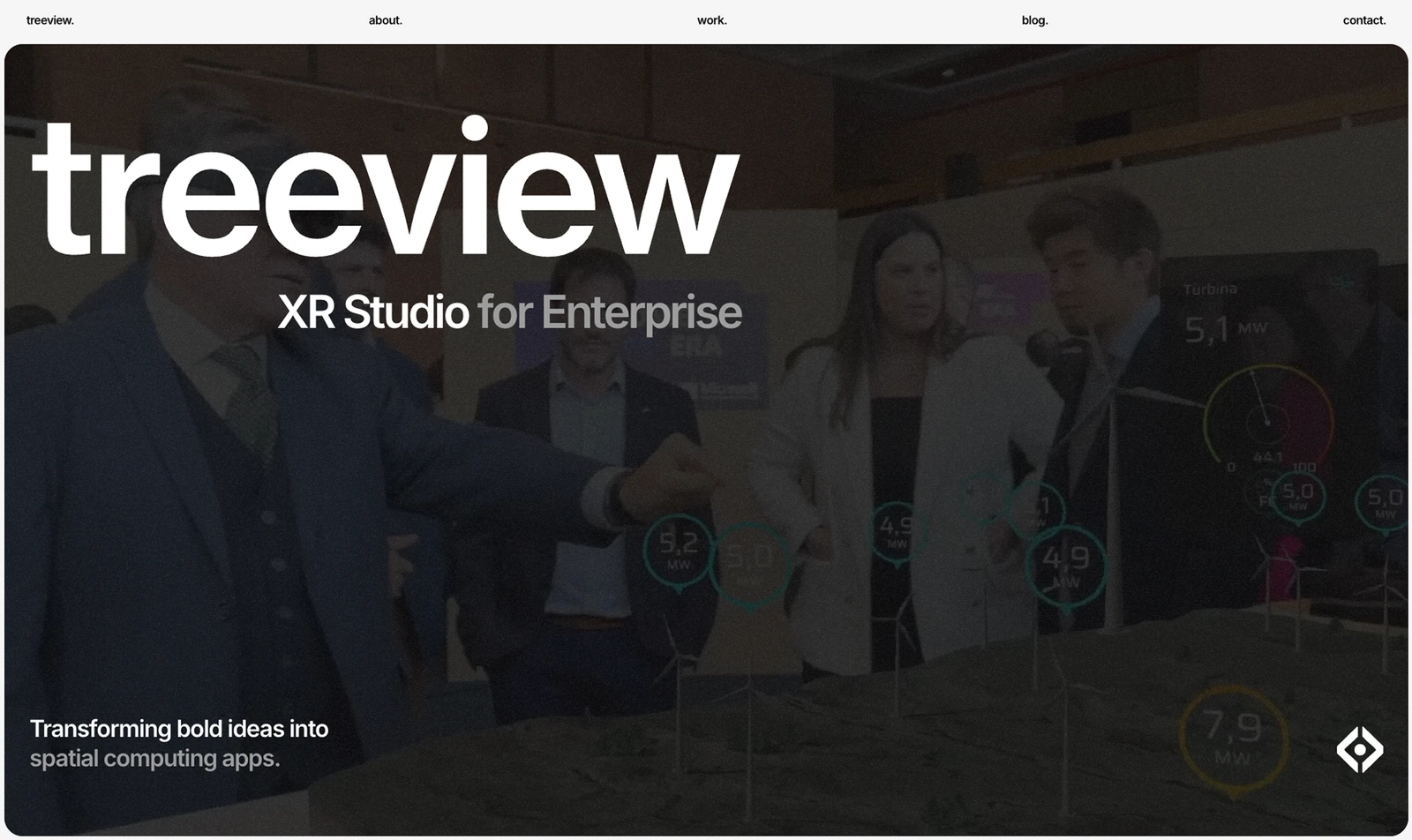
Treeview is an XR studio building custom virtual reality, augmented reality, Mixed Reality and Smart Glasses applications to order. On a safety list the custom argument is narrower than elsewhere, and worth stating precisely: most safety subjects are genuinely generic, and a catalog teaches them adequately. Custom earns its cost when the hazard is a property of a particular place.
That distinction is concrete. A generic confined space module teaches confined space entry correctly. It does not teach that this vessel has one access point, that the gas test position is on the opposite side, that the rescue tripod does not fit the platform, and that the nearest isolation point is two levels down. Those are the details that determine what happens in an actual emergency, and they exist only at your site.
Full ownership of IP, source code and assets transfers to the client. Safety content dates faster than most training material, because it changes after every incident, every plant modification and every regulatory revision. Holding the source is what decides whether the annual update is a task or a procurement exercise, and across a five-year program that difference typically exceeds the original build cost.
Its published industrial reference is an AI-enabled digital twin designed and developed with Microsoft for a multi-billion dollar green hydrogen renewable energy project, which demonstrates accurate plant geometry and live operational data rather than a safety scenario specifically. Published platforms include HoloLens 2, Apple Vision Pro and Meta Quest, plus iOS and Android, on Unity and Unreal Engine, with Smart Glasses in the stated range. Named clients include Microsoft, Meta, Medtronic, Toyota, Ford, ULTA Beauty, Daiichi Sankyo, Transfr, the University of Alberta and the University of Adelaide. Founded in 2016 by chief executive Horacio Torrendell, it works from Montevideo, Uruguay and New York City. Team size, rates and record-keeping integrations are not published, so how completion reaches your systems is a scoping question. Best for site-specific emergency scenarios you intend to maintain.
2. Immersive Factory
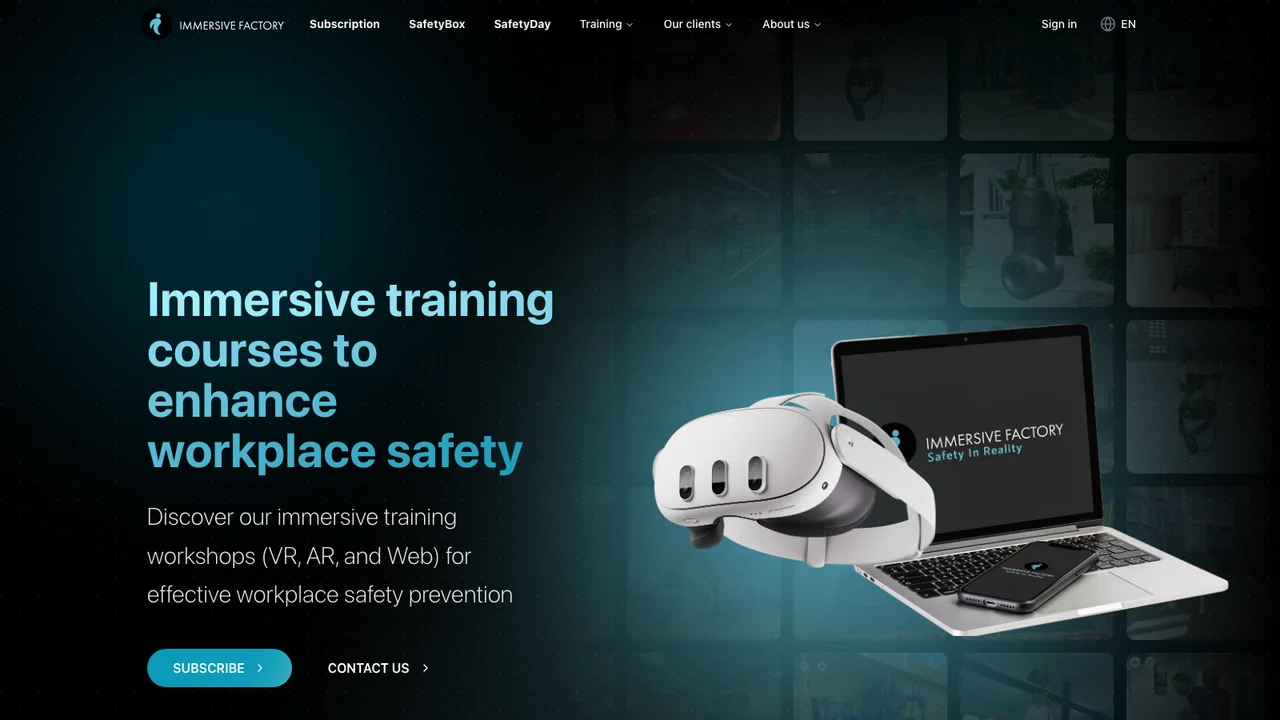
Immersive Factory sells subscription-based immersive training in VR, AR and web formats built specifically around workplace safety prevention, and it is the only company here whose entire published proposition is safety. It also states custom content creation alongside the catalog.
Its client list is the most relevant in this group for industrial safety at scale and includes Vallourec, Orano, EDF, SUEZ, Veolia, Saint-Gobain, Imerys, Spie, Colas, FM Logistique, DS Smith, Givaudan, Coca-Cola and Merck. That set spans nuclear fuel, energy, utilities, chemicals, construction, logistics and food production, which is a broad enough sample to show the catalog works across very different risk profiles rather than one favorable sector.
The subscription model addresses the population problem directly, and it is the reason this ranks second. Safety training is the one requirement that has to reach everyone on site, including people who do not work for you. Per-seat catalog access scales to a contractor workforce arriving for a two-week shutdown in a way a commissioned build priced per project cannot, and web delivery reaches people who will never be issued a headset.
Device support is published across HTC Vive Focus 3, Meta Quest 3 and Pico Neo 4 Ultra headsets, plus PC, Mac, tablet and mobile, with LMS and SCORM compatibility for web-delivered courses. The SCORM point carries more weight in safety than anywhere else in this directory. Safety training is the training most likely to be examined after an incident, sometimes years later, by people with no relationship to the vendor. A completion record that exists only inside a supplier's dashboard is a weak position, and one exported in a standard format into your own system is a defensible one.
A headquarters address, founding year, team size and module count are not published on the pages reviewed. Best for site-wide and contractor safety at volume, particularly across European operations.
3. Vobling
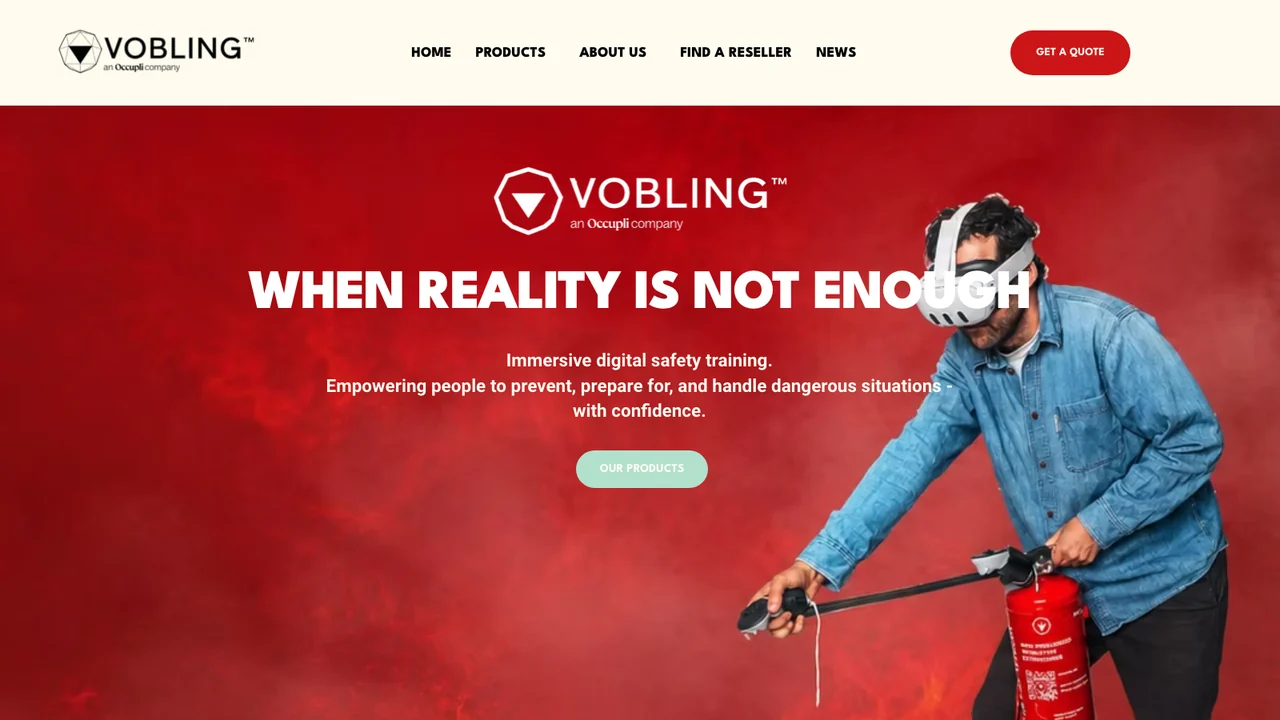
Vobling builds immersive digital safety training with a published product line aimed at named hazard disciplines. Its products are the VR Fire Trainer, the Vobling Training Platform and Electrical VR Training, alongside applications for hot work covering welding and for working at height using a scissor lift.
It is the only company in this list publishing named regulatory approvals, and that changes what a safety manager is buying. Its fire training states compliance with SVEBRA 2026:3, the guideline for practical fire extinguishing training, and with SBF 2022:1 Annex 3, Section 2.3, covering extinguishing simulator systems. It states approval by Brannvernforeningen, and that digital extinguishing with VR is permitted by DSB as part of the official ADR practical training curriculum in Norway.
The hardest question in safety VR procurement is whether a simulated exercise counts against a practical training requirement, and for most vendors the honest answer is that it depends on your regulator. Vobling has answers on record for specific Nordic standards, which converts a debate into a document reference. Buyers elsewhere still have to confirm acceptability with their own regulator, because an approval in Norway or Sweden does not transfer automatically, but a supplier that has been through the process once is better prepared for the conversation.
The VR Fire Trainer integrates with a real fire extinguisher, so the trainee handles the physical device while the fire is simulated, and it publishes seven extinguishing agents covering powder, water, CO2, wet chemical, foam, lithium and water mist, five fire types including A, B, E, F and lithium battery, and sixteen languages. Published scenario locations include a truck, warehouse, forklift, hospital kitchen, electrical room, roofing zone, train, bus, garage, oilfield fire and institutional care setting. A mixed reality version using passthrough and hand tracking is published for Meta devices.
Founded in 2015 and based in Sweden, the company works from Torsgatan 26 in Stockholm with offices in Cork, Dublin and London, states more than 200 XR-enabled projects, and is part of Occupli. Its published leadership includes chief executive Filip Grufman and chief technology officer Oskar Skoglund. Named clients include Covenant Health, the NHS, Securitas, Outokumpu, Cramo, Vy and Bifrost Wind Academy. Coverage is bounded by the published product line, and record-keeping integration is not published. Best for fire, electrical, hot work or height training that must satisfy a named standard.
4. Serious Factory
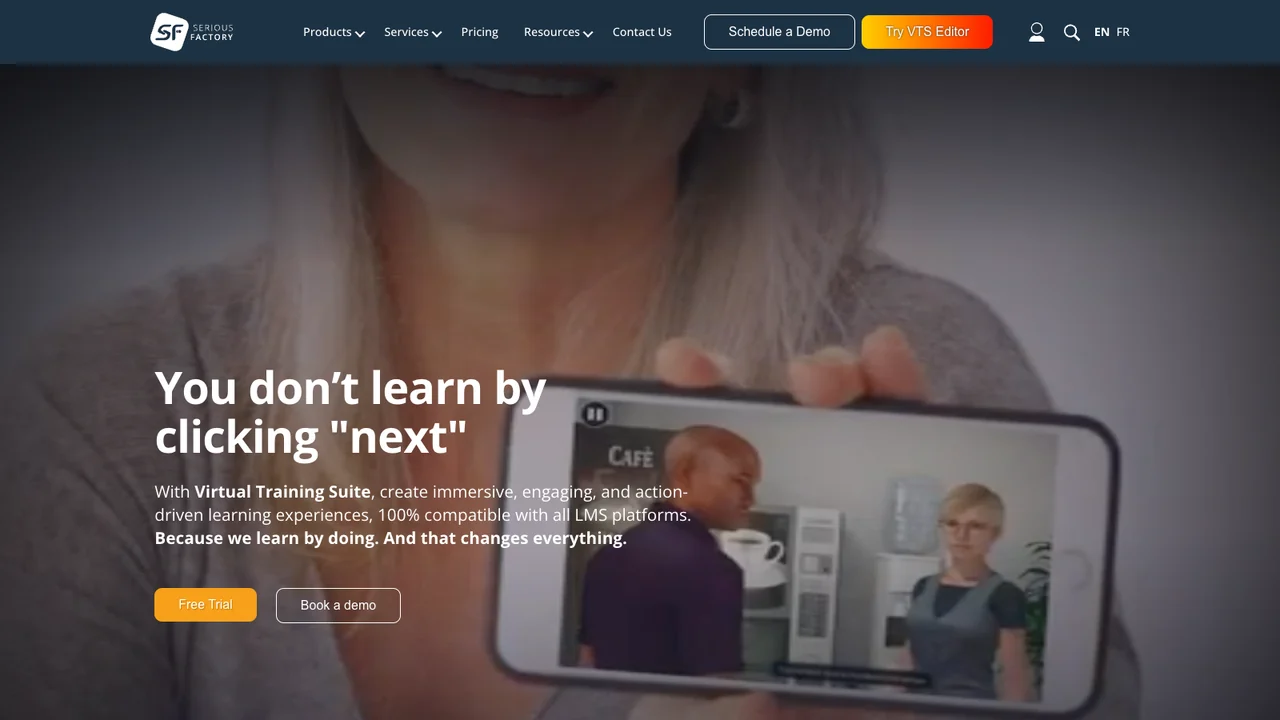
Serious Factory needs a category note before anything else, because it is not a VR company in the sense the other four are. It is an e-learning and serious games vendor, and its published products are VTS Editor, described as e-learning design software, VTS Perform, an LMS platform, Virtual Training Place, an off-the-shelf training catalog, and SF Studio for interactive video learning.
The extent of its VR involvement is specific and worth quoting accurately. VTS Editor states that it contains numerous 2D, 360 degree or virtual reality backgrounds across a range of environments. Virtual reality there describes a type of scene backdrop inside a scenario authoring tool. The product pages reviewed make no mention of headsets, Meta Quest or any VR delivery, so a buyer expecting headset-based safety training from this supplier would be buying something different from what they imagined.
What it actually does is worth taking seriously on its own terms, because it addresses a real weakness in safety training. Its published positioning attacks passive e-learning directly, arguing that modules are launched and quickly forgotten, too linear, too passive and too far from real-world practice. Its answer is branching role-play scenarios with characters who express emotion, which is a genuinely good fit for the safety topics that are behavioral rather than physical: challenging unsafe behavior, refusing an unsafe instruction, reporting a near miss, or handling pressure to skip a step.
Those situations are social rather than mechanical, and rehearsing a difficult conversation does not require a headset. It publishes SCORM 1.2 and SCORM 2004 compatibility and compatibility with all LMS on the market, which puts its record keeping alongside Immersive Factory's and ahead of the custom studios here. Its stated industries include Health, Education, Vocational training and Consulting firms.
It ranks fourth on a VR safety list because the VR claim is thin, while the underlying product is credible for a specific slice of safety training. No founding year, headquarters address, team size or rates are published on the pages reviewed. Best for behavioral and conversational safety training delivered on screens, not for physical hazard rehearsal.
5. ForgeFX Simulations
ForgeFX Simulations has built custom 3D training simulation software and custom virtual and augmented reality applications since 2002, from the San Francisco Bay Area. Its safety relevance rests on work that sits at the technical end of the discipline rather than the general awareness end.
Its HazOps work addresses hazard and operability study training, which is process safety rather than occupational safety, and the distinction matters. Occupational safety covers slips, lifting and personal protective equipment, and every catalog teaches it. Process safety covers loss of containment, where incidents are rare, catastrophic and driven by sequences rather than single acts, and almost no catalog teaches it because it cannot be made generic. A studio with published HazOps work is operating in the part of safety where custom development is genuinely necessary.
OcuWeld, its welding simulator, is the second relevant project, since welding carries fire, fume, radiation and burn hazards simultaneously and is the classic hot work case. Its other published projects include a horizontal directional drill simulator, an aircraft deicing simulator, CyberLab, Virtual Walking the Pens and a heavy rail operator training simulator.
Its named clients include Komatsu, Caterpillar, Vermeer Corporation, JLG Industries, Joy Global, Pierce Manufacturing, StrataTech Education Group, MRIGlobal, General Electric Healthcare, Pearson Education, Adobe, Farmers Insurance, Zoetis, SAK Construction, WMATA and Global Ground Support. Pierce Manufacturing builds fire apparatus and StrataTech runs welding education, both adjacent to hazard training, and the equipment manufacturers imply simulations validated against real machine behavior.
It ranks fifth because this list is ordered by how much of a company's published record is workplace safety specifically, and ForgeFX's is dominated by equipment operation with safety as one component. Published device targets span VR headsets and stereoscopic 3D displays, augmented reality spatial computing devices and traditional desktop platforms. Team size, headquarters address, rates, ownership terms and record-keeping integrations are not published. Best for process safety and equipment hazard training requiring technical fidelity.
What safety training programs have to account for
Four things determine whether a safety VR program is renewed.
The first is naming the incident. A program that sets out to improve safety culture has no measurable endpoint and will lose its budget to something that does. One that sets out to reduce a specific incident type, with a baseline taken beforehand and a cost attached, can be defended. Decide this before selecting a supplier, because it determines which supplier is right.
The second is the record. Safety training gets examined after incidents by regulators, insurers and lawyers, sometimes years later. Completion evidence has to live in the system your organization treats as authoritative, in a format it can export. Immersive Factory publishes LMS and SCORM compatibility and Serious Factory publishes SCORM 1.2 and 2004. The three others do not publish integration detail, so it belongs in the specification.
The third is whether a simulated exercise satisfies your legal requirement. This varies by jurisdiction and by competence, and some requirements specify practical assessment that a simulation cannot replace. Vobling publishes named approvals for specific Nordic fire standards. Everywhere else, confirm with your regulator or certifying body before the format is chosen rather than after content is built.
The fourth is the population you actually have to reach. Count contractors, agency workers and visitors, not just employees. If they are the majority of your exposure, a model requiring a headset per person and a supervised session does not solve your problem, and a device-flexible catalog does.
How to choose between these workplace safety VR companies
Match the supplier to the hazard type, since no single one covers the range. Fire, electrical, hot work or working at height: Vobling has built those products and, for fire, holds named approvals. Broad prevention and hazard recognition across a large mixed population: Immersive Factory's subscription catalog is designed for exactly that. Process safety, HazOps and equipment hazards: ForgeFX has the technical record. Emergency procedures specific to your own plant: Treeview builds them and hands over the source. Behavioral safety, difficult conversations and reporting culture: Serious Factory's branching scenarios fit, on screens rather than headsets.
Then check whether the safety claim is a category or a credential. Many suppliers list safety among their industries; fewer publish safety products, named standards or clients in regulated hazardous work. Vobling publishes standards. Immersive Factory names Orano, EDF and Vallourec. ForgeFX names manufacturers whose equipment carries the hazards. Ask for one reference in your own hazard class rather than your own sector.
Settle record keeping before content. It is the requirement that cannot be added cheaply afterwards, and it is the one that matters most when the training is examined.
Finally, price the annual revision. Safety content changes after incidents, plant modifications and regulatory updates, and content that cannot be updated cheaply will eventually teach something that is no longer correct. In safety training that is worse than teaching nothing, because people act on it.
Related reading. BestInXR's enterprise training guide covers buying, building and sustaining VR training. companies for VR hazardous environment and safety training covers high-consequence environments in more depth, and VR companies for oil and gas simulation and training covers the sector case. For custom builds see companies for custom VR training development, and for guidance during work, AR work instruction and guided work companies.
Frequently Asked Questions (FAQ)
1. Does VR safety training satisfy a legal requirement?
Sometimes, and only where a regulator has said so. Vobling publishes compliance with SVEBRA 2026:3 and SBF 2022:1 Annex 3, approval by Brannvernforeningen, and DSB permission for digital extinguishing within Norway's ADR practical curriculum. Those are jurisdiction-specific and do not transfer. Confirm with your own regulator before choosing a format.
2. Is VR better than a toolbox talk?
For rehearsing a fast, correct sequence under pressure, yes, because that is the thing a briefing cannot deliver. For conveying information, a briefing is far cheaper and no source reviewed here shows VR beating it. The honest test is whether the failure you are addressing is a knowledge failure or a response failure.
3. How do contractors and temporary workers get covered?
Through catalog or subscription content on devices they already have, since issuing headsets to a workforce present for two weeks is rarely practical. Immersive Factory's model is built for this and publishes PC, Mac, tablet and mobile delivery alongside headsets. Commissioned builds priced per project do not scale to that population.
4. Where does the completion record end up?
Wherever you specify. Immersive Factory publishes LMS and SCORM compatibility, and Serious Factory publishes SCORM 1.2 and 2004. Treeview, Vobling and ForgeFX do not publish record-keeping integrations on the pages reviewed, so how a result reaches your safety management system is a question for the specification.
5. Is Serious Factory a VR company?
Not in the sense the others are. Its VTS Editor lists 2D, 360 degree and virtual reality backgrounds as scene types inside a scenario authoring tool, and its product pages make no mention of headsets or VR delivery. It is an e-learning and serious games vendor, credible for behavioral safety scenarios on screens rather than for physical hazard rehearsal.
6. What does VR safety training cost?
None of the five publishes rates, so no figure is recorded here. Cost is driven by whether content is licensed or built, how many scenarios are in scope, devices and their management, record-keeping integration, and how many people must be reached including contractors. Annual revision is the line most often missing from a first budget.
7. Who builds VR safety training for industrial environments?
Industrial safety is a narrower problem than workplace safety, and the split in this list follows it. Immersive Factory licenses a catalog of generic industrial hazards and reaches contractors on devices they already own. ForgeFX builds equipment simulations for the case where the machine itself is the hazard. Treeview builds to a specific plant, which is the route when the hazard is your own process rather than a generic one. Vobling is the specialist where fire is the hazard and a named regulator has approved the format.
8. Who develops VR training for heavy equipment operators?
Of the five here, ForgeFX is the one that publishes machine-level work by name. Its Komatsu Mining Corporation simulators cover electric rope shovels, an underground loader, a blasthole drill and a longwall system, and its JLG access equipment simulators cover scissor lifts, telehandlers and boom controls. The buyer can be either the machine maker or the operator, and ForgeFX names both: Komatsu and JLG are manufacturers, while its own client list also carries the Washington Metropolitan Area Transit Authority for heavy rail operator training and SAK Construction, whose quoted testimonial describes a program built "for us to use and distribute". That is a different purchase from the programs ranked above. An operator simulator models one machine's controls rather than a site's hazards, so scope it per machine and ask who owns the right to distribute it.