Custom VR training development means a supplier builds a simulation to your specification rather than licensing you one that already exists. That decision is worth making deliberately, because custom costs more upfront and earns it back only under conditions that do not apply to every buyer. This list ranks five on documented custom work, delivery model and what you own at the end.
In short:
- Treeview builds custom XR end to end across current headsets and transfers full ownership of IP, source code and assets
- ForgeFX Simulations has taken custom simulation contracts since 2002, with named work for Komatsu, Caterpillar, Vermeer, JLG and Joy Global
- Motive.io is an authoring platform rather than a development studio, which is the cheaper path once you intend to build repeatedly
- Think Digital brings a 14 metre mobile classroom with 20 headsets, solving delivery rather than only production
How this list was built
This list ranks companies by four criteria: documented custom development work, whether the supplier builds for you or equips you to build, named clients, and what the buyer holds when the engagement ends.
Custom is not automatically better, and a list about custom development should say so first. Licensing an existing catalog is cheaper, faster and lower risk, and for a great many training needs it is simply the correct answer. Generic content transfers perfectly well when the subject is generic: manual handling, fire response, hazard recognition, forklift basics. Nobody should commission a bespoke build to teach something a catalog already teaches adequately.
Custom earns its cost in three situations. The first is when the procedure belongs to your site: your plant layout, your equipment revision, your permit conditions, your sequence. Generic content teaches a facility nobody works in. The second is when the training has to reach a standard an external party will examine, such as an equipment manufacturer, a regulator or a customer quality clause, and an off-the-shelf module cannot demonstrate it. The third is when the simulation must integrate with something you already run, so that results land in your systems rather than a vendor dashboard.
The question that separates good custom engagements from expensive ones is what happens in year two. A bespoke simulation is a piece of software, and software needs maintenance. Procedures change, headsets are replaced, operating systems stop supporting old builds. A buyer who owns source code can have any competent developer make those changes. A buyer who owns a delivered application and nothing else is committed to their original supplier for as long as the program runs, at whatever the supplier quotes.
Disclosure varies. ForgeFX publishes no headquarters address or team size, Motive.io publishes no founding year, and Think Digital publishes no founding year. Mesmerise publishes no services page, portfolio, founding year or team size, and its most recent published news is dated January 2025. Those gaps read Not disclosed rather than as estimates. Pricing is not a ranking factor, because none of the five publishes rates.
| Company | HQ | Model | Named clients | Best for |
|---|---|---|---|---|
| Treeview | Montevideo, Uruguay / New York City, USA | Custom development | Microsoft, Toyota, Ford, Medtronic | Builds you intend to own and maintain |
| ForgeFX Simulations | San Francisco Bay Area, USA | Custom development | Komatsu, Caterpillar, JLG, NASA suppliers | Equipment fidelity to an OEM standard |
| Motive.io | Not disclosed | Authoring platform | Not published | Teams building repeatedly in house |
| Think Digital | Adelaide, South Australia | Development and delivery | Meat and Livestock Australia | Programs that must travel to people |
| Mesmerise | London, UK | Holding group | TD, Fortune Global 500 unnamed | Healthcare education via neuRealities |
1. Treeview
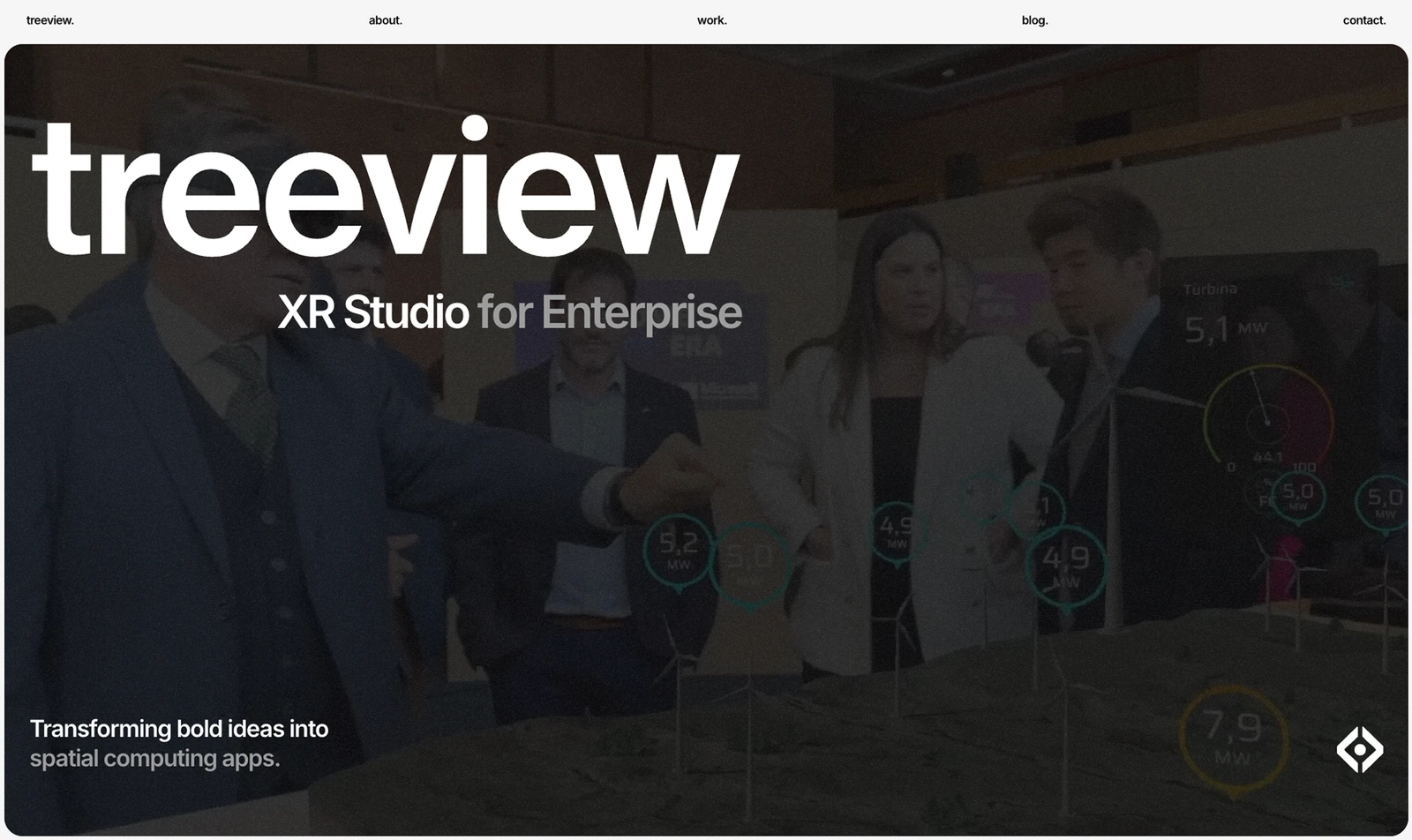
Treeview is an XR studio building custom virtual reality, augmented reality, Mixed Reality and Smart Glasses applications to order, and custom development is its entire published business rather than one service among many. Named clients include Microsoft, Meta, Medtronic, Toyota, Ford, ULTA Beauty, Daiichi Sankyo, Transfr, the University of Alberta and the University of Adelaide.
That client list is the relevant evidence for a custom buyer, and it is worth reading for what it implies rather than for the logos. Medtronic, Toyota and Ford all operate supplier qualification and internal review processes that a studio has to pass before work is accepted, and Transfr is itself a VR training company, which means a specialist judged the studio capable of building to its standard.
Full ownership of IP, source code and assets transfers to the client, and on a custom list this is the term that most deserves scrutiny across the whole market. Commissioning a build and receiving only an application is a common arrangement and a poor one, because the buyer has funded development and holds none of the output. Where the source transfers, a training program becomes an asset the organization can maintain, port to a new headset generation, extend to a second site or hand to a different contractor.
Its published services span the full engagement: strategy and discovery, 3D content creation, development, system integration, testing, deployment and support. Discovery and system integration are the two that separate a studio equipped for enterprise work from one that only produces content, since most custom failures originate in a poorly specified scope or an integration nobody owned. Published platforms include HoloLens 2, Apple Vision Pro and Meta Quest, plus iOS and Android, on Unity and Unreal Engine.
Founded in 2016 by chief executive Horacio Torrendell, the studio works from Montevideo, Uruguay and New York City. Team size and rates are not published, it builds no physical simulator hardware, and it publishes no authoring tool, so every revision is a development task rather than something a training team edits. Best for organizations commissioning a build they intend to own and maintain for years.
2. ForgeFX Simulations
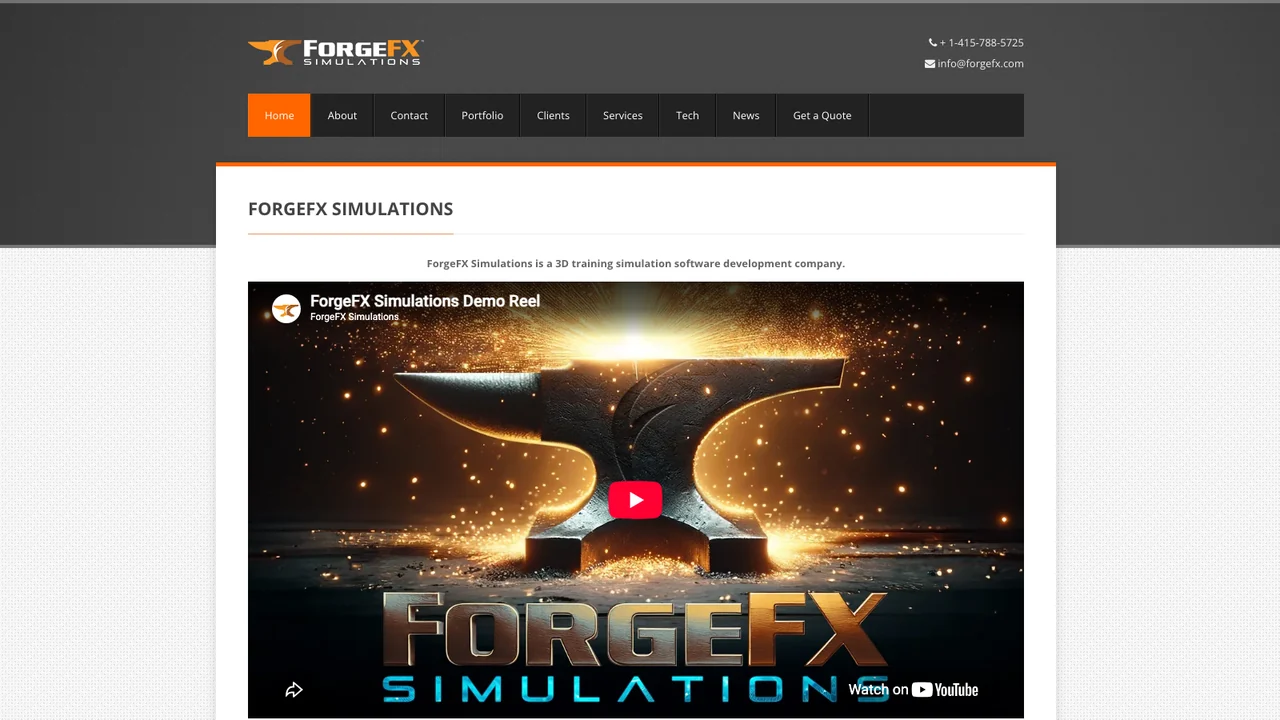
ForgeFX Simulations has built custom 3D training simulation software and custom virtual and augmented reality applications since 2002, from the San Francisco Bay Area. More than two decades of continuous custom work is the longest such record in this list, and in a market where studios routinely appear and disappear inside a single training program's life, that longevity is itself a procurement consideration.
Its named clients carry unusual weight for custom work: Komatsu, Caterpillar, Vermeer Corporation, JLG Industries, Joy Global and Pierce Manufacturing are equipment manufacturers, and a simulation commissioned by the company that builds the machine has been validated against the real thing. Its wider list includes StrataTech Education Group, MRIGlobal, General Electric Healthcare, Pearson Education, Adobe, Farmers Insurance, Zoetis, SAK Construction, WMATA and Global Ground Support.
Its published projects show the range a custom studio needs: a horizontal directional drill simulator, OcuWeld for welding, an aircraft deicing simulator, HazOps training for hazard and operability study work, CyberLab, Virtual Walking the Pens and a heavy rail operator training simulator. That spread across drilling, welding, aviation ground operations, process safety and rail is the practical evidence of custom capability, because each required learning an unfamiliar domain well enough to model it correctly.
Published device targets span VR headsets and stereoscopic 3D displays, augmented reality spatial computing devices and traditional desktop platforms. Desktop matters in custom work more than it appears: a bespoke build that only runs on headsets reaches only the people issued headsets, and most organizations issue far fewer than they train. Its stated industries include heavy equipment, welding, aviation, healthcare, construction, insurance, transit, agriculture and CBRN detection. Team size, headquarters address, rates and ownership terms are not published, so IP is a term to settle explicitly. Best for equipment and process simulation where fidelity must satisfy an external standard.
3. Motive.io
Motive.io is an authoring platform rather than a development studio, and stating that plainly matters most on a custom list, because it is the entry that answers the custom question differently from the other four. Rather than building a simulation for you, it equips your own team to build.
The economics of that choice are worth spelling out. A commissioned build has a fixed cost per simulation, and an organization needing twenty of them pays roughly twenty times. An authoring platform has a license cost plus internal effort, so the first simulation is expensive in learning time and the twentieth is comparatively cheap. Organizations that discover this in year three, having commissioned each module separately, tend to wish they had understood it in year one.
The trade-off is equally real. Authoring platforms constrain what can be built to what the tool supports, and a simulation requiring unusual physics, a bespoke interaction or integration with a proprietary control system will exceed those limits. They also require someone internally to own the work, which is a staffing commitment rather than a procurement one, and the platform is worthless if that person leaves and is not replaced.
For a buyer evaluating custom against platform, the honest test is volume and repeatability. One high-fidelity simulation of a critical procedure is a development project. Twenty variations on a scenario across sites and roles is a content operation, and content operations want tools rather than contracts. Motive.io publishes no founding year, headquarters address, team size, named clients or rates on the pages reviewed, so capability limits and support arrangements need establishing directly, ideally by building a real scenario during evaluation rather than watching one demonstrated. Best for organizations that will build repeatedly and can staff it.
4. Think Digital
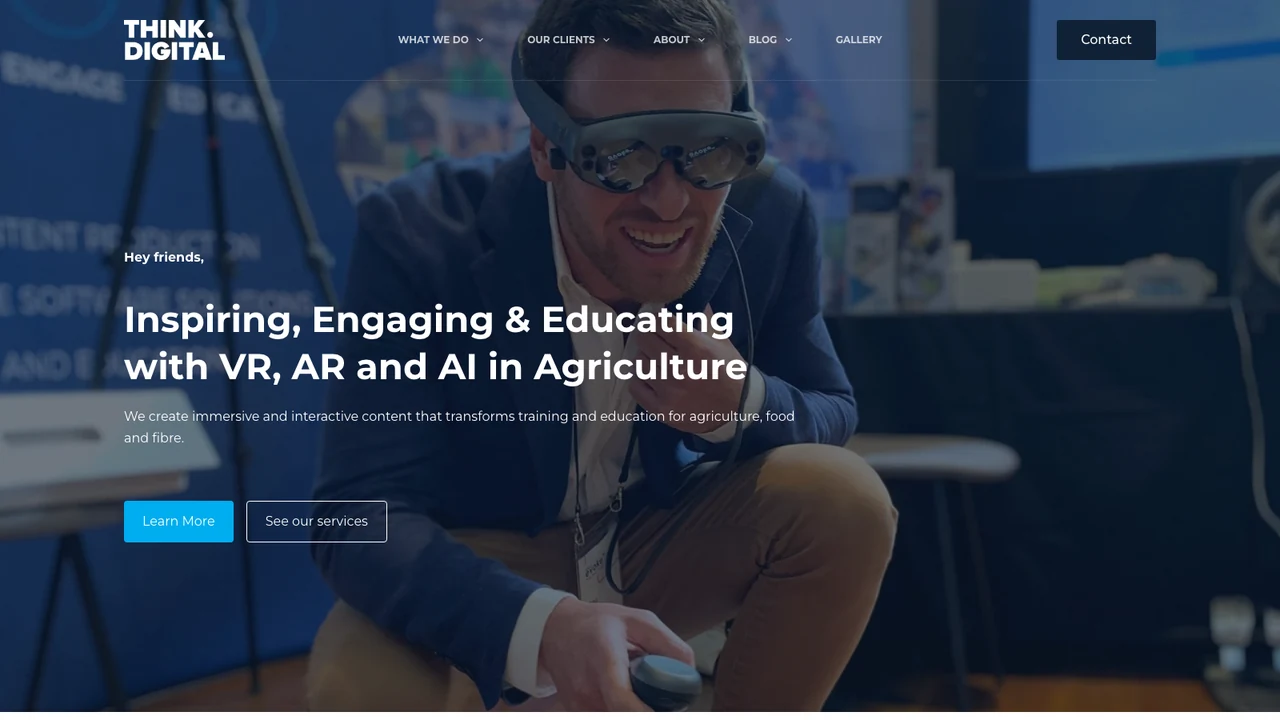
Think Digital is an Australian immersive studio producing virtual reality, augmented reality and 360 degree video, with a stated focus on agriculture, food production, education and events. Its published services include custom VR and AR applications, virtual tours, and VR workshops and training.
It takes custom commissions, but the reason it appears on this list is what it does after the build. Think Digital operates the Think Digital Coach, a 14 metre mobile classroom fitted with 20 VR headsets, and runs sessions physically as well as producing software. Custom development that ends at handover leaves the buyer holding the harder half of the problem, which is getting charged, updated, supervised hardware in front of the right people, and a supplier that runs the sessions has removed it.
That model suits a specific and common shape of program: a dispersed audience, no existing device estate, and no internal team to run one. Regional operations, seasonal workforces, community programs and industries whose workers are not desk-based all fit, and all are poorly served by a commissioned application delivered as a file.
Its clearest published project is a red meat education program built with Meat and Livestock Australia and the Australian Research and Development Corporations, which the company states has been experienced by more than 50,000 people since the campaign launched in 2017, delivered across schools and communities in six Australian states and territories. That is a genuine reach figure for a custom-built program, and reach is what most custom training builds fail to achieve.
The studio works from Adelaide, South Australia and was started by founder Tim Gentle and chief executive Kat Bidstrup. Nine team members are listed, making capacity a fair question for a large program, and the mobile delivery model is geographically bounded in practice. No founding year, rates or ownership terms are published. Best for custom programs whose difficulty is reaching the audience rather than building the content.
5. Mesmerise
Mesmerise requires a correction before anything else. The domain mesmerise.com is a parked page listed for sale through a broker and is not the company. The business operates as Mesmerise Global Limited from London at mesmerisegroup.com, with co-founder and chief executive Daglar Cizmeci, co-founder Andrew Hawken and directors Wilson Cook and Dan Connell.
What it publishes today is a holding group rather than a development studio. Its site carries three sections, Home, Team and Latest, with no services page, no portfolio and no case studies. It describes itself as a trusted guide for enterprises looking to unlock the potential of immersive technologies and manage the opportunities of artificial intelligence, and states that it has partnered with Fortune Global 500 companies to deliver brand experiences, training programs and digital events, without naming them. The one named client reference on the pages reviewed appears in a quote from Andrew Hawken about work with TD.
Its substantial recent activity is corporate rather than client work. On 13 January 2025 it announced neuRealities, Inc., a company it founded in collaboration with Mayo Clinic, built on Mesmerise's immersive technology and AI work and Mayo Clinic's clinical expertise, delivering hyper-realistic AI-powered digital human avatars, scalable immersive training experiences and an open-standards platform for healthcare education. For a healthcare education buyer that is a serious and specific proposition, and the Mayo Clinic relationship is a strong signal.
For a buyer seeking custom VR training development generally, the position is different and should be stated plainly. There is no published services page, no portfolio to assess, no founding year, no team size, and the most recent published news is dated January 2025, which is over eighteen months old at the time of writing. None of that means the company cannot take work, but it means an evaluation cannot be done from published material and has to start by establishing what the group currently offers and whether the relevant capability now sits inside neuRealities. It ranks fifth here for that reason rather than on capability. Best approached as a healthcare education conversation, via neuRealities, rather than as a general custom studio.
What custom VR training engagements have to account for
Four things decide whether a commissioned build repays what it cost.
The first is whether it needed to be custom. Test the assumption honestly against a catalog before committing, because the licensing option is cheaper and faster and sometimes wins. If the answer is that generic content teaches a facility nobody works in, or cannot satisfy an external standard, the custom case is real. If the answer is that the catalog version looked a bit generic, it usually is not.
The second is ownership, and it is the term that determines total cost more than the day rate. Establish who holds source code, project files, 3D assets and third-party licenses at handover, and what documentation comes with them. Treeview publishes full transfer. The other four do not publish ownership terms, which makes it a negotiation rather than a given.
The third is the revision path. Ask what a change costs in year two, how long it takes, and whether anyone other than the original studio can make it. A custom build with no revision path is a depreciating asset with a hard expiry, and the expiry usually arrives when a headset generation is retired rather than when the content becomes wrong.
The fourth is delivery. A commissioned application is not a training program until it reaches people, and the gap between the two is charging, hygiene, updates, device management, scheduling and supervision. Decide who owns that before the build starts. Think Digital is the only supplier here that takes it on.
How to choose between these custom VR training companies
Decide first whether you are buying one thing or building a capability. One high-fidelity simulation of a critical procedure is a development project, and Treeview and ForgeFX are the studios. Twenty variations across sites and roles is a content operation, and Motive.io's authoring model fits it better than twenty separate contracts would.
Then match evidence to your fidelity requirement. If the simulation must behave like a specific machine, ForgeFX has built for the companies that make machines. If it must match your own facility and integrate with your systems, Treeview publishes discovery, integration and full ownership transfer. If the harder problem is reaching a dispersed workforce, Think Digital arrives with the headsets. If your requirement is healthcare education specifically, the Mesmerise conversation is really a neuRealities conversation.
Settle ownership and the revision path in the specification rather than the contract review. Both are cheap to agree before a supplier is selected and expensive afterwards, and together they determine what this costs over five years rather than three months.
Finally, define what will be measured before the build begins. A custom simulation is commissioned to change something, time to competence, error rate, incident frequency, throughput. Name the measure, take the baseline first, and make sure results reach the system where your competency records actually live.
Related reading. BestInXR's enterprise training guide covers buying, building and sustaining VR training. VR companies for manufacturing and equipment operation training covers the equipment case, and VR companies for workforce and vocational training covers catalogs as the alternative to building. For safety see companies for VR hazardous environment and safety training, and for procurement, selecting XR developers for enterprise deployment.
Frequently Asked Questions (FAQ)
1. When is custom VR training worth it over licensing a catalog?
When the procedure belongs to your site, when the training must satisfy an external standard a generic module cannot demonstrate, or when it has to integrate with systems you already run. For generic subjects such as manual handling or hazard awareness, a catalog is cheaper and faster and usually the right answer.
2. Who owns a custom VR training build?
Whatever the contract says, and it is frequently less than buyers assume. Treeview publishes full transfer of IP, source code and assets to the client. ForgeFX, Motive.io, Think Digital and Mesmerise do not publish ownership terms on the pages reviewed. Without source code, every future change goes back to the original supplier.
3. Is an authoring platform cheaper than commissioning?
It depends on volume. Commissioning has a fixed cost per simulation, so twenty modules cost roughly twenty times one. A platform such as Motive.io has a license cost plus internal effort, making the first module expensive and the twentieth cheap. It also requires someone in house to own the work permanently.
4. Which of these name clients?
ForgeFX names Komatsu, Caterpillar, Vermeer, JLG, Joy Global and Pierce Manufacturing. Treeview names Microsoft, Meta, Medtronic, Toyota, Ford and Transfr. Think Digital names Meat and Livestock Australia. Mesmerise names TD in a quote and refers to unnamed Fortune Global 500 partners. Motive.io names none on the pages reviewed.
5. What happens to a custom build when headsets change generation?
It has to be ported, which is a development task. Whether that is a change request or a re-tender depends entirely on whether you hold the source code. This is the most common way custom training programs end, and it is foreseeable at the point of commissioning rather than a surprise.
6. What does custom VR training development cost?
None of the five publishes rates, so no figure is recorded here. Cost is driven by scenario count and complexity, fidelity required, integration with existing systems, device coverage, and whether delivery and hardware are included. Revision in year two and porting at the next headset generation are the lines most often missing from a first budget.