Best VR Companies for Construction Safety Training
On a construction site most of the people exposed to your hazards do not work for you. A safety program that reaches employees and stops at the subcontractor gate leaves the actual risk untouched, which is why reach matters more here than in any other training category. The second thing to settle is which half of the category you are buying, because hazard training and equipment operator training are different products with different hardware.
In short:
- Reach decides the outcome. The workforce changes by the week and most of it is contracted. Pixaera onboards contractors through self-serve access links rather than assuming everyone is in your LMS.
- Two products, one budget. Hazard and behavior training runs on a headset or a phone. Operator training runs on a motion platform with real controls and needs a room.
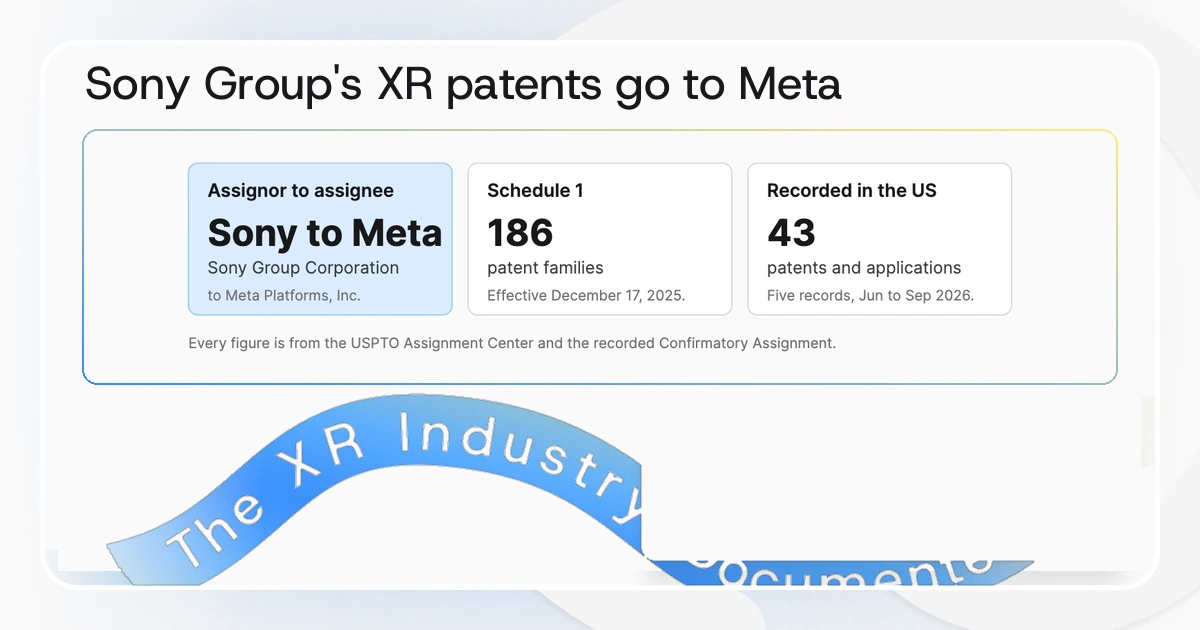
- A widely listed supplier changed its name. seriouslabs.com now redirects to industrialsims.com, trading as Serious Industrial Motion Simulators, one of three renames in BestInXR's XR ownership map.
- Ask what the training leads to. SIMS publishes IPAF PAL card renewals. Most hazard awareness content leads to a completion record and nothing more.
How this list was built
VR construction safety training is immersive software that puts a worker inside a hazardous situation and requires a decision, then records what they did. It divides cleanly into two products. Hazard, behavior and life-saving-rules training runs on headsets, phones and browsers and is bought for the whole site population. Equipment operator training runs on motion-based simulators with real controls and is bought per seat of hardware.

This list ranks four suppliers on four criteria: which half of the category the supplier actually serves, whether the product reaches subcontractors and how, what the training leads to at the end and what the buyer owns or integrates. Course counts are reported and are not a ranking factor, because a catalog nobody outside your payroll can open does not reduce site risk.
| Company | Half of the category | Reaches contractors | Best for |
|---|---|---|---|
| Pixaera | Hazard, behavior, life-saving rules | Self-serve access links | One safety standard across a contractor chain |
| Treeview | Whatever is commissioned | However it is specified | Site-specific hazards no catalog models |
| CM Labs | Equipment operation | No, it is hardware-bound | Operator training programs at a training center |
| SIMS | Equipment operation | No, it is hardware-bound | Lift and crane operators who need a card |
1. Pixaera
Pixaera is ranked first because it is built around the problem that actually defines construction safety, which is that your workforce is not yours.
Its construction page states the case more bluntly than a vendor usually does: every project runs on a complex chain of contractors, across different sites, in different languages, under rules the client often sets, and inductions get clicked through and forgotten. The product answers that with self-serve access links for onboarding contractors, LMS integration for the people who are already in your system and classroom sessions with recorded attendance for crews who train together on site. Multi-language delivery is treated as a core feature rather than an add-on, which on a real site is the difference between a standard and a document.

The content is organized around life-saving rules and the incident types that actually kill people, which the company frames around serious injuries and fatalities. Its published construction programs include Working at Heights, Line of Fire, Excavation, Dropped Objects, Confined Space, Safe Mechanical Lifting, Hot Work, Live Electrical, Start Work Checks, Slips Trips and Falls, Fire and Explosion, Driving Safety and Hazard Spotting. It also turns incident reports into lessons, which is the one mechanism in this category that connects training content to what has already gone wrong on your own projects.
Its customer stories name BP, Shell and PCL, and the construction page carries a client logo bar including bp, Chevron, ConocoPhillips, Fluor, GE, PCL, Shell and SLB. Fluor and PCL are large contractors, which is the relevant signal here: this is being bought by the organizations that run the sites rather than only by the owners who commission them. The gap to close before buying is certification: nothing here leads to an operator card, and it is not meant to. Best for a contractor or owner that needs one safety standard to hold across every subcontractor, site and language.
2. Treeview
Treeview is the option when the hazard is specific to your site and no catalog contains it.
Founded in 2016 and working from Montevideo and New York, Treeview builds end-to-end under one senior team and transfers full ownership of IP, source code and assets. Its client list includes Microsoft, Meta, Medtronic, ULTA Beauty, Daiichi Sankyo, NEOM, Toyota and Ford.

Catalog safety content teaches a generic excavation, a representative scaffold and a typical confined space. That is the right purchase for the rules that apply everywhere. It is the wrong one for the hazard that is unique to a particular project: a specific lift plan over a live roadway, a plant layout with one bad sightline, a client's own permit system or a method statement written for one structure. Those are usually the situations where an incident is actually likely, and they are precisely what a catalog cannot cover.
What Treeview publishes that bears on the argument is the ability to model real sites and deliver to people who are not all wearing headsets. The AI-enabled digital twin it built with Microsoft for a green hydrogen project models a real plant and runs on HoloLens 2, mobile and WebGL. Ownership matters more than usual here because safety content is revised after every incident and every method change, and the party holding the source decides whether that is an edit or a change order. BestInXR's workplace safety training list and its hazardous environment list cover the general-industry equivalents. Best for project-specific hazards, client permit systems and method statements that no catalog models.
3. CM Labs
CM Labs is the established name in construction equipment simulation and the most complete offer on the operator side. Working from Montreal, it develops Vortex Studio, the real-time simulation platform underneath its own products, and sells simulators alongside curriculum and a training management system it calls Intellia.
That packaging is the reason to shortlist it rather than a simulator alone. An operator training program is a curriculum, a record of who trained and an assessment, and a machine in a room is only the first of those. CM Labs sells the three together, which suits a training center, a union program or a contractor running structured operator development across locations.
It publishes outcome figures of 50% lower training costs, 2.5 times faster operator training and 40% fewer safety incidents. Those are company-published claims rather than audited results and should be treated that way. A quoted customer, Doug Dalton of Baker Technical Institute, puts the same figure in his own words, saying the learning rate is about 2.5 times faster on simulators than sitting in the actual machine. Ask for the study behind the numbers rather than the numbers.
The trade-off is structural and applies to this half of the category generally. Simulators are hardware. They cost floor space, they do not travel to a subcontractor and they train the operator rather than the hundred other people on site. Best for organizations running a real operator training program with somewhere to put the equipment.
4. SIMS
SIMS is the specialist in the lifting equipment that causes a disproportionate share of construction fatalities, and it is the supplier here whose training most clearly leads to a credential.
Start with the name, because an older shortlist will have the wrong one. seriouslabs.com now redirects to industrialsims.com, and the company presents itself as Serious Industrial Motion Simulators. What became of the former branding is not documented on the pages served and this post does not guess. The products are motion-based VR simulators for mobile elevating work platforms, forklifts and cranes, combining motion, VR environments and real equipment controls.
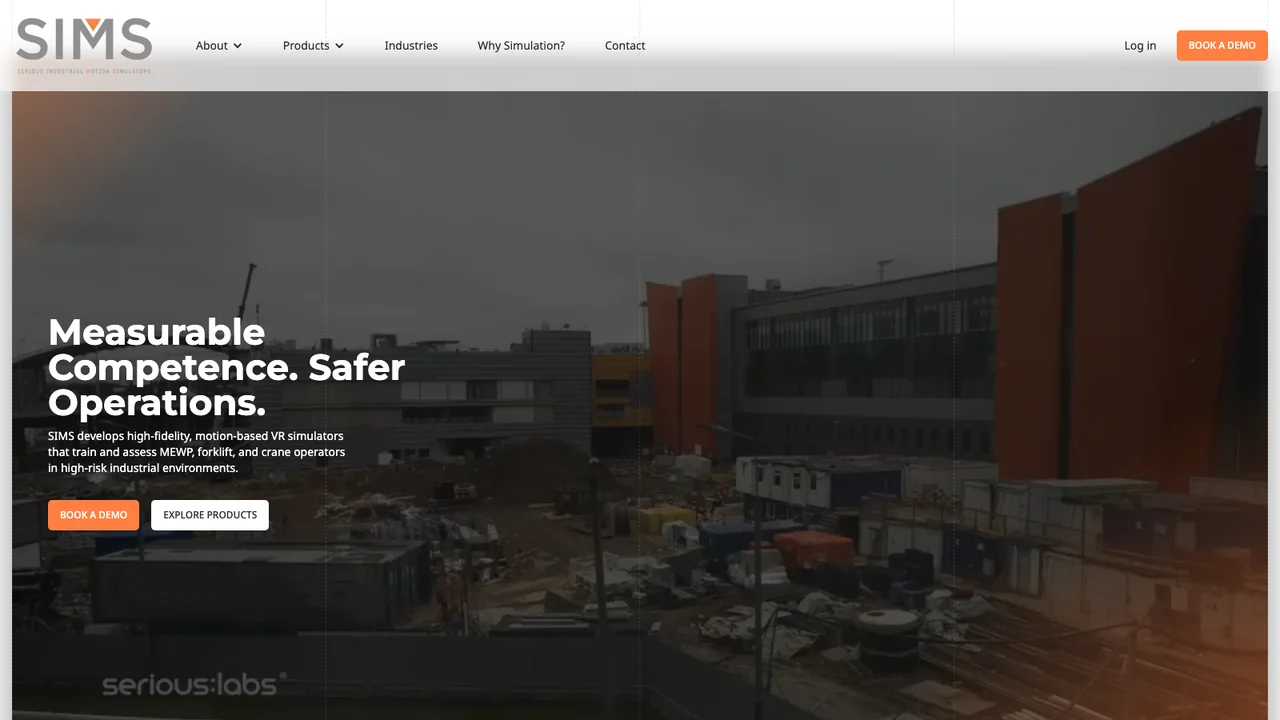
The credential link is what separates it. The company states that approved training providers can deliver structured testing and certification using the simulator, and names IPAF PAL card renewals, IPAF PAL+ advanced licenses and Energy Safety Canada Certificates of Recognition among supported programs. It also claims 97% predictivity of real-world operator performance, which is a company-published figure and the kind of claim worth asking to see the methodology for, since certifying someone on a simulator rests on it.
Supported equipment on the MEWP simulator covers boom lifts, slab scissor lifts and rough-terrain scissor lifts, and the company names aviation maintenance, construction, logistics and heavy industry as its environments. Best for lift and crane operators where the outcome has to be a card rather than a completion.
Who else was considered, and where each fits
General enterprise VR training platforms that list construction among many verticals are excluded. Construction safety is governed by rules the client often sets and by hazards specific to a site, and a platform treating it as one industry among twenty rarely publishes which rules its content maps to.
Multi-trade skills catalogs are excluded because they answer a different question. Teaching someone to install a system competently is not the same as teaching them to recognize the hazard that kills them, even though both get called training. BestInXR's skilled trades and HVAC list covers that side, including suppliers whose construction coverage overlaps this one.
Site scanning and reality capture tools are excluded despite frequently appearing in the same articles. Capturing a site as a model is not safety training, and a walkthrough with no decision, no assessment and no record is a visualization.
How to choose between these construction safety training companies
Start by counting who you actually need to reach. If the number includes subcontractors, and on most projects it is mostly subcontractors, then delivery is the deciding feature and Pixaera is built around getting training to people who will never appear in your LMS.
If the requirement is an operator card, that is the hardware half of the category, and SIMS is the supplier here that publishes the certification programs its simulator supports.
If the requirement is a full operator development program with curriculum, assessment and records rather than a machine, CM Labs sells the three as one system.
If the hazard is specific to one project, one client's permit system or one method statement, no catalog will contain it, and Treeview is the supplier here that publishes what you own at the end.
Then ask all of them the question that decides whether any of this survives contact with a site. What does the record look like when your client, your insurer or a regulator asks who was trained, on what, in which language and when. A training product that cannot produce that export is an experience rather than a control. BestInXR's enterprise training guide sets out the license against build decision in general terms.
Frequently Asked Questions (FAQ)
1. What is VR construction safety training?
It is immersive software that places a worker inside a hazardous situation, requires a decision and records the outcome. It covers hazard recognition and behavior on headsets, phones or browsers, and equipment operation on motion-based simulators with real controls.
2. Which companies offer VR construction training?
Pixaera covers hazard, behavior and life-saving-rules training with contractor access. CM Labs and SIMS build heavy equipment operator simulators, with SIMS focused on lifts, forklifts and cranes. Treeview builds commissioned training for site-specific hazards.
3. Does VR safety training count toward certification?
Sometimes, and only on the equipment side. SIMS publishes support for IPAF PAL card renewals and PAL+ licenses through approved training providers. Hazard awareness content generally produces a completion record rather than a certification, which is not a defect as long as you know which you are buying.
4. How do you train subcontractors outside your LMS?
Through delivery designed for it. Pixaera publishes self-serve access links for contractor onboarding alongside LMS integration and classroom sessions with recorded attendance. Ask any supplier to demonstrate a worker with no account completing training and appearing in the report.
5. Is a VR headset required for construction safety training?
Not for the hazard and behavior half, which commonly runs on phones and browsers as well as headsets, and that reach is the point on a site with rotating crews. Equipment operator training is different and generally requires a motion platform with real controls.