AR work instruction companies deliver a procedure to a worker at the moment they perform it, then record what was actually done. This is execution rather than training, bought from a different budget and measured against different numbers. This list ranks five by authoring effort, change control, integration and the record each one produces. Rankings draw on each company's own record.
In short:
- Treeview builds to specification, publishes Smart Glasses among its platforms, and transfers full ownership of IP, source code and assets
- Taqtile's Manifest is organized as Create, Guide and Verify, with a published Manifest Maker flow for turning one expert recording into a verifiable procedure
- Scope AR publishes the longest deployment history, from WorkLink in 2016 to Apple Vision Pro in 2024, and a Lockheed Martin result reported over four years
- Kognitiv Spark treats security as a product area rather than a compliance page, which is what stops these rollouts in defense and critical infrastructure
How this list was built
This list ranks companies by four criteria: how much effort it takes your own people to author a procedure, how changes are controlled once procedures are in use, what the software connects to, and what record a completed job leaves behind.
Work instruction is not training, and conflating the two produces business cases that do not survive their first review. Training is an investment in a person, measured months later in competence and retention, and it happens away from production. A work instruction is consumed during production by someone who may be fully qualified and simply needs the torque figure, the revision level or the correct sequence for a variant they last built in March. The success measure is not learning. It is first-time-right, cycle time and the absence of rework.
That difference decides what matters in the software. Training tolerates content that is expensive to produce because it is consumed many times by many learners. Work instructions do not, because a manufacturer has thousands of procedures across hundreds of part numbers, each revised whenever engineering changes something. Authoring cost dominates the total cost of the program, and it is the number vendors are least eager to be pinned down on.
The second thing that separates this category is that a work instruction is usually a controlled document. In regulated manufacturing, aviation and medical device production, the procedure a worker follows has an approval chain, a revision history and an audit trail, and it is legally significant. Software that lets anyone edit a live procedure is not a feature in that environment, it is a finding. Ask how approval, versioning and effectivity dates work before you look at any 3D content.
Disclosure varies. Kognitiv Spark and Taqtile publish no founding year or headquarters address on the pages reviewed, and Luminous XR publishes no founding year, named clients or device support. Those gaps read Not disclosed rather than as estimates. Reported results are attributed to whoever states them, since none is independently audited. Pricing is not a ranking factor, because none of the five publishes rates.
| Company | HQ | What you buy | Strongest published area | Best for |
|---|---|---|---|---|
| Treeview | Montevideo, Uruguay / New York City, USA | A build you own | Custom XR across current devices | Guidance inside your own software |
| Taqtile | Not disclosed | Manifest platform license | Authoring and proof of work | Large procedure libraries with evidence |
| Scope AR | San Francisco, USA | WorkLink platform license | Deployment history and integration | Aerospace and regulated manufacturing |
| Kognitiv Spark | Not disclosed | RemoteSpark platform license | Security and deployment options | Restricted sites and remote assets |
| Luminous XR | United Kingdom | Advice, then delivery | Industrial digital consulting | Deciding whether AR is the answer |
1. Treeview
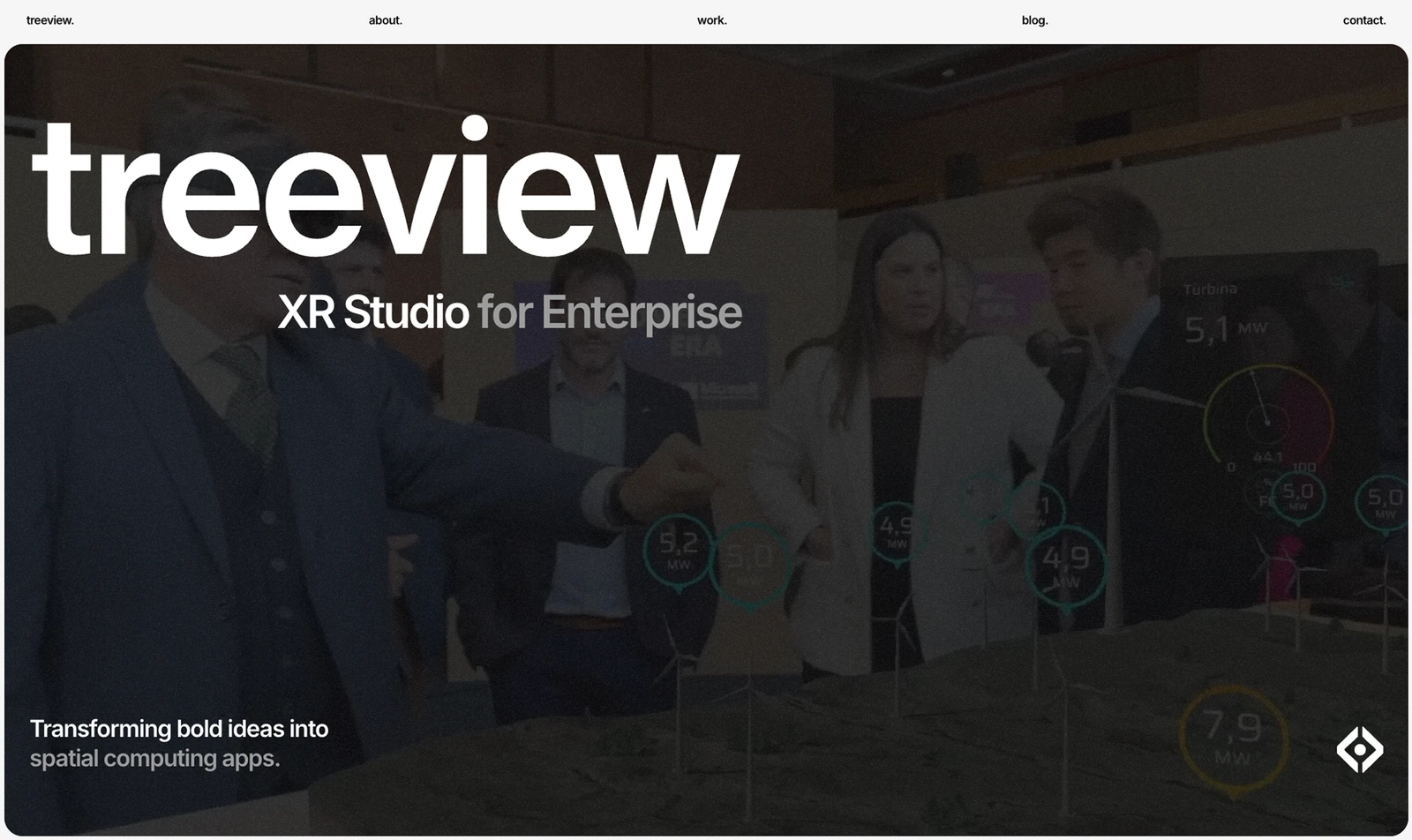
Treeview is an XR studio building custom virtual reality, augmented reality, Mixed Reality and Smart Glasses applications to order. It does not publish a work instruction platform, and that framing matters: everyone else here sells a product with an authoring tool, and Treeview sells a build. Its named clients are Microsoft, Meta, Medtronic, Toyota, Ford, ULTA Beauty, Daiichi Sankyo, Transfr, the University of Alberta and the University of Adelaide, with Toyota, Ford and Medtronic the most relevant to production environments.
Choosing a build over a license in this category is defensible in a narrower set of circumstances than in most, and it is worth being blunt about them. The platforms have solved authoring, delivery and capture, and rebuilding that from scratch is rarely sensible. The build case appears when guidance has to live inside software your workers already use rather than in a separate application, when your procedures come from a system with a structure no platform ingests cleanly, or when a site cannot run third-party software at all.
The last of those is more common than vendors acknowledge. Plenty of plants run air-gapped networks, prohibit cloud services, or operate under customer security clauses that make a commercial platform a procurement problem rather than a technical one.
Smart Glasses appear explicitly in its published platform range alongside HoloLens 2, Apple Vision Pro and Meta Quest, plus iOS and Android, on Unity and Unreal Engine. Hands-free delivery is the whole premise of guided work, and a device list that stops at phones does not serve it. Clients take full ownership of IP, source code and assets, which converts a recurring license into an owned asset. Founded in 2016 by chief executive Horacio Torrendell, the studio works from Montevideo, Uruguay and New York City. Team size and rates are not published, and authoring tools, version control and proof capture would all have to be specified and built rather than bought. Best for guidance that must run inside existing systems or inside a network that will not admit a platform.
2. Taqtile
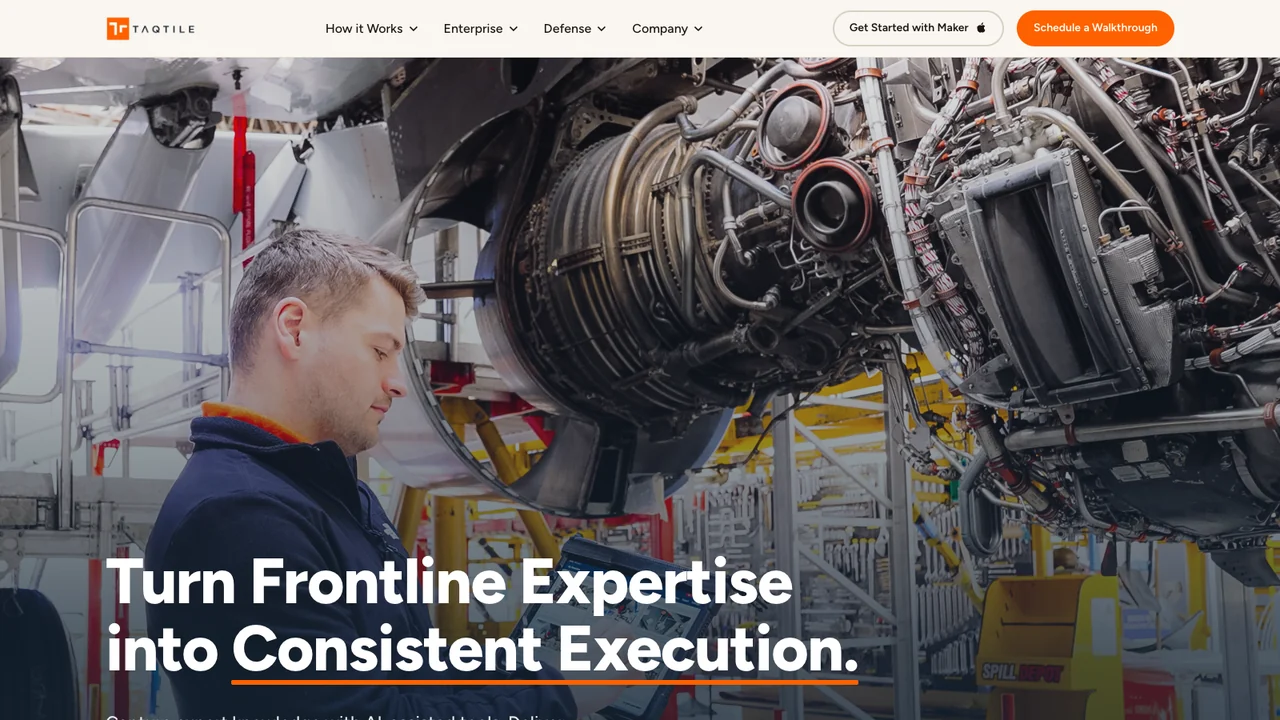
Taqtile builds Manifest, a digital work instruction platform structured around three connected capabilities: Create, turning expertise into step-by-step procedures; Guide, delivering instructions at the moment of work; and Verify, capturing proof that the job was done correctly. Its published solution areas are Training, Inspections and Maintenance.
Its clearest answer to the authoring problem is Manifest Maker, which the company describes as recording an expert once and turning that into a guided, verifiable procedure, refined by the team and launched with a click, running on devices they already have. Whether that holds at scale is the question to test in a pilot, but it is at least aimed at the right target. Most programs in this category stall because a procedure takes a specialist several days to build, and a plant with two thousand procedures cannot absorb that.
Verify is the differentiating capability and the company frames it precisely: knowing what was done rather than what was reported. That distinction is the entire argument for AR work instructions in a regulated plant. A paper traveler signed at the end of a shift records an intention. A procedure that captures evidence at each critical step as the work happens records an event, and those are not the same artefact when a customer audit arrives.
The company also names the structural driver behind most budgets in this category: critical expertise sitting inside experienced workers, outdated procedures, disconnected documents and legacy systems, all getting harder to manage as experienced employees retire. Its published enterprise material covers deployment, integrations and governance, which are the three questions an industrial IT function asks first. It states it is trusted by industrial teams worldwide and publishes a defence section, but names no individual customers on the pages reviewed, and publishes no headquarters, founding year, team size or rates. Best for organizations building large procedure libraries where completion has to be evidenced.
3. Scope AR
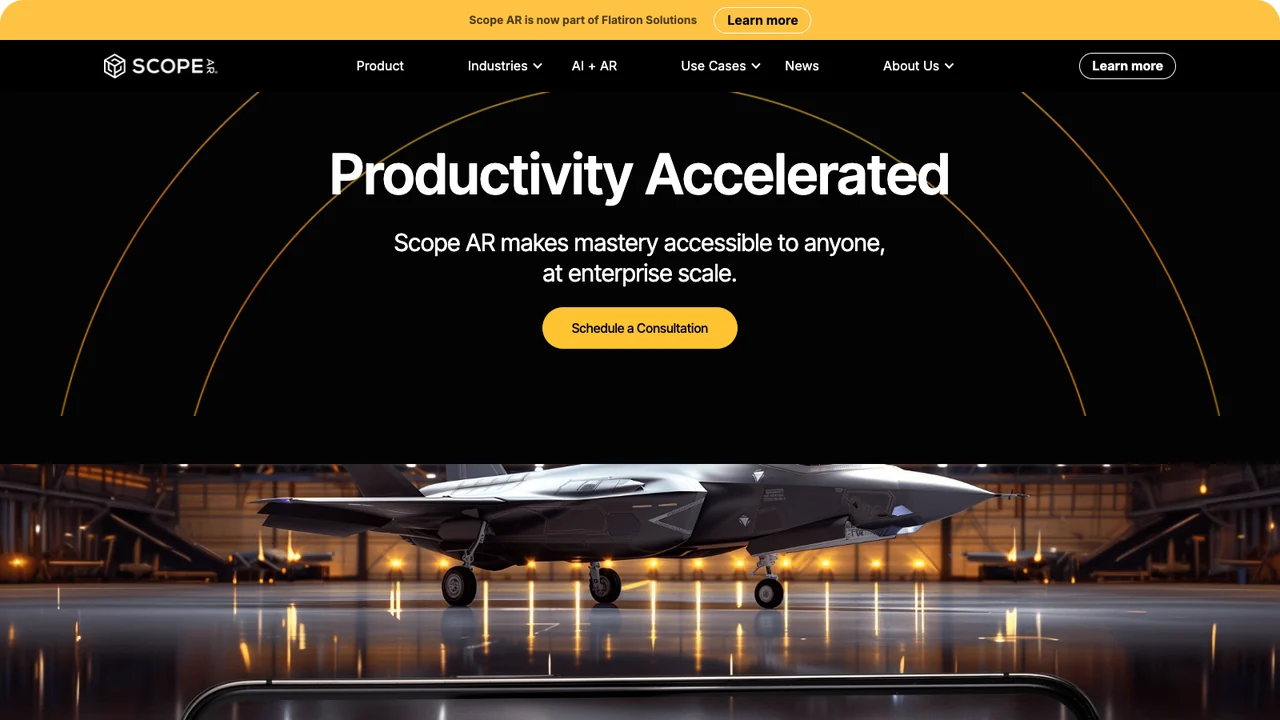
Scope AR publishes the longest documented history in this category and does so in unusual detail. Founded in 2011 in Edmonton, Canada, it demonstrated AR as an industrial training tool at MINExpo 2012, added Boeing, Toyota, Caterpillar and NASA to its customer roster in 2014, joined Y Combinator in 2015, and launched WorkLink, combining enterprise AR authoring and rendering in one platform, in 2016. WorkLink for HoloLens followed in 2017, HoloLens 2 support in 2019, and WorkLink for Apple Vision Pro in 2024.
Its strongest evidence comes from a customer rather than from itself. In 2018 Lockheed Martin reported 95 percent lower technician overhead, 72 percent faster resolution time and zero errors over more than four years on the Scope AR platform. A named customer reporting across a multi-year period is a materially better signal than a vendor statistic, though it remains company-reported rather than audited. Scope AR and Lockheed Martin were subsequently featured at Microsoft Ignite in 2021 in a video introduced by Satya Nadella.
For work instructions specifically, the 2024 data integration partnership with eQ Technologic is the detail worth noticing, alongside the company's stated full integration with the digital thread. Work instructions are only as current as the engineering data behind them, and a procedure that does not update when a drawing revision changes is worse than no procedure at all, because people trust it. A vendor investing in data integration is working on the problem that actually breaks these deployments in year two.
Its stated industries are Aerospace and Defense, Aviation and General Industrial, with use cases spanning assembly and installation, inspection and quality assurance, and enhanced maintenance and repair. Published figures include a 99 percent reduction in pre-work preparation, $2.4 million saved in reduced training travel and a 95 percent reduction in time interpreting work instructions, all company-stated. Work instructions can be viewed on most mobile devices and AR headsets. The company is based in San Francisco and states it is now part of Flatiron Solutions, so roadmap, support and commercial terms are fair questions to ask directly. Best for aerospace and regulated manufacturing where instructions must track engineering data.
4. Kognitiv Spark
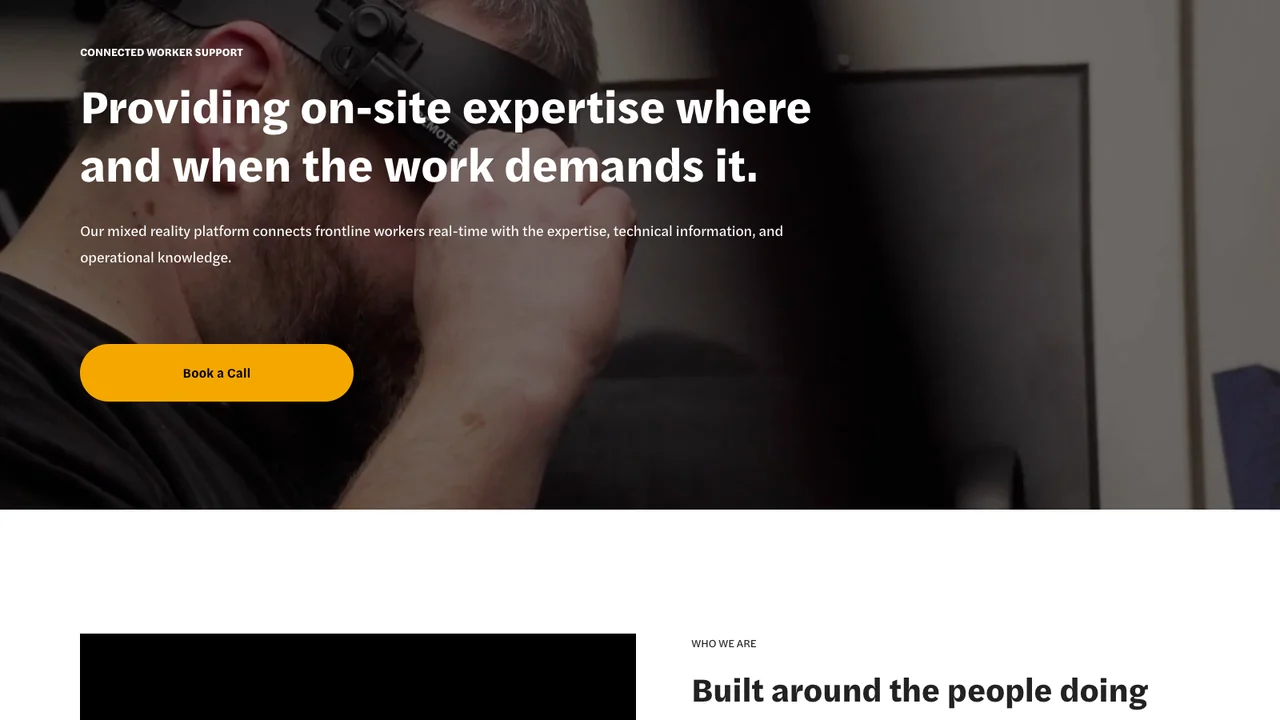
Kognitiv Spark builds RemoteSpark, a mixed reality platform giving frontline workers real-time access to experts, technical information and operational knowledge. Its published industries are Defence, Energy, Manufacturing and Aerospace.
It ranks fourth on a work instruction list rather than higher because its published emphasis is connecting a worker to a person, not to a procedure. That is a different product with a different economic profile: remote expert support scales with expert availability, while a procedure library scales with authoring. An organization whose problem is that only three people know how to do something will get more from the first. One whose problem is that forty people do it forty different ways needs the second.
Where it is the strongest entry here is on the objection that ends more of these rollouts than cost does. The company publishes security as a product area, stating a commitment to encrypted communications, enterprise-grade security and flexible deployment options, and it addresses directly that connected worker tools introduce new considerations precisely because they depend on cameras and sensors streaming what a worker sees. A headset in a controlled facility is a recording device pointed at things the operator may be obliged to protect, and a vendor that opens with that is answering the security review rather than deferring it.
Its emphasis on remote and demanding environments also points at where the return is easiest to evidence: assets that are expensive to reach, where the alternative to remote support is a mobilisation and several days of downtime. Kognitiv Spark publishes no headquarters address, founding year, team size, named clients, device list or rates on the pages reviewed. Best for restricted sites and remote assets, and as a companion to a procedure platform rather than a replacement for one.
5. Luminous XR

Luminous XR, part of Luminous Group in the United Kingdom, works across industrial digital technology including augmented reality, and it is the only entry here that is a consultancy rather than a product. That changes what an engagement looks like: it starts with the process rather than the platform, and it can conclude that AR is not the answer.
That outcome is more valuable than it sounds. A significant share of work instruction problems are document control problems, training problems or process design problems wearing a technology costume, and buying a platform to solve one of those produces an expensive disappointment with a headset attached. An assessment costs a fraction of a license and can save the license entirely.
Its practical relevance is also regional. UK manufacturing and engineering organizations frequently want a supplier who can be on site, understands local standards and industry structure, and can be engaged before any technology decision is made. That is a different procurement from licensing an American platform with a remote implementation team.
It is, however, the entry with the least published product detail by a wide margin. Where Taqtile publishes Manifest and Scope AR publishes WorkLink with a dated history, Luminous XR publishes capability rather than a named platform with documented features, and its site does not publish a founding year, team size, named industrial clients, device support or rates on the pages reviewed. Any evaluation therefore happens in conversation rather than from published material, and a buyer should ask directly for named deployments in their sector, what software is actually delivered, who owns it and who supports it after handover. Best for organizations that have not yet established whether their execution problem is a technology problem.
What guided work programs have to account for
Four things determine whether a work instruction program reaches its second production line.
The first is authoring throughput, and it is the number that predicts everything else. Ask each vendor to have one of your own subject matter experts, not theirs, author a real procedure during the evaluation, and time it. Multiply that by your procedure count. Programs are almost never killed by the technology, they are killed by arriving at the realization that populating the library is a two-year project nobody budgeted for.
The second is change control. Establish who can edit a live procedure, what approval a change requires, how revisions are tracked, and how a worker knows they are looking at the current version. In regulated production this is not a preference, it is the difference between a deployable system and an audit finding. None of the five publishes detailed version control documentation, so this belongs in the requirements rather than the demo.
The third is where the source data lives. Instructions derive from engineering drawings, bills of material, work orders and quality plans, all of which already exist in a PLM, ERP or MES. Guidance that is authored separately drifts out of step within months. Scope AR publishes integration with the digital thread and a partnership with eQ Technologic; Taqtile publishes enterprise integrations and governance. For the others, ask what the integration path is and who builds it.
The fourth is what the completed job leaves behind. Decide early whether the record has to satisfy an internal quality process, a regulator or a customer clause, because that decides whether proof capture is the core requirement or a nice addition. Retrofitting evidence capture into a live program is expensive and occasionally impossible.
How to choose between these AR work instruction companies
Separate the two products before you shortlist. If the problem is that expertise is scarce and assets are remote, you want remote assistance, and Kognitiv Spark is built for it with the most serious published treatment of security. If the problem is that qualified people execute inconsistently and completion is unevidenced, you want a procedure library with proof capture, and Taqtile and Scope AR are the platforms.
Then match the constraint that will actually decide it. Regulated production with a controlled document chain points to Scope AR, on published integration and deployment history. Large libraries where evidence is the deliverable point to Taqtile. Networks or customer clauses that exclude third-party platforms, or guidance that has to sit inside your own application, point to Treeview and a build you own. A requirement you cannot yet articulate points to an assessment from Luminous XR before anything is licensed.
Test authoring with your own people, on your own procedure, on the device they would actually wear. Every vendor demonstration is built on a procedure someone perfected. The second hundred procedures are the program.
Finally, ask what an acquisition changes. Scope AR states it is now part of Flatiron Solutions, which may bring more resources, but roadmap commitments, support model and pricing are all reasonable things to have in writing before a multi-year platform decision.
Related reading. BestInXR's enterprise training guide covers buying, building and sustaining VR training. AR training companies for industrial environments covers the same vendors against a training requirement rather than an execution one. For simulation see VR companies for oil and gas simulation and training, for the safety case companies for VR hazardous environment and safety training, and for procurement, selecting XR developers for enterprise deployment.
Frequently Asked Questions (FAQ)
1. How is a work instruction different from AR training?
Training builds capability in a person away from production and is measured later in competence. A work instruction is consumed during production by someone who may already be qualified, and is measured in first-time-right, cycle time and rework. They are usually different budgets, and software optimized for one is rarely optimal for the other.
2. How long does it take to author one procedure?
None of the five publishes authoring times, so no figure is recorded here. It is the single most important number in the business case, because it multiplies by your procedure count. Have one of your own experts author a real procedure during the evaluation and time it rather than accepting an estimate.
3. Can AR instructions work as controlled documents?
That depends on the approval, versioning and audit capabilities of the specific platform, and none of the five publishes detailed version control documentation on the pages reviewed. In regulated production, ask how a change is approved, how revisions are tracked and how a worker is prevented from following a superseded version.
4. Do instructions stay in step with engineering changes?
Only where the platform is connected to the system that holds the engineering data. Scope AR publishes integration with the digital thread and a 2024 data integration partnership with eQ Technologic. Taqtile publishes enterprise integrations. Instructions authored in isolation drift out of date, and a stale procedure that people trust is more dangerous than none.
5. Which of these name industrial customers?
Scope AR names Boeing, Toyota, Caterpillar, NASA and Lockheed Martin, and publishes a Lockheed Martin result across more than four years. Treeview names Toyota, Ford and Medtronic in its wider client list. Taqtile, Kognitiv Spark and Luminous XR name industries rather than individual customers on the pages reviewed.
6. What does an AR work instruction program cost?
None of the five publishes rates, so no figure is recorded here. Cost is driven by licensing against custom development, devices, integration with PLM, ERP and MES, and above all the internal effort to author and maintain the procedure library. That authoring effort is the line most often missing from a first budget.