Best VR Companies for Skilled Trades and HVAC Training
Skilled trades training is measured by credentials, not by completions. EPA 608 is legally required to handle refrigerants, OSHA 10 is a card a worker carries, NATE is an industry certification and IACET governs whether continuing education units count. A product that does not lead to one of those is enrichment, and enrichment does not survive a budget review.
In short:
- Ask what credential it leads to. Interplay Learning publishes IACET accreditation and preparation for EPA 608, OSHA 10 and NATE. Most suppliers publish neither.
- The buyer changes the shortlist. An employer upskilling technicians, a college feeding a pipeline and an EHS function proving compliance are three different purchases.
- Headsets are not always the answer. Much of this category ships as 3D simulation on a laptop, because a technician in a van has a phone and a tablet, not a headset.
- Trades content ages against code. Electrical and refrigerant rules change, so establish who updates the content and how often before signing.
How this list was built
Skilled trades training covers the practical competencies behind HVAC, electrical, plumbing, solar, facilities and industrial maintenance: diagnosing a system, following a procedure safely and working to code. Immersive delivery suits it because the equipment is expensive, the faults are hard to stage on demand and a mistake on a live system is dangerous.
This list ranks four suppliers on four criteria: what credential or certification the training leads to, who the product is actually sold to, how the content is delivered and kept current and what the buyer holds at the end. Learner counts are reported as company claims and are not a ranking factor, because a large number of completions says nothing about whether anyone passed an exam.
| Company | Primary buyer | Credential position | Best for |
|---|---|---|---|
| Interplay Learning | Employers and colleges | IACET accredited, EPA 608, OSHA 10, NATE prep | Trades upskilling that has to lead to a certification |
| Treeview | The commissioning organization | Whatever the organization requires | Equipment or procedures no catalog covers |
| Transfr | Schools and workforce boards | Career pathways rather than certification | Building a pipeline into the trades |
| Immersive Factory | EHS and safety functions | Safety behavior, LMS and SCORM delivery | Industrial safety training at site scale |
1. Interplay Learning
Interplay Learning is the only supplier here whose training plugs directly into the credentials the trades actually run on. It publishes CEUs and preparation for widely recognized certification exams including EPA 608, OSHA 10 and NATE, holds IACET accreditation and describes itself as an authorized NATE training academy.

That list is the reason to start here. EPA 608 certification is a legal requirement for anyone handling refrigerants in the United States, so an HVAC employer is not buying training in the abstract, it is buying a route to a card that lets a technician do the job at all. A supplier accredited by IACET can issue CEUs that count toward continuing education requirements. Neither of those is a marketing claim, and both can be checked before you buy.
Coverage runs across residential and commercial HVAC, plumbing, electrical, solar, multi-family maintenance, facilities maintenance, industrial maintenance, data centers, crane and rigging and safety. It publishes 14,000 or more companies and 500,000 or more learners, and names Lowe's, Carrier, Ruud, Daikin, Ferguson and the International Training Institute among customers. Those figures are company-published rather than audited, and its homepage claim to be the world leader in the category is its own wording rather than a verified position. The delivery point worth noting is that this is not headset-only: much of it is 3D simulation that runs on a laptop or tablet, which fits a workforce that is rarely in one room. Best for trades upskilling where the outcome has to be a certification rather than a completion.
2. Treeview
Treeview is the option when the equipment is yours and no catalog contains it. A catalog teaches a generic rooftop unit or a representative panel. It cannot teach the specific plant an employer actually operates, the proprietary equipment a manufacturer services or a procedure written for one site's configuration, and that is usually exactly where the expensive mistakes happen.
Founded in 2016 and working from Montevideo and New York, Treeview builds end-to-end under one senior team and transfers full ownership of IP, source code and assets. Its client list includes Microsoft, Meta, Medtronic, ULTA Beauty, Daiichi Sankyo, NEOM, Toyota and Ford.

Its published work is industrial rather than trades-specific, and it is the right shape for this argument. The AI-enabled digital twin it built with Microsoft for a green hydrogen project models a real site's plant and runs on HoloLens 2, mobile and WebGL. Modeling real equipment accurately, and delivering it to people who are not all wearing headsets, is the same problem a commissioned trades build has.
Ownership decides the running cost here more than in most categories, because trades content ages against code. Electrical and refrigerant regulations change, equipment lines are superseded, and an organization holding the source updates the content rather than commissioning a new project. BestInXR's enterprise training guide sets out that license against build decision in general terms. Best for proprietary equipment or site-specific procedures that no catalog models.
3. Transfr
Transfr is the VR-first supplier here and it is aimed at a different buyer: schools, community colleges and workforce boards building a pipeline into the trades rather than employers upskilling people already in them. It splits its offer into Transfr Trek for career exploration and Transfr Train for skills training.
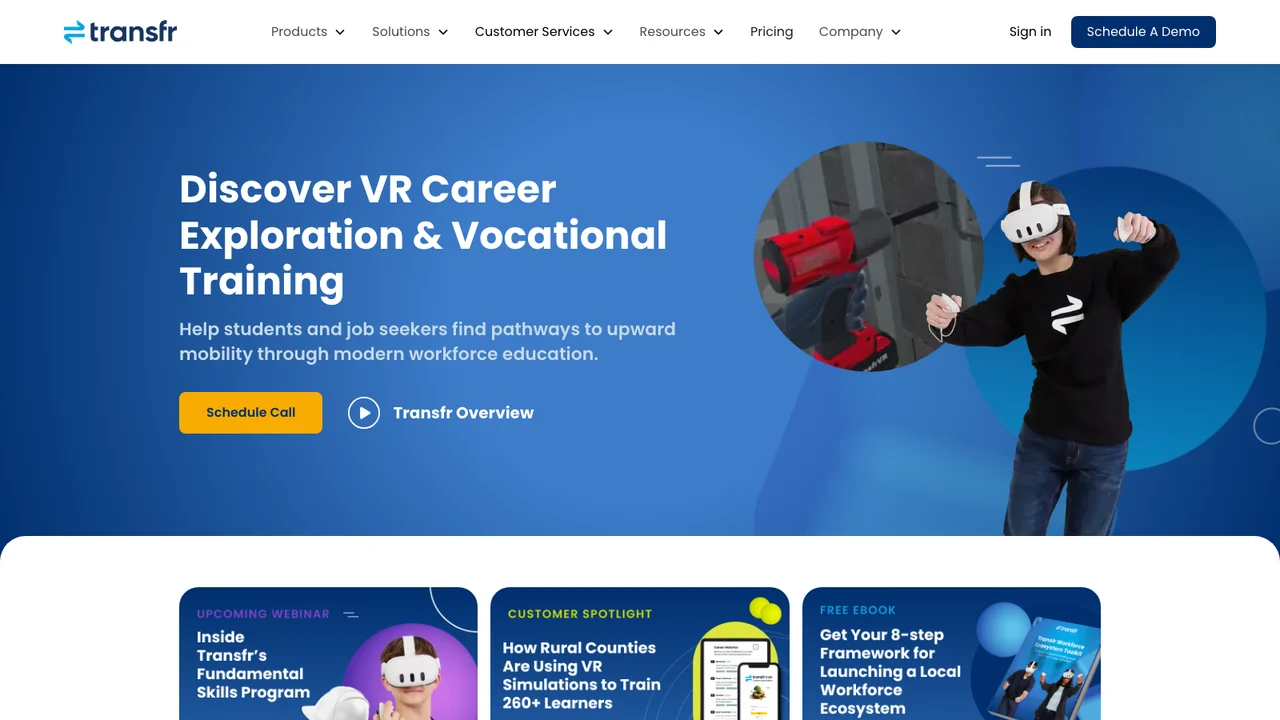
That split is the insight worth borrowing even if you buy elsewhere. A large part of the skilled trades shortage is that people do not consider the work, not that they try and fail, and career exploration is a different product from training. Transfr publishes more than 50 VR simulations for exploration and more than 330 across training, spanning automotive, construction, electrical construction, hospitality and tourism, aviation, diesel technology, health science and manufacturing.
Its published scale is 48 states, more than a million simulations experienced, more than 275,000 learners and more than 1,100 implementations, and it names secondary and post-secondary education, workforce boards, non-profits and justice-impacted populations as its audiences. It references efficacy studies on its site without detailing the metrics on the homepage, so ask for the study rather than the headline. The gap against Interplay for an employer is credential preparation, which Transfr does not foreground. Best for a school or workforce board building a pipeline, including people deciding whether the trades are for them.
4. Immersive Factory
Immersive Factory sits in the adjacent category that trades buyers usually also need, which is health, safety and environment training at industrial sites. It is included because the two budgets frequently meet, and because it solves a delivery problem the others do not.
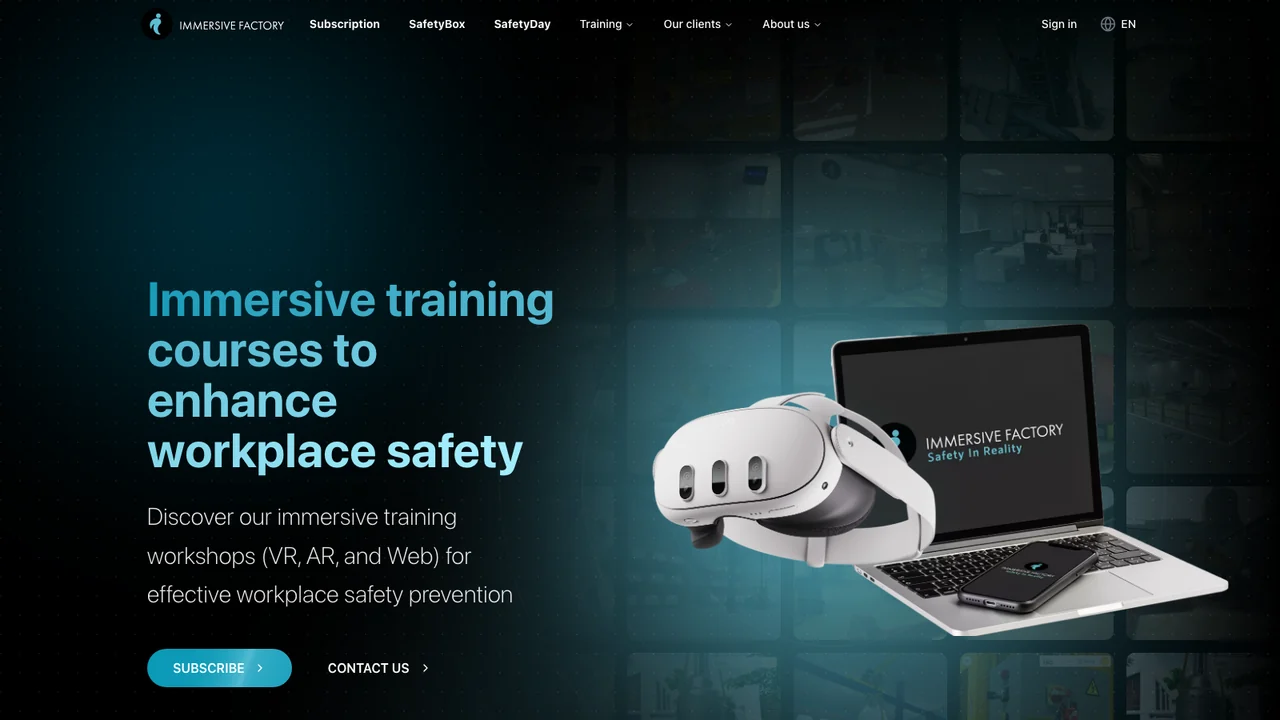
It ships the same content three ways: VR on a headset, AR on a mobile or tablet and web modules compatible with an LMS and SCORM. For a safety function that has to evidence completion for every worker on a site, SCORM output into an existing LMS is often the requirement that eliminates other suppliers, regardless of how good the headset experience is. Exercise formats include hazard spotting, risk hunts, challenges, quizzes and serious games, and it supports HTC Vive Focus 3, Meta Quest 3 and Pico Neo 4 Ultra.
It offers both a catalog and custom creations developed with large industrial companies, and names SUEZ, FM Logistique, Imerys, Orano, Spie, Colas, Saint-Gobain, EDF, Veolia, Coca-Cola and ArcelorMittal among clients, which is a notably European industrial base. No certification alignment is published on the homepage, which matters less for safety awareness than it would for a trade credential. Best for industrial safety training that has to report into an existing LMS.
Who else was considered, and where each fits
Equipment manufacturers' own training is excluded, and for an employer servicing one brand it is often the right answer. Carrier, Daikin and others run their own programs, and a dealer network usually has access to them already. They are not comparable to a multi-vendor platform and should be evaluated separately.
Union and trade association apprenticeship programs are the incumbent route into the trades and are excluded for the same reason: they are a pathway rather than a supplier, and immersive content usually sits inside them rather than replacing them. The International Training Institute appearing as an Interplay customer is an example of exactly that.
General enterprise VR training platforms that list the trades among many verticals are excluded. Trades training has to lead to a credential, and a platform treating it as one industry among twenty rarely publishes which.
How to choose between these skilled trades training companies
Start by naming the credential. If the outcome has to be EPA 608, OSHA 10 or NATE, that narrows the field immediately, and Interplay Learning is the supplier here that publishes the accreditation and the exam preparation to support it.
If the problem is upstream of training, that people are not entering the trades at all, that is career exploration, and Transfr is built for it and sells to the institutions that do it.
If the training has to cover your own plant, your own proprietary equipment or a procedure written for one site, no catalog will contain it, and Treeview is the supplier here that publishes what you own at the end.
If the requirement is site safety evidenced in an existing LMS, Immersive Factory ships SCORM alongside the headset experience, and that is usually the deciding feature.
Then ask the question that applies to all four. Trades content ages against code, so establish who updates it, how often, and what happens to your own edits when they do. BestInXR's workforce and vocational training list and its hazardous environment and safety training list cover the neighboring categories.
Frequently Asked Questions (FAQ)
1. What is VR skilled trades training?
It is immersive training for practical trade competencies such as HVAC, electrical, plumbing and facilities maintenance, delivered as headset VR or as 3D simulation on a laptop or tablet. It suits work where equipment is expensive, faults are hard to stage and mistakes are dangerous.
2. Can VR training lead to an HVAC certification?
Some suppliers prepare learners for certification exams rather than issuing the certification themselves. Interplay Learning publishes preparation for EPA 608, OSHA 10 and NATE and holds IACET accreditation for continuing education units. Ask any supplier which exam its content prepares for.
3. Does skilled trades VR training need a headset?
Often not. A significant share of this category ships as 3D simulation running on a laptop or tablet, which suits technicians who are rarely in one room. Headsets add value for spatial and procedural tasks rather than for every module.
4. Which companies offer VR HVAC training?
Interplay Learning covers residential and commercial HVAC alongside plumbing, electrical and solar, with certification preparation. Transfr covers trades through career exploration and vocational training for schools and workforce boards. Treeview builds commissioned training for proprietary equipment.
5. How does trades training stay current with code?
That is a contractual question rather than a technical one. Electrical and refrigerant rules change, so establish who is responsible for updating content, how often updates ship and what happens to any customizations you have made when they do.