

Meta announced a headset, its first camera-free glasses, a third generation of Ray-Ban Meta, five new Meta Glasses options, six new countries and an FDA-cleared hearing feature on September 23, 2026. One number frames the rest: the cheapest thing announced is $249 and the most expensive is $1,299.99, and only one of them is more than eighteen months old as an idea.
In short:
- The headset: Meta VR Glasses, about 100 grams, a tethered pocket puck, $1,299.99, Spring 2027.
- The glasses: Ray-Ban Meta Audio with no camera at $349, Ray-Ban Meta (Gen 3) at $449, and Meta Glasses from $249.
- The display line: Meta Ray-Ban Display reaches five new countries and goes on sale online for the first time.
- The one nobody expected: hearing enhancement, which Meta describes as an FDA-cleared software feature, $149.99 or included with a Meta One subscription.
- The pattern: Meta now sells a pair with no camera, a pair with a camera, a pair with a display and a headset. The lineup is a taxonomy, not a ladder.

Everything announced, with the published price
Read from Meta's own store on September 24, 2026, US figures.
| Product | Price | Availability | What it has |
|---|---|---|---|
| Meta Adventurer | From $249 | Pre-order, on sale October 23 | Camera, no display, plug-in case |
| Meta Capri, Meta Nova | From $299 | New shapes | Camera, no display |
| Meta Fury | From $299 | Meta Lab stores only | Camera, no display, limited edition |
| Ray-Ban Meta Audio (Clubmaster, Burbank) | From $349 | Pre-order, ships October 13 | No camera, no display, 12 hours |
| Meta Glasses LISA and Kylie editions | From $399 | New collections | Camera, no display |
| Ray-Ban Meta (Gen 3) | From $449 | On sale now | Camera, no display, 9 hours |
| Meta Ray-Ban Display | From $799 | Online ordering opens, 5 new markets | Camera, in-lens display, Neural Band |
| Meta VR Glasses | $1,299.99 | Spring 2027 | Full headset, tethered puck |
Two older lines carry on unchanged in the same store: Ray-Ban Meta (Gen 2) at $379 and its Optics models at $499, Gen 1 marked down to $224 from $299, and Oakley Meta HSTN at $399 and Vanguard at $499.

The glasses line now splits three ways
The most consequential thing Meta did yesterday was stop selling one kind of glasses. As of September 23 the line divides on two independent questions: does it have a camera, and does it have a display.
Ray-Ban Meta Audio answers no to both. Meta's product page states plainly that it is "built without a camera," and the camera rows of Meta's own comparison table are empty. Ray-Ban Meta (Gen 3) answers yes and no: a 12 MP camera, no display. Meta Ray-Ban Display answers yes and yes. Meta VR Glasses answer the question a different way entirely, by putting the world on a screen instead of leaving it in front of the eye.
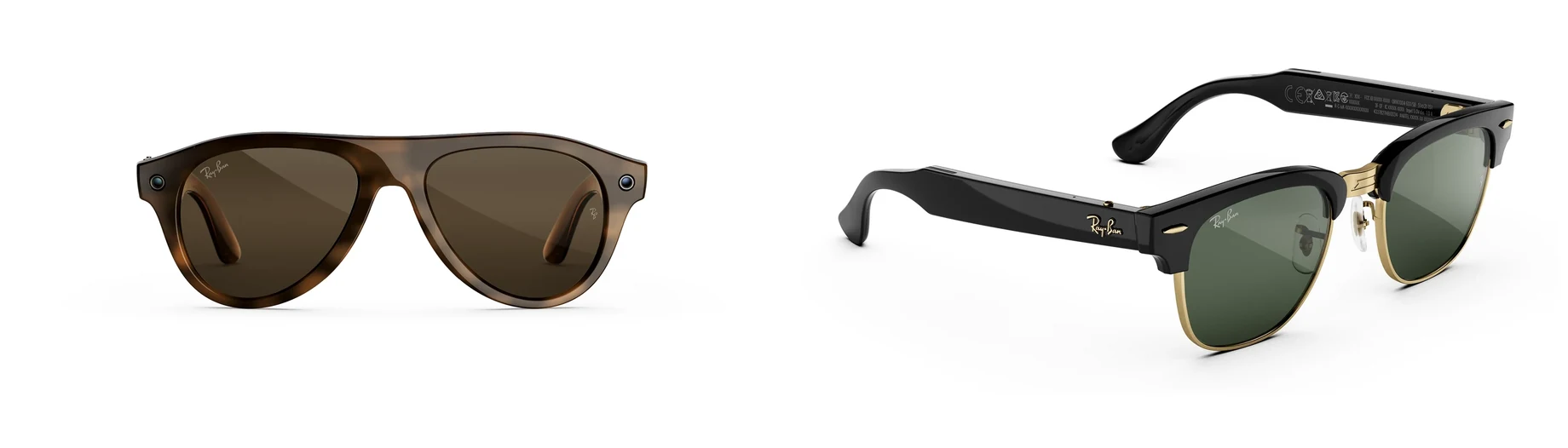
That is a taxonomy rather than a good, better, best ladder, and it matters for anyone choosing. The $349 camera-free pair is more expensive than the $249 pair with a camera. Nothing about the price tells you what the product does.
Meta's four answers do not exhaust the grid either. The cell Meta does not occupy is display without assistant, which is what the cycling glasses that put a rider's numbers in the field of view are: a screen in the lens, no camera, no microphone and nothing to talk to.
Our smart glasses business guide has argued that split at product level all year. Meta has now built it into a price list.
The software, and one genuinely new thing
Most of the feature list is incremental: landmark-based walking directions, hands-free guided workouts, nutrition tracking, shopping AI that reads prices, custom gestures, personalized audio, Dolby Atmos capture and Muse, Meta's personal AI agent, reaching the glasses "in the coming months."
Muse on glasses is the one worth tracking rather than the one worth writing about today, because it is the same bet several vendors have now placed: Rokid published an agent framework for its own glasses two days before this keynote. Meta has the distribution and the others have the head start.
One item is not incremental. Meta says hearing enhancement is an FDA-cleared software feature for adults 18 and older with perceived mild to moderate hearing loss, that it can be set up at home in minutes with no clinic or prescription, and that it will cost $149.99 as an add-on to supported AI glasses or come with a Meta One subscription. It launches in the US later this year.
Two things about that deserve care. Cleared is a specific regulatory status and is not the same as approved or authorized, and Meta publishes no clearance number, no device listing and no indication of which glasses count as supported. And a paid software unlock on hardware already bought is a business model this category has not used before. Both are worth watching rather than celebrating, and this post reports Meta's own wording rather than restating it as a health claim.
Meta also announced audio balance and mono audio controls for every AI glasses wearer, which are accessibility features with no price attached.
Where wearable spatial computing goes next
This section is BestInXR's reading rather than anything Meta, Qualcomm, Apple or Google has stated. The facts under it are all sourced. The conclusion is an argument.
The chip decided the shape. Meta names Qualcomm's Snapdragon Reality Elite in the headset. Qualcomm announced that platform on June 16, 2026 and said it "will power high-performance all-in-one video-see-through (VST) headsets and lightweight tethered optical-see-through (OST)," naming XREAL Project Aura and a Play for Dream device as first. Its product brief sells the platform on being up to 20% longer on battery at the same workload and up to 12 degrees Celsius cooler under load, which is a thermal pitch, and thermals are what has kept spatial computing in a box on the face.
Within one year, two unrelated companies used that platform to make the same structural move. Meta put the compute in a pocket puck on an optical tether. XREAL AURA put the compute in a pocket puck too, with its own coprocessor in the frames, and describes the result in three words on its own homepage: "Spatial computing, in glasses." XREAL states Fall 2026 and a retail price no higher than $1,500 before tax. Meta states Spring 2027 and $1,299.99.
The three camps are not converging on the same answer. Meta chose video see-through: cameras rebuild the room on a screen. XREAL chose optical see-through: the room stays visible through the lens, at a 70 degree field of view, with no passthrough delay. Both run on the same silicon, and Qualcomm built it to do either, which means the fork is a product decision rather than a technical constraint.
Google is under both halves of one of those camps. Android XR is what Google calls "a new platform built for headsets and glasses", it runs Samsung's Galaxy XR at $1,799.99, and it runs XREAL AURA. Galaxy XR uses Snapdragon XR2+ Gen 2, which is precisely the chip Qualcomm measures Reality Elite against. A platform one generation old is already on sale in a headset while its successor goes into glasses.
Apple is the one that has not moved. Vision Pro's most recent hardware change was the M5 in October 2025. Its 2026 work was software: visionOS 27 shipped on September 14, 2026, and it was an operating system release, not a form factor. Apple has confirmed nothing about the glasses reported as N50, and until it does, the company with the most refined spatial operating system has no product in the shape everyone else is now building.
Nothing announced this week is the thing people actually want. The destination is obvious and nobody is there: full spatial computing in something that looks like ordinary glasses, worn all day, with no second device in a pocket. Measure the announcements against it. Meta VR Glasses weigh about 100 grams on the face and run three hours on media playback, with the battery elsewhere and a cable between. XREAL AURA is a puck too. Meta Ray-Ban Display is the closest thing to all-day eyewear with an image in it, and Meta gives it six hours and a monocular display. Ray-Ban Meta Audio is genuinely all-day at twelve hours and has no display at all.
The tether is the tell. It is not a design flourish, it is a thermal budget made visible, and it will stay until silicon and batteries make it unnecessary. Qualcomm is selling degrees Celsius because degrees Celsius are the constraint.
One more surface belongs in this picture and it is not on anyone's face. The same optics and the same spatial tracking are going into windshields, and Forvia Hella and Distance Technologies are building an AR head-up display that projects into the driver's real field of view with no eyewear at all. A category defined by what you wear is competing with one defined by where you already sit.
So the thing to watch is not what Meta ships next. It is what happens at the seam. The all-day wearable exists and has no spatial computing in it. The spatial computer exists and cannot be worn all day. Those two lines are converging from opposite ends, and the interesting question is which one crosses first: a pair of glasses people already wear getting a real display and real tracking, or a headset shedding enough heat to become a pair of glasses.
What would falsify this reading: an all-in-one device at glasses weight with all-day battery and a wide field of view, from anyone, with no puck. Nobody has announced one. If Apple's first wearable product turns out to be that, this argument is wrong and the tether was a Qualcomm-era detour.
What Meta did not announce
No new Quest. The Quest lineup is unchanged, Quest 3 is still $599.99 after the April 2026 increase, and Meta VR Glasses are a separate product rather than a successor. Meta published no Quest price change, no new Quest model and no end-of-life date for the existing ones.
No unit numbers. Meta calls Ray-Ban Meta "the world's best-selling AI glasses" and publishes no figure behind it. No shipment, sales or install base number appears in any of the four announcements.
No per-eye specification for the headset. Meta gives 5K, micro-OLED and 37 pixels per degree and no per-eye pixel count, no field of view and no puck weight, which is the pattern the XR spec gap documents across this whole category.
Related reading. Each product has its own piece: Meta VR Glasses, Ray-Ban Meta Audio, Ray-Ban Meta (Gen 3), Meta Ray-Ban Display and the Meta Glasses styles. Our comparison of AI and smart glasses prices the shipping category with the date each figure was checked, and the XR hardware price index puts every class of XR hardware in one dated table.
Frequently Asked Questions (FAQ)
1. What did Meta announce at Connect 2026?
Meta VR Glasses at $1,299.99 for Spring 2027, Ray-Ban Meta Audio at $349 shipping October 13, Ray-Ban Meta (Gen 3) at $449 on sale now, new Meta Glasses styles from $249, Meta Ray-Ban Display in five new countries with online ordering, and a set of software features including an FDA-cleared hearing enhancement add-on at $149.99.
2. Did Meta announce a new Quest headset?
No. The Quest line is unchanged. Meta VR Glasses are a separate product with a tethered compute puck, announced for Spring 2027, and Meta published no new Quest model, price or end-of-support date.
3. What is the cheapest thing Meta announced?
A Meta Adventurer from $249 with a plug-in case, which Meta calls its most accessible price yet. Pre-orders opened September 23, 2026 and Meta gives October 23 as the on-sale date.
4. What is Meta's hearing enhancement feature?
Meta describes it as an FDA-cleared software feature for adults 18 and older with perceived mild to moderate hearing loss, set up at home without a clinic or prescription, launching in the US later in 2026 at $149.99 or included with a Meta One subscription. Meta publishes no clearance number and does not say which glasses support it.
5. Which Meta glasses have no camera?
Ray-Ban Meta Audio, in the Clubmaster and Burbank styles. It is the first pair Meta has sold without one, and Meta's own product page states it is built without a camera.