
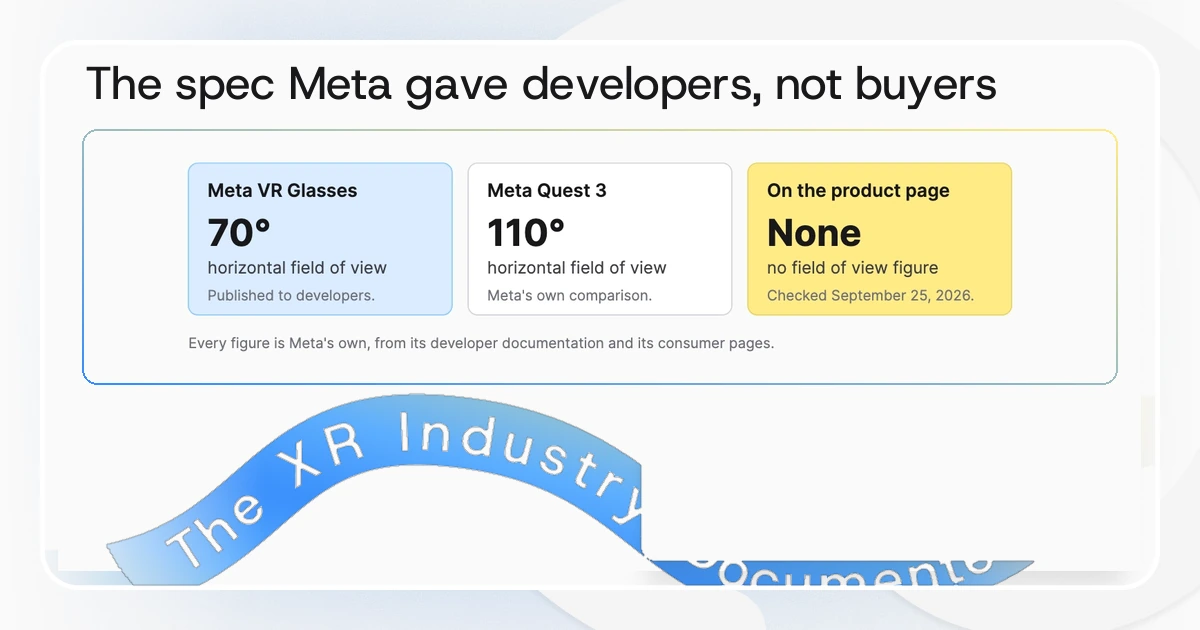
Meta's announcement of VR Glasses gives no field of view. Meta's developer documentation gives 70 degrees horizontal by 66 vertical, narrower than Quest 3 at 110 by 96, along with the per-eye resolution, memory and refresh rate the buyer-facing pages leave out. Two of those documentation pages carry an update date of September 4, 2026, nineteen days before the keynote.
In short:
- The number: 70 degrees horizontal by 66 degrees vertical, which Meta calls a nominal straight-ahead figure and tells developers to treat as an upper bound.
- For comparison: Meta's own table puts Quest 3 at 110 by 96 and Quest 3S at 96 by 90. Meta states plainly that Quest devices have a wider field of view than VR Glasses.
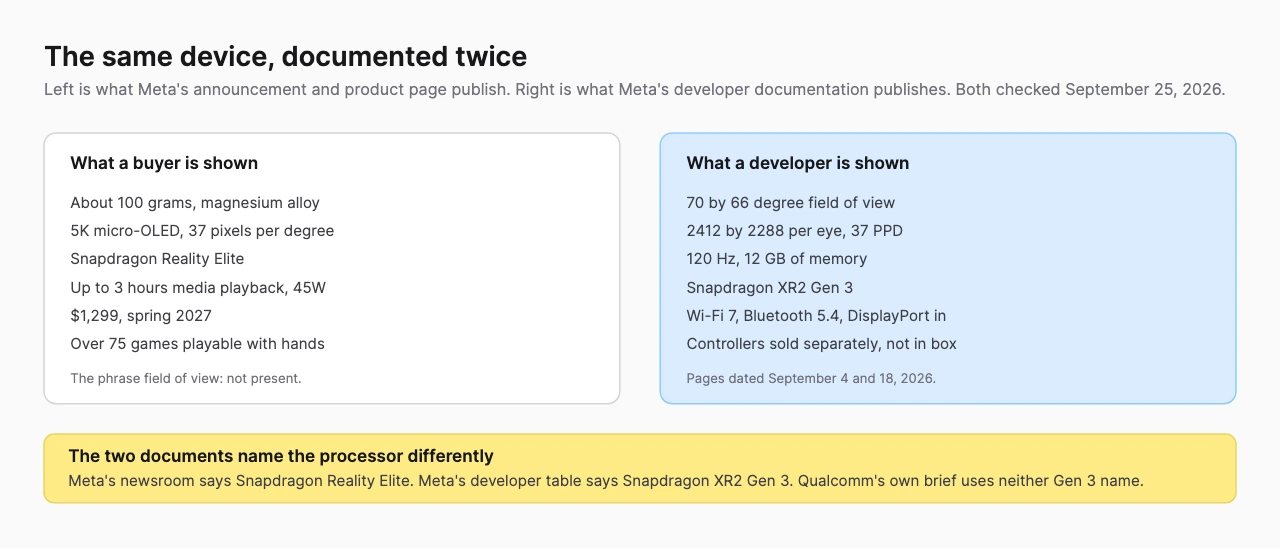
- What else developers get: 2412 by 2288 per eye, 37 pixels per degree, 120 Hz, 12 GB of memory, Wi-Fi 7, Bluetooth 5.4 and DisplayPort input on the puck.
- What buyers get: the meta.com product page carries no field of view, no per-eye pixel count, no refresh rate and no memory figure. Neither does the announcement.
- The controllers: the announcement says no controllers are needed. The documentation says the device ships without them and that they are sold separately.
What Meta published to developers and not to buyers
On September 23, 2026 Meta announced Meta VR Glasses at $1,299 for spring 2027. That post describes a 5K Infinite Display on micro-OLED panels at 37 pixels per degree. It contains no field of view figure and no per-eye pixel count. Neither does the product page, which gives 100 grams, magnesium alloy and a shipping window.
Meta's developer site publishes both, in a device comparison table that also covers Quest 3 and Quest 3S.
| Spec | Meta VR Glasses | Meta Quest 3 | Meta Quest 3S |
|---|---|---|---|
| Field of view | 70° horizontal, 66° vertical | 110° horizontal, 96° vertical | 96° horizontal, 90° vertical |
| Per-eye resolution | 2412 x 2288, 37 PPD | 2064 x 2208, 25 PPD | 1832 x 1920, 20 PPD |
| Display | micro-OLED, Dolby Vision, HDR10, HLG | LCD | LCD |
| Refresh rate | 120 Hz | 120 Hz | 120 Hz |
| Chipset | Snapdragon XR2 Gen 3 | Snapdragon XR2 Gen 2 | Snapdragon XR2 Gen 2 |
| On-board memory | 12 GB | 8 GB | 8 GB |
| Passthrough | Color stereoscopic, 26 PPD, autofocus and depth sensing | Color stereoscopic, 4 MP, 18 PPD, depth sensor | Color stereoscopic, 4 MP, 18 PPD |
| IPD | 56 to 70 mm, manual, per-eye | Continuous slider | 3 presets |
| Wi-Fi and Bluetooth | Wi-Fi 7, Bluetooth 5.4 | Wi-Fi 6E, Bluetooth 5.2 | Wi-Fi 6E, Bluetooth 5.2 |
| External display | DisplayPort DP-In on the puck | Not available | Not available |
| Controllers | Sold separately | In box | In box |
Every figure in that table is Meta's own, from the compare devices page, which carries an update date of September 18, 2026. BestInXR has measured none of it.
Three of those rows close gaps this site recorded as open the day after the keynote. Our account of the announcement said Meta had published no per-eye pixel count, no field of view, no memory figure and no refresh rate. That was accurate about the announcement and the product page, and it is wrong about Meta as a whole. Both posts have been corrected.
Why 70 degrees is the number that matters
Meta gives the figure three ways, and a dedicated documentation page exists to keep developers from confusing them.
- Nominal straight-ahead field of view, 70 by 66 degrees, described as "the upper bound of the visible area with the eyes facing forward and the device in its normal position on the face."
- Per-eye render extent, 74 by 68 degrees, which Meta calls "the angular extent used for rendering, not a guarantee that a person sees the full area."
- Display resolution, 2412 by 2288 pixels per eye, "the physical display pixel grid, not an app window size."
Meta then narrows the first one itself. The page says device fit and gaze direction can reduce the visible area below the nominal figure, that a greater eye-to-lens distance costs vertical view, and that looking toward an edge lets the lens limit the view before the display does. Its instruction is to "treat this value as an upper bound rather than the full area available for placing UI."
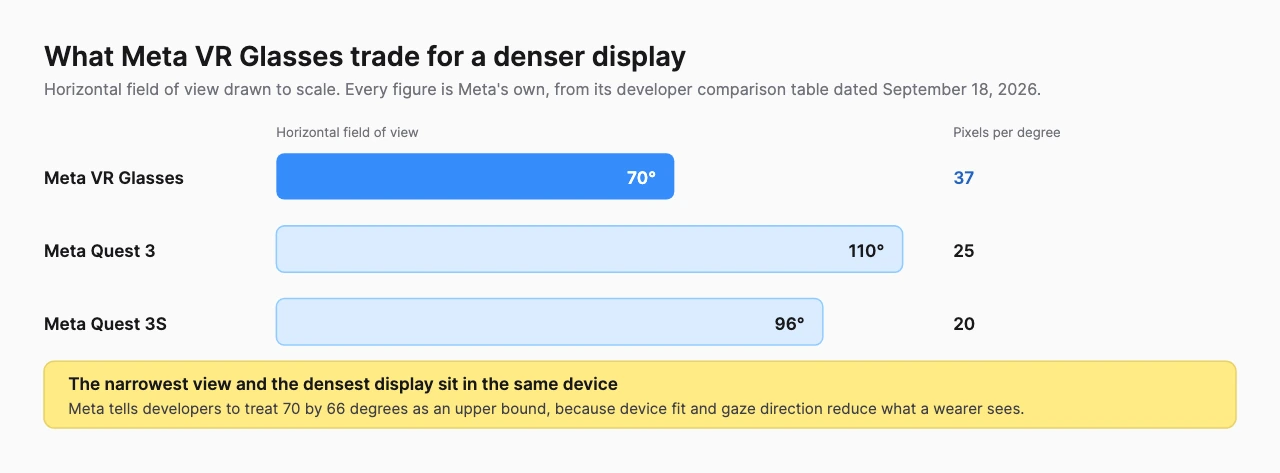
The trade-off is visible in the same table. VR Glasses carry the densest display Meta has shipped, 37 pixels per degree against 25 on Quest 3, and the narrowest view. Meta's developer blog states the consequence in its own words: "text is more legible and eye fatigue drops, and the perceptual difference is minor." It also reports that in Meta's testing "a few apps that occasionally place UI elements at the extreme edges of the field of view" became harder to see, and asks developers to move key interface elements toward the center.
That is the same withholding pattern the XR spec gap documents across this category, with an unusual twist. The figure is not missing. It is published to the audience that has to build against it and left out of the pages a buyer reads.
The headset ships without controllers, and the store knows
The consumer announcement says "No controllers needed." Meta's app compatibility page is more specific: Touch Plus controllers "are optional for the device and are not included with it," and the migration guide says VR Glasses "ship without controllers." The comparison table lists them as available for purchase separately, against in box for both Quest models.
Meta tells developers what happens when a controller-only title is launched on the device. The app installs, because it stays binary compatible with the Quest line, and then "the Switch to Controllers dialog blocks entry until controllers are active." Meta's guidance is direct: "do not assume the person has a pair."
The store treats input as a ranking signal. Meta's developer blog states that "customers who own controllers get recommendations from the full catalog. Customers who only use their hands see hand-tracked titles first, including titles that support both controllers and hands," and tells studios that "hands support affects your reach."
Two smaller requirements sit alongside it. The binary must be 64-bit, and Meta says a binary containing only 32-bit native libraries "cannot run on this device at all" although the same binary still runs on Quest. And Meta warns developers not to trust its own storefront labels as a test: "Store labels and visibility rules can differ from the app behavior that you test."
Meta's own documentation also marks where its guidance runs out. The migration guide rates the Native build path "Partial," on the grounds that "no single published Meta guide combines eye-gaze targeting and hand-pinch activation into an end-to-end Native migration," and says no current Spatial SDK page validates an end-to-end simulator workflow.
What Meta is paying developers to build
Meta opened the second Meta VR Start Developer Competition on September 24, 2026, running to November 18 with winners announced on or around December 11. Meta states $1M in total prizes across 20 cash awards ranging from $20,000 to $100,000, in three tracks: entertainment, gaming and productivity.
The entry requirement is the part worth reading. Meta writes: "Your experience must be fully usable with hands, end-to-end. Controller support is welcome, but not required." The gaming track is described as "genres that work well for seated play, without controllers," and the guidance asks for seated-optimized designs that "limit roomscale and avoid large physical movement."
Meta's consumer page promises "over 75 VR games on day one designed to be played with just your hands." The competition is a paid eight-week program to enlarge that number before the hardware ships, and the v207 SDKs are available now for developers who do not have a device.
The chip has two names
Meta's announcement says VR Glasses are "powered by Qualcomm's new Snapdragon Reality Elite processor." Meta's developer comparison table gives the chipset as Snapdragon XR2 Gen 3.
Qualcomm's own Snapdragon Reality Elite product brief uses neither the phrase XR2 Gen 3 nor any Gen 3 designation. It names the platform Snapdragon Reality Elite throughout and states that "all comparisons are to the previous generation, the Snapdragon XR2+ Gen 2 Platform," the chip inside Samsung's Galaxy XR.
Two Meta documents published within days of each other therefore name the processor differently, and the supplier's document supports only one of the two names. Meta does not reconcile them anywhere BestInXR could find, and this post does not guess which is current.
Related reading. Our account of the Meta VR Glasses announcement covers the price, the puck and what the keynote claimed, and the roundup of everything Meta announced at Connect 2026 sets it beside the glasses and the hearing clearance. The comparison of current XR headsets lists what ships today with checked prices, and the Quest lineup reference records what is on sale in the meantime.
Frequently Asked Questions (FAQ)
1. What is the Meta VR Glasses field of view?
Meta publishes a nominal straight-ahead field of view of 70 degrees horizontal by 66 degrees vertical, and a larger per-eye render extent of 74 by 68 degrees that it says people do not necessarily see. Meta describes the 70 by 66 figure as an upper bound that device fit and gaze direction can reduce.
2. Is that narrower than Meta Quest 3?
Yes, and Meta says so itself. Its comparison table gives Quest 3 at 110 degrees horizontal by 96 vertical and Quest 3S at 96 by 90, and the page states that Quest devices have a wider field of view than Meta VR Glasses. VR Glasses carry a denser display in exchange, at 37 pixels per degree against 25 on Quest 3.
3. Do Meta VR Glasses come with controllers?
No. Meta's documentation states that the device ships without them and that Meta Quest Touch Plus controllers are sold separately. A controller-required app can be installed, but Meta says a Switch to Controllers dialog blocks entry until controllers are active.
4. Why is the field of view missing from the product page?
BestInXR does not know, and Meta has not explained it. What is checkable is that the figure appears in developer documentation carrying an update date of September 4, 2026 and in a comparison table updated September 18, and that neither the September 23 announcement nor the meta.com product page contains the phrase field of view.
5. What is the Meta VR Start Developer Competition?
An eight-week contest Meta opened on September 24, 2026 and closes on November 18, with $1M in total prizes across entertainment, gaming and productivity tracks and winners announced around December 11. Entries must be fully usable with hands from end to end, and controller support is optional.