

Apple will introduce its first smart glasses at WWDC in June 2027 and ship them later that year, Bloomberg's Mark Gurman reported on July 26, 2026. The device, codenamed N50, has slipped roughly a year. Apple has still not settled the most basic question about it: whether it carries a camera at all.
In short:
- What it is: A reported schedule and a reported open design question, both sourced to one Bloomberg newsletter.
- What it is not: An Apple announcement. Apple has made no public statement about N50.
- The open question: Whether the glasses ship with a full camera, a camera restricted to feeding Siri or no camera.
- The backdrop: Meta faces a US class action and a UK regulator inquiry over how Ray-Ban glasses footage was handled.
What Bloomberg reported about Apple's smart glasses
Gurman reported a June 2027 unveiling at WWDC with consumer availability by the end of 2027. The device sits inside Apple's Vision hardware group under the codename N50. Earlier reporting from the same source had pointed to a late 2026 reveal and an early 2027 release, so this is the second slip on the same product.
Other details in the reporting, all unconfirmed by Apple: a price band of roughly $200 to $500, oval camera housings, several frame styles and no display in the lens. The glasses would depend on a paired iPhone for heavy processing, in the way AirPods and Apple Watch do.
Treat every number in that paragraph as reported rather than specified. None of it comes from Apple. Coverage of the newsletter is available at MacRumors, Macworld and The Next Web.
Why Apple delayed the glasses to WWDC 2027
Gurman attributes the latest delay primarily to privacy work, both the engineering and the messaging. Apple's teams are reportedly still prototyping hardware and software protections that do not exist on any shipping product, and the company has spent months on how to explain the product rather than only on how to build it.
The earlier delay had a different stated cause. When the timeline first moved in May 2026, the reported reason was doubt about whether Apple's Visual Intelligence stack was strong enough to carry a first-generation device. The reasons stack rather than replace each other, which is worth noting: a product delayed twice for two different reasons is a product with two unsolved problems.
The two camera options Apple is weighing
Apple is reportedly weighing two options: remove the cameras entirely, or keep them but block user-initiated photo and video capture so they function only as input for Siri and Visual Intelligence. Gurman has previously reported that Apple prototyped a version with no camera system at all.
The second option was reportedly Apple's original concept for the product. It is also the harder sell. Capture is the feature that made Ray-Ban Meta work as a consumer product, and a device that sees but never saves is a different product in the same frame.
This is not a philosophical question for a directory. It is a spec question with a category consequence. Glasses that capture photos and video and glasses that only feed a model are not comparable devices, and putting them on the same spec sheet without flagging the difference misleads the reader. Whichever way Apple goes, the smart glasses category splits into capture devices and sensor-only assistants.
Why court bans apply to all smart glasses
Dropping the camera would not exempt Apple's glasses from the venue bans now appearing, because those bans are not written around cameras.
New York's Unified Court System barred smart glasses from every court facility in the state effective July 20, 2026, following a July 1 memorandum from the Office of Court Administration. It is the first statewide court ban in the United States and it covers more than 1,240 state, county, city, town and village courts. The restriction applies to everyone entering, including attorneys, court staff and members of the public, and prescription smart eyewear is included. Devices are surrendered to uniformed court officers on entry.
The scope is the part worth reading closely. The memo defines smart glasses as eyewear or headwear containing a camera, a microphone, a computer or other technology permitting the user to record video or audio, prescription or not. Cameras are one item on a four-item list, and the operative test is recording capability.

Every version of N50 currently reported has microphones and speakers, and every version is a compute-connected iPhone accessory. On the plain text of the New York rule, the most privacy-conservative option Apple is reportedly considering, shipping with no camera at all, would still be barred from every courthouse in the state. So would a pair of AirPods-class microphones in a frame.
That matters beyond one state. The Syracuse report on the New York ban noted that other states including Pennsylvania and Wisconsin have already restricted the hardware. If venue policy continues to define the category by recording capability rather than by camera presence, Apple cannot design its way past it with a lens decision. It can only design its way past it with a disclosure and control story, which may be exactly why Gurman describes the delay as a messaging problem as much as an engineering one.
What the Meta lawsuit actually alleges
The complaint driving this is not about bystanders being filmed. It is about what happened to the wearer's own footage after capture.
In February 2026, Svenska Dagbladet and Göteborgs-Posten reported that workers at Sama, a Nairobi-based annotation subcontractor, were reviewing and labeling footage from Meta's glasses to train AI, including highly private material. On March 4, 2026, plaintiffs Gina Bartone and Mateo Canu filed a class action against Meta Platforms and Luxottica of America in the Northern District of California, Bartone v. Meta Platforms Inc., No. 3:26-cv-01897. The complaint alleges the companies marketed the glasses on privacy while not disclosing that captured video traveled to servers and then to human reviewers overseas. The UK Information Commissioner's Office wrote to Meta seeking answers on its data protection obligations.
The case has since grown. An amended complaint raised the named plaintiffs from two to nineteen and the proposed subclasses from two to sixteen states. These are allegations. No finding has been made.
The distinction matters for reading Apple's options. A tamper-proof recording indicator addresses the bystander problem, which is whether a stranger can tell they are on camera. On-device processing addresses the wearer problem, which is where the footage goes and who sees it. They are separate failures with separate fixes, and Apple's reported shortlist mixes them. Removing the camera solves both at once by removing the product's most useful sensor, which is why it remains on the list at all.
Who ships before Apple
Two competitors reach shelves before Apple reveals anything.
Samsung introduced its Android XR eyewear at Galaxy Unpacked in London on July 22, 2026, four days before the Gurman report, in designs built with Gentle Monster and Warby Parker. Per Samsung, the glasses run Gemini, have no display, carry a built-in camera and open-ear audio and deliver up to nine hours on a charge, with the case supplying up to seven more full charges. They use the Snapdragon AR1 Gen1 platform and require a paired phone. Pricing was not disclosed and neither was an availability date. The hardware cleared FCC certification on September 27, 2026 under two FCC IDs, which is permission to market rather than a schedule.

Meta's lead is measured in years and units. EssilorLuxottica reported in its Q4 2025 results that it sold more than seven million AI glasses during 2025 alone, against two million across 2023 and 2024 combined. Ray-Ban Meta launched in October 2023. If Apple ships in late 2027 as reported, it enters against a rival with four years in market and an installed base in the millions, while facing litigation that the incumbent absorbed first.
What you can check, and where
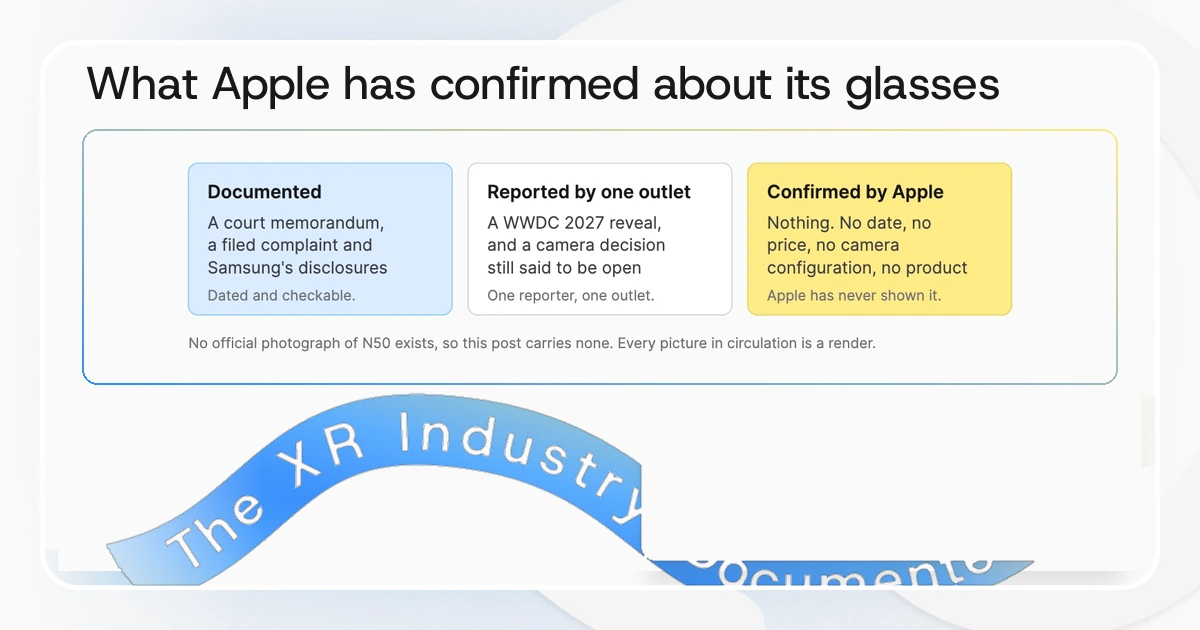
Everything about N50 traces to one reporter at one outlet. Apple has confirmed no date, no price, no camera configuration and no product. Gurman's record on Apple hardware is strong, and that is a reason to take the reporting seriously rather than a reason to record it as fact.
What is documented: the New York court ban and its July 1 memorandum, the filed complaint and its docket number, the ICO's letter, EssilorLuxottica's reported unit figures and Samsung's own product disclosures. Those are dated, attributable and checkable. The Apple timeline is not, and the gap between the two is the whole story of how this category is currently covered.
That gap extends to images. There is no official photograph of N50, because Apple has never shown it. Every picture of "Apple smart glasses" circulating online is a fan render or an AI generation, which is why this post carries none.
Related reading
What the category already ships, and what is on sale while Apple is not.
Recent news covering this hardware:
- visionOS 27 Shipped, and Vision Pro Is One of Two Platforms With Siri AI in the EU, September 14, 2026
Frequently Asked Questions (FAQ)
1. When are Apple smart glasses coming out?
Bloomberg reported on July 26, 2026 that Apple aims to unveil the glasses at WWDC in June 2027 and ship them by the end of 2027. Apple has not announced a date, and this timeline has already moved twice.
2. How much will Apple smart glasses cost?
Reporting points to roughly $200 to $500. Apple has published no pricing. For reference, Ray-Ban Meta Gen 2 launched at $379 and Meta Ray-Ban Display launched at $799.
3. Will Apple smart glasses have a camera?
Undecided as of the July 2026 reporting. Apple is said to be choosing between no camera and a camera that cannot take user-initiated photos or video and instead only feeds Siri and Visual Intelligence.
4. Do Apple smart glasses have a display?
No, not in the first generation. Reporting is consistent that N50 has no in-lens display and returns information through audio. A display-equipped model is reported for a later generation.
5. Why is Apple worried about smart glasses privacy?
Meta faces a US class action and a UK Information Commissioner's Office inquiry over reports that Ray-Ban glasses footage was reviewed by contractors abroad. Apple markets heavily on privacy, so a comparable failure would cost it more.
6. Are smart glasses banned anywhere?
Yes. New York barred all recording-capable eyewear and headwear from its 1,240 plus court facilities effective July 20, 2026, the first statewide court ban in the United States. Other jurisdictions including Pennsylvania and Wisconsin have their own restrictions.


