
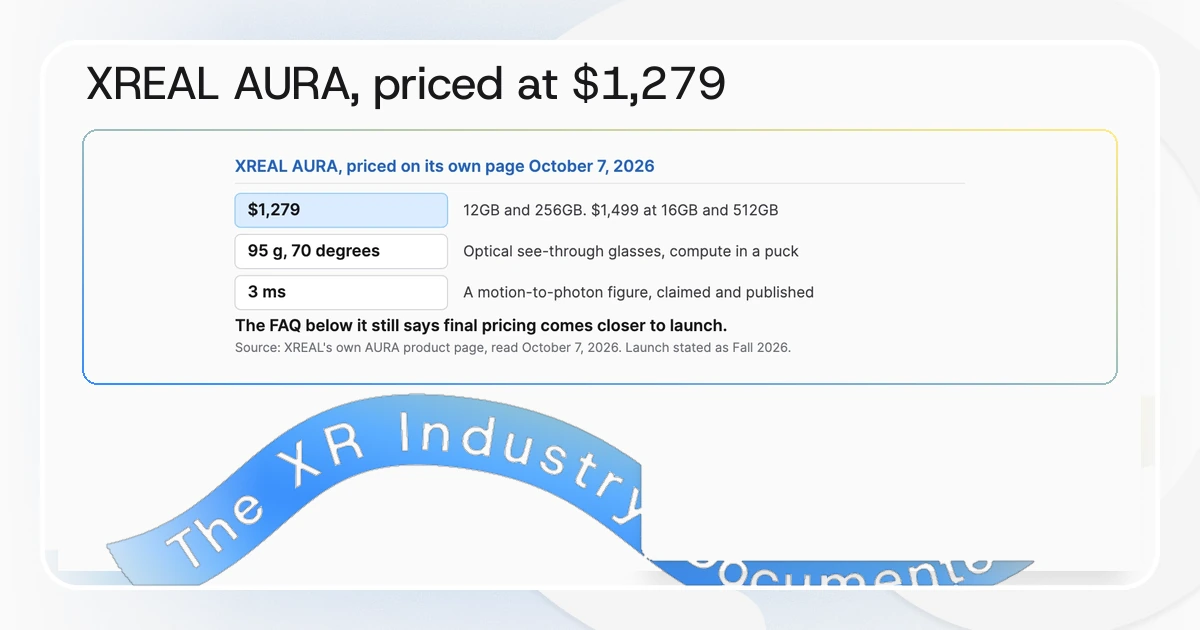
XREAL's own AURA page now prices the Android XR glasses at $1,279 with 12GB of memory and 256GB of storage, and $1,499 with 16GB and 512GB. Purchase access opens first to people holding an existing reservation, starting in the United States, Canada, Japan and South Korea. Launch stays Fall 2026.
In short:
- What it is: XREAL AURA is a pair of wired optical see-through glasses with a separate compute puck, running Android XR. XREAL's page calls it spatial computing eyewear rather than a headset.
- What is now published: two configuration prices, a 95 gram glasses weight, a 70 degree optical see-through display and a full specification table for both halves of the device.
- The figure worth noting: the spec table states a motion-to-photon latency of 3ms, a field that headset makers generally leave out, as BestInXR's XR spec gap recorded.
- What the same page still says: its FAQ gives a price ceiling of "no more than US$1,500" and says final pricing "will be announced closer to launch", which the purchase module above it has now overtaken.
- Where it lands: $1,279 undercuts Meta VR Glasses at $1,299.99, and Meta's device is a Spring 2027 product while AURA states Fall 2026.
What XREAL publishes for AURA today
The purchase module on XREAL's AURA page lists two configurations and their prices: $1,279 for 12GB of memory with 256GB of storage, and $1,499 for 16GB with 512GB. Read on October 7, 2026, the global page at xreal.com/aura and the United States page at xreal.com/us/aura carry identical figures on every specification and price checked, so there is no locale discrepancy to report here.
Access is staged rather than open. The module asks whether the reader already holds a Launch Credit, Priority Deposit or Founder Priority Pass, and routes those holders to XREAL's own store to complete a purchase. Underneath it, a second block invites new reservations with a Priority Deposit of $199 and the line "Missed the first wave?". So the prices are published, and buying at them is currently a benefit of having reserved.
The region note attached to that module reads "Starting with the US, Canada, Japan, and South Korea. More regions will be available soon."
XREAL published no press release for any of this. Its newsroom returns "No content available", and the most recent entry on its blog is dated May 19, 2026 and covers the device under its old Project Aura name. The product page is the document, which is worth stating plainly because it is the only thing a reader can check.
How AURA reached this point
Google announced that reservations were open on June 16, 2026, in a post from Augmented World Expo describing AURA as "XREAL's first wired XR glasses powered by Android XR and using the Snapdragon® Reality Elite Platform" and "coming this fall". That post carries no price, no specification table and no region list.
The silicon was announced the same day. Qualcomm's Snapdragon Reality Elite release said the platform "will power high-performance all-in-one video-see-through (VST) headsets and lightweight tethered optical-see-through (OST)", and named XREAL Project Aura and a Play for Dream device as the first products on it. Its product brief sells the platform on thermals, claiming up to 20 percent longer battery at the same workload and up to 12 degrees Celsius cooler under load.
XREAL's own Project Aura write-up from Google I/O on May 19, 2026 is where the device was first shown. The name lost the word Project somewhere between then and now.
What the AURA specification table lists
XREAL splits the specification between the glasses and the puck, which is the honest way to present a tethered device. Every figure below is XREAL's own claim from its spec table, read on October 7, 2026, and none carries a stated measurement method.
The glasses:
| Field | Published figure |
|---|---|
| Weight | 95 g |
| Chip | X1S Spatial Coprocessor |
| Motion-to-photon latency | 3 ms |
| Display | Sony Micro-OLED, 1920 by 1200 pixels per eye |
| Color | 100% sRGB, delta E under 3, individually factory calibrated |
| Brightness | 1050 nits maximum |
| Pixels per degree | 32 |
| Refresh | Up to 120 Hz |
| Field of view | 70 degrees optical see-through, stated in the page copy rather than the table |
| Perception | Two world-facing tracking cameras, 6DoF spatial anchoring, hand tracking |
| Dimming | Electrochromic, automatic or manual, 5 levels, blocking up to 99.9% of external light |
| Audio | Sound by Bose, spatial audio through Android XR, 4 microphone array |
| IPD fit | M size 60 to 66 mm, L size 66 to 72 mm |
The compute puck:
| Field | Published figure |
|---|---|
| Operating system | Android XR |
| Chip | Snapdragon Reality Elite platform |
| AI processing | 48 TOPS |
| Memory and storage | 12GB with 256GB, or 16GB with 512GB, UFS 4.0 support |
| Battery | 4455 mAh, 34.84 Wh |
| Glasses port | USB-C, 5V at 2A maximum, USB 3.1, full ADB support |
| Charging and video port | USB-C, 5 to 19V at 3A, 57W maximum, QC3.0 and PD3.0 with PPS, DP Alt Mode |
| Input | Hands, voice and a touchpad on the puck, plus Bluetooth keyboards, mice and controllers |
| Connectivity | Wi-Fi 6 and 6E, Bluetooth 5.3 |
A camera with a privacy LED indicator sits on the glasses, and a fingerprint button on the puck handles power, unlocking and authentication for supported apps. The page also states that AURA supports insertable prescription lenses.
What the 3 ms latency figure measures
XREAL states a motion-to-photon latency of 3 ms for AURA, in the same spec entry that names the X1S Spatial Coprocessor. Motion-to-photon latency is the delay between a head movement and the display updating to match it. On an optical see-through device there is no camera stage in that path, because the room stays visible through the lens, so the number describes how quickly the rendered overlay catches up rather than how quickly a rebuilt view of the room appears.
That makes it a different quantity from the nearest published comparison. Apple's Vision Pro specifications give a 12 millisecond photon-to-photon latency, which measures the camera passthrough path on a video see-through headset. Comparing 3 against 12 would be comparing two different paths on two different display architectures.
What makes the figure worth recording is that it exists at all. BestInXR's XR spec gap found that almost every device in the XR hardware price index publishes a price and withholds a latency measurement, and the documented alternative has been a frame budget rather than a latency figure. Microsoft tells HoloLens developers to hold a constant 60 frames per second, which is a new image every 16 milliseconds, and states no motion-to-photon target. XREAL publishing a number here is a supplier choosing to be measured on a field its category has kept dark, and it is a claimed figure until somebody measures it with a stated method.
What the FAQ on the same page still says
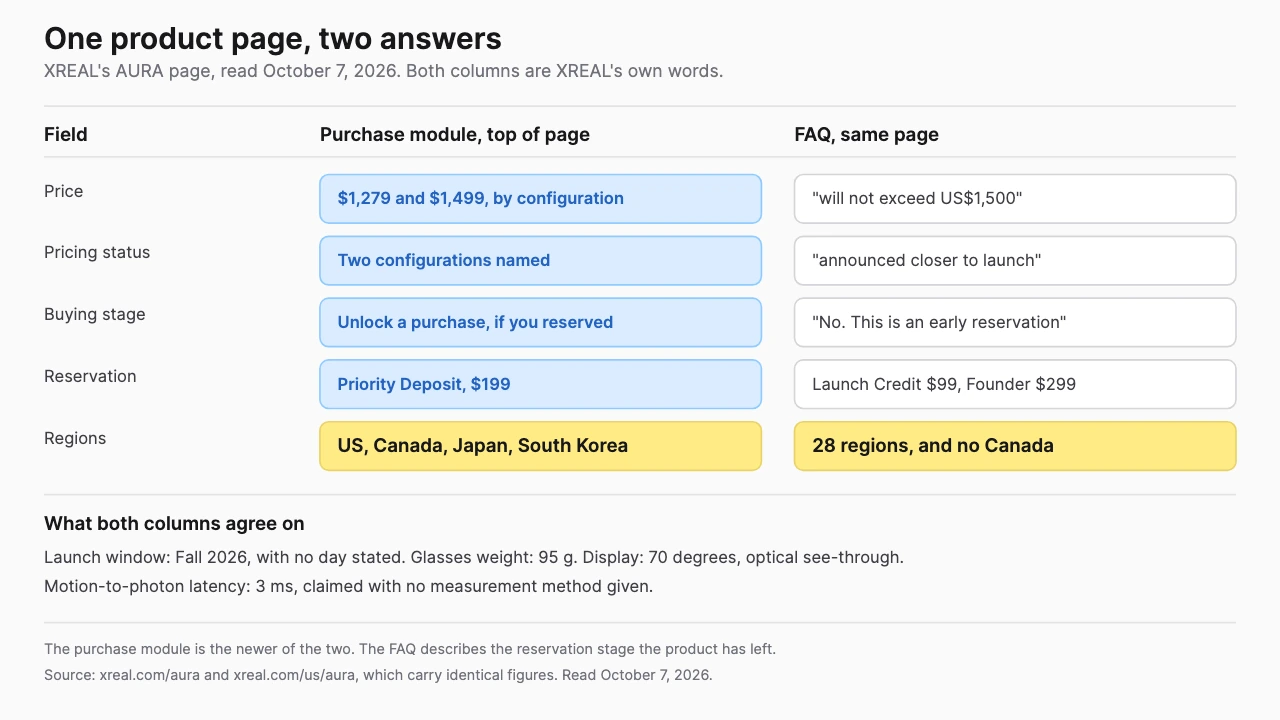
The FAQ further down the AURA page describes an earlier stage of the product and has not been revised to match the purchase module above it. Three entries now disagree with the top of the page.
On price, the FAQ answers "What will XREAL AURA cost?" with "The final retail price of the base model will not exceed US$1,500, excluding applicable taxes. Final pricing and configurations will be announced closer to launch." The base model is now priced at $1,279 and both configurations are named, so the ceiling is satisfied and the second sentence is overtaken.
On whether this is a purchase, the FAQ answers "Is this a pre-order?" with "No. This is an early reservation for XREAL AURA", and says no additional payment is required until final purchase confirmation. That is accurate for a new reservation at $199 and not for a reservation holder following the unlock link to buy.
On reservation tiers, the FAQ describes a Launch Credit at US$99 returning US$199 of credit, and a Founder Priority Pass at US$299 limited to 2,000 reservations globally. The live module offers a Priority Deposit at $199 and describes the earlier round in the past tense.
On regions, the FAQ lists 28 supported launch regions: the United States, the United Kingdom, Czech Republic, Italy, Spain, Germany, Belgium, Netherlands, France, Luxembourg, Poland, Austria, Denmark, Ireland, Croatia, Hungary, Slovakia, Slovenia, Estonia, Latvia, Lithuania, Sweden, Bulgaria, Romania, Finland, Portugal, Japan and South Korea. Canada is not among them, and Canada is one of the four countries the purchase module names. A buyer in Toronto and a buyer in Lisbon each find one statement on this page that includes them and one that does not.
Both statements come from XREAL, on one page, read the same minute. The post reports the pair rather than picking the one that reads better, and the reservation module is the newer of the two.
Where AURA sits on price
Three Android XR and tethered devices now have published prices, and they arrive across more than a year.
| Device | Architecture | Published price | Stated timing |
|---|---|---|---|
| XREAL AURA | Optical see-through glasses with compute puck | $1,279 at 12GB and 256GB, $1,499 at 16GB and 512GB | Fall 2026 |
| Meta VR Glasses | Video see-through glasses with compute puck | $1,299.99 | Spring 2027 |
| Samsung Galaxy XR | Standalone video see-through headset | $1,799.99 | On sale |
The $20 gap between AURA's base configuration and Meta VR Glasses is the number to watch, because the two devices sit on the same Qualcomm platform and split on what the wearer sees. Meta rebuilds the room on a screen. XREAL leaves the room visible through the lens. BestInXR's roundup of everything Meta announced at Connect 2026 covers the other half of that fork, and the AR and display glasses comparison covers XREAL's shipping lineup, which is tethered display glasses without an Android XR puck.
What to confirm before Fall 2026
Four things on this page are dated by a launch and one reader action settles each.
A launch date. XREAL states Fall 2026 and no day. The FAQ adds that the shipping date depends on the official launch time in each region.
A region list a Canadian buyer can rely on. The two lists on the page disagree about Canada, and the one attached to the buy button is the newer.
Whether the prices survive general availability. XREAL's FAQ reserves the right to announce final pricing and configurations closer to launch, and the pattern in this category is that a price read on one day is a snapshot. BestInXR's hardware price index records three suppliers that were running promotions on the day they were checked.
A measurement method for the 3 ms figure. Until one is published, it is XREAL's claim rather than a comparable result.
Related reading. The glasses already on sale with published prices are compared in AI glasses compared, with prices, and the fields this category routinely withholds are counted in BestInXR's XR spec gap. Our smart glasses guide sets out how the categories divide, from AI glasses to assisted reality.
Frequently Asked Questions (FAQ)
1. How much does XREAL AURA cost?
XREAL's AURA page lists $1,279 for the configuration with 12GB of memory and 256GB of storage, and $1,499 for 16GB with 512GB. The FAQ on the same page still describes a ceiling of no more than US$1,500 before tax and says final pricing will be announced closer to launch.
2. When does XREAL AURA launch?
XREAL states Fall 2026 and has published no specific day. Its FAQ adds that the shipping date follows the official product launch time in each region, and Google's June 16, 2026 announcement described the device as coming this fall.
3. Can anyone buy XREAL AURA now?
Not yet at the published prices. The purchase link on XREAL's page is gated to people holding an existing Launch Credit, Priority Deposit or Founder Priority Pass, and new reservations are taken with a Priority Deposit of $199.
4. What chip is in XREAL AURA?
Two. The compute puck runs Qualcomm's Snapdragon Reality Elite platform with 48 TOPS of AI processing, and the glasses carry XREAL's own X1S Spatial Coprocessor for display and sensor work. Qualcomm announced Reality Elite on June 16, 2026 and named Project Aura as one of its first two devices.
5. Which countries get XREAL AURA at launch?
The two statements on XREAL's page differ. The purchase module names the United States, Canada, Japan and South Korea as the starting markets, while the FAQ lists 28 regions that include the United Kingdom and most of the European Union but not Canada.
6. Is XREAL AURA a headset or glasses?
XREAL calls it spatial computing eyewear and states that it is neither a headset nor display glasses. Structurally it is a pair of wired optical see-through glasses weighing 95 grams, with the computing in a separate pocket puck connected over USB-C.