

Best AI Glasses and Smart Glasses
The price ladder in this category does not buy a bigger screen. It buys a different job. The $599 pair has by far the largest display and no camera and no assistant. The $799 pair has a small display in one lens and needs a wrist band to control it. The $379 pair, which Meta says outsells every other pair of AI glasses, has no display at all. Decide which job you are buying before you compare a single specification.
In short:
- Most AI glasses have no display. Ray-Ban Meta (Gen 2) is a camera, open-ear audio and an assistant on your face, starting at $379.
- The biggest screen has no camera. XREAL One Pro is $599 for a 57 degree virtual display, and its camera is a separate $99 accessory.
- One product does all three jobs. Rokid Glasses combines display, 12MP camera and assistant in a 49 gram frame.
- Prescription changes the price. Meta Ray-Ban Display is $799, and $999 with prescription lenses.
How this list was built
This is a price and capability comparison, not a category explainer. BestInXR's smart glasses business guide already sets out what separates AI glasses, display glasses, assisted reality and true AR, and this post assumes that division rather than repeating it.
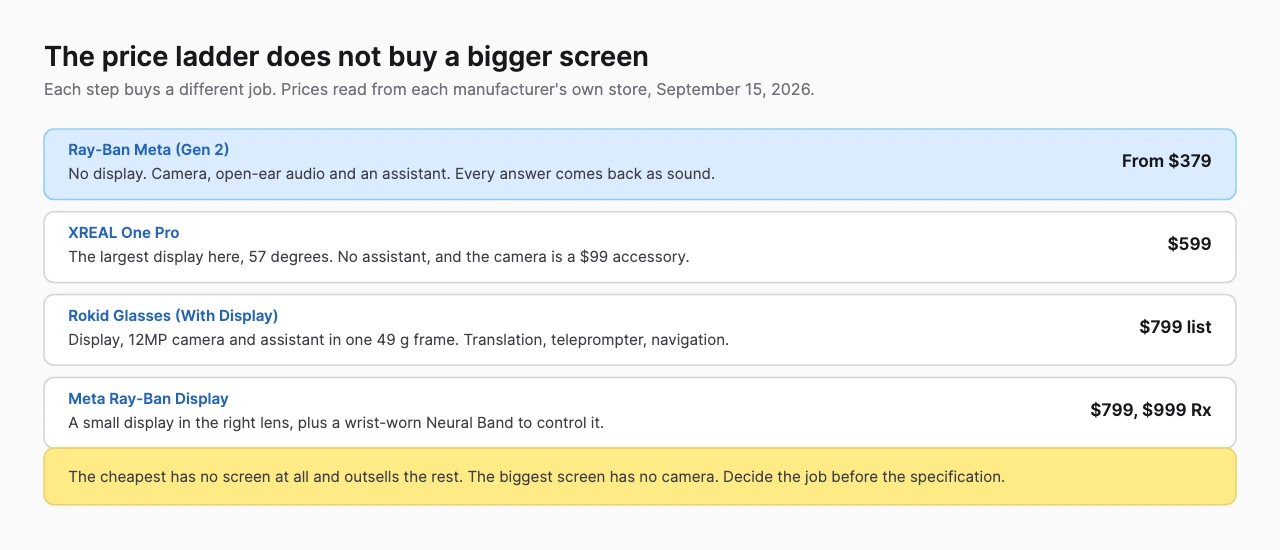
What that guide does not carry is a single price. This one ranks four products on four criteria: what it costs, whether there is a display and what kind, whether there is a camera and an assistant and what you have to carry or wear alongside it. All prices were read from each manufacturer's own store on September 15, 2026.
| Product | Price | Display | Camera and assistant |
|---|---|---|---|
| Ray-Ban Meta (Gen 2) | From $379 | None | Yes, both |
| XREAL One Pro | $599 | 57 degree virtual screen | Camera is a $99 add-on, no assistant |
| Rokid Glasses | $699, regular $799 | Dual-eye micro-LED | Yes, both |
| Meta Ray-Ban Display | From $799 | In-lens, right eye only | Yes, both |
1. Ray-Ban Meta (Gen 2)
Ray-Ban Meta is the product that made this category real, and the thing to understand first is that it shows you nothing.
Meta's own comparison lists Ray-Ban Meta (Gen 2) starting at $379 with no in-lens display, against Meta Ray-Ban Display at $799 with a full-color display in the right lens. The Gen 2 pair captures 1080p or better video at 30 frames per second, carries open-ear audio for calls, music and Meta AI and comes in 3 styles and more than 15 colors. Meta describes it as the number one selling AI glasses and footnotes that claim to IDC sales data as of July 2025. That is a third-party basis rather than a bare vendor assertion, and it is also fourteen months old. Neither company publishes a current unit figure.
No display sounds like a limitation and is closer to the point. What you get is a camera you can trigger without reaching for a phone, audio nobody else hears and an assistant you talk to. Everything comes back as sound. For capture, calls, music and questions, that is the whole job and the glasses stay glasses.
The constraint is the one that follows from it. Anything needing a visual answer, a map, a subtitle, a message, a teleprompter line, cannot be delivered. If your use case ends in a picture rather than a sentence, this is the wrong tier. It is also available for online and in-store purchase, which the display model is not. Best for most people, most of the time, at the lowest price in the category.
2. XREAL One Pro
XREAL One Pro is $599 and is not really in the same business as the others, which is exactly why it keeps appearing next to them.
It is a wearable screen. XREAL publishes a Sony 0.55 inch micro-OLED panel, 1080p per eye at up to 120 Hz, a 57 degree field of view and a virtual image up to 171 inches, with 700 nits, three modes of electrochromic dimming, TÜV Rheinland certification and audio tuned by Bose engineers. The cheaper XREAL One sits below it at $399 and 87 grams.
Read the accessory list before you read the specifications, because it tells you what this product is not. The camera, XREAL Eye, is a separate $99 add-on weighing 1.5 grams at up to 12 megapixels. There is no built-in assistant. XREAL also sells the Beam Pro at $199 as a companion device. The glasses expect to be connected to something that supplies the picture.
So the most screen in this comparison costs less than the least screen, and comes with none of the AI glasses features people mean when they search for AI glasses. If you want a large private monitor for a laptop, a console or a flight, this is the strongest product here. If you want glasses that see what you see and answer questions, it is the wrong one. Best for a private big screen on the move, not for hands-free capture or assistance.
3. Rokid Glasses
Rokid Glasses is the only product in this comparison doing all three jobs in one frame, and at 49 grams it does them without looking like equipment.
Rokid publishes a bright dual-eye micro-LED display at 1,500 nits, a 12 megapixel point-of-view camera and an assistant invoked by saying Hi Rokid that the company says runs on GPT and Gemini. The published applications are the ones a display actually makes possible: real-time translation subtitles in your field of view, a teleprompter for speaking notes and turn-by-turn navigation. It is prescription friendly through a built-in magnetic optical insert.
The pricing needs a date and a health warning, and this product supplies the evidence for both. Rokid's own page markup gave a sale price of $699 against a regular price of $799, a 13% discount, when checked on September 15, 2026. The page as it rendered in a browser the same day showed $629 with 10% off a $699 regular price, a different number from the same page on the same day. The site was also running a buy-one-get-one-half-off offer and a gift bag promotion at the time. Treat $799 as the list price, treat anything below it as a moving target, and check the figure yourself on the day you buy. The company describes it as the lightest AI glasses and as a first for combining GPT and Gemini, both of which are its own claims.
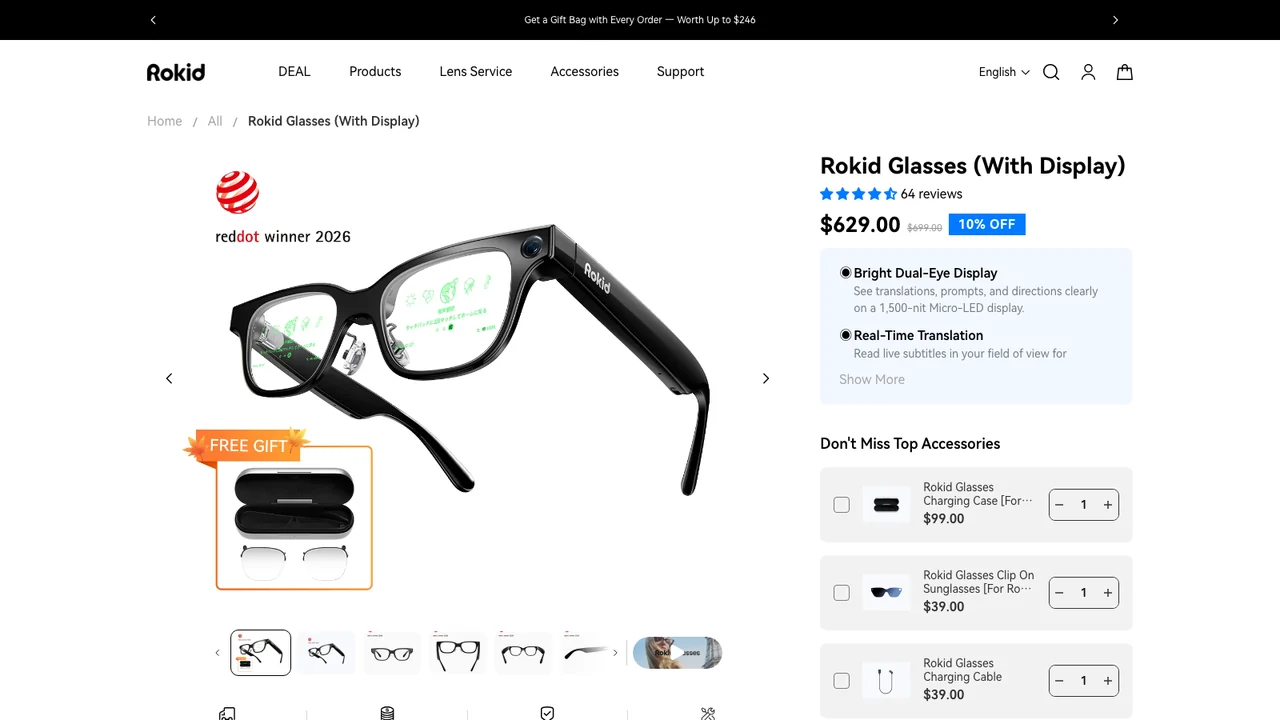
Rokid splits its own line the way this post does, selling Rokid Glasses (With Display) alongside a Rokid AI Glasses Style (Non-Display) variant. A manufacturer naming the presence or absence of a display in the product name is telling you that the distinction is the purchase. Best for translation, prompting and navigation, where the answer has to be seen rather than heard.
4. Meta Ray-Ban Display
Meta Ray-Ban Display is the most expensive option here and the most interesting one, because of how you control it.
Meta publishes it starting at $799 with a full-color display built into the right lens, and available with prescription for an additional $200, which is $999 for the frame and prescription lenses together. It comes in 1 style and 2 colors against 3 styles and 15 or more colors for the Gen 2 glasses.
The part that separates it from everything else is the Meta Neural Band, a wrist-worn controller Meta says lets you navigate the in-lens display with natural gestures. A display on your face creates a control problem, because talking to glasses in public is socially expensive and touching the arm is fiddly, and the wristband is Meta's answer to it. It also means the product is two things to charge and two things to wear.
One practical detail decides whether you can even try it. Meta lists the display model as available for in-store purchase, where the Gen 2 glasses are available online and in store. A product you must buy in person is a product with a geography attached, which is worth checking before planning around it. Best for someone who wants a display from Meta's ecosystem and accepts a wristband as part of the deal.
What the specifications do not tell you
A display in one eye is not a screen. The Meta unit puts a full-color display in the right lens. That is built for glanceable information, not for watching anything, and it is a different product from a 57 degree virtual monitor despite both being called a display.
The camera is the socially loaded part. Glasses that record change how people behave around you, and that is a rule question as much as a preference. BestInXR's Apple smart glasses timeline documents a New York court system ban on smart glasses in courthouses, which is the sort of constraint no specification sheet lists.
Prescription is a real line item. Meta charges $200 extra. Rokid builds in a magnetic optical insert. If you wear glasses already, price the version you can actually use.
Promotional pricing moves. Rokid was discounting 13% with two other offers running on the same day. Check the price on the day you buy rather than trusting any article, including this one.
How to choose AI glasses
Start by deciding whether the answer has to be seen. If everything you want can come back as audio, a photo or a video, buy the cheapest tier and stop: Ray-Ban Meta at $379 does that job, and it is the tier Meta says sells best.
If you need to read something, work out what. Subtitles, directions and speaking notes are glanceable text, and Rokid Glasses is built around exactly those three at $799 list. A movie, a spreadsheet or a second monitor is not glanceable text, and that is XREAL One Pro at $599, which does it better than anything here and does not pretend to be an assistant.
If you want the display inside Meta's ecosystem and are comfortable wearing a wristband to drive it, Meta Ray-Ban Display is the one, at $799 or $999 with prescription, and you should confirm you can reach a store that stocks it.
Then check the two things people discover late: what the prescription version costs, and whether the places you intend to wear them allow a camera. BestInXR's smart glasses business guide covers the enterprise categories and device management, and our comparison of current XR headsets covers the headsets these sit beneath.
Frequently Asked Questions (FAQ)
1. What are AI glasses?
They are eyeglasses with a camera, microphones, open-ear speakers and a voice assistant. Most have no display at all, so answers come back as audio. Ray-Ban Meta starts at $379 and is the pair Meta says sells best.
2. What is the difference between AI glasses and smart glasses with a display?
AI glasses answer with sound. Display glasses put an image in front of your eye, and that splits again: a small in-lens display for glanceable text, as on Meta Ray-Ban Display, or a large virtual screen for media and work, as on XREAL One Pro.
3. How much do AI glasses cost?
Manufacturer prices checked in September 2026 run from $379 for Ray-Ban Meta (Gen 2), through $599 for XREAL One Pro and $799 list for Rokid Glasses, to $799 for Meta Ray-Ban Display, or $999 with prescription lenses.
4. Do AI glasses work with prescription lenses?
Often, at extra cost. Meta charges an additional $200 for prescription on the display model, bringing it to $999. Rokid publishes a built-in magnetic optical insert. Confirm the price of the version you can actually wear.
5. Which AI glasses have a camera?
Ray-Ban Meta, Meta Ray-Ban Display and Rokid Glasses all include one, with Rokid publishing 12 megapixels. XREAL One Pro does not: its camera, XREAL Eye, is a separate $99 accessory.