
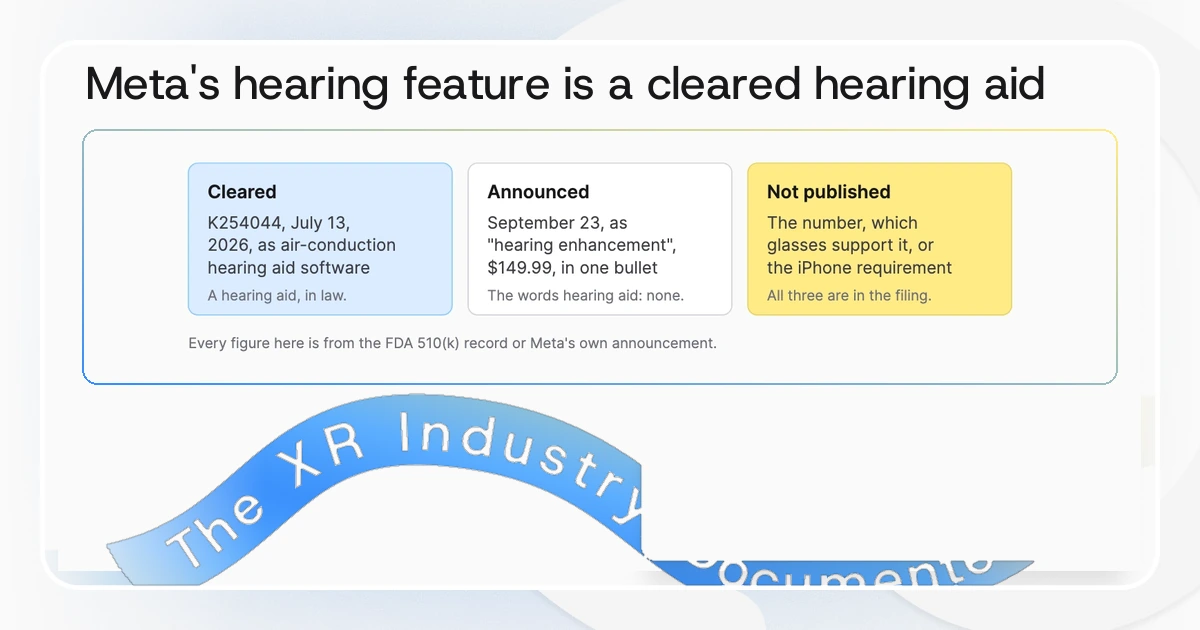
Meta's hearing enhancement is an over-the-counter hearing aid. The FDA cleared it on July 13, 2026 as number K254044, seventy-two days before Meta announced it, under a regulation named air-conduction hearing aid software. Meta's own submission names Apple's AirPods Pro feature as its predicate device, requires an iPhone and claims at least three hours of continuous use.
In short:
- What it is: an over-the-counter, self-fitting hearing aid for adults 18 and older with perceived mild to moderate hearing loss, regulated as Class II software as a medical device.
- What Meta calls it: hearing enhancement, at $149.99 or with a Meta One subscription, launching in the US later in 2026. The words hearing aid do not appear in the announcement.
- The clearance: K254044, decided July 13, 2026, filed December 17, 2025. It was public for ten weeks before the keynote.
- The predicate: Apple. Meta's filing argues its hearing aid is substantially equivalent to Apple's Hearing Aid Feature, the De Novo that created this device category in September 2024.
- What the filing adds: an iOS phone is required, Android is a planned change rather than a shipped one, and the clinical evidence is a 142-person trial.
Where did Meta announce hearing enhancement?
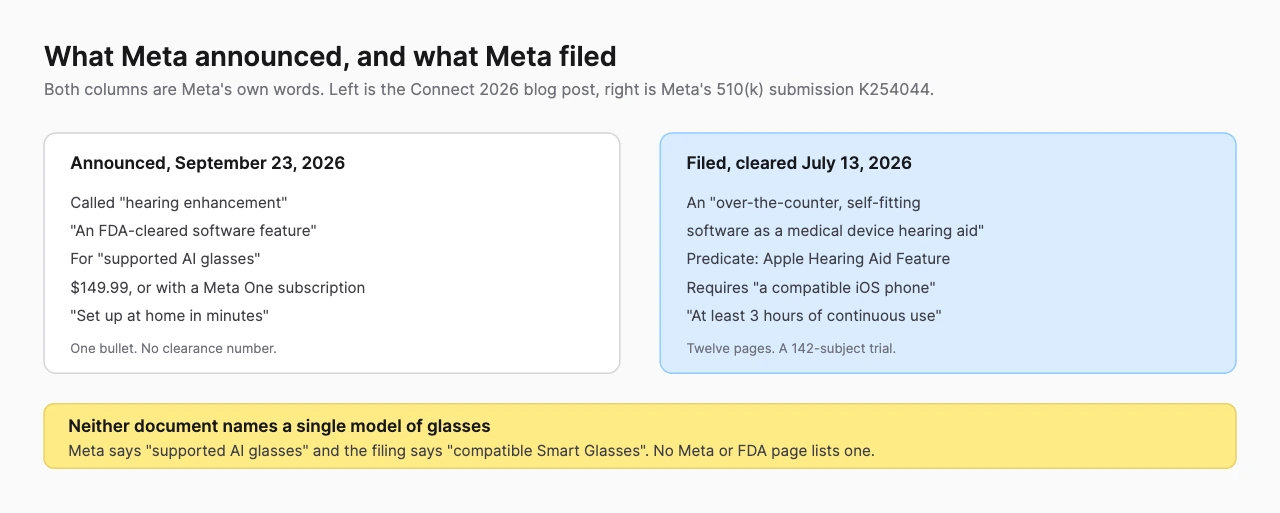
Meta announced hearing enhancement in a single bullet on one page. Its Connect 2026 roundup describes "onboard hearing assistance" as "an FDA-cleared software feature that helps adults 18 and older with perceived mild to moderate hearing loss hear better, coming to supported AI glasses," set up "at home in minutes, no clinic or prescription needed," at $149.99 to add to supported AI glasses or included with a Meta One subscription. A footnote on the same page states it is eligible for HSA or FSA reimbursement.
That bullet is the whole of it. Meta's newsroom post introducing the day's glasses, Introducing Ray-Ban Meta Audio and More AI Glasses Styles, does not mention hearing at all. Neither does the matching post on Meta's own blog. Read in full in a browser on September 24, 2026, the Ray-Ban Meta Audio product page contains the word hearing zero times, including in its FAQ, although a camera-free pair of glasses with open-ear speakers is the most obvious candidate for the feature.
So the only regulated medical device Meta cleared this year was announced in one bullet, on the page least likely to be read closely, and it is absent from every product page that would carry it.
Is hearing enhancement a hearing aid?
Yes, in the only sense that carries legal weight. The FDA cleared it under 21 CFR 874.3335, air-conduction hearing aid software, which the FDA defines as "a device that is intended to be used with a compatible wearable hardware platform to compensate for impaired hearing." Meta's own submission is blunter than Meta's marketing: it describes the product as "an over-the-counter (OTC), self-fitting software as a medical device (SaMD) hearing aid."
Meta uses three names for one thing. The marketing calls it hearing enhancement and onboard hearing assistance. The FDA record calls it Hearing assist. The regulation calls it a hearing aid.
The word Meta did choose is the correct one. Cleared is a real and specific status, meaning the FDA agreed the device is substantially equivalent to one already on the market. It is not approval, which is a higher bar reserved for premarket approval applications, and it is not registration, which is only a filing. BestInXR has written before about vendors blurring those four statuses, and this is the opposite case. Meta's adjective is accurate. It is the noun that is doing the softening.
The distinction matters to a reader because the category is defined by its limits. The FDA states that over-the-counter hearing aids are for adults 18 and older with perceived mild to moderate hearing loss and are "NOT for the treatment of severe or profound hearing loss," because they are limited in maximum output. Someone who buys $149.99 of software expecting it to address serious hearing loss has bought the wrong thing, and the regulatory category says so plainly while the announcement does not.
What is K254044, and why is it hard to find?
K254044 is the 510(k) number for the clearance. The FDA received the submission on December 17, 2025 and decided it on July 13, 2026, a 208-day review that concluded Substantially Equivalent. The public record includes the clearance letter and Meta's own twelve-page 510(k) summary, both in one PDF on the FDA's server.
Two things make it easy to miss. Meta publishes no clearance number anywhere, so a reader who wants to check the claim has nothing to search for. And the FDA's index lists the applicant as Meta Platform Technologies, LLC, singular, at 333 Airport Boulevard in Burlingame, California. A database search for Meta Platforms returns no match at all. The summary document inside the same PDF writes the company's name as Meta Platforms Technologies, LLC, with the plural, so the two halves of one filing do not agree on the applicant's name.
None of that is misconduct. It is the ordinary friction of a public record that nobody links to, and it is the reason a claim announced as FDA-cleared went a full day without anyone publishing what was cleared.
Why does Apple appear in Meta's filing?
Because Apple created the category Meta filed into. On September 12, 2024 the FDA granted Apple's De Novo request DEN230081 for the Hearing Aid Feature, which established product code SCR and regulation 874.3335. A De Novo creates a new classification where no predicate exists. Every subsequent clearance in the category, Meta's included, is measured against it.
Meta's submission names the predicate device explicitly: "Device Name: Apple Hearing Aid Feature (HAF). 510(k) Number: DEN230081. Manufacturer: Apple Inc." Its conclusion states that Hearing assist "is as safe and effective as the predicate device (Apple HAF)." The comparison table in the filing runs Meta's device against Apple's row by row, and on indications for use, patient population, product code, regulation number and regulatory class it records Same as predicate.
The company Meta spent the keynote positioning against is the company whose product its hearing aid is legally defined by. That is how the 510(k) pathway works and it is not a criticism of either firm. It is simply not visible from the announcement.
Where does EssilorLuxottica fit?
Meta's own filing points at it. Defending the glasses form factor, the summary states: "A glasses form factor with external speaker and mic placement has been previously cleared by FDA under K243150 (Nuance) under the SCR product code."
K243150 is Luxottica Group S.P.A. of Milan, cleared January 31, 2025 for Nuance Audio Hearing Aid Software. Nuance Audio's own site lists it beside Ray-Ban, Oakley, Persol and LensCrafters as a brand of EssilorLuxottica, which is the same partner that makes Meta's glasses and that Meta's newsroom credits for "our biggest expansion of AI glasses yet."
So the eyewear group manufacturing Meta's frames had cleared hearing aid software in glasses eighteen months before Meta did, under the same product code, and Meta cites that clearance as precedent for its own. Readers tracking who owns what in this category will find the relationship in our XR ownership map.
What did Meta test, and on how many people?
A 142-subject clinical investigation at three sites in the United States, run in two phases. Phase one fitted the devices and took clinical measurements in a lab. Phase two sent participants home for 14 days to use the glasses in their own environments. Subjects were enrolled across three bands by four-frequency pure tone average: no impairment with perceived hearing difficulty at 15 to 25 dB HL, mild loss at 26 to 40 and moderate loss at 41 to 60.
The trial compared a self-fit group against a group fitted by a licensed hearing care professional, and it was designed to show non-inferiority rather than superiority. On the primary endpoint, the International Outcome Inventory for Hearing Aids after 14 days of field use, the self-fit group scored 25.77 and the professionally fitted group 26.81, a mean difference of -1.04 with a 95% confidence interval of -2.28 to 0.24. On the secondary endpoint, speech in noise measured by QuickSIN, mean SNR loss was 4.4 dB self-fit against 4.2 dB professionally fitted. Both endpoints met their non-inferiority criteria. A within-participant comparison found an average 4.8 dB signal-to-noise benefit with the device against without it.
Adverse events are in the record too. Five of 142 participants reported six adverse device effects, of which five were headache and one was tiredness and fatigue, all described as mild and transient with full recovery. Four serious adverse events occurred in two participants, a fall with injury and a cardiac event, both recorded as unrelated to the device or the procedures. One participant withdrew before completion.
This is more clinical evidence than any other feature Meta announced that day, and none of it appeared in the announcement.
What does the filing say that the announcement does not?
Five things a buyer would want, none of them in Meta's bullet.
| Detail | What the filing states |
|---|---|
| Phone requirement | Two software modules are required: a Hearing assist iOS application on "a compatible iOS phone" and firmware on the glasses. Android is not cleared |
| Android | Covered only by a Predetermined Change Control Plan, a pre-agreed path to add it later. It is a plan, not a shipped platform |
| Battery | "At least 3 hours of continuous use on fully charged Smart Glasses," with up to 32 hours from the charging case. Apple's predicate is listed at roughly 4 to 6 hours |
| Frequency response | 232 Hz to 7,809 Hz, against 100 Hz to 10,000 Hz for Apple's device. Both are stated to meet the bandwidth requirement in 21 CFR 800.30 |
| Per-ear control | Volume and sharpness "apply adjustments bilaterally" and "cannot be fine-tuned independently for each ear," though per-ear gain limits bound the result |
One structural detail sits underneath all of those figures. The filing states that the hearing aid software "uses the smart glasses platform hardware (such as microphones and loudspeakers) and software (such as audio processing pipelines and control interfaces)" provided by the glasses, and it describes the glasses themselves as a combination of a Class 1 medical device for vision correction and a general computing platform. The medical device here is software running on consumer audio hardware, which is the same layer that new audio silicon for glasses is being built to compete over.
The iOS requirement is the one that changes a purchase. Meta's glasses are sold to Android and iPhone owners alike, the announcement names no phone, and as cleared the hearing aid runs only with an iPhone. Meta has not said when the Android version arrives.
The three-hour figure deserves care rather than alarm. It describes continuous hearing aid operation, which is a heavier load than audio playback, and it sits beside Meta's separately published up to 12 hours on a single charge for Ray-Ban Meta Audio doing ordinary listening. The two numbers measure different work. They are still the difference between a device worn for an afternoon and one worn for a day.
Other measured figures in the comparison table are mixed rather than uniformly better or worse. Meta records maximum output sound pressure level at 108.6 dB SPL against Apple's 105.93, self-generated noise at 25.2 dBA against 28.2 and harmonic distortion at 2% or less against 1% or less. Latency is listed as 9.25 milliseconds for Meta and 3.15 for Apple, but the filing labels the first device latency and the second median latency, so they are not stated on the same basis and should not be read as a like-for-like gap.
Who else has cleared hearing aid software?
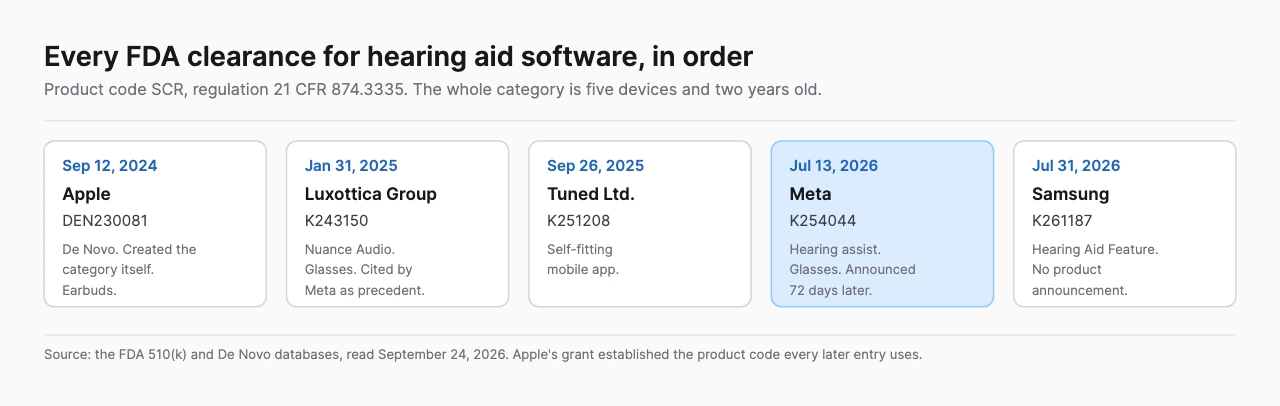
Five devices, all under product code SCR, and the list is short enough to read whole.
| Decided | Number | Company | Device |
|---|---|---|---|
| Sep 12, 2024 | DEN230081 | Apple | Hearing Aid Feature, the De Novo that created the category |
| Jan 31, 2025 | K243150 | Luxottica Group | Nuance Audio Hearing Aid Software |
| Sep 26, 2025 | K251208 | Tuned Ltd. | Tuned Self-Fitting Mobile App |
| Jul 13, 2026 | K254044 | Meta Platform Technologies | Hearing assist |
| Jul 31, 2026 | K261187 | Samsung Electronics | Hearing Aid Feature |
Samsung's clearance landed eighteen days after Meta's and has not been announced as a product either. Two of the five sit in eyewear and three in earbuds or phones, which makes glasses the fastest-growing shape in a category that is two years old in total. For where that sits against the rest of the market, see our guide to AI glasses and smart glasses and the wider smart glasses business guide.
What has Meta still not published?
Which glasses. Meta's announcement says "supported AI glasses" and names none of them, and the FDA filing says "compatible Smart Glasses" without naming a model either. A reader deciding whether the Ray-Ban Meta Audio pair or the Gen 3 pair they are about to buy will run the feature cannot find out from any Meta document.
Meta has also not published a launch date beyond "later this year," a list of supported countries beyond the United States or the clearance number itself. The filing does answer one question Meta left open about how the software will change: the Predetermined Change Control Plan states explicitly that it "does not include provisions for implementation of adaptive algorithms that will continuously learn in the field," and that all algorithm modifications will be locked and validated before release.
That pattern of a specified product with unspecified compatibility is the one this site has measured across the corpus. The full announcement it sits inside is covered in our Meta Connect 2026 roundup.
Frequently Asked Questions (FAQ)
1. Is Meta's hearing enhancement a real hearing aid?
Yes. It is cleared by the FDA under 21 CFR 874.3335 as air-conduction hearing aid software, and Meta's own submission describes it as an over-the-counter, self-fitting hearing aid. Meta's marketing calls it hearing enhancement and does not use the words hearing aid.
2. What is Meta's FDA clearance number for hearing enhancement?
K254044, decided on July 13, 2026. The applicant is listed as Meta Platform Technologies, LLC of Burlingame, California. Meta publishes the number nowhere, and a search of the FDA database for Meta Platforms with an s returns no match.
3. Does Meta's hearing aid work with an Android phone?
Not as cleared. The filing requires a Hearing assist application on a compatible iOS phone alongside firmware on the glasses. Adding Android is covered by a Predetermined Change Control Plan, which is a pre-agreed path to make that change later rather than a shipped feature, and Meta has published no date.
4. How much does Meta hearing enhancement cost?
$149.99 as an add-on to supported AI glasses, or included with a Meta One subscription. Meta states it is eligible for HSA or FSA reimbursement and that it launches in the United States later in 2026. Meta has not named the supported glasses.
5. Which Meta glasses support hearing enhancement?
Meta has not said. Its announcement refers only to "supported AI glasses" and the FDA filing refers only to "compatible Smart Glasses," so no Meta or FDA document currently names a model.
6. How was Meta's hearing aid tested?
In a 142-subject clinical investigation at three US sites, comparing people who set the device up themselves against people fitted by a licensed hearing care professional, with 14 days of use at home. Both the primary endpoint, a standard hearing aid outcome inventory, and the secondary endpoint, speech in noise, met their non-inferiority criteria.