
Virtual Tours: What They Are and How to Evaluate One
A virtual tour either persuades or records, and the two are different products. A communications tour shows a place to recruits, customers or the public and is judged on how it looks. An operational tour is a working record of a facility as it stands, used for planning, induction and remote inspection, and is judged on whether it is accurate.
In short:
- What it is: A navigable representation of a real place, built from 360 degree photography, laser scanning or full 3D modeling.
- What it is not: One product. A recruitment tour and an as-built engineering record have different accuracy requirements and rarely come from the same supplier.
- What decides the shortlist: How the place is captured, what the finished environment supports afterwards, named client evidence and who operates the result.
- What kills tours: No refresh plan. A tour depicting last year's layout stops being used, and nobody tells the person who commissioned it.
What a virtual tour is
A virtual tour is a navigable representation of a real place that someone can move through remotely. It covers 360 degree photography stitched into a walkthrough, laser-scanned point clouds turned into measurable environments and fully modeled 3D scenes built in a game engine.
The technology matters less than the purpose. The same facility can be captured three ways at three price points, and choosing between them is a question about who opens the tour and what they need to do inside it, rather than a question about capture technology.
That single answer eliminates most suppliers. A studio producing beautiful marketing walkthroughs is usually not equipped to deliver a dimensionally accurate as-built record, and a reality capture platform that excels at the second rarely produces something a marketing team wants on a homepage.

Concept3D builds interactive maps and campus experiences, where the tour usually sits alongside a map and an events calendar rather than standing alone.
Four products sold under the virtual tour label
| Product | Bought to | Judged on | Refresh need | Fails when |
|---|---|---|---|---|
| Communications tour | Attract and inform | Engagement, applications | On rebrand or rebuild | It looks dated |
| Operational tour | Record a facility as built | Accuracy against reality | Continuous | It drifts from reality |
| Remote presence | Replace a site visit | Travel avoided | Not applicable | Connectivity is poor |
| Architectural walkthrough | Sell or verify a design | Sales, or problems found | Per design revision | Purpose is not stated |
The distinction that costs the most money is the first two rows. They look similar in a demonstration, differ by roughly an order of magnitude in price, and cannot substitute for one another. A marketing tour asked to serve as an operational record fails at first use, when someone tries to take a measurement and discovers the tour is a series of photographs.

How a place is actually captured
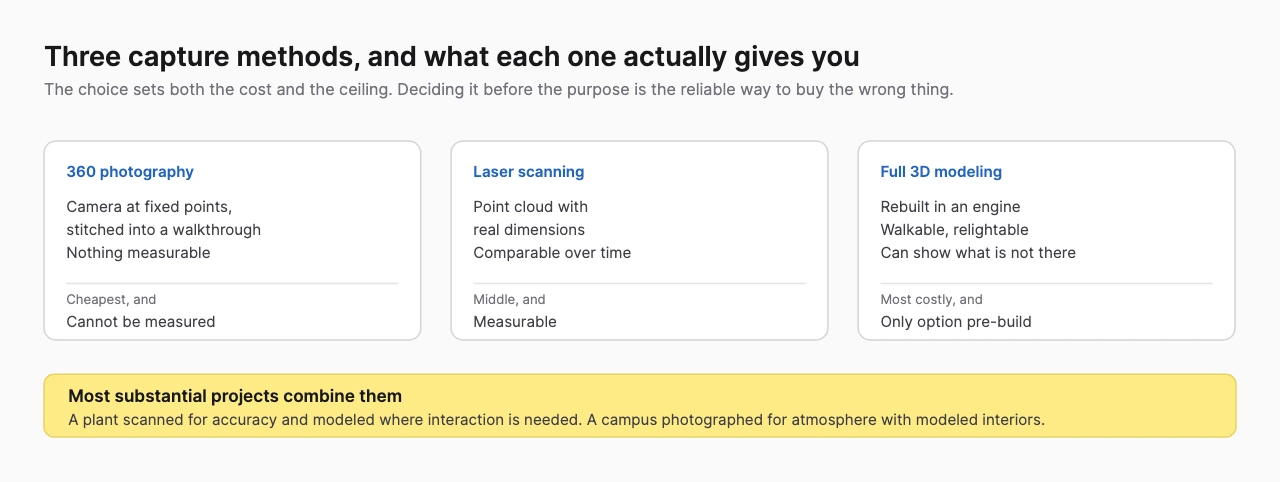
Three methods dominate, and the choice sets both the cost and what the finished tour can do. Deciding it before the purpose is settled is the most reliable way to buy the wrong thing.
360 degree photography places a camera at a series of points and stitches the results into a walkthrough. It is fastest and cheapest, it looks like the real place because it is a photograph of it, and it produces nothing measurable. A viewer can look around from each point but cannot move freely between them or take a dimension off anything.
Laser scanning and reality capture records the space as a point cloud with real dimensions. The output is measurable, which is what makes it useful for engineering, and it is heavier to process and more expensive to collect.
Prevu3D turns reality capture into editable environments, and Cintoo works from scan data with comparison against earlier captures, which is what separates an operational model from a decorative one.
Full 3D modeling rebuilds the place in a game engine, from design files or from scan data. It is the most expensive and most flexible, since a modeled environment can be walked freely, relit, altered and used to show what is not there yet. It is the only option for a building that has not been constructed.
Most substantial projects combine them. A plant might be scanned for accuracy and modeled selectively where interaction is needed. A campus might be photographed for atmosphere with modeled interiors for the buildings that matter most to applicants.
Real estate
Best VR companies for real estate tours splits the market on whether the building exists. Capturing standing property is a per-listing workflow; showing an unbuilt one is a visualization commission, and no supplier is genuinely best at both.
Hospitality and tourism
Best companies for hospitality and tourism VR experiences separates venue capture, destination promotion and built attractions, which sit in three different departments and rarely share a supplier.
The four kinds of tour
Communications and marketing tours
Communications tours exist to make a place appealing to someone who has not visited. They are bought by marketing, admissions and recruitment teams, and their measure is engagement rather than accuracy.
YouVisit works in this segment, where higher education is the largest single buyer. These tours are allowed to flatter. That is the brief, not a criticism.
Best companies for university and campus VR tours ranks the higher education group.
Operational and industrial tours
Operational tours are working records of a facility as it stands, used for planning, contractor induction, remote inspection and maintenance. They are judged on whether they match reality closely enough to make decisions from.
Best VR companies for industrial and factory virtual tours covers this segment, and best VR companies for hazardous and remote site tours covers the case where visiting in person is dangerous or impractical.
The distinguishing question is what happens after handover. A marketing tour is finished when it ships. An operational tour is a record that has to keep matching a facility that changes.
Remote presence and live tours
Remote presence tours are live rather than recorded. Someone walks a site with a 360 degree camera while remote participants look around independently, which suits inspections, audits and client visits that would otherwise require travel.
Avatour works here, where the product is presence at a moment rather than a persistent environment. The business case is the simplest in this guide, because avoided travel already has a price attached.
Architectural and pre-construction walkthroughs
Architectural walkthroughs show a building before it exists, and they split by whether the output sells or verifies.
A marketing walkthrough exists to make a building desirable before it is built, and its measure is sales velocity and price achieved. A verification walkthrough exists to test whether a design works, and its measure is problems found, including unflattering ones.
Neoscape, Mir and Binyan Studios sit on the selling side of that line, which is where most of this market is built. Best companies for architectural and pre-construction walkthroughs ranks the segment, and its practical warning bears repeating. Do not brief a marketing studio to find your design problems.
Who buys virtual tours, and why
Higher education is the largest single buyer, because a campus visit is expensive for the applicant and a tour reaches people who cannot travel. The measure is applications rather than engagement, and admissions teams are usually clear about that, which makes the segment unusually well defined.
Industrial operators buy for access rather than persuasion. A plant that is hazardous, remote or simply busy is expensive to walk, and a tour letting an engineer inspect it without traveling pays back against a cost already tracked. Operational accuracy matters most here and marketing polish matters least.
Property developers and architects buy to sell space that does not exist yet, which is a different problem from representing a place that does. The output is judged commercially, and the studios serving it come from advertising and film rather than software.
Cultural institutions and tourism buy for reach, extending access to people who will never visit. The requirement resembles higher education more than industry, and the same suppliers often serve both.
Magnopus works across cultural and entertainment experiences, which sits at the boundary between a tour and a produced experience, and best companies for custom 3D virtual experiences covers the commissioned end of that market.
Who actually supplies virtual tours
Three kinds of company, and the difference explains most of the spread between quotes.
Platform vendors sell a capture-and-publish product you operate yourself. Concept3D, YouVisit, ThingLink and Avatour sit here. The economics are subscription-based, deployment is fast and the ceiling on customization is whatever the product supports.
Reality capture specialists sell the pipeline from physical space to measurable model. Prevu3D and Cintoo work here, and their model usually assumes recurring capture, which aligns their commercial interest with the thing that most often kills tours.
Studios build a commissioned experience. Neoscape, Mir, Binyan, Magnopus and Treeview sit in this group. You get something shaped to a brief rather than to a product roadmap, at higher cost, with ownership terms that vary enormously.
The mismatch to watch for is a studio quoting an operational requirement, or a platform quoting a bespoke one. Both will produce an honest number for a job that is not quite the one you described.

The three supplier types compared
| Platform vendors | Reality capture specialists | Studios | |
|---|---|---|---|
| You get | A product you operate | A measurable model, recaptured | A commissioned experience |
| Cost shape | Subscription | Per capture, recurring | Project |
| Strongest at | Speed, scale, self-service | Accuracy, change over time | Craft, narrative, bespoke fit |
| Weakest at | Bespoke requirements | Visual polish | Refresh and maintenance |
| Refresh assumption | Built in | Built in | Usually none |
The last row is the one that predicts abandonment. Two of the three business models assume you will come back. The third assumes a finished deliverable, which is correct for a marketing tour and wrong for an operational record, and buying the third while needing the first two is the most common structural mistake in this market.
Which platforms do tours run on?
Most operational and architectural work is built on Unity or Unreal Engine, while communications tours frequently run in a browser with no game engine at all. Reality capture platforms sit alongside both, handling scan data an engine cannot ingest directly.
Browser delivery matters more than headset support in this category, because most tours are opened on a phone or laptop. Performance on a mid-range phone over a mobile connection is the test that predicts whether a tour gets used, and it is rarely the test a demonstration is designed to pass.
How long does a virtual tour take?
Weeks for a photographic tour of an accessible building. Months for a scanned record of an operating facility. The variable is almost never the processing.
Site access sets the schedule for anything operational. A working plant grants capture windows around production, and those windows are the constraint rather than the scanning time. Permits, escorts and safety inductions add to it, and a supplier who has worked in your sector will build them into the plan.
Content assembly sets the schedule for communications tours, because someone has to decide what the tour says, in what order, and that is an editorial process owned by the buyer. Admissions tours in particular stall on copy and stakeholder review rather than on capture.
Approval is the third. A tour showing a workplace shows the people in it, and organizations increasingly want a view on privacy, likeness and what is visible in the background of a scan. Raising that early is cheaper than reshooting.
What virtual tour projects have to account for
Naming the audience and the purpose. Write down who opens the tour, how often and to do what, before choosing a supplier. That single answer eliminates most of the market. The question sounds obvious and is skipped constantly: a tour commissioned because a competitor has one has no audience defined, and it is the kind that quietly stops being linked from anywhere.
The refresh cycle. Facilities change, and a tour depicting last year's layout stops being trusted. Decide at the outset how often it is recaptured, who does it and what that costs. Platforms built around recurring capture price for it. Studios that build a commissioned environment often assume no refresh at all, which is why so many operational tours are abandoned within two years.
What the environment supports afterwards. Measurement, annotation, linking to asset records and exporting to other tools are what turn a tour into a working record, and they are not present by default. A tour that only supports looking is a communications product, whatever budget it came from.
Who operates the result. Some suppliers hand over an environment the client maintains. Others operate it as a service. Others provide a platform and expect the client's team to capture and publish.
Treeview publishes full transfer of IP, source code and assets, which matters most for custom-built environments rather than platform subscriptions.
What does a virtual tour cost?
Published pricing is rare and the range across the four types is wide enough that a single figure would mislead. What can be said is which decisions drive it.
| Cost driver | Scales with | Usually in the quote | Notes |
|---|---|---|---|
| Capture method | Photography, scanning or modeling | Yes | The gap between methods is a multiple, not a margin |
| Area and complexity | Floor area, number of spaces, detail | Yes | A campus is not a building |
| Site access | Shift patterns, permits, escorts | Rarely | Access windows set the schedule, not scanning time |
| Interactivity | Number of features beyond looking | Sometimes | Measurement and annotation are additions |
| Hosting and recapture | Refresh frequency, viewers | Rarely | Absent from most one-off marketing quotes |
Site access is the driver buyers most often overlook. Scanning a plant that runs three shifts is not the same job as scanning an empty warehouse, and the schedule is set by when the supplier is allowed in.
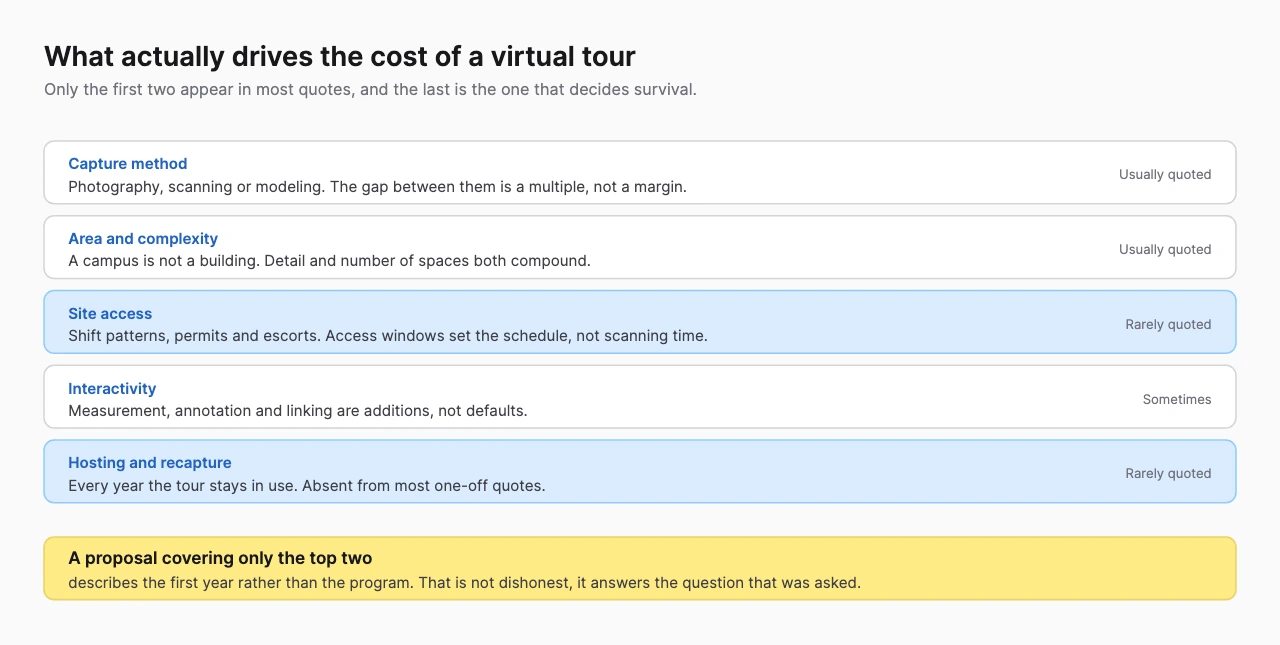
A one-off marketing tour has no recurring cost. An operational record has capture, hosting and update costs every year it stays in use, and a proposal omitting them describes the first year rather than the program.
What the handover includes
Ask for the list before signing, because it varies more than buyers expect. A tour delivered as a hosted link is a different asset from one delivered as project files, and the difference only becomes visible when you want to change something.
Three things are worth naming explicitly. The source capture, meaning the raw scans or photography rather than the published output, since without it any future update means recapturing from scratch. The project or engine files, which determine whether another supplier could take the work on. And the hosting arrangement, including what happens if the subscription lapses.
None of this is exotic, and reputable suppliers answer it readily. It is simply the category where the question is asked least often, because a tour feels like a finished thing rather than a maintained one.

What keeps a virtual tour useful
A named owner. A tour commissioned by a manager who then changes role loses its refresh budget and its place in anyone's week. It stays online, diverging from the place it depicts, until someone notices it shows a building that has been demolished.
Scope bought from the right column. An operational requirement served by a communications tour looks fine at handover and fails at first use. The reverse also happens: a scanned point cloud delivered to a marketing team that wanted something attractive.
A priced refresh cycle. Suppliers quote what was asked for, so a buyer who raises recapture gets it in the quote. A program priced for year one alone has no second year budget.
Phone-first delivery. Most tours are opened on a phone or a laptop. A supplier demonstrating only in VR should be asked how the same tour performs on a phone, since that is how nearly everyone will see it.
All four are decided before a supplier is chosen, which is why the audience and purpose question sits at the top of this guide rather than in a procurement section.
What happens to a tour after launch
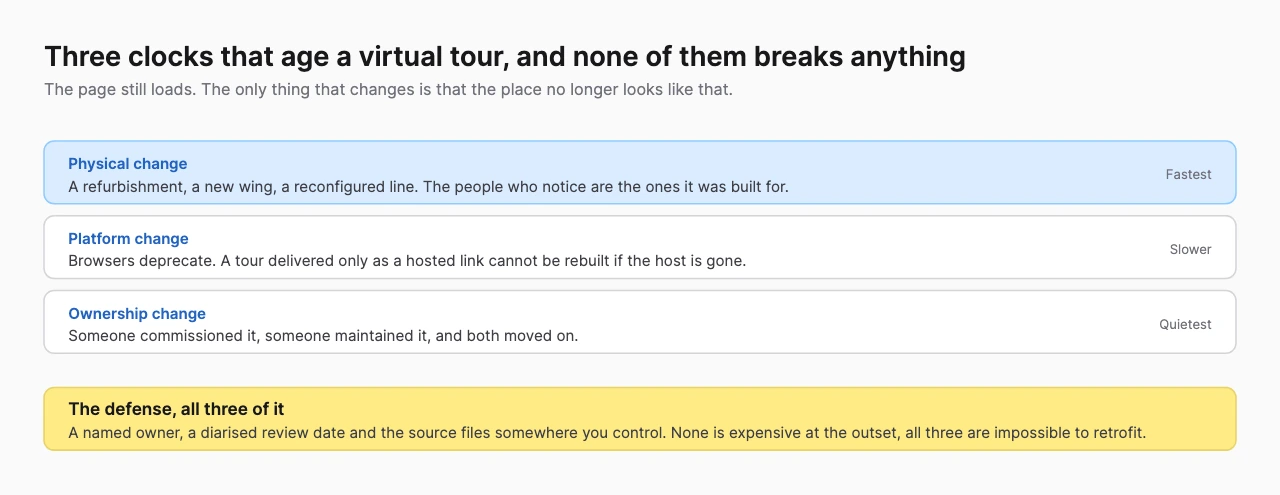
Tours decay in a way that is easy to miss, because nothing breaks. The page still loads, the images still render, and the only thing that changes is that the place no longer looks like that.
Physical change is the first clock. A refurbishment, a new wing, a reconfigured production line or a rebrand all age a tour instantly, and the people who notice are the ones it was built for. An applicant who arrives to find the building looks nothing like the tour has learned something about the institution that no amount of production value offsets.
Platform change is the second. Browsers deprecate, plugins die and a tour built on a technology that mattered five years ago may simply stop working. Tours delivered as project files can be rebuilt. Tours delivered only as a hosted link cannot, if the host is gone.
Ownership change is the third and the quietest. Someone commissioned it, someone maintained it, and both moved on. There is rarely a moment where a tour is decided against, only a series of moments where nobody decides for it.
The defense is unglamorous: a named owner, a diarised review date and the source files somewhere you control. None of the three is expensive at the outset and all three are impossible to retrofit once the supplier relationship has lapsed.
What you can check, and where
| Claim type | Checkable from a primary source | Where to check it |
|---|---|---|
| Named client tours | Usually | The tour itself is normally public |
| Capture method | Usually | Supplier documentation, or ask |
| Platform and browser support | Usually | Try it on a phone |
| Accuracy tolerances | Sometimes | Scanning suppliers publish, studios rarely do |
| Hosting and continuity terms | Rarely published | Ask directly, then put it in the contract |
| Headcount and project counts | Rarely | Self-reported directory profile fields, unaudited |
| Pricing | Rarely | Platform vendors sometimes, studios almost never |
This category has one unusual advantage for a buyer: the product is normally public. A supplier's published tours can be opened, on a phone, on a slow connection and judged directly. That is a stronger check than most markets allow, and it is worth doing before a meeting rather than after one.

No primary source exists for market size or adoption statistics in virtual tours. Figures circulating in vendor material trace to commercial research whose methodology is not public, and this site does not repeat them.
How the rankings below were built
Every list linked here ranks on four published criteria and states what is not a ranking factor, set out in each post under How this list was built.
Across the tour lists the recurring four are how the facility is captured, what the finished environment supports afterwards, named client evidence and who operates the result. Pricing is generally not a ranking factor, because most suppliers publish no rates and the ones that do are platform vendors whose model is not comparable to a studio's.
The methodology page sets out how entries are assessed.
Where to start
Write down who opens the tour and what they need to do inside it, then read the list covering that purpose.
- Top virtual tour companies
- Best companies for custom 3D virtual experiences
- Best VR companies for industrial and factory virtual tours
- Best companies for university and campus VR tours
- Best VR companies for hazardous and remote site tours
- Best companies for architectural and pre-construction walkthroughs
- Best VR companies for real estate tours
- Best companies for hospitality and tourism VR experiences
The directory lists developers, platforms and software with sourced entries, and the digital twins guide covers what happens when a tour acquires a live data connection.
Related reading
Each of these covers one part of this subject in depth, with the suppliers ranked on criteria stated in the post.
Frequently Asked Questions (FAQ)
1. What is a virtual tour?
A virtual tour is a navigable representation of a real place that someone can move through remotely, built from 360 degree photography, laser scanning or full 3D modeling. The purpose rather than the technology determines which approach is appropriate.
2. Which companies build virtual tours?
They divide by purpose. Concept3D and YouVisit work in campus and communications tours, Prevu3D and Cintoo in operational reality capture, Avatour in live remote presence, and Neoscape, Mir and Binyan Studios in architectural visualization.
3. How often does a virtual tour need updating?
It depends entirely on type. A marketing tour is refreshed on a rebrand or rebuild. An operational record of a working facility drifts continuously and needs a defined recapture cycle, and a tour without one tends to be abandoned within about two years.
4. Do virtual tours need a VR headset?
Usually not. Most are opened on a phone or laptop in a browser, and headset support is an addition rather than the default. A supplier demonstrating only in VR should be asked how the tour performs without one.
5. What is the difference between a virtual tour and a digital twin?
A virtual tour lets someone look around a representation of a place. A digital twin connects that representation to live operational data so it reflects current state. Tours are frequently the visual layer of a twin, but a tour on its own carries no live data.
6. Can a marketing walkthrough double as a design review?
Rarely, and briefing one to do both usually produces neither. A marketing walkthrough is built to flatter and a verification walkthrough is built to expose problems, including unflattering ones. Most studios in this market are built for the first.
7. How much does a virtual tour cost?
Published pricing is rare, and capture method is the largest driver: photography is cheaper than scanning, which is cheaper than full modeling, and the gaps are multiples rather than margins. Site access and refresh frequency are the two costs most often left out of a quote.
8. What should you receive at handover?
At minimum the published tour, and ideally the source capture, the project files and a written hosting arrangement. Without the source capture, any future update means recapturing the site from scratch.