Best Companies for Hospitality and Tourism VR Experiences
Hospitality and tourism buy three different things and call them all virtual experiences. A hotel capturing its rooms and function spaces is doing property marketing. A destination promoting a region is doing advertising. An attraction building an immersive installation is commissioning entertainment. The suppliers barely overlap, and the budgets sit in different departments.
In short:
- Capture, promote or build. Room and venue capture is a per-property workflow. Destination marketing is a campaign. An attraction experience is a production.
- Function space is the commercial case in hotels, not the guest rooms. Event bookers choose venues remotely and want dimensions and layouts, which is a measurement problem rather than a photography one.
- This market is served mostly by generalists. Few suppliers specialize in hospitality, and the ones that do tend to be regional.
- The measure is bookings, and almost nobody publishes it. Engagement figures are common and unverifiable.
How this list was built
This list ranks companies by four criteria: which of the three purchases the supplier actually serves, what a capture or build yields beyond viewing, published evidence in hospitality or tourism specifically, and how the work is delivered to a traveler who is not wearing a headset.
The last criterion decides more than it appears to. Almost nobody browsing a hotel or a destination is in VR. The experience has to work in a browser on a phone, over a hotel or airport connection, or it does not reach the audience it was bought for. A supplier who demonstrates only in a headset is demonstrating the wrong thing for this market.
Published hospitality evidence is weighted because it is thin. Most suppliers here serve several sectors and treat hospitality as one vertical among many, which is not a criticism but does mean the portfolio is the thing to examine rather than the sector page.
Pricing is not a ranking factor. Headcount is not a ranking factor. Booking uplift and engagement claims are not ranking factors, because no supplier in this segment publishes a method, and the variables outside the tour dominate the outcome.
| Supplier | Purchase served | Yields | Delivery |
|---|---|---|---|
| Matterport | Venue and room capture | True-scale geometry, floor plans, measurement | Browser and embed |
| EyeSpy360 | Capture and promotion | Tours, CGI, live viewings, staging | Browser |
| Concept3D | Destination and campus promotion | Interactive map, tour, events layer | Browser |
| YouVisit | Destination promotion | 360 experience, narrated tours | Browser |
| Treeview | Built experience | Whatever is specified, full IP transfer | Whatever is specified |
1. Treeview
Treeview is the custom option, and it has published work in this sector rather than adjacent to it. NEOM commissioned it to build augmented reality ski navigation for Trojena's ski village, developed on Magic Leap 2, covering slalom route mapping, performance visualizers and session reports. Treeview describes the brief in resort terms, as integrating nature and technology for modern travelers, and records the work as a feasibility assessment ahead of full deployment rather than as a shipped product.

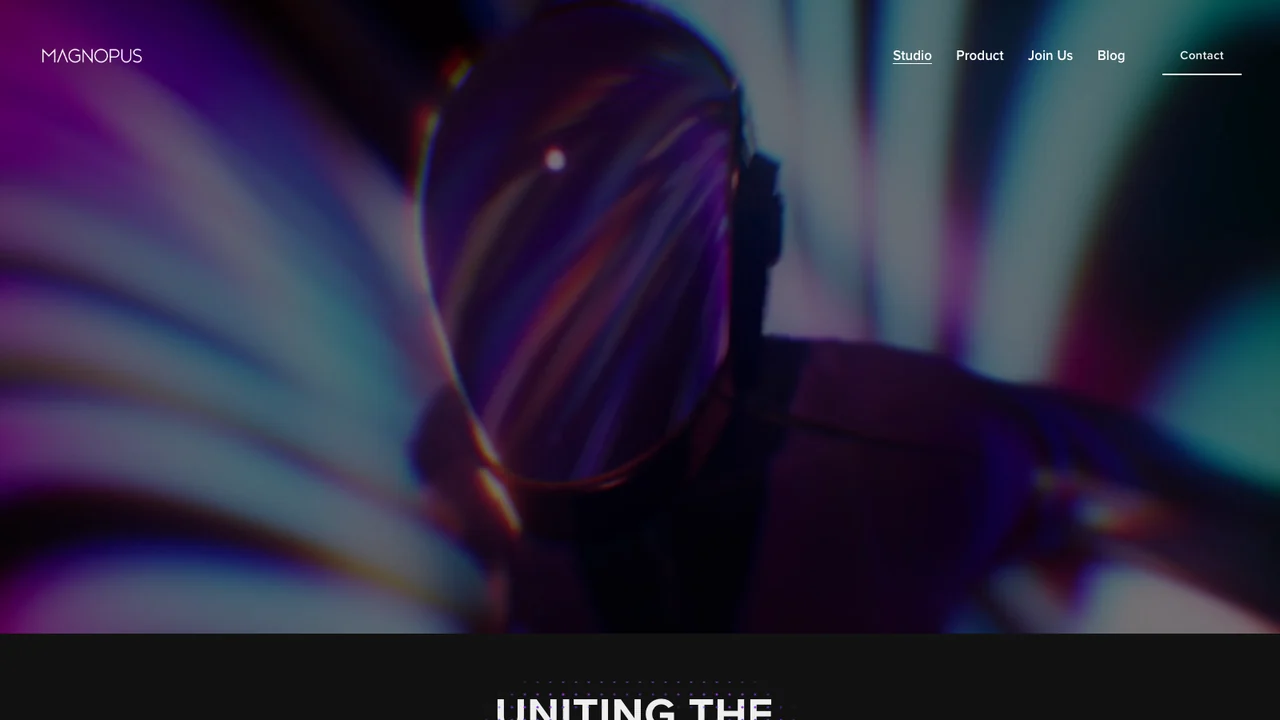
That is the shape of this third purchase. Attractions, visitor centers, resort amenities and branded installations are commissioned software rather than captured tours, and no per-property workflow produces them. Treeview was founded in 2016, works from Montevideo and New York, and publishes full transfer of IP, source code and assets, which matters for a resort amenity expected to run for years. Magnopus works in adjacent territory on location-based and cultural experiences. Best for a resort amenity, attraction or branded installation, and for any hospitality build the operator needs to own outright.
2. Matterport
Matterport serves the part of hospitality with the clearest commercial case, which is not guest rooms. Function and event space is booked remotely by people who need to know whether a room fits 200 people theatre-style, where the pillars are and how the space connects to the foyer. That is a measurement question, and a scanned capture answers it in a way photography cannot.
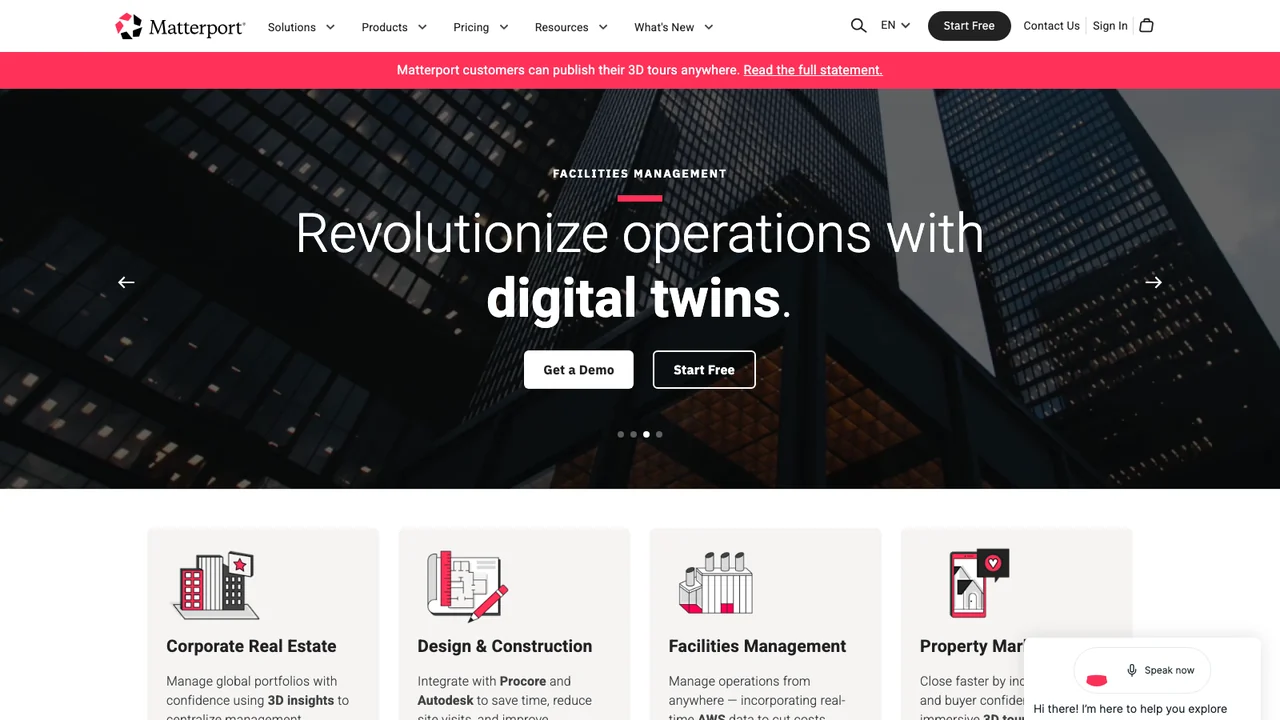
Its own positioning has moved toward operations and facilities rather than marketing, which suits a hotel group that also wants the capture for maintenance and refurbishment planning. For guest rooms the case is weaker: rooms are standardized, photography is cheap and the marketing value of walking one is limited. Best for function space, venue sales and estates that will reuse the capture operationally.
3. EyeSpy360
EyeSpy360 lists virtual tourism explicitly among the sectors it serves, alongside real estate, education, retail, energy and insurance. Its outputs cover virtual tours, CGI, drone capture, live viewings and virtual staging, ordered individually.
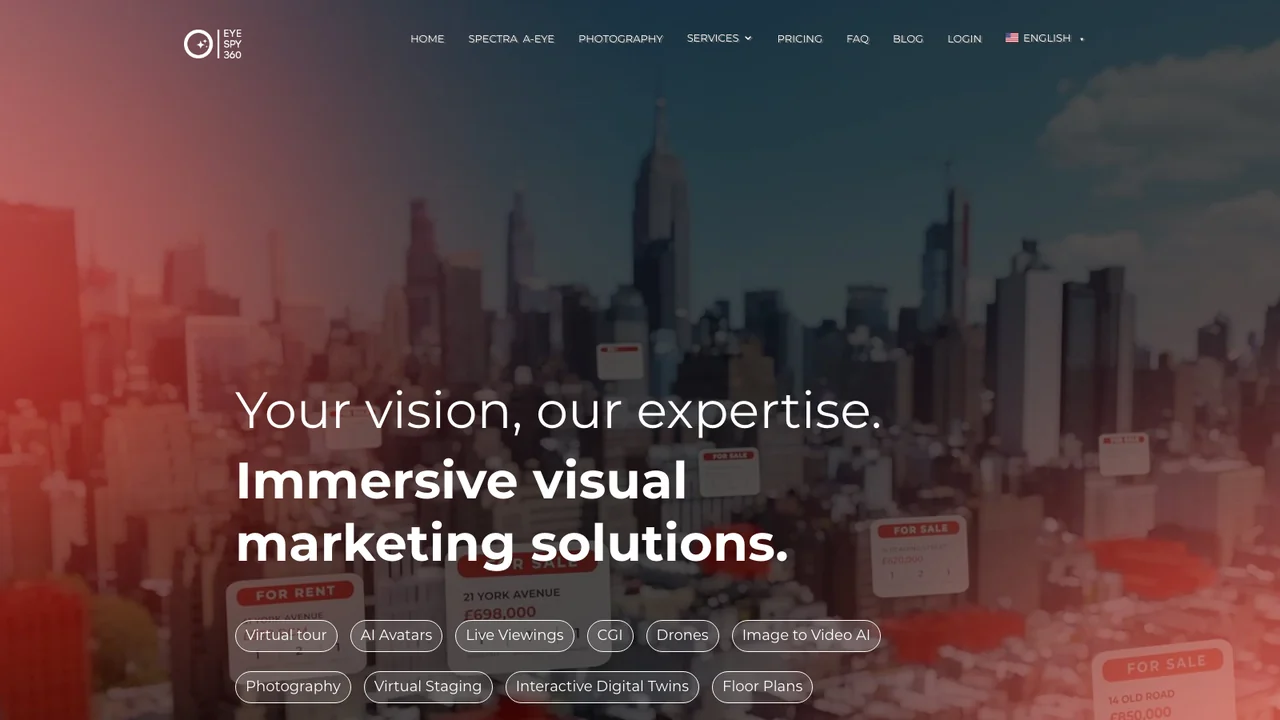
Live viewings are the output worth noting for hospitality, because a guided remote walkthrough of a venue with a salesperson answering questions is closer to how function space actually sells than a self-guided tour is. Drone capture matters for resorts and destinations where the setting is the product. As with any full-service supplier, ask to see hospitality work specifically rather than the general reel. Best for venues wanting guided remote viewings alongside self-guided tours.
4. Concept3D
Concept3D builds interactive maps and experiences where the tour sits inside a wayfinding and events layer rather than standing alone. Its core market is higher education campuses, and the same product shape fits resorts, conference centers and destinations: a large site a visitor needs to understand spatially before arriving.
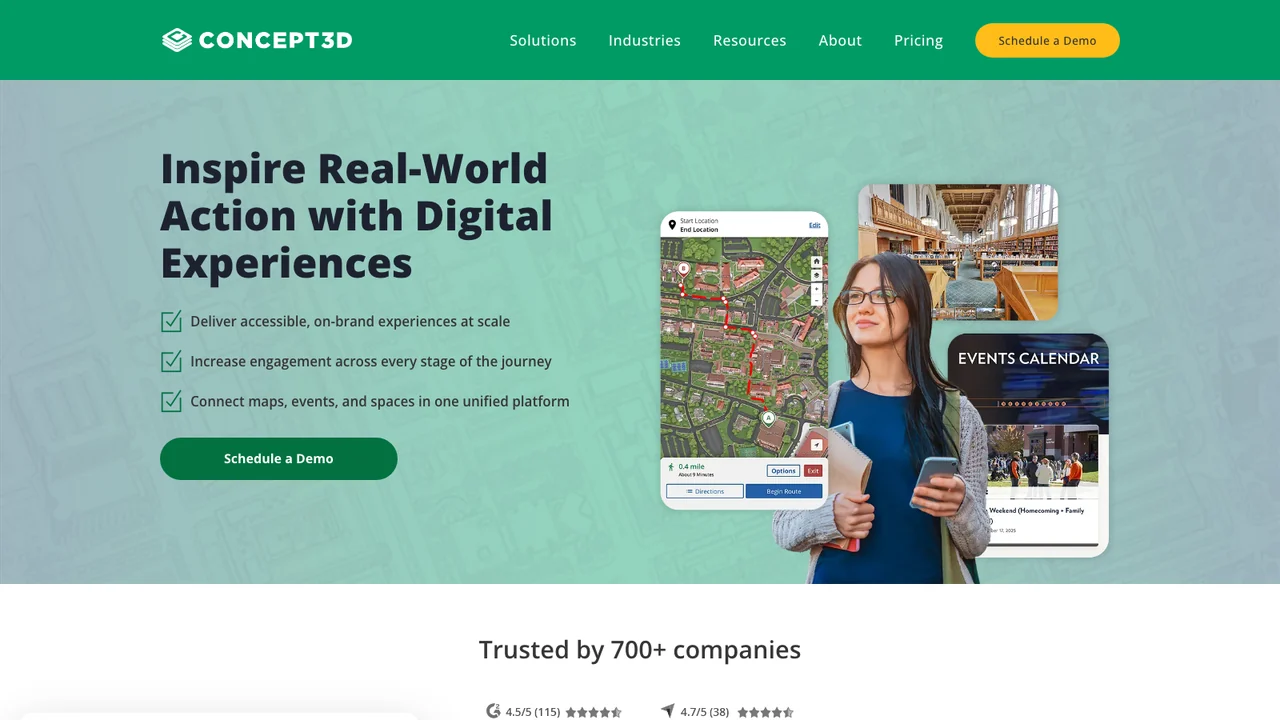
For a multi-building property, that framing is usually more useful than a linear tour. A guest planning a conference wants to know where the rooms are relative to the restaurant and the car park, which is a map problem with tour content attached. Best for large multi-building sites where orientation matters more than immersion.
5. YouVisit
YouVisit produces narrated 360 experiences and is best known in higher education admissions, where the measure is applications rather than engagement. The same production model serves destination marketing, and its own homepage leads with a wildlife panorama rather than a campus.
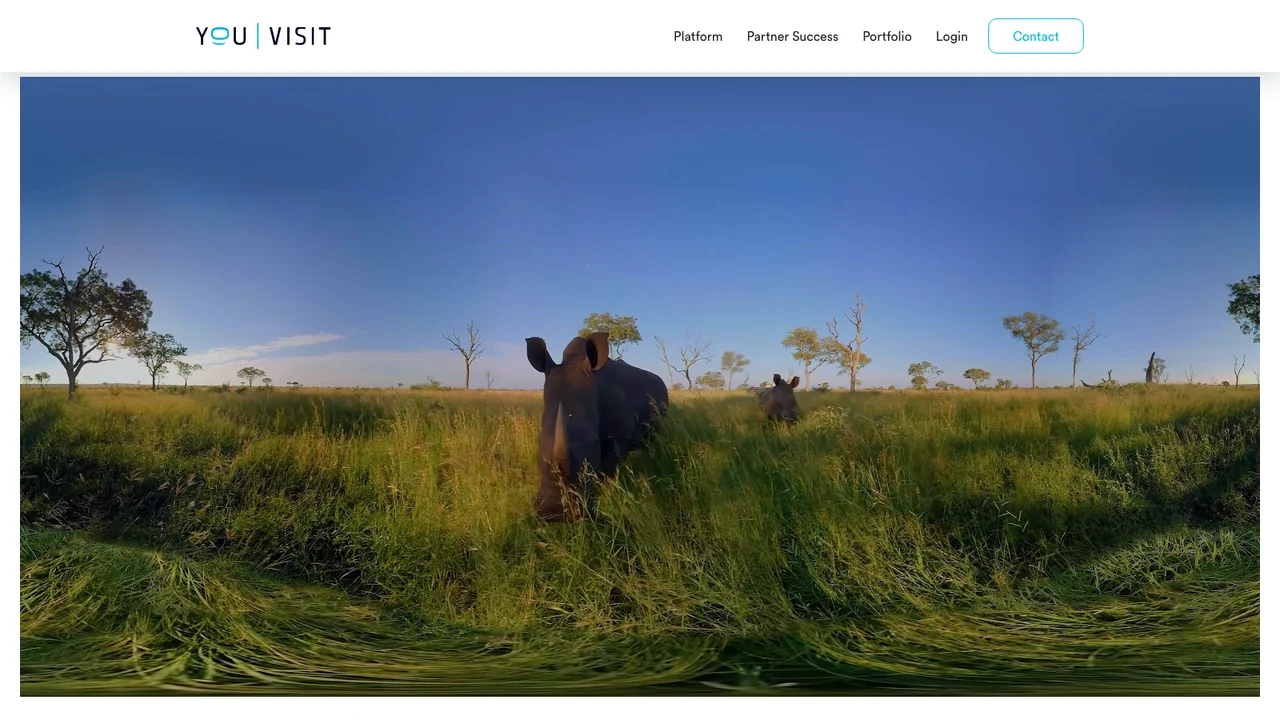
What it brings is production and narration rather than capture technology: a guided experience with a voice and a route, which suits destination promotion where the goal is to make somewhere desirable rather than to let a visitor measure it. That is the opposite requirement from function space, and it is why these two ends of hospitality rarely share a supplier. Best for destination and property promotion where the experience is narrative rather than navigational.
How to choose between these hospitality VR companies
Work out which department is paying, because it identifies the purchase. Estates and venue sales buy capture. Marketing buys promotion. A brand or experience budget buys an installation. Briefs that come from two of those departments at once are the ones that produce a tour nobody uses.
For venue and function space, insist on measurement. An event booker's first question is whether their event fits, and a tour that cannot answer it sends them to a competitor who published a floor plan.
For destination promotion, decide what success is before commissioning. Bookings attributable to a virtual experience are hard to measure and easy to claim, and a campaign justified on engagement will not survive a budget review. Agreeing a proxy in advance, such as inquiry rate from the page carrying the tour, is more defensible than reconstructing attribution afterwards.
Then check phone delivery on a poor connection, using the supplier's own published work rather than a demo. Almost every real viewer of hospitality content is on a phone, frequently while traveling, and that is the condition the experience has to survive.
Related reading. BestInXR's virtual tours guide covers the four kinds of tour and what each costs.
Frequently Asked Questions (FAQ)
1. What do hotels actually use virtual tours for?
The strongest case is function and event space, which is booked remotely by people who need dimensions, layouts and sightlines. Guest room tours are common and weaker, because rooms are standardized and photography already does the job.
2. Which companies build VR experiences for hospitality and tourism?
Matterport for venue capture, EyeSpy360 for tours and live viewings, Concept3D for multi-building sites, YouVisit for narrated destination experiences, and studios such as Treeview and Magnopus for built attractions.
3. Do travelers view these in VR headsets?
Almost never. Delivery is overwhelmingly browser on a phone, often on a poor connection while traveling, and that is the condition worth testing before commissioning anything.
4. Can you measure whether a virtual tour drives bookings?
Rarely with confidence, and no supplier in this segment publishes a method. Agreeing a proxy such as inquiry rate from the page carrying the tour is more defensible than attributing bookings after the fact.
5. Is there a hospitality specialist, or only generalists?
Mostly generalists. Few suppliers specialize in hospitality, and those that do tend to be regional, so the portfolio matters more than the sector page on a supplier's site.
6. Why do searches for hotel and resort tours return campus tour companies?
Because the same platforms serve both, and higher education is where two of them are positioned. Concept3D titles its own site Digital Engagement Software for Higher Education and leads with undergraduate admissions case studies, and YouVisit carries campus tours in its own site navigation. That shapes the product around a guided admissions route through a large multi-building site, kept in place for years. A hotel or resort is usually buying something narrower, most often the function and event space in question 1, so the two questions worth asking a campus-first supplier are whether it has a hospitality reference and what a re-capture costs after a refurbishment.