
Best VR Companies for Real Estate Tours
Real estate tours divide on whether the building exists. Capturing a property that stands is a photography and scanning workflow priced per listing. Showing a building that does not exist yet is a visualization commission priced per project, and it is a different industry with different suppliers. This list ranks five across both.
In short:
- Existing property is a volume business. Per-listing pricing, fast turnaround and a tour that is one output among floor plans, stills and a property page.
- Pre-construction is a commission. Priced per project, produced by studios from advertising and film, and judged on sales velocity rather than accuracy.
- Measurement is the dividing line. A scanned capture yields true-scale geometry and a floor plan. A stitched panorama does not, and for off-plan sales that distinction becomes a legal one.
- Cupix is not on this list. It repositioned to construction and facility management 4D digital twins.
How this list was built
This list ranks companies by four criteria: whether the subject exists or is being visualized, what the capture actually yields, how the work is priced and what the buyer receives beyond the tour itself.
Existence is weighted first because it separates two businesses that share a label. An agent listing a flat needs a repeatable per-property workflow that produces a tour, a floor plan and marketing stills from one visit. A developer selling off-plan needs images persuasive enough to close a sale on something unbuilt, and accurate enough not to create a problem when it is built.
What the capture yields is weighted second, because it is checkable and it decides reuse. A LiDAR or structured scan produces true-scale geometry that supports measurement and a floor plan. A stitched panorama produces a viewing experience and nothing measurable, which is fine for marketing and useless for anything else.
Pricing is not a ranking factor, though it is unusually well published in this segment compared with the rest of the directory, because per-listing products list rates. Headcount is not a ranking factor. Conversion and engagement claims are not ranking factors, because none of the suppliers publishes a method behind them.
| Supplier | Subject | Capture yields | Priced |
|---|---|---|---|
| Matterport | Existing property | True-scale 3D, measurement, floor plans | Subscription and per-capture |
| Giraffe360 | Existing property | HDR stills, LiDAR floor plans, tour, property site | Per listing, hardware included |
| EyeSpy360 | Existing and rendered | Tours, floor plans, CGI, virtual staging | Per output |
| Neoscape | Pre-construction | Rendered film, stills, interactive | Per project |
| Treeview | Whatever is specified | Whatever is specified | Per project, full IP transfer |
1. Matterport
Matterport is the reference point for scanned property capture, and its own positioning has moved beyond real estate: its site now leads on operations and digital twins, with corporate real estate, design and construction, facilities management and property marketing as separate solution areas.
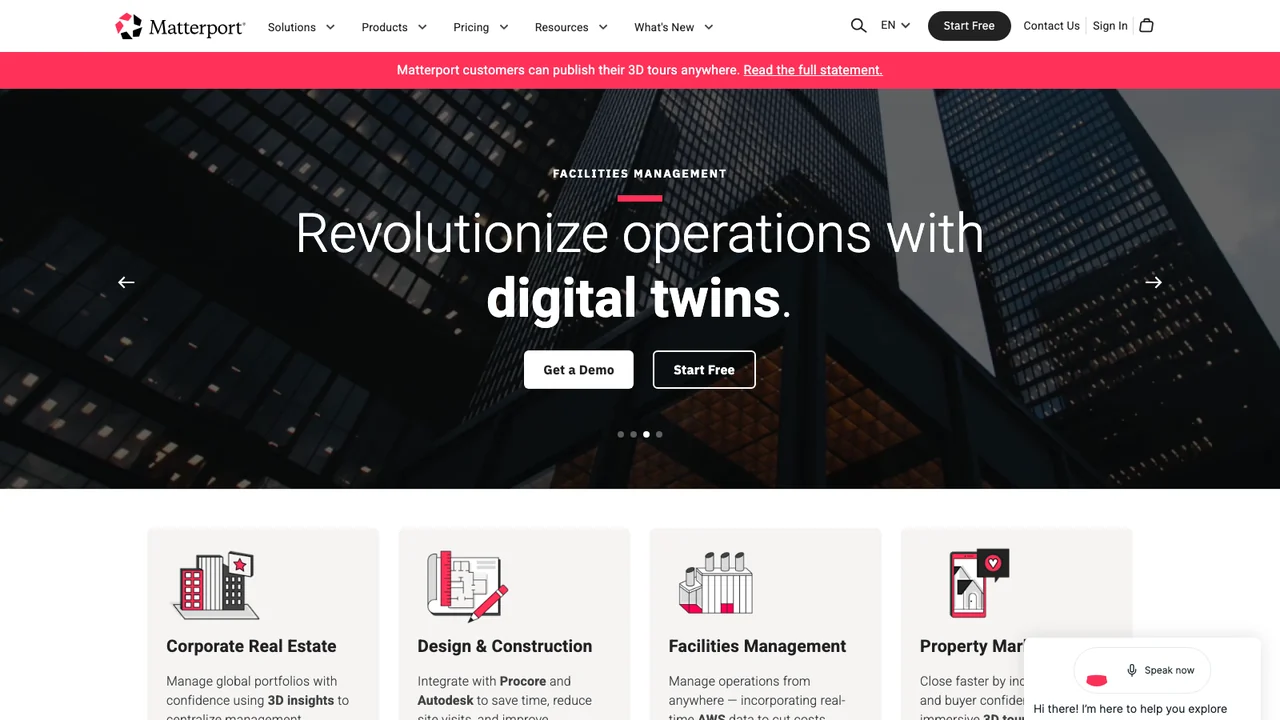
For an agent or property manager, what matters is that the capture yields true-scale geometry rather than a set of linked photographs. That supports measurement, floor plan generation and reuse for facilities purposes after the sale, which is why the same capture serves marketing and operations. The trade is that it is a platform relationship with recurring cost rather than a per-listing purchase. BestInXR's virtual tours guide sets out why capture method decides everything downstream. Best for portfolios where the capture will be reused beyond the listing.
2. Treeview
Treeview is the option for property work that is a software product rather than a listing output. Its published NEOM Trojena project, a mixed reality navigation build for a resort development, is the closest thing in this list to a large scheme's bespoke experience.
Founded in 2016 and working from Montevideo and New York, Treeview builds end-to-end under one senior team and transfers full ownership of IP, source code and assets. Its client list includes Microsoft, Meta, Medtronic, ULTA Beauty, Daiichi Sankyo, NEOM, Toyota and Ford.

The case is a development marketing experience that is not a tour at all: a sales-suite installation, a configurator for unit finishes or an interactive masterplan for a large scheme. Those are software products rather than listing outputs, they run for the years a scheme takes to sell, and ownership of the source decides whether they can be updated as phases release. For per-unit listing production the specialists above are faster and cheaper. Best for a large development requiring a bespoke sales experience rather than per-unit tour production.
3. Giraffe360
Giraffe360 is built for the listing workflow specifically. It supplies a 360 camera alongside an editing platform, and its stated output from a single capture is HDR photographs, floor plans, a virtual tour, video and a property website. It states that over 10,000 real estate professionals use it.
The detail that matters operationally is the capture claim: 10k HDR stills and panoramas plus a point cloud, which is what allows the LiDAR-accurate floor plans it advertises. Its AI editing includes virtual staging, sky replacement, object removal and privacy blurring, the last of which is a practical requirement in occupied properties that agents discover late. Best for an agency doing volume listings that wants one visit to produce the entire marketing kit.
4. EyeSpy360
EyeSpy360 spans both halves of this market, offering virtual tours, live viewings, CGI, drone capture, virtual staging, floor plans and interactive digital twins as separate orderable outputs. It lists real estate and construction alongside virtual tourism, education, retail, energy and insurance as sectors served.
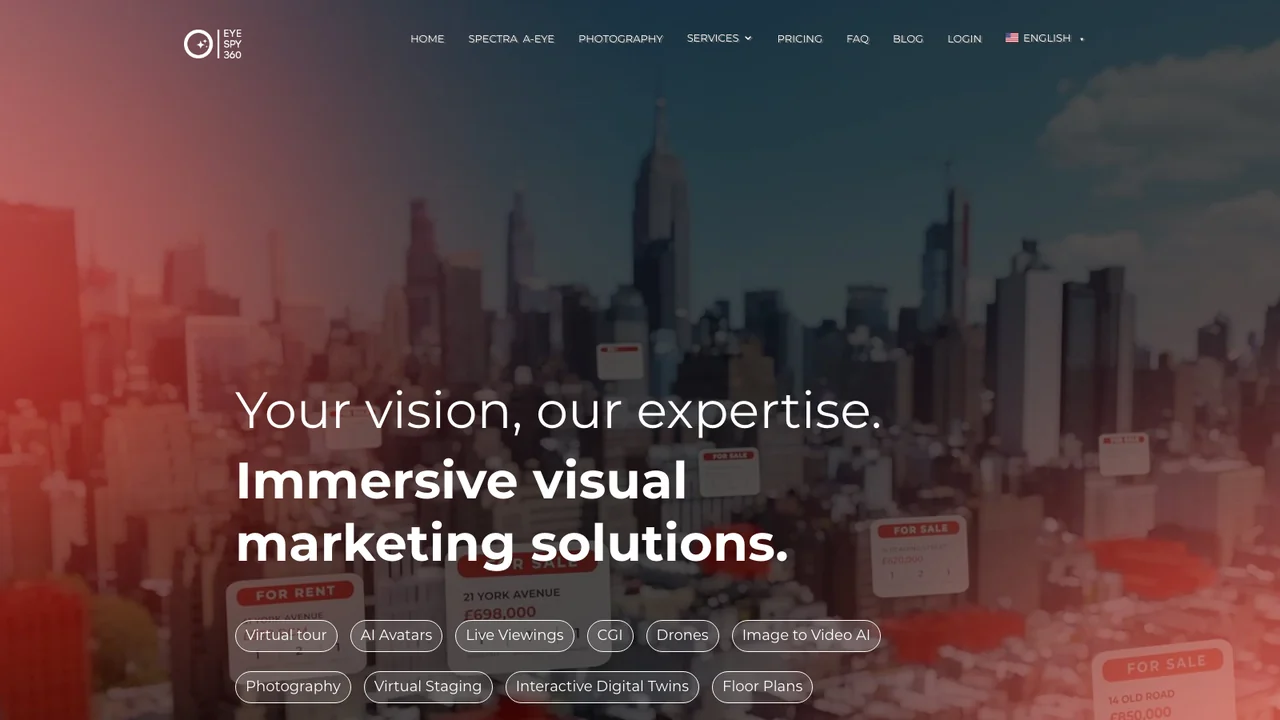
The breadth is the offer: a single supplier for capture and for rendering, which suits a developer or agency that needs both an existing-stock workflow and off-plan imagery without managing two relationships. Breadth is also the thing to test, because a full-service provider is rarely the strongest at every output. Ask to see work in the specific output you are buying rather than the showreel. Best for an operation needing both capture and CGI from one supplier.
5. Neoscape
Neoscape sits firmly on the pre-construction side, producing renderings, films, brands and digital experiences, and states it has been doing so for over 30 years. Buildings that do not exist are sold on imagery, and the studios that produce it come from advertising and film rather than from software.
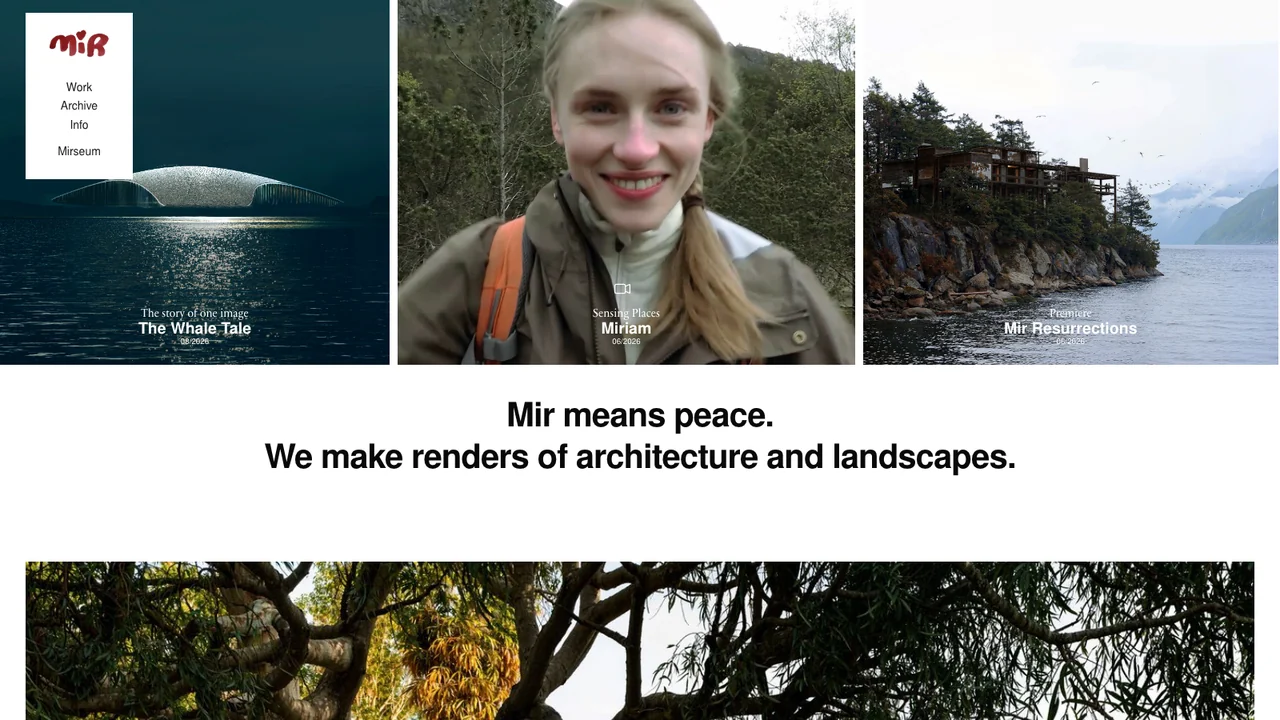
The distinction BestInXR's architectural walkthrough list draws applies directly here: a marketing walkthrough exists to make a building desirable and is allowed to flatter, while a verification walkthrough exists to find problems. Neoscape and peers such as Mir are built for the first. Do not brief them for the second. Best for off-plan sales and marketing where the image has to sell before anything is built.
Who else was considered, and where each fits
Cupix appears on lists of real estate virtual tour providers. Its current positioning is construction and facility management: it describes itself as a spatial intelligence platform turning 360 video into 4D digital twins, aimed at general contractors, owners and operators across construction, oil and gas, manufacturing and government. Tracking site change over time is a different product from marketing a listing, and it should be evaluated against BestInXR's digital twins guide rather than against tour suppliers.
How to choose between these real estate tour companies
Decide first whether the building exists, because that determines which half of the market you are in and no supplier is genuinely best at both.
For existing stock, ask what the capture yields rather than what the tour looks like. If you will ever need a floor plan, a measurement or a reusable record, you need scanned geometry rather than stitched panoramas, and the price difference is smaller than the difference in what you can do afterwards.
For off-plan, agree what the imagery is allowed to imply. Renderings sell, and they also become the basis on which a buyer believes they know what they are purchasing. That is a commercial and occasionally legal question, and it is settled with the marketing team and legal rather than with the studio.
Then check who owns the capture. Per-listing products often retain hosting, which means the tour disappears if you stop paying. For a listing that is fine. For a development sold over three years it is not.
Frequently Asked Questions (FAQ)
1. What is the difference between a scanned tour and a 360 photo tour?
A scanned capture produces true-scale geometry, which supports measurement, floor plan generation and reuse. A 360 photo tour produces a viewing experience with nothing measurable behind it. For marketing either works; for anything downstream only the first does.
2. Which companies make virtual tours for real estate?
Matterport and Giraffe360 for capturing existing property, EyeSpy360 for both capture and rendering, and Neoscape and Mir for pre-construction visualization.
3. Can one supplier do both existing property and off-plan?
Some offer both, and breadth is rarely matched by equal strength in each. Ask to see work in the specific output you are buying rather than a general showreel.
4. Does Cupix do real estate tours?
Its current positioning is construction and facility management 4D digital twins rather than property marketing. It is aimed at contractors, owners and operators tracking site change over time.
5. What happens to a tour if you stop paying?
With per-listing and subscription products, hosting usually stops with the subscription. That is acceptable for a listing that sells in weeks and a problem for a development marketed over years, so it is worth establishing before the first capture.