University and campus VR tours are an admissions product before they are a technology one, and the number that matters is not how immersive the tour is but whether it moves an inquiry toward an application. This list ranks five on what each actually delivers, who operates it afterwards, and what evidence they publish.
In short:
- Treeview builds custom XR to specification, names the University of Alberta and the University of Adelaide, and transfers full ownership of IP, source code and assets
- YouVisit states more than 700 current partners and thousands of virtual experiences produced across six continents
- Concept3D combines interactive maps, 360 degree tours, an events calendar and room reservation in one platform, and publishes pricing
- CampusReel has repositioned from student-led video tours toward an AI enrollment engine, which changes what a school is buying
How this list was built
This list ranks companies by four criteria: what the deliverable actually is, whether the institution or the supplier operates it afterwards, published evidence of scale, and how the work connects to admissions.
The first thing to be clear about is who this is for. A campus tour is bought by marketing or admissions, not by IT or by a faculty, and it is judged against enrollment funnel metrics rather than against immersion. That has a direct consequence for shortlisting: the suppliers here are mostly not XR companies, they are enrollment marketing companies that use 360 degree content. Evaluating them as XR studios misses what they are selling and what their buyers actually measure.
The second is that campus tours are not really about VR headsets, and it is worth saying plainly. Prospective students look at tours on phones and laptops, often for a few minutes, often comparing several institutions in one sitting. A headset requirement removes almost all of that audience. Every supplier here delivers primarily to browsers and phones, and any proposal centered on headset delivery should be questioned closely about who is expected to wear one.
The third is maintenance, which is where campus tours quietly fail. Buildings open, departments move, a new sports center gets built, and a tour showing a hall that was refurbished three years ago is a small credibility problem in a marketing asset. Ask what updating costs, how quickly it can be done, and whether the institution can do it without the supplier.
Disclosure varies. YouVisit publishes no founding year, headquarters address or team size on the pages reviewed, and CampusReel publishes no founding year or team size. Reach figures are attributed to the company stating them, since none is independently audited, and unverified superlative claims are reported as claims rather than repeated as fact. Pricing is not a ranking factor, though Concept3D and ThingLink both publish rates.
| Supplier | HQ | What you get | Who operates it | Best for |
|---|---|---|---|---|
| Treeview | Montevideo, Uruguay / New York City, USA | A custom build | You, with the source code | Something no platform sells |
| YouVisit | Not disclosed | Produced experience plus platform | Supplier produces, you publish | Institutions wanting it done for them |
| Concept3D | United States | Maps, tours, events, reservations | Your team, on their platform | Tying the tour to the campus map |
| CampusReel | United States | Student content and enrollment tools | Supplier platform | Inquiry generation from content |
| ThingLink | Not disclosed | Authoring tool license | Your team, entirely | Building and updating it yourself |
1. Treeview
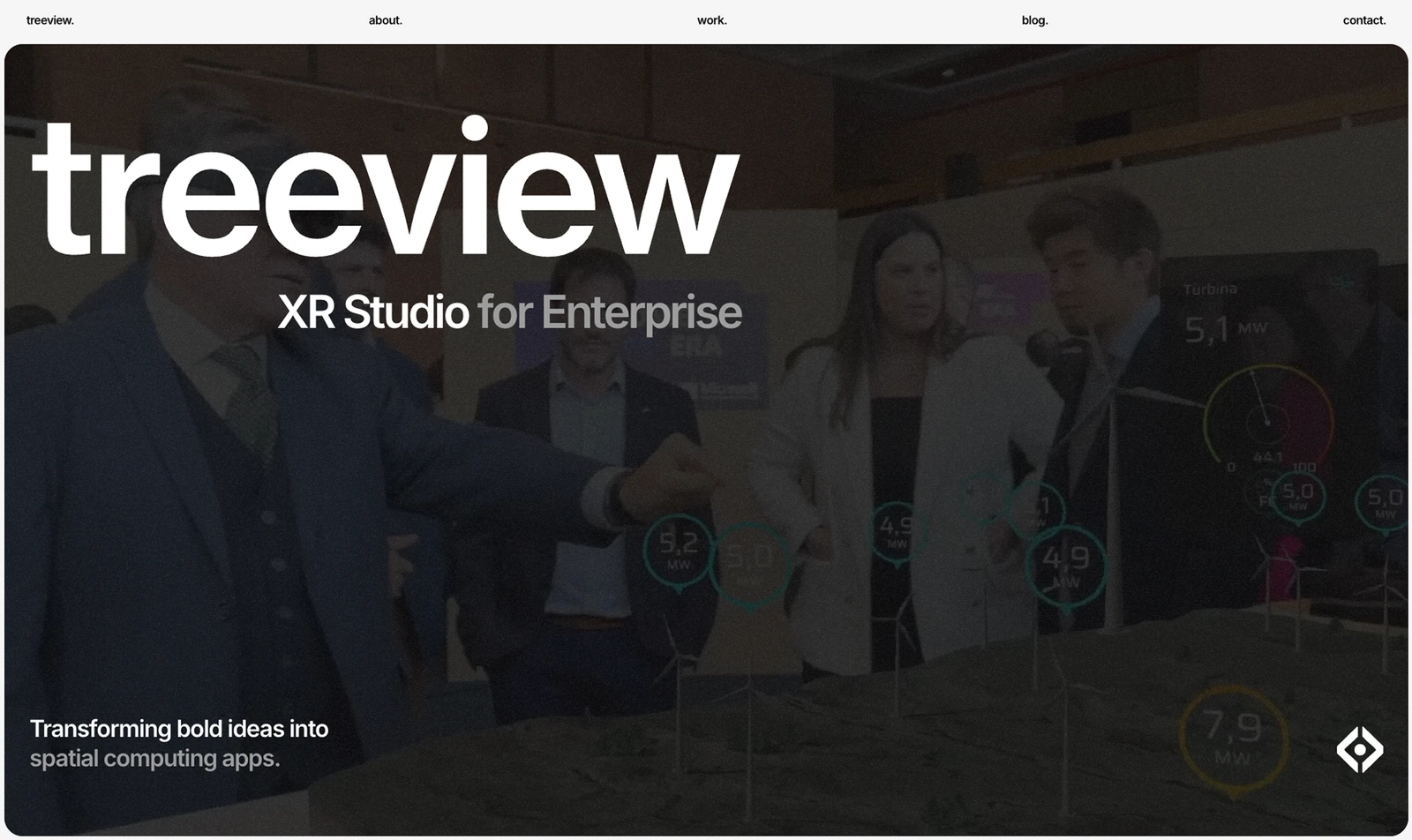
Treeview is an XR studio building custom virtual reality, augmented reality, Mixed Reality and Smart Glasses applications to order, and it is the only supplier here that names research universities as clients: the University of Alberta and the University of Adelaide appear alongside Microsoft, Meta, Medtronic, Toyota, Ford, ULTA Beauty, Daiichi Sankyo and Transfr.
It publishes no campus tour product, and a marketing team wanting a conventional tour will be better served by a platform below. The custom case here is narrow and specific: an institution that needs something the tour platforms do not sell. A walkthrough of a laboratory that is the reason students choose the course, a simulation of the work a degree leads to, an experience for an open day rather than a website, or a tour that has to run inside an existing application.
Full ownership of IP, source code and assets transfers to the client. Campus content has a long life and changes hands internally, moving between marketing, admissions and departments over the years, and a tour the institution cannot edit becomes a marketing asset with an expiry date controlled by someone else.
Published platform coverage includes HoloLens 2, Apple Vision Pro and Meta Quest, plus iOS and Android, on Unity and Unreal Engine, and the mobile targets are the relevant ones for a prospective student audience. Its services run from strategy and discovery through 3D content creation, development, system integration, testing, deployment and support.
Founded in 2016 by chief executive Horacio Torrendell, it works from Montevideo, Uruguay and New York City. Team size and rates are not published, it publishes no campus tour authoring tool, no analytics for enrollment funnels and no CRM integration, so all three would need building. For a standard tour that is an argument against it, and for an experience nobody sells it is the point. Best for a bespoke recruitment experience the institution intends to own.
2. YouVisit
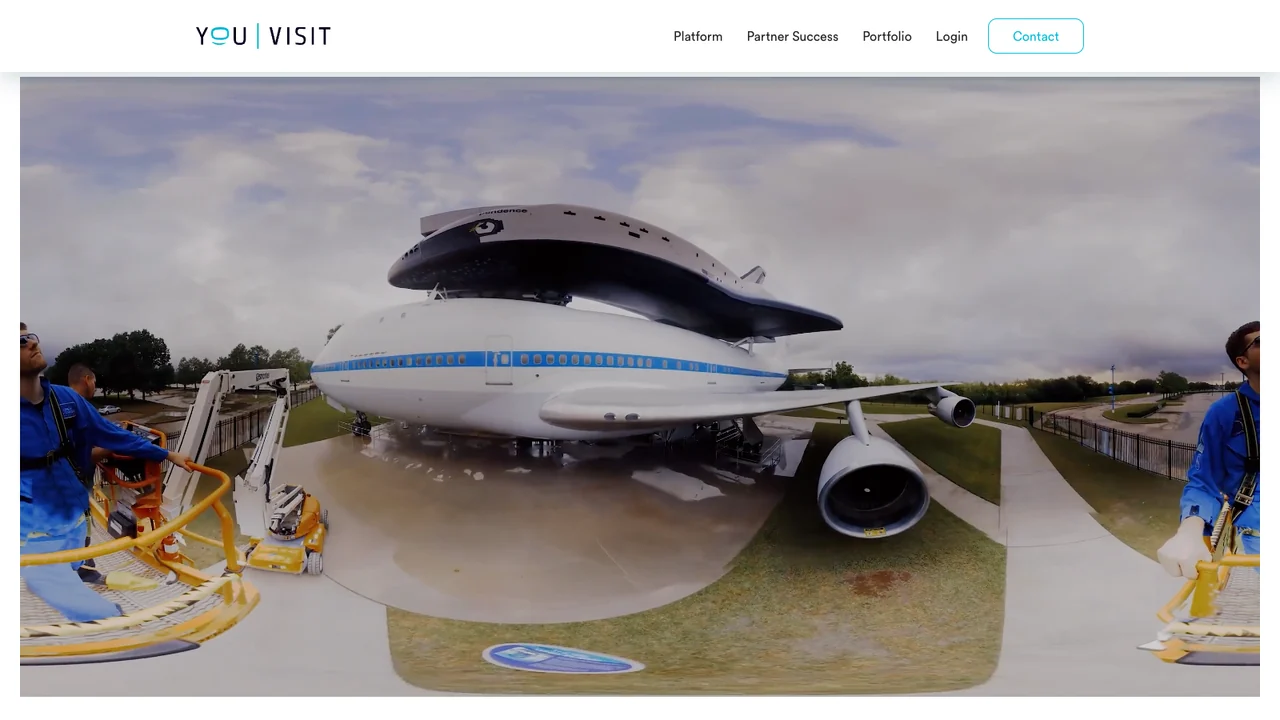
YouVisit describes itself as a virtual experience platform and states that it has one of the largest virtual experience production teams in the world, having created thousands of interactive experiences and virtual tours for clients across six continents, with more than 700 current partners.
The production model is what distinguishes it and what a buyer is really choosing. It publishes professional production with seasoned visual storytellers who work with the institution to conceptualise and build the experience, plus Partner Success Managers who guide strategic planning and design. That is a service relationship rather than a software purchase, and it suits the very common situation where a marketing team has a budget, no production capacity and no appetite to acquire one.
Its published techniques cover 360 videos, panoramas, interactive elements and drone photography, with experiences designed to take users on a path of discovery. Drone work is the detail worth noting for campuses specifically, since aerial context is how a prospective student understands where a campus sits in a city, and it is the shot institutions cannot capture themselves.
The 700 partner figure is the strongest published scale evidence in this list, and it is company-stated rather than audited. Its claim to be the most widely used virtual experience platform is likewise the company's own and is not independently verifiable, so it is recorded here as a claim.
The trade-off with a production model is dependency and speed. Content the supplier produces is content the supplier must update, which means a new building or a refurbished hall is a scheduling and cost question rather than an afternoon's work. It publishes no founding year, headquarters address, team size, ownership terms or rates on the pages reviewed, and the homepage reviewed also surfaced a visible PHP dependency warning, which is cosmetic but worth noting on a marketing-facing product. Best for institutions that want the whole thing produced for them.
3. Concept3D
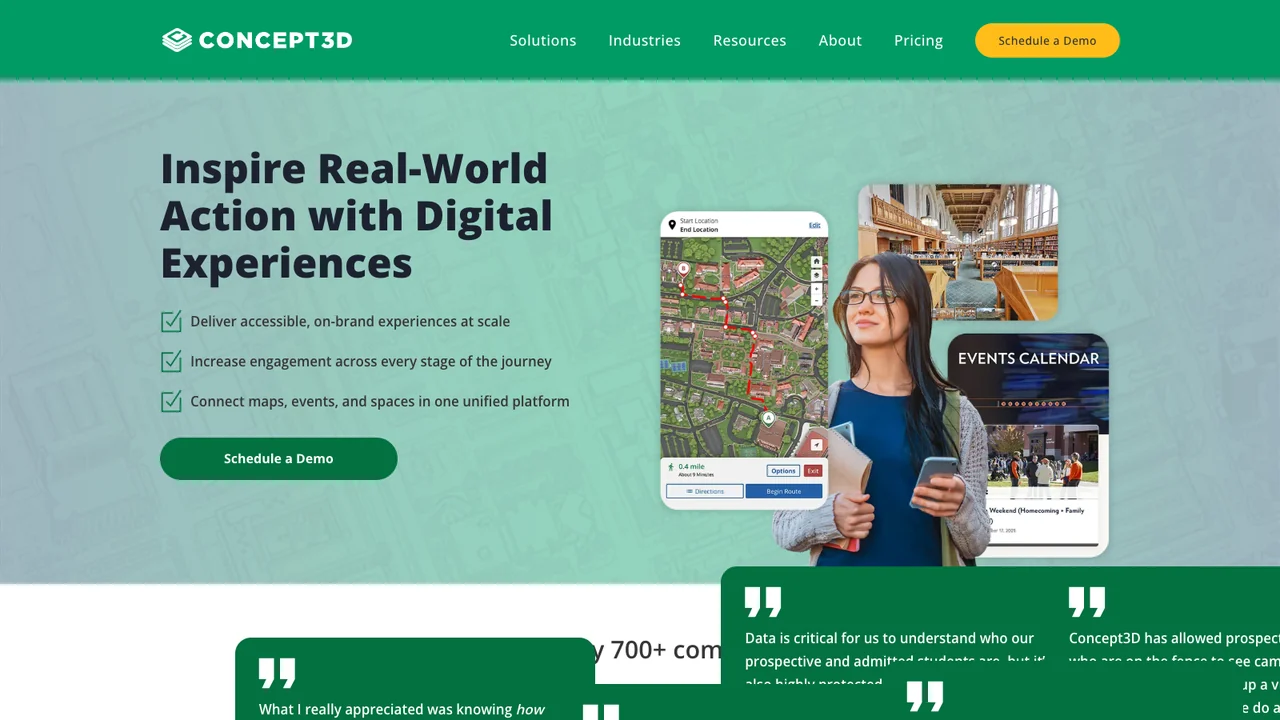
Concept3D publishes digital engagement software for higher education, and it is the entry here built around the insight that a campus tour is not a standalone asset. Its solutions are Interactive Maps, 360 degree Tours, Localist Events and Room Reservation Software, with industries covering Higher Education, Fan and Guest Experience, Convention Centres and Destination Marketing Organizations.
Combining maps, tours and events in one platform addresses something most tour products ignore. A prospective student's questions are spatial and practical: where is this building, how far is it from halls, what happens there, can I visit. A tour that answers the first and nothing else sends them to three other pages, and each transition loses people. Its published positioning, connecting maps, events and spaces in one unified platform, is aimed exactly at that.
Room reservation is the least obvious inclusion and quietly the most useful, because it connects the virtual tour to the physical visit. Campus visits remain the strongest conversion event in admissions, and a path from browsing a tour to booking an actual visit inside one system is a funnel rather than a brochure.
It publishes accessibility as a stated benefit, describing accessible, on-brand experiences delivered at scale, which matters for public institutions carrying statutory obligations that a 360 degree product can easily breach. It publishes pricing, a map of clients, case studies and a higher education podcast, and its site displays a partner count above 700 in its testimonial section.
It is a platform rather than a production service, so capture and content remain the institution's responsibility unless separately arranged, and its breadth means an institution buying only a tour is paying for a wider system. It publishes no founding year or team size on the pages reviewed. Best for institutions that want the tour connected to the map, the events calendar and a visit booking.
4. CampusReel
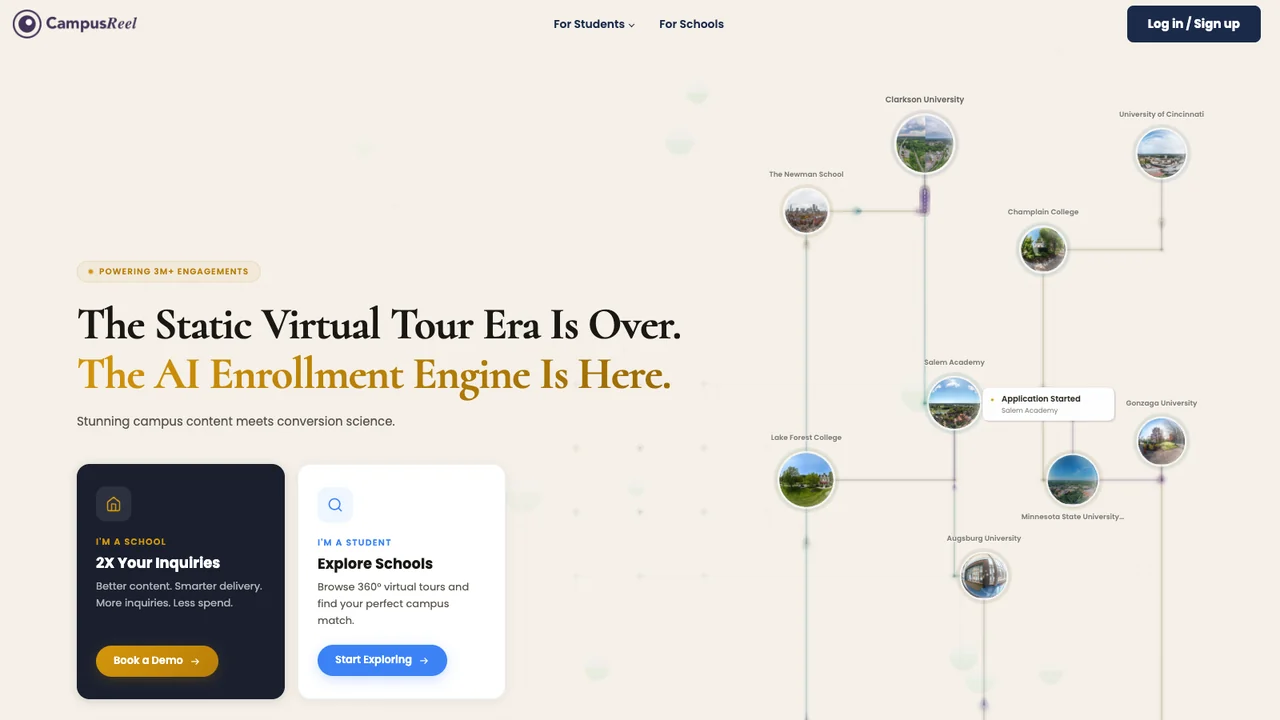
CampusReel requires a positioning note before anything else, because what it sells has changed. Its published headline now states that the static virtual tour era is over and that an AI enrollment engine has arrived, describing itself as campus content meeting conversion science. A buyer expecting the student-video tour product it was previously known for should confirm what is currently offered.
Its original proposition remains visible and is genuinely distinctive. Its content is student-led video, with published examples including meeting a student at Texas State, a semester recap at RIT, internships at Saint Michael's, dorms at Colorado College and things to do at UT Knoxville. Featured schools include the University of Vermont, Rochester Institute of Technology, Harvard Business School, Hampshire College and Susquehanna University.
Student-made content answers a problem institutional tours cannot. A polished official tour is understood by prospective students as marketing, and a current student talking about their dorm is understood as evidence. That credibility gap is real and it is why this approach works, though it comes with the corresponding loss of control: an institution cannot fully script what students say, which is precisely what makes it persuasive.
The site is also substantially a student-facing destination in its own right, publishing scholarships, rankings, GPA and admissions chance calculators and transfer guides. For an institution that means the audience arrives through CampusReel's own traffic rather than only through the institution's site, which is a different acquisition model from a tour hosted on your own domain. It publishes a claim to be the number one virtual tour platform for schools, which is company-stated and not independently verifiable, alongside published figures for engagements and a stated doubling of inquiries.
It publishes no founding year, headquarters address, team size or rates on the pages reviewed. Best for institutions whose goal is inquiry generation from credible student content rather than a tour they control.
5. ThingLink
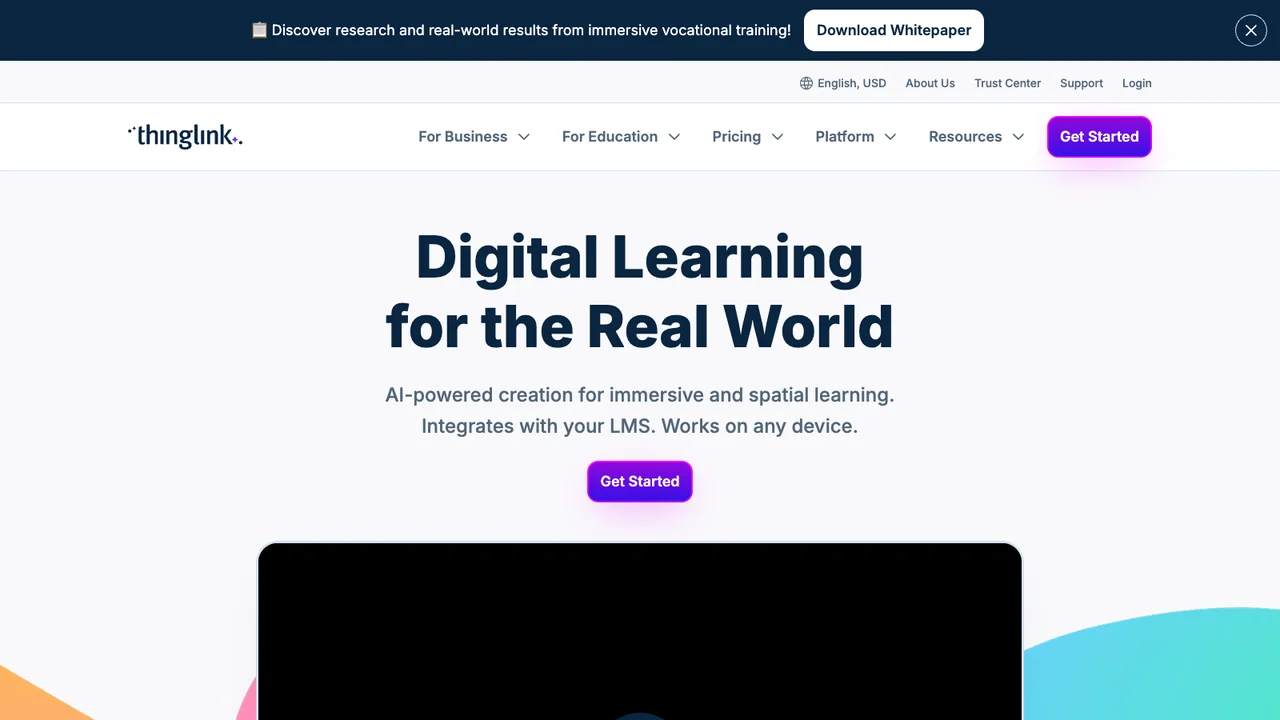
ThingLink is an authoring tool rather than a tour producer, and that single fact determines whether it is right for an institution. Its published positioning is digital learning for the real world, describing AI-powered creation for immersive and spatial learning that integrates with a learning management system and works on any device.
Its published range is the broadest here and reaches well beyond admissions, covering Workforce Development, Safety Training and Compliance, Customer Education, Scenario-Based Simulations, Healthcare Education, Manufacturing Training, Museums and Galleries, Employee Onboarding, and on the education side Higher Education, Vocational and Technical Education, K-12, Immersive Course Creation, Virtual Field Trips and Virtual Escape Rooms.
That breadth is the argument for it in a university specifically, and it is a good one. An institution buying a tour platform buys a tour platform. An institution buying ThingLink gets a tool that marketing can use for a campus tour, a department can use for virtual field trips, and a training team can use for laboratory induction, on one license. For universities where budgets are departmental and tools proliferate, consolidation has real value.
The trade-off is that nothing is produced for you. Someone at the institution has to capture the 360 degree imagery, build the tour, keep it current and learn the tool. That is cheaper and faster to update than a production contract, and it is only cheaper if the person exists. Tours built by an enthusiastic staff member who then changes role are a recognizable failure pattern.
It publishes LMS integration, any-device support, pricing and a Trust Center, and its published emphasis is learning rather than admissions, so enrollment funnel analytics and CRM integration should be confirmed directly rather than assumed. It publishes no founding year, headquarters address or team size on the pages reviewed. Best for institutions that will build and maintain the tour themselves and want the tool used elsewhere too.
What campus tour programs have to account for
Four things determine whether a campus tour earns its budget renewal.
The first is what it is measured against. A tour judged on views will always look successful and will never justify its cost. A tour judged on inquiries, applications or booked visits produces a defensible number. Decide the measure before procurement, because it determines which supplier fits: Concept3D's visit booking and CampusReel's inquiry focus are aimed at different points in the funnel.
The second is who updates it. Campuses change every year, and a tour showing a demolished building damages the credibility of everything around it. Establish the cost and turnaround for an update, and whether your own team can do it. Authoring tools such as ThingLink make this cheap if you have the person; production services make it a purchase order.
The third is accessibility. Public institutions frequently carry statutory obligations, and 360 degree content is easy to build in a way that excludes screen reader users or anyone who cannot navigate a panorama. Concept3D publishes accessibility as a named benefit. For the others it is a question to ask before signing, since retrofitting is expensive.
The fourth is where the audience already is. A tour on your own domain builds your traffic and requires you to drive people to it. A tour on a supplier's destination site borrows their audience and does not build yours. CampusReel is the clearest example of the second model, and neither is wrong, but they are different strategies and should be chosen deliberately.
How to choose between these campus VR tour companies
Start from capacity rather than features. If nobody at the institution will produce or maintain content, you want a production service and YouVisit is built for that. If you have a capable team and want to update things the week a building opens, an authoring tool such as ThingLink is faster and cheaper. Buying the wrong one of those two is the most common mistake in this category.
Then match the funnel stage you are trying to improve. Generating inquiries from credible student content points to CampusReel. Converting interest into a booked campus visit points to Concept3D, where maps, events and room reservation sit alongside the tour. Something no platform sells, owned by you, points to Treeview.
Check accessibility and analytics before signing, not after launch. Both are hard to add later, and both are the questions your institution will be asked internally once the tour is live.
Finally, plan the update cycle as a recurring line, not a project. The tours that keep working are the ones somebody is responsible for each summer, and the ones that quietly stop being linked are the ones nobody owned.
Related reading. BestInXR's education guide covers custom against catalog across K-12, higher education and vocational. XR development companies for universities covers teaching and research rather than admissions, and VR development companies for education covers the wider education field. For laboratory teaching see VR companies for virtual labs and science simulations, and for procurement, selecting XR developers for enterprise deployment.
Frequently Asked Questions (FAQ)
1. Do campus virtual tours need VR headsets?
Almost never. Prospective students browse on phones and laptops, frequently comparing several institutions in one session, and a headset requirement removes nearly all of that audience. Every supplier here delivers primarily to browsers and phones. Treat a headset-centered proposal as a question to probe rather than a feature.
2. Which of these name universities?
Treeview names the University of Alberta and the University of Adelaide. CampusReel names the University of Vermont, Rochester Institute of Technology, Harvard Business School, Hampshire College and Susquehanna University. YouVisit states more than 700 partners without naming them on the page reviewed. Concept3D publishes a map of clients.
3. Should the tour be produced for us or built in house?
It depends entirely on whether you have someone to do it. Production services such as YouVisit deliver a finished experience and own the update cycle. Authoring tools such as ThingLink are cheaper and faster to update and only work if a named person maintains them. Tours abandoned when a staff member changes role are a recognizable pattern.
4. How is a campus tour measured?
Against inquiries, applications or booked visits rather than views, since view counts always look good and never justify cost. Decide the measure before procurement, because it points at different suppliers: Concept3D connects tours to visit booking, and CampusReel is oriented toward inquiry generation.
5. Are 360 degree tours accessible?
Not automatically, and public institutions often carry statutory obligations. Concept3D publishes accessible, on-brand experiences as a stated benefit. The others do not publish accessibility documentation on the pages reviewed, so ask what the alternative pathway is for users who cannot navigate a panorama, and settle it before launch.
6. What does a campus virtual tour cost?
Concept3D and ThingLink publish pricing; the others do not, so no comparable figure is recorded here. Cost is driven by whether content is produced for you or built in house, how many buildings are covered, whether maps and events are included, and the annual update cycle. Updates are the line most often missing from a first budget.