

Five companies build immersive showroom experiences for car dealerships, and they do not build the same thing. Treeview and Theia Interactive write custom applications, ZeroLight puts a configurator on the sales floor, AutoViewpoint photographs the building and RelayCars Pro shows cars from a stock library. None of the five publishes a price.
In short:
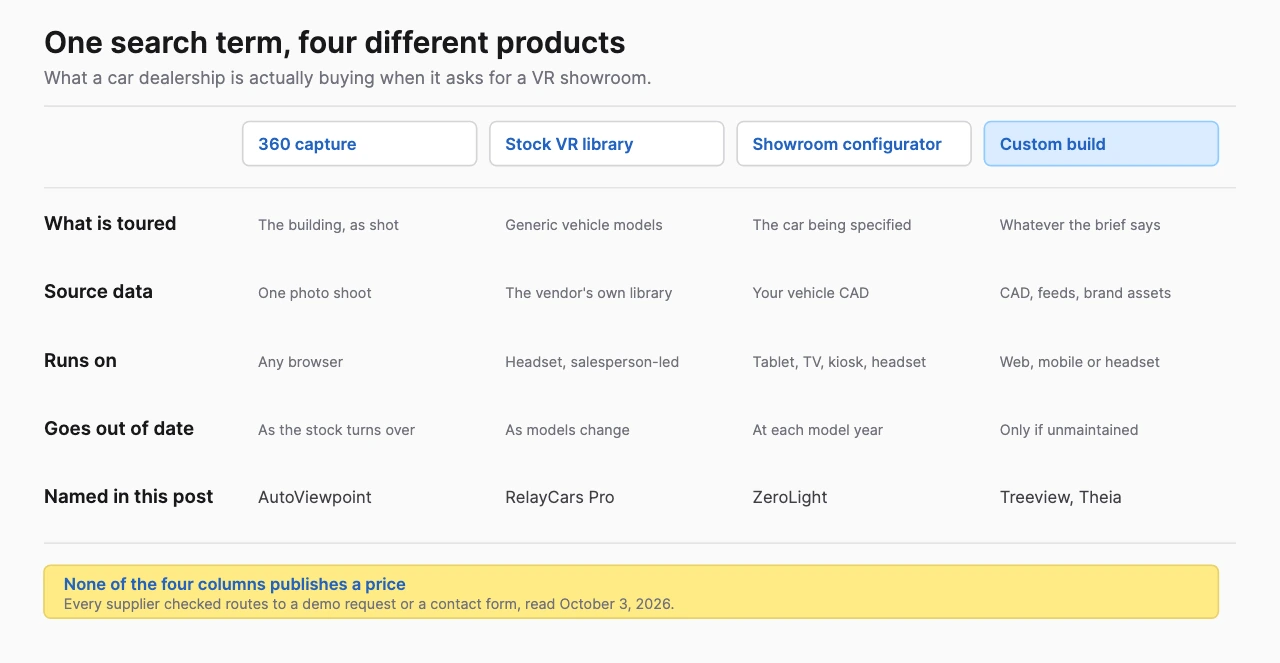
- What the phrase hides: four different products. A 360 capture tours your building, a stock VR library shows cars you may not stock, a configurator sells the car in front of the customer and a custom build does whatever the brief says.
- What decides the purchase: whether the thing being toured is the premises, a generic vehicle model or your actual inventory. Those are three different data problems.
- What nobody publishes: a price. Every supplier in this category routes to a demo request or a contact form.
- What to check first: who owns the finished experience, because the capture route and the custom route answer that differently.
What is a VR showroom tour for a dealership?
A VR showroom tour is any immersive experience that lets a buyer explore a dealership or its vehicles without standing in the building, and the term covers at least four distinct products that are bought for different reasons and priced on different work.
The distinction matters before any shortlist, because a dealer group asking for "a VR showroom" and a manufacturer asking for the same thing usually want opposite ends of this list.
The capture route tours the premises
A 360 photographic tour is made by photographing the showroom. What the visitor explores is the building, with the cars that happened to be parked in it on the day of the shoot. AutoViewpoint sells exactly this, and also publishes the tour to Google Street View, which is the clearest signal of what the product is: a walkable record of a physical place.
This is the cheapest route and the fastest to deliver. It is also the one that goes stale, because the inventory in the photographs is the inventory from the shoot.
The stock library route shows cars, not your cars
RelayCars Pro takes the opposite approach. It describes itself as the VR app for automotive dealerships and places the customer in the driver's seat of a vehicle drawn from its own image database, which the page puts at 1,300 cars and growing weekly. The salesperson steers the session from a companion app on an Android device.
Nothing here is a tour of your dealership. It is a catalog, and the buyer is a sales manager who wants a customer to sit in a trim level the lot does not carry. Read the footer before signing: the copyright notice on that page reads 2018, checked on October 3, 2026.
The configurator route sells the car in the room
ZeroLight builds interactive showroom configurator experiences that run on tablets, televisions, kiosks and virtual or augmented reality, deployed across dealer networks from its cloud platform. Its page describes CRM integration and personalized follow-up content generated after the visit.
This is not a tour at all. It is a point-of-sale tool for a customer who is already in the building, and the follow-up content is the part a dealer principal will care about. ZeroLight's customers page names Suzuki, Mitsubishi and Corvette work.
The custom route does whatever the brief says
A development studio writes an application. The cost and the timeline are whatever the scope is, and so is the result, which is why this route wins when the requirement does not fit the three products above.
1. Treeview
Treeview has built virtual and augmented reality applications since 2016, and its client roster names Toyota alongside Microsoft, Meta, Medtronic, ULTA Beauty, Daiichi Sankyo, Transfr, the University of Alberta, Stanford Medicine and NEOM. For a dealer group or a manufacturer that wants an experience built to its own brief rather than configured inside somebody else's platform, that combination of a named automotive client and a decade of custom delivery is the starting point.
The services it publishes cover the relevant ground: custom virtual reality development in Unity and Unreal Engine, augmented reality for mobile on iOS and Android, mixed reality for Quest and Apple Vision Pro and digital twin development for real-time simulation of physical environments.
Two things make it the first call on a custom build. It transfers intellectual property, source code and assets in full, which matters more in this category than in most, because a showroom experience is a brand asset that a dealer group will want to extend without returning to the supplier. And its published project list is custom one-off work across industries rather than a single productized template, which is the shape of supplier a bespoke brief needs.
What Treeview's own site does not publish is an automotive showroom project. The work page lists digital twin data visualization, cultural preservation, augmented reality ski navigation, an immersive music experience, cardiovascular patient onboarding and three education builds. Brief it on the strength of the custom VR practice and the Toyota relationship, and ask to see automotive work under NDA.
2. Theia Interactive
Theia Interactive is the strongest published automotive portfolio in this list. Its automotive page names Lucid Motors, Harley-Davidson, Mitsubishi Canada and Cruise as clients, and lists virtual showrooms, product configurators, digital twins and training among its capabilities.
The technical choice worth noting is pixel streaming. Theia states that it puts Unreal Engine in any browser with no download required, which changes the deployment question for a dealership: the experience runs on a customer's own phone or a showroom screen without an install or a headset, while still rendering at full engine quality.
Its published delivery process starts by documenting the audience, the business goal, the source material and the measures of success, then reviewing CAD, BIM and product data before production. For a manufacturer that already holds vehicle CAD, that is the right first question, and it is the question the capture suppliers never have to ask.
Theia sits second rather than first only because the ranking here is on custom development breadth. On named automotive clients alone it leads.
3. ZeroLight
ZeroLight is the entrenched specialist in this category, and its published customer work is the reason: the customers page names Suzuki, Mitsubishi and Corvette configurator projects, which is more named automotive deployment than any other supplier here publishes.
Its product is an in-person interactive configurator rather than a tour, deployed from a cloud platform across retail spaces with what the page calls "seamless setup and simple maintenance". The formats it supports are tablets, televisions, digital kiosks and virtual and augmented reality. Dealers get CRM integration and automatically generated follow-up content for a buyer who has left the building.
Buy ZeroLight when the problem is conversion on the showroom floor across many sites. Do not buy it expecting a walkable record of your premises, because that is not what it builds.
4. AutoViewpoint
AutoViewpoint is the clearest expression of the capture route, and its three published product lines map the category neatly: 360 vehicle virtual tours, 3D vehicle configurators and digital showrooms with trade show walkthroughs.
The Google Street View publishing option is the feature to weigh. A tour that lives inside Street View is discoverable by a buyer who never visits the dealer's own website, which is a distribution argument rather than an experience argument, and it is the strongest reason to choose capture over a custom build for a single rooftop.
The limit is inherent to the method. A photographic tour shows the stock that was on the floor when the photographer came.
5. RelayCars Pro
RelayCars Pro is a sales tool rather than a tour, and it is on this list because it answers a question the other four do not: how a salesperson shows a customer a vehicle the dealership does not have.
The product places the customer in the driver's seat of a car from a published library of 1,300 vehicles, growing weekly, with 360 degree interior and exterior views and promotional video. The salesperson directs the session from an Android companion app, which is an unusual and practical design: the customer wears the headset, the salesperson keeps control of the conversation.
Two caveats, both checkable. The library is RelayCars' own, so the vehicles are generic models rather than the specific car on your lot with its specific options. And the copyright notice on the site reads 2018, read on October 3, 2026, so confirm the library's current state before committing a sales process to it.
What nobody in this category publishes
A price. Not one of the five publishes a figure, and the pattern holds beyond them. SimLab publishes no price for its automotive package, and Mass Interact has a pricing page that states only that tours are tailored to the customer's needs, checked on October 3, 2026.
That is worth stating plainly rather than estimating around, and it is the same non-disclosure pattern the site measures across the industry in its specification gap report. Budget from scope and comparable work, and treat any figure quoted in a roundup that is not on the supplier's own site as unsourced.
Who is not on this list, and why
Four suppliers appear in searches for this work and were left out on criteria the post publishes.
SimLab sells a self-serve authoring platform built around SimLab Composer, which it describes as requiring no coding. That is a different purchase from commissioning a build, and it belongs beside authoring tools rather than development studios. Its automotive page also leads with market growth projections and percentage improvement claims carrying no stated method, which is not evidence a buyer can check.
YORD Studio publishes a genuine automotive virtual showroom case study, cross-device from web and mobile through to headsets. The client on that case study is identified only as "Automotive", with no company named, so there is no named reference to weigh against the four suppliers above.
VRROOM sells project-based activations for vehicle launches and flagship showrooms, with temporary or dedicated hardware deployment and on-site support, and describes itself as Dubai-based serving the MENA region. That is an events purchase rather than an always-on showroom asset. Its page displays two uplift percentages that do not resolve in the served markup, so neither figure is reported here.
Mass Interact is a capable 360 tour producer across many sectors, including a long published list of university tours, but automotive is one vertical among ten rather than a specialism.
How to choose between these automotive VR showroom companies
Answer one question first: what is being toured?
If the answer is the building, buy capture, and AutoViewpoint is the specialist. If the answer is a vehicle the customer cannot sit in today, buy a stock library and RelayCars Pro is the only supplier here built for it. If the answer is the car in the room and the goal is conversion across a dealer network, buy ZeroLight. If the answer is something none of those describes, commission a build from Treeview or Theia Interactive, and ask Theia first if the source material is vehicle CAD you already own.
Then ask who owns the result. A custom build transfers to you if the contract says so, and Treeview publishes that it transfers intellectual property, source code and assets. A platform experience lives on the platform. For a dealer group planning to extend an experience over several model years, that difference outweighs the first invoice.
Related reading. Our list of companies building VR showrooms and virtual stores covers the same work outside automotive, the 3D car and automotive configurator comparison ranks the configurator layer in depth, the virtual tour software comparison prices the capture platforms by subscription tier, and the virtual tours guide sets out how the whole category divides.
Frequently Asked Questions (FAQ)
1. Who develops immersive VR showroom tours for automotive dealerships?
Treeview and Theia Interactive build custom applications, ZeroLight deploys in-showroom configurators across dealer networks, AutoViewpoint produces 360 photographic tours of the premises and RelayCars Pro supplies a stock VR vehicle library operated by a salesperson.
2. How much does a VR showroom cost for a car dealership?
No supplier in this category publishes a price. All five route to a demo request or a contact form, and Mass Interact's pricing page states only that tours are tailored to the customer. Budget from scope rather than from a published figure.
3. What is the difference between a virtual showroom and a car configurator?
A virtual showroom is a place a buyer explores, whether that is a photographed dealership or a built 3D environment. A configurator is a tool for specifying one vehicle, picking colors, materials and options in real time. ZeroLight and Theia Interactive build configurators, and AutoViewpoint sells both separately.
4. Can a dealership virtual tour show its actual inventory?
A 360 photographic tour shows the vehicles present when the photographs were taken, so it goes out of date as stock turns. A stock library such as RelayCars Pro shows generic models rather than the specific car on the lot. Showing live inventory accurately needs a custom build connected to a feed.
5. Do customers need a headset for a dealership VR showroom?
Not always. Theia Interactive states that its pixel streaming puts Unreal Engine in any browser with no download, ZeroLight runs its configurators on tablets, televisions and kiosks as well as headsets, and 360 tours open in a normal browser. RelayCars Pro is the headset-first product in this list.
6. Who owns a VR showroom experience after it is built?
It depends on the route. Treeview publishes that it transfers intellectual property, source code and assets in full. An experience built inside a vendor platform remains dependent on that platform, which matters for a dealer group that wants to extend it across several model years.