XR companies for cultural heritage record, reconstruct and reinterpret sites and objects, often ones that are damaged, inaccessible or at risk of being lost. This list ranks five by documented heritage work, whether the organization documents, fabricates or interprets, and what a site or institution receives afterwards. Rankings draw on each organization's own record.
In short:
- Treeview builds custom XR to specification and hands over full ownership of IP, source code and assets, which matters when a national institution funds a reconstruction
- Iconem, founded 2013, specializes in 3D digitization of endangered heritage and has produced exhibitions with the British Museum, the Smithsonian, the Grand Palais and the Vatican
- CyArk is a registered 501(c)(3) nonprofit publishing more than 230 documented project pages, including Pompeii, Angkor, Petra, Chichén Itzá and Rapa Nui
- Factum Arte works in high-resolution 3D recording and physical facsimile production, which is where digital records become objects again
How this list was built
This list ranks companies by four criteria: documented heritage work at named sites or institutions, what the organization actually does with a site once recorded, evidence of working with heritage authorities rather than only with museums, and what the site or institution receives at the end.
Cultural heritage divides into three activities that are frequently conflated in a single brief, and separating them is the most useful thing a buyer can do before approaching anyone. Documentation is the accurate capture of a site or object as a measurable record, and its output is data with a stated accuracy, intended to survive. Interpretation is turning that record into something an audience experiences, and its output is an exhibition, a film or an application. Fabrication is turning the record back into a physical object, whether a facsimile, a replacement element or a cast. The organizations here sit in different places across those three, and one that is excellent at interpretation may hold no position at all on archival standards.
The second thing that distinguishes heritage from the rest of this directory is that the record often outlives the site. Documentation of a monument that is later damaged by conflict, fire, earthquake or erosion becomes the only remaining evidence of what it was, and in several well-known cases that has already happened. This changes what good practice looks like: file formats, metadata, accuracy statements and where the archive is deposited matter more than resolution or visual polish, because the audience for the data may be a conservator in fifty years rather than a visitor next season.
The third is that heritage is rarely owned by the person commissioning the work. Sites belong to states, communities, religious institutions and descendant groups, and permissions to record are separate from permissions to publish, reproduce or commercialise. A project that captures a site without settling who may use the resulting data, and for what, creates a dispute rather than an archive.
Disclosure varies. Factum Arte and Think Digital publish no founding year on the pages reviewed, and CyArk publishes no founding year on the pages reviewed. Those gaps read Not disclosed rather than as estimates. Project counts are attributed to the source stating them, and CyArk's figure is a count of its own published project pages. Pricing is not a ranking factor, because none of the five publishes rates.
| Organization | HQ | Type | Primary activity | Best for |
|---|---|---|---|---|
| Treeview | Montevideo, Uruguay / New York City, USA | Commercial studio | Custom XR development | Interpretation the institution must own |
| Iconem | France | Commercial studio | 3D digitization and exhibitions | Endangered sites and touring exhibitions |
| CyArk | United States | 501(c)(3) nonprofit | Documentation and capacity building | Archival records and training local teams |
| Factum Arte | Not disclosed | Digital mediation studio | Recording and physical facsimiles | Turning records back into objects |
| Think Digital | Adelaide, South Australia | Commercial studio | VR, AR, 360 video and delivery | Community and regional heritage outreach |
1. Treeview
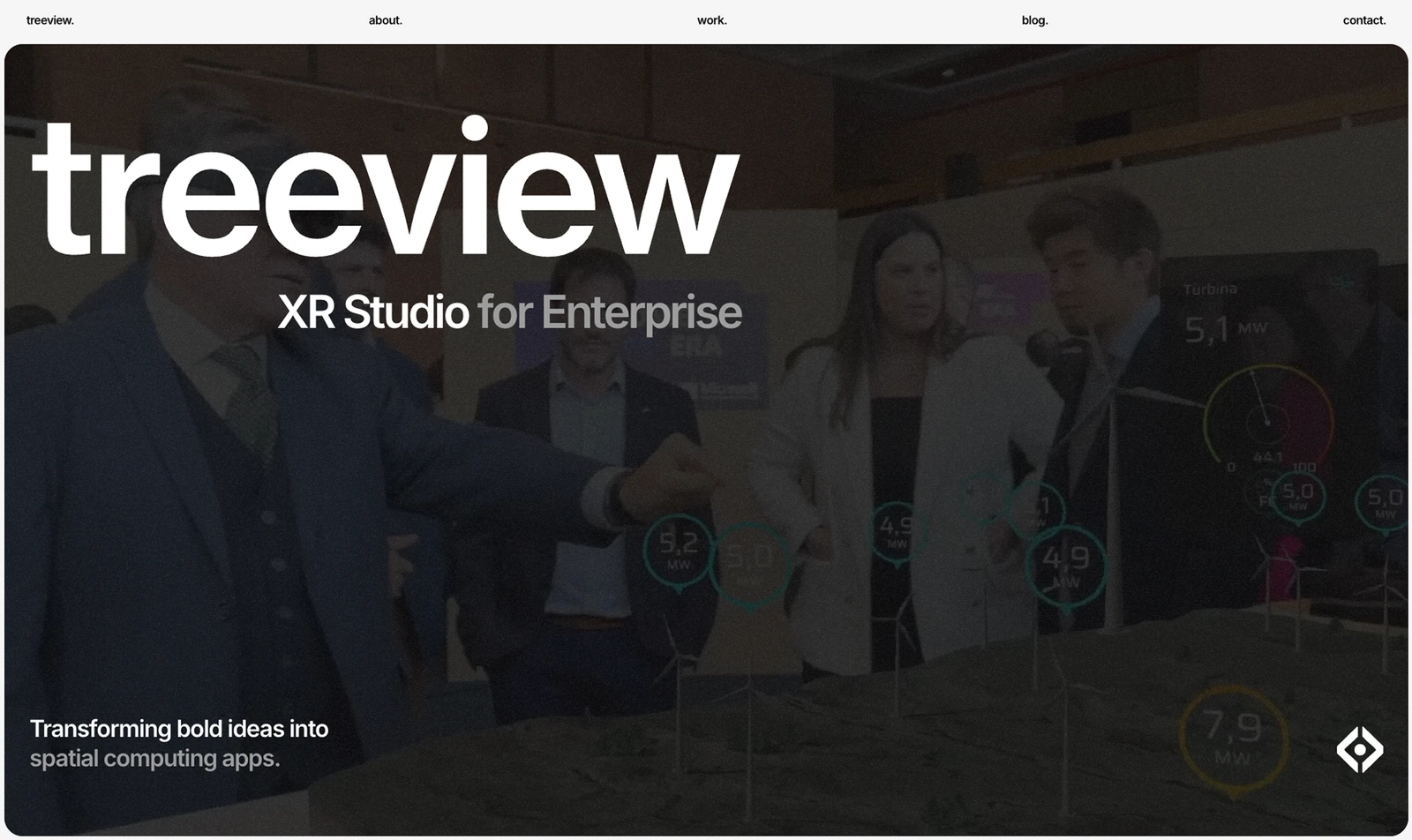
Treeview is an XR studio building custom virtual reality, augmented reality, Mixed Reality and Smart Glasses applications to order. It publishes no cultural heritage project, and that should be read first: its named clients are Microsoft, Meta, Medtronic, Toyota, Ford, ULTA Beauty, Daiichi Sankyo, Transfr, the University of Alberta and the University of Adelaide. A heritage body evaluating it is buying build capability and contractual terms rather than a record of work at monuments.
Where that is the right choice is the interpretation half of the problem, and specifically the case where documentation already exists. Many sites have been surveyed, photogrammetrically captured or laser scanned already, sometimes several times by different teams, and the gap is not more data but something an audience can use. A studio that builds accurately to a specification, using data the institution already holds, is exactly the supplier for that, and it does not need heritage credentials to do it well provided the archaeological direction comes from the institution.
Full ownership of IP, source code and assets transfers to the client. In heritage this is more consequential than in most sectors, because the commissioning body is often a state agency, a national museum or a site authority with a statutory duty to preserve what it holds. An interpretation product that cannot be maintained, redeployed or archived by the institution because a supplier retains the code is an awkward thing for a public heritage body to own, and awkward to explain to a funder.
Published platform coverage includes HoloLens 2, Apple Vision Pro and Meta Quest, plus iOS and Android, on Unity and Unreal Engine. The mobile targets matter most here, since on-site heritage interpretation generally reaches visitors through their own phones rather than through issued hardware, and many heritage sites have no power, no network and no staffed building to run equipment from. Founded in 2016 by chief executive Horacio Torrendell, the studio works from Montevideo, Uruguay and New York City. Team size and rates are not published, and it publishes no position on archival standards or data deposit. Best for interpretation and visitor-facing builds where the institution supplies the scholarship and wants to own the result.
2. Iconem
Iconem specializes in the digitization of endangered cultural heritage sites in 3D, and it is the closest thing in this list to a company built for exactly this problem. Founded in 2013 and working from France, it states that it works with international organizations, and its published output runs from field capture through to large-format immersive exhibitions.
Its exhibition record is the strongest here for reaching audiences through major institutions. Published projects include I am Ashurbanipal at the British Museum in 2018, Age-Old Cities at the Arab World Institute in Paris in 2018, subsequently shown at the Bundeskunsthalle in Bonn, the National Museum in Riyadh and the Smithsonian's Freer Gallery of Art and Arthur M. Sackler Gallery, Venice Revealed at the Grand Palais Immersif in Paris in 2022, Pétros Ení at Saint Peter's Basilica in the Vatican in 2024, Salvaged from the Shadows at the National Museum of China in Beijing in 2024, Changing Landscapes at the Museum of Science in Boston in 2024, Syria Matters at the Museum of Islamic Art in Doha, Syrian Symphony at the Aga Khan Museum in Toronto, Nineveh at the National Museum of Antiquities in Leiden, and work at Carcassonne, Mont Saint-Michel and the Crac des Chevaliers.
Two things stand out in that list. The first is the concentration of Syrian and Iraqi sites: Aleppo, Nineveh, the Crac des Chevaliers and the Age-Old Cities program all address heritage damaged or destroyed in conflict, which is the hardest form of this work and requires operating in circumstances most studios cannot. The second is that the same body of capture keeps reappearing as different exhibitions in different countries, which is the economically sensible model for heritage documentation: the survey is expensive and the interpretation is reusable.
The company describes itself as a startup and lists Research, Studio, Exploration and Contribute alongside its projects. It publishes no team size, no rates, no ownership terms and no accuracy or archival standards on the pages reviewed. For a site authority commissioning a survey, the archival questions are the ones to press, because an exhibition-oriented capture and an archival record are not automatically the same deliverable. Best for endangered and conflict-affected sites, and for institutions wanting a touring immersive exhibition from a real survey.
3. CyArk
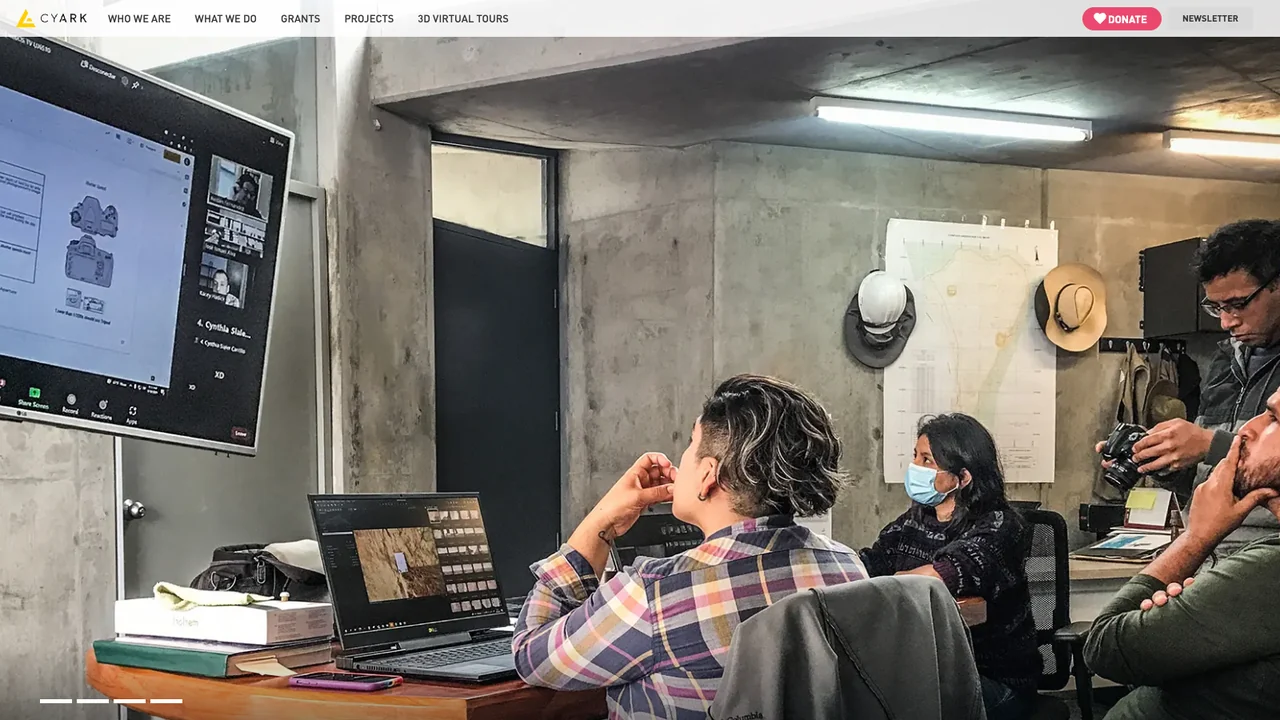
CyArk is a registered 501(c)(3) nonprofit in the United States dedicated to preserving the world's cultural heritage, and its nonprofit status is the most important fact in its entry rather than an administrative footnote. It changes the incentives: the mission is the record and the community rather than a deliverable sold to a client, and its funding model is donations and grants rather than fees.
Its stated mission is unlocking 3D technology to make cultural heritage accessible to new audiences and future generations, across three activities: documenting at-risk cultural sites, training local heritage professionals in 3D documentation, and creating immersive experiences. It describes creating accurate and photo-realistic digital twins for heritage documentation, and it publishes 3D virtual tours, collections, lesson plans and a grants program.
Its published project archive is by far the largest in this list, running to more than 230 individual project pages. Named sites include Pompeii, Angkor, Babylon, Bagan, Petra, Chichén Itzá, Rapa Nui, Tikal, Mesa Verde, Ancient Corinth, Ancient Merv, Ancient Thebes, Ayutthaya, Kilwa Kisiwani, the Antonine Wall, Mount Rushmore, the Brandenburg Gate, Bears Ears, the Old and New Towns of Edinburgh and the Assyrian collection of the British Museum. That breadth across continents, periods and site types is not matched by any commercial studio here.
The training element deserves particular weight, because it addresses the structural weakness of the entire field. A foreign team that arrives, captures a site and leaves has produced a record and no capacity, and the site is in the same position when it needs recording again. Training local heritage professionals in 3D documentation means the next survey does not require an expedition, which is both cheaper and a better answer to who should hold and control a country's heritage data.
What CyArk is not is a supplier that will build a commissioned visitor experience to a brief on a commercial timetable. Engagement runs through partnership, grants and its program rather than procurement, and it publishes no founding year, team size, ownership terms or fee structure on the pages reviewed. Best for archival documentation, at-risk sites and any program where local capacity is part of the goal.
4. Factum Arte
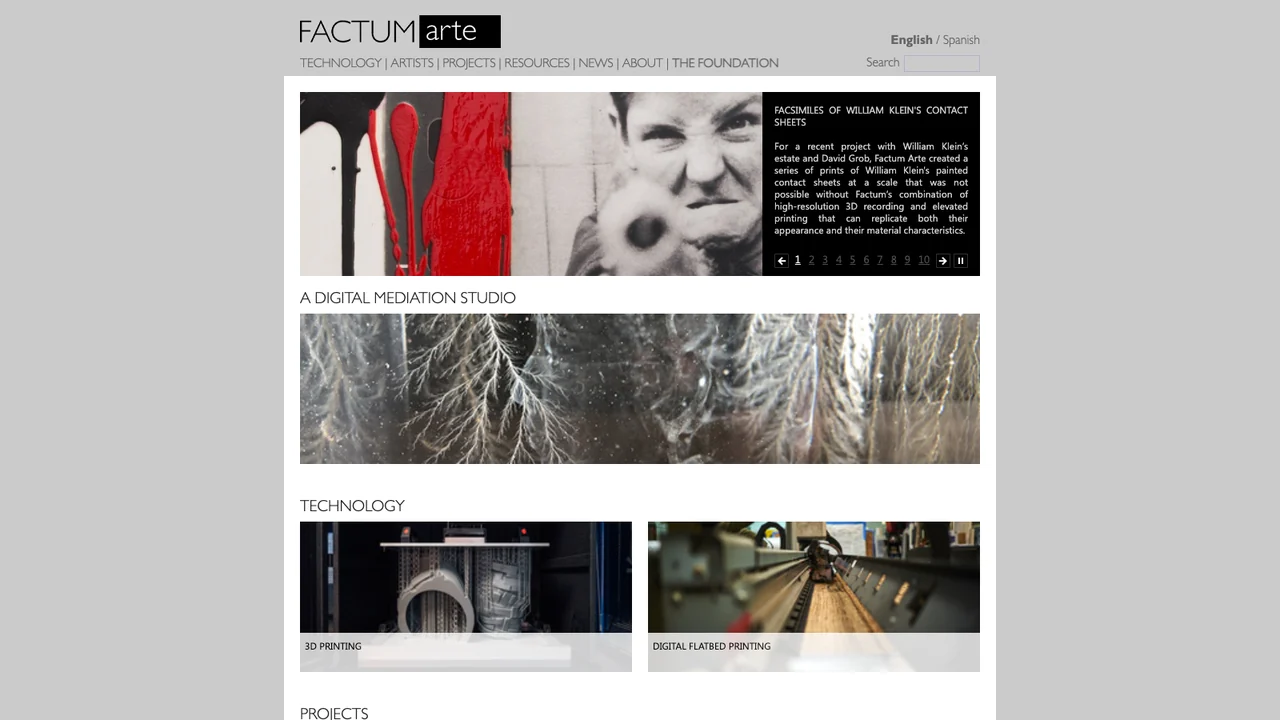
Factum Arte describes itself as a digital mediation studio, working across high-resolution 3D recording, 3D printing, digital flatbed printing and physical fabrication. It is the only organization in this list that closes the loop from object to data and back to object, and that is the reason it belongs here despite being the least XR-centric entry.
Its published work includes facsimiles of William Klein's painted contact sheets, produced with the Klein estate and David Grob using a combination of high-resolution 3D recording and elevated printing intended to replicate both appearance and material characteristics; Behold Humanity, a tapestry by Grayson Perry for the 2026 Royal Academy Summer Exhibition; a life-size lead cast of an Eskimo Curlew for Annalee Davis's installation at the 61st Venice Biennale; and Art Lovers, a monumental work by Tschabalala Self installed on the façade of the New Museum in New York. It works alongside the Factum Foundation and publishes sections for Technology, Artists, Projects and Resources.
The phrase to take seriously is material characteristics. Most heritage digitization records geometry and color, which is sufficient for a screen and insufficient for a surface. A facsimile intended to stand in for an original in a room has to reproduce texture, gloss, translucency and the way light behaves across a surface, and that is a substantially harder recording problem than producing a model for a headset. A studio solving it is capturing at a fidelity most heritage projects never require, and the same records serve conservation documentation well.
The practical heritage case for facsimiles is well established and worth stating plainly: an exact replica allows a fragile original to be removed from visitor pressure, a dispersed object to be shown in its original context, or a lost element to be restored to a site. That is a conservation intervention rather than a media project, and it is bought by a different department with a different budget.
Factum Arte publishes no headquarters address, founding year, team size, rates or ownership terms on the pages reviewed, and its published work is fabrication and fine art rather than headset-delivered XR, so an institution wanting a visitor-facing VR or AR product should confirm recent work in that format. Best for facsimiles, conservation-grade surface recording and putting objects back into places.
5. Think Digital
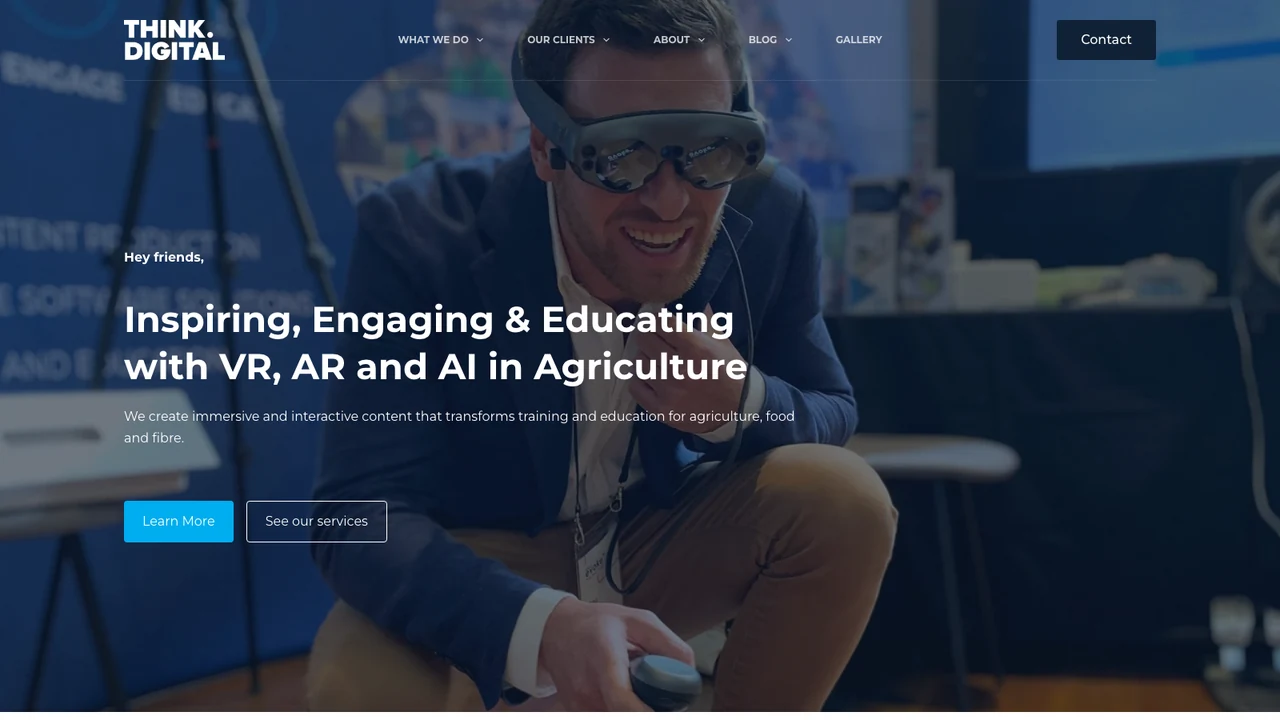
Think Digital is an Australian immersive studio producing virtual reality, augmented reality and 360 degree video, with a stated focus on agriculture, food production, education and events. Published services include custom VR and AR applications, virtual tours, and VR workshops and training.
It ranks fifth on a heritage list because it publishes no heritage site documentation and no archaeological work, and an institution should not infer either. What it publishes instead is a delivery capability the other four do not have. Think Digital operates the Think Digital Coach, a 14 metre mobile classroom fitted with 20 VR headsets, and runs sessions in person as well as producing software.
For heritage that solves a specific and genuinely difficult problem. A large share of heritage significance sits with communities that are remote, regional or otherwise distant from the museums where interpretation is usually shown, and the people with the strongest claim on a site's story are frequently the least likely to see the exhibition made about it. An organization that can take twenty headsets to a town hall or a community center is addressing that directly, and the model is proven rather than theoretical.
Its clearest published project is a red meat education program built with Meat and Livestock Australia and the Australian Research and Development Corporations, which the company states has been experienced by more than 50,000 people since the campaign launched in 2017, delivered across schools and communities in Queensland, South Australia, Victoria, Tasmania, the Australian Capital Territory and New South Wales. That is a public-good program delivered at community scale rather than a heritage project, and it should be read as evidence of reach rather than of heritage expertise.
The studio works from Adelaide, South Australia and was started by founder Tim Gentle and chief executive Kat Bidstrup. Nine team members are listed, making it the smallest organization here, so capacity is a fair question, and the mobile model is geographically bounded in practice. No founding year is published. Best for community and regional heritage outreach where getting the experience to people is the hard part.
What cultural heritage projects have to account for
Four things separate a heritage project that produces a lasting asset from one that produces a launch event.
The first is permissions, and they are plural. Permission to access a site, to record it, to publish the record, to reproduce it commercially and to allow third parties to use it are five different things, and they may rest with different parties including a state agency, a religious authority, a landowner and a descendant community. Settle all of them in writing before capture, because renegotiating after the data exists is far harder and occasionally impossible.
The second is archival standards. Ask what accuracy the survey achieves and how it is stated, what formats the raw and processed data are delivered in, what metadata accompanies them, and where the archive is deposited. A capture optimized for a visually striking exhibition may not meet the standard a conservator needs, and the difference is usually invisible in a presentation. If the record is meant to outlive the site, this is the section of the specification that matters most.
The third is who holds the data afterwards. Heritage data has repeatedly become the object of disputes about ownership, access and repatriation, and the pattern is familiar: a well-intentioned foreign project captures a site and the resulting archive sits on a server in another country under someone else's control. CyArk's training model addresses this directly by building capacity where the heritage is. For any commissioned project, name the custodian in the contract.
The fourth is what the audience actually gets. Documentation does not become interpretation on its own, and a point cloud is not an exhibition. Budget the interpretation separately, and be honest about whether the project is producing a record, an experience, or both, because a project funded for one and expected to deliver the other disappoints on both counts.
How to choose between these cultural heritage XR companies
Start by naming which of the three activities you need. For documentation of an at-risk site with community capacity as part of the outcome, CyArk is the organization, and the route is partnership rather than procurement. For digitization that becomes a touring immersive exhibition, Iconem has the strongest institutional record and the deepest experience of conflict-affected sites. For turning a record into a physical object at conservation fidelity, Factum Arte is the only entry here that does it. For interpretation built to your specification from data you already hold, Treeview builds and transfers ownership. For reaching communities the exhibition will never travel to, Think Digital brings the hardware.
Then read the record for the site type you have. Conflict-damaged, remote and structurally unstable sites are a different discipline from a well-served monument with a visitor center and mains power. Iconem and CyArk both publish work in genuinely difficult conditions; the others do not.
Settle permissions, archival standards and data custody before commissioning. All three are cheap to agree in a brief and expensive to resolve once a survey exists, and all three outlast the project by decades.
Finally, separate the record from the experience in your budget. The survey is the durable asset and the exhibition is the current use of it. Institutions that fund them as one line usually find the survey shaped to serve the exhibition, which is the wrong way round if the site is at risk.
Related reading. BestInXR's list of spatial computing companies explains why suppliers doing this work rarely use the term, and routes to the vertical list for each sector. BestInXR's museums and culture guide covers what a cultural institution is actually buying. XR development companies for museums covers gallery exhibits and permanent installation, and companies for VR and AR art exhibitions covers commissioning and authorship. For institutional buying see XR development companies for universities, and for procurement, selecting XR developers for enterprise deployment.
Frequently Asked Questions (FAQ)
1. What is the difference between documentation and interpretation?
Documentation is the accurate, measurable record of a site or object, made to survive and to serve conservation. Interpretation turns that record into something an audience experiences. CyArk and Iconem both document. Iconem, Treeview and Think Digital all interpret. Factum Arte records and fabricates. A brief that asks for one and expects the other is the most common failure in this field.
2. Which of these have documented named heritage sites?
CyArk publishes more than 230 project pages including Pompeii, Angkor, Babylon, Bagan, Petra, Chichén Itzá, Rapa Nui, Tikal and Mount Rushmore. Iconem publishes work at Carcassonne, Mont Saint-Michel, the Crac des Chevaliers, Nineveh, Aleppo and Saint Peter's Basilica. Factum Arte publishes recording and fabrication projects. Treeview and Think Digital publish no heritage site documentation.
3. Who owns the 3D data captured at a heritage site?
It depends on the agreement, and it is contested often enough that it should never be left implicit. Access, recording, publication, commercial reproduction and third-party use are separate permissions that may rest with different parties. Treeview publishes full transfer of IP and assets to the client. The others do not publish ownership or data custody terms, so name the custodian in the contract.
4. Can a digital record substitute for the physical site?
No, and no source reviewed here claims it can. What a record does is preserve evidence, support conservation decisions, allow access for people who cannot travel, and provide the basis for reconstruction if a site is damaged. Where a physical stand-in is genuinely needed, a facsimile of the kind Factum Arte produces is the answer rather than a digital model.
5. What accuracy should a heritage survey achieve?
None of the five publishes accuracy standards on the pages reviewed, so no figure is recorded here. The requirement depends on the use: monitoring structural movement, supporting a restoration and producing a visitor experience need very different tolerances. Ask for the accuracy to be stated and evidenced in the deliverable rather than described in a proposal.
6. Who builds VR recreations of heritage sites?
Recreating a heritage site in VR is two jobs that different suppliers do. Documentation captures what is physically there now, at a stated accuracy, and produces a record. Recreation reconstructs what is no longer there, or what a site looked like at a chosen date, which is an interpretive act requiring scholarly sourcing rather than a survey. The companies ranked above split along that line, and a brief asking for a recreation while budgeting for a survey is the most common way these projects go wrong. Establish which one you are buying, and who signs off the historical interpretation, before anyone scans anything.
7. What does cultural heritage XR work cost?
None of the five publishes rates, so no figure is recorded here. Cost is driven by site access and conditions, survey accuracy, the volume of data, whether interpretation is in scope, and whether fabrication is involved. Archiving and long-term data custody are the lines most often missing from a first budget.