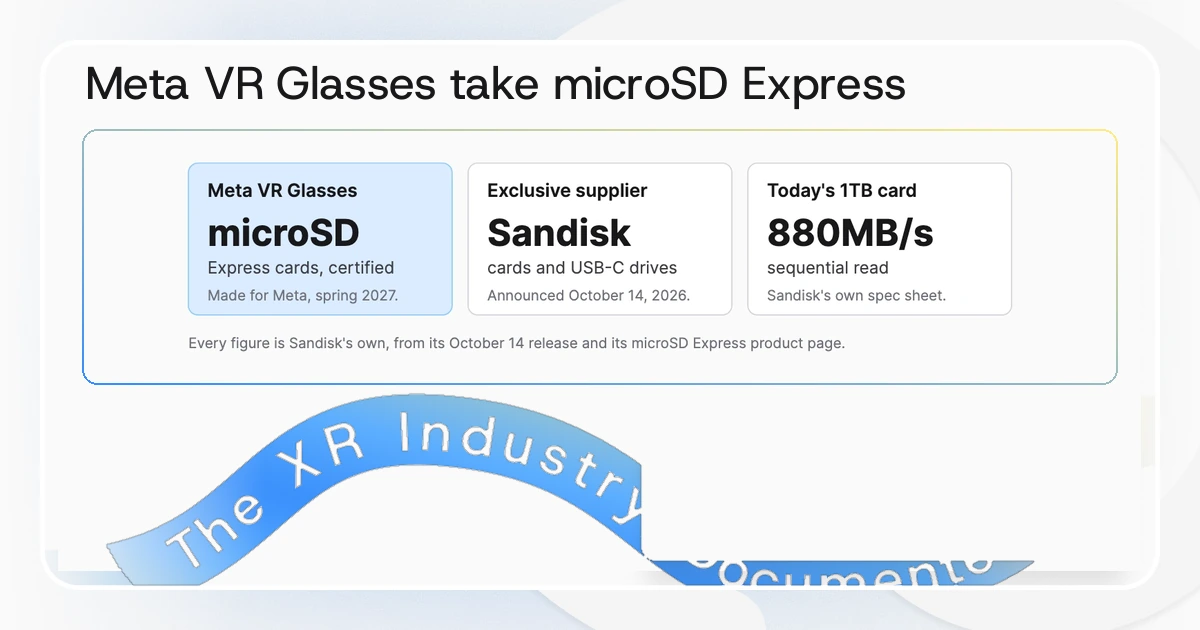
Meta VR Glasses will take microSD Express cards, and Sandisk is the exclusive supplier of the storage certified for them. Sandisk announced on October 14, 2026 that its microSD Express memory cards and USB-C flash drives will join the Made for Meta program when the glasses launch in spring 2027. Capacities and prices for the Meta versions are still to be announced, so Sandisk's current microSD Express line is the best published guide to what a buyer will be choosing from.
In short:
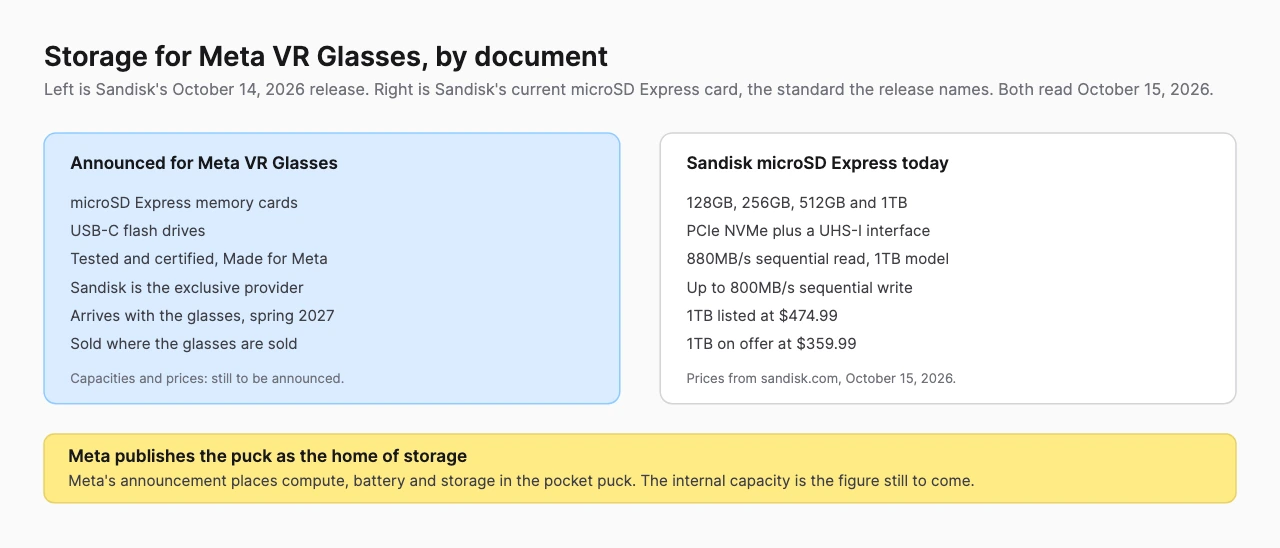
- What was announced: Sandisk named itself the exclusive storage provider for Meta VR Glasses, with microSD Express cards and USB-C drives tested and certified for the device.
- When: at the glasses' spring 2027 launch, sold in the markets where the glasses are sold.
- What it tells a buyer: the puck's storage can be expanded after purchase, through a card standard built on PCIe and NVMe rather than the older UHS-I bus.
What Sandisk published
The release describes the products as designed in collaboration with Meta and part of the official Made for Meta accessory program, and says they are "tested and certified for Meta VR Glasses". Susan Park, vice president of product management for consumer products at Sandisk, says the cards give users "immediate access to additional storage capacity". The release is datelined Milpitas, California, and names two product types: microSD Express memory cards and USB-C flash drives.
That fills in half of a question our launch coverage of Meta VR Glasses left open. Meta's announcement places compute, battery and storage in the pocket puck, at $1,299.99 for spring 2027. Sandisk's release establishes that the storage expands. The internal capacity is the half still to come: it appears in neither Sandisk's release nor Meta's announcement, its product page or its developer device comparison, all read on October 15, 2026.
What microSD Express means for the card you buy
microSD Express is a distinct tier of the SD standard. The SD Association's bus speed table lists SD Express at up to 985MB/s over a single PCIe Gen 3 lane, against 104MB/s for UHS-I. The association's standard overview adds that the first row of pins on an Express card keeps it compatible with conventional hosts.
Sandisk's own microSD Express card shows what the tier looks like on a shelf today. It carries both a PCIe NVMe interface and a UHS-I interface, comes in 128GB, 256GB, 512GB and 1TB, and the 1TB model is rated at 880MB/s sequential read and up to 800MB/s sequential write. On October 15, 2026 Sandisk listed the 1TB card at $474.99 and offered it at $359.99.
Those are figures for the card on sale now, not for the Made for Meta versions, which Sandisk has not priced. Treat them as a planning range for the storage line of a headset budget, and confirm the certified SKUs when Meta and Sandisk publish them closer to launch. For how the glasses compare with headsets on sale today, our comparison of current XR headsets carries checked prices, and the field of view and resolution Meta gave developers covers the display side.