XR for Museums and Culture: What It Is and How to Evaluate It
Museum XR differs from every other category in this directory in one respect that dominates the rest: nobody is trained, nobody is supervised and nobody has to be there. A worker in a safety simulation has been told to complete it. A visitor has paid for a day out and will walk away from anything confusing within about a minute.
In short:
- What it is: Virtual, augmented and mixed reality used by museums, galleries, heritage sites and cultural institutions for exhibits, interpretation, documentation and remote access.
- What it is not: Enterprise XR with nicer art. Everything that can be assumed about attention in a workplace has to be earned in a gallery, in the first thirty seconds.
- What decides the shortlist: Named work with cultural institutions, whether the company designs whole exhibits or supplies a technology layer, evidence of operating in a gallery rather than a demo, and what the institution owns at the end.
- What kills projects: Permissions settled late. Access, recording, publication, commercial reproduction and third-party reuse are five different grants that may rest with five different parties.
What cultural XR covers
Cultural XR is the use of immersive technology by museums, galleries, heritage sites and archives to interpret a collection, reconstruct a place, record a site or reach an audience that cannot visit.
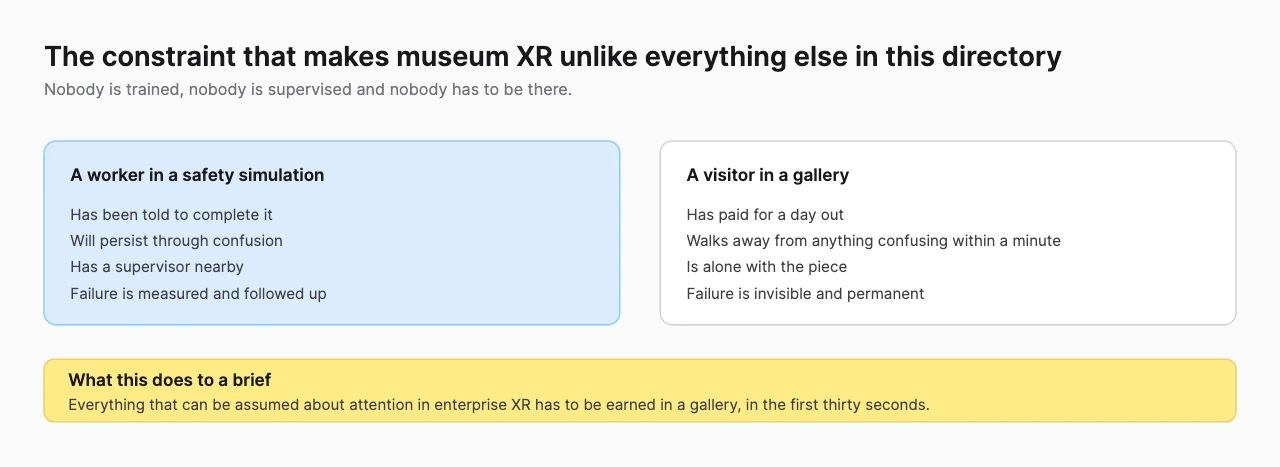
The visitor constraint shapes every decision downstream. A worker persists through a confusing interface because their supervisor told them to. A visitor does not, and their failure is invisible: they simply move to the next room, and nobody records that the piece did not work.
This is why one of the four ranking criteria across these lists is evidence of operating in a gallery rather than in a demo. A piece that works with its creator standing beside it is not evidence that it works unattended on a wet Tuesday in August.
Three activities routinely conflated
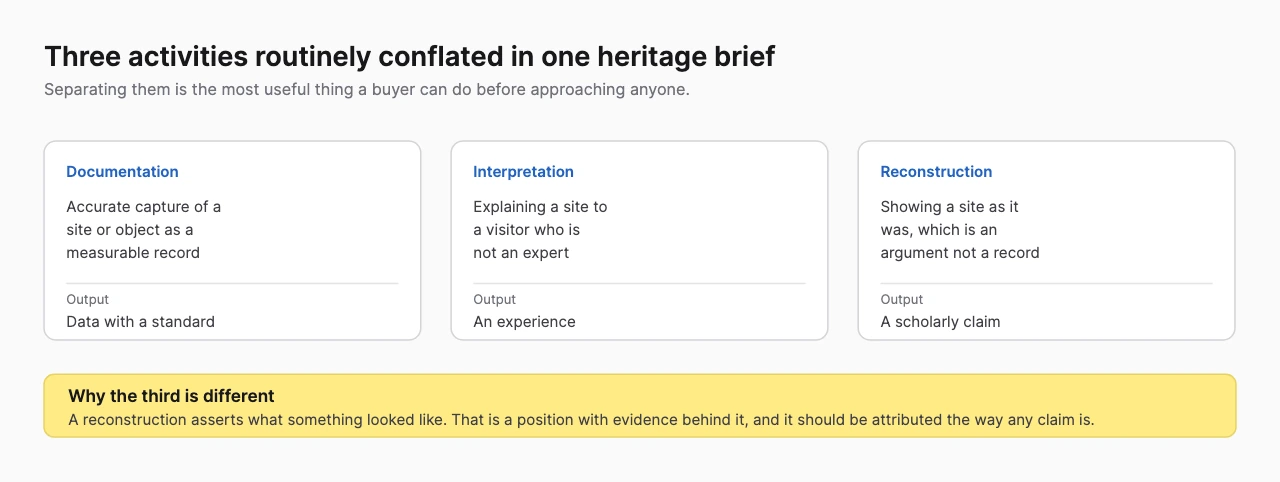
Cultural heritage divides into three activities that are frequently combined in a single brief, and separating them is the most useful thing a buyer can do before approaching anyone.
Documentation is the accurate capture of a site or object as a measurable record. Its output is data with a standard attached, and its value is archival rather than experiential.
Interpretation explains a site or object to a visitor who is not an expert. Its output is an experience, and it is judged on comprehension and engagement.
Reconstruction shows a site as it was. That is an argument rather than a record: it asserts what something looked like, on evidence, and it should be attributed the way any scholarly claim is attributed.
| Documentation | Interpretation | Reconstruction | |
|---|---|---|---|
| Output | Measurable data | An experience | A scholarly claim |
| Judged on | Accuracy and standard | Comprehension | Evidence and attribution |
| Audience | Researchers, archives | Visitors | Both, differently |
| Survives as | An archival record | An exhibition run | A citable position |
| Fails when | Format becomes unreadable | Visitors walk away | Evidence is not shown |
A brief that asks for all three without distinguishing them will get whichever one the supplier is best at, priced as though it were all of them.
The distinction to establish before any conversation

A studio and an artist collective appear on the same shortlists, and the difference is routinely missed.
A studio is engaged to realize someone else's vision, is paid a fee and delivers a build. An artist collective authors its own work, which is then exhibited, toured and sometimes licensed. The institution briefs the first and hosts the second.
Best companies for VR and AR art exhibitions records this distinction first for every entry, because it changes who owns the idea as well as the file, and because a commissioning conversation with a collective is a fundamentally different negotiation.
Cultural XR by purpose
Five distinct purchases, each with its own ranked list.
Museum exhibits and technology
Best XR development companies for museums ranks on named institutional work, whether the company designs whole exhibits or supplies a technology layer, evidence of gallery operation and what the institution owns at the end. Local Projects and Bluecadet design whole exhibits; others supply a layer within someone else's design.
Art exhibitions
Best companies for VR and AR art exhibitions covers the gallery and art institution market, where the studio and collective distinction matters most. Marshmallow Laser Feast authors its own work; a commissioned studio does not.
Cultural heritage
Best XR companies for cultural heritage experiences ranks on documented heritage work at named sites, what the organization does with a site once recorded, evidence of working with heritage authorities rather than only museums, and what the site receives at the end. Iconem, CyArk and Factum Arte work at different points between documentation and reproduction.
Virtual museum tours
Best VR companies for virtual museum tours covers remote access to collections, which overlaps with the virtual tours guide and is bought by audience or digital teams rather than by curatorial.
Interactive exhibits and artefact visualization
Best AR companies for interactive exhibits and artifact visualization covers in-gallery AR, where the hardware lives in a public place and the recurring cost of keeping it working is the dominant number.
Who supplies cultural XR
Four kinds of organization, and knowing which you are talking to explains most of the difference in how a conversation goes.
Exhibit design firms take a whole gallery brief and deliver a finished visitor experience, of which XR is one component. They subcontract the technology and own the visitor journey. Local Projects and Bluecadet work this way.
Technology studios supply a layer inside someone else's exhibit design. They are briefed by the designer rather than by the institution, which changes who they answer to and what they can change.
Artist collectives author work that institutions host. Marshmallow Laser Feast is the clearest example. The institution is not commissioning a build, it is programming a work.
Heritage documentation organizations record sites to a standard. CyArk is a non-profit, Iconem is a company and Factum Arte works between documentation and physical facsimile. Their outputs are archival first and experiential second, which is the opposite of the other three.
| Exhibit design | Technology studio | Artist collective | Heritage documentation | |
|---|---|---|---|---|
| Briefed by | The institution | The designer | Nobody, it authors | The institution or authority |
| Delivers | A visitor experience | A component | A work | A record |
| Institution's role | Client | Indirect | Host | Custodian |
| What survives | The exhibit | The component | The work, and it tours | The data |
What cultural XR costs
Published pricing is effectively absent in this sector, because almost every project is bespoke and many are grant-funded with confidential budgets. What can be described is where the money goes and which parts are recurring.
| Cost center | Nature | Usually quoted | Notes |
|---|---|---|---|
| Content and build | One-off | Yes | The part everyone budgets for |
| Hardware in the gallery | One-off, then replacement | Sometimes | Public-place hardware has a short life |
| Maintenance and reset | Recurring, for the run | Rarely | The dominant cost over a long exhibition |
| Invigilation | Recurring, staff | Rarely | Someone helps visitors into headsets |
| Archival storage | Recurring, indefinite | Almost never | For documentation work, this is the whole point |
The two recurring lines are the ones that decide whether a piece runs for the full exhibition. Hardware in a public place is handled by thousands of strangers, and the cost of keeping it working usually exceeds the cost of building it. Institutions that budgeted only for the build tend to reduce the run rather than fund the maintenance.
What a competent cultural supplier sounds like
They ask how long the run is before they ask what it should do. A three-week festival piece and a three-year permanent gallery installation are different products, and the second is far more constrained.
They raise unattended operation themselves. A supplier who has run work in a gallery knows this is the hard part and will describe how their piece resets, fails and recovers.
They ask who else is in the room. A piece that requires quiet, darkness or a queue imposes on the gallery around it, and an experienced supplier scopes that with the curator rather than discovering it at install.
They are precise about permissions. For heritage work especially, a supplier who lists the five grants without prompting has been caught by them before.
A negative signal: a supplier whose portfolio is entirely festivals, biennales and launch events, presented as gallery experience. Those are attended, short and staffed. They demonstrate craft and say very little about whether a piece survives a permanent installation.
Permissions are plural
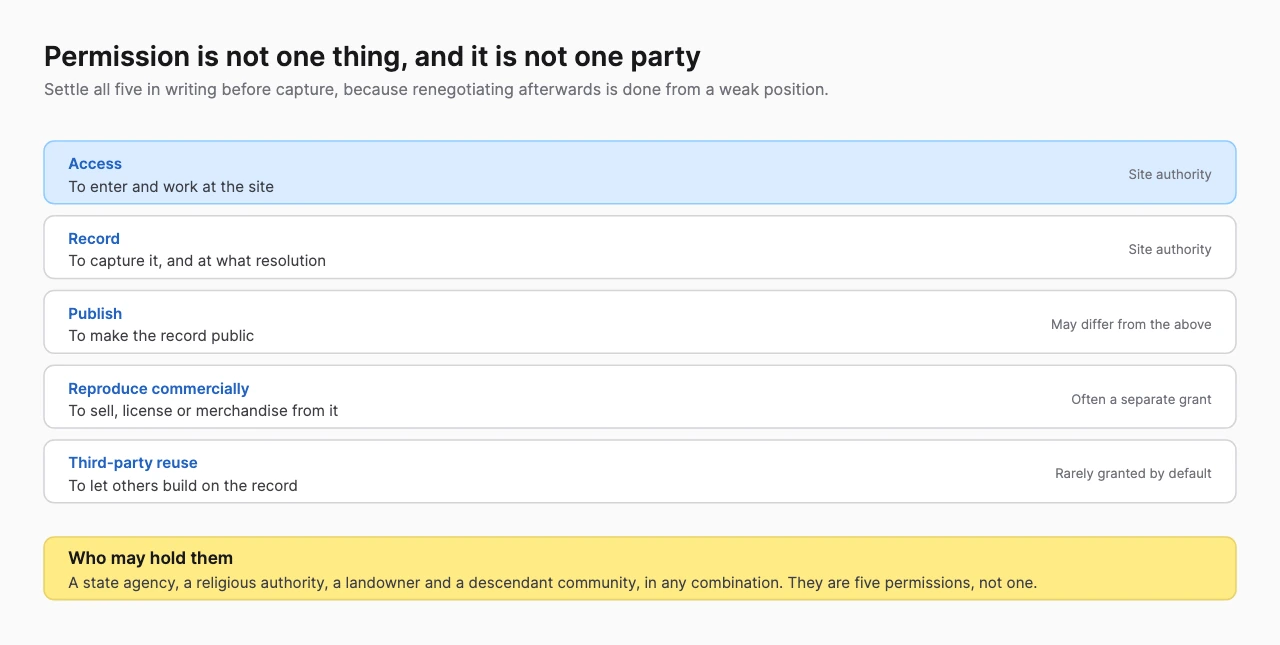
Permission to access a site, to record it, to publish the record, to reproduce it commercially and to allow third parties to use it are five different things, and they may rest with different parties including a state agency, a religious authority, a landowner and a descendant community.
Settle all of them in writing before capture, because renegotiating afterwards is done from a weak position: the recording already exists, and the party you need has learned that you want something.
This is the single most common cause of a heritage project producing a launch event rather than a lasting asset. The experience opens, the press covers it and the underlying record cannot be reused because nobody secured the right to reuse it.
What running in a gallery requires
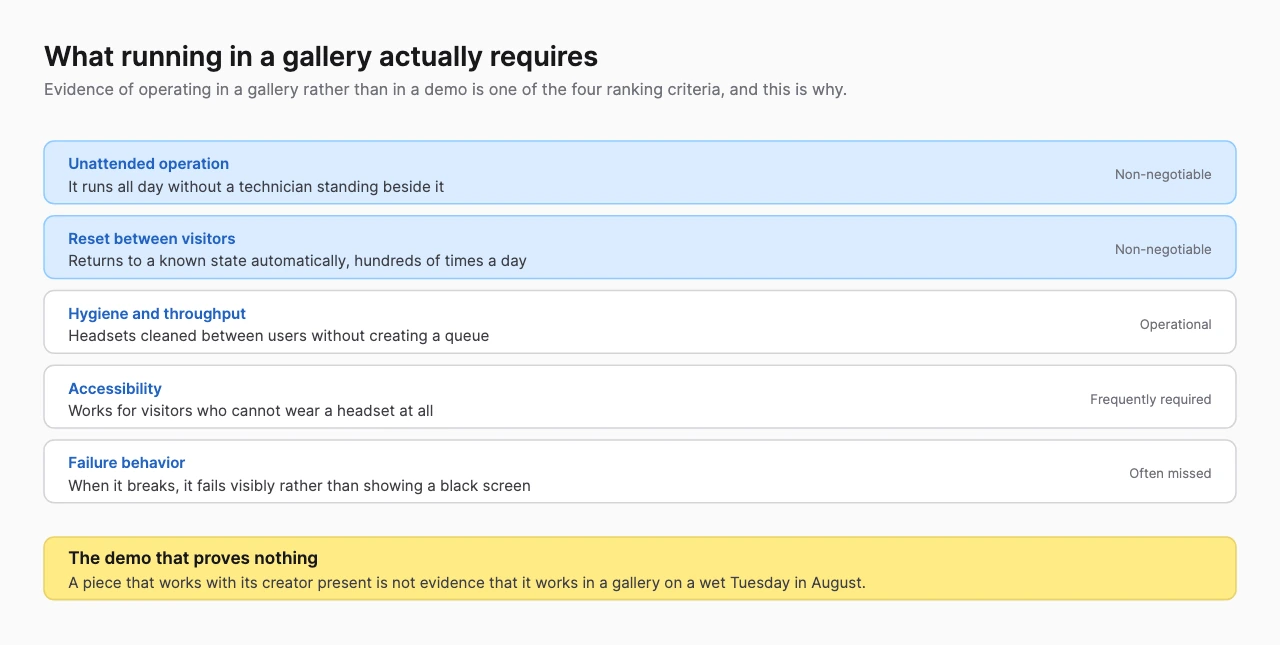
Five requirements separate a piece that survives an exhibition run from one that survives a demonstration.
Unattended operation. It runs all day without a technician beside it. This alone eliminates a large proportion of impressive work.
Reset between visitors. It returns to a known state automatically, hundreds of times a day, including after someone abandons it halfway.
Hygiene and throughput. Headsets cleaned between users without creating a queue that becomes the visitor's memory of the exhibit.
Accessibility. Something exists for visitors who cannot wear a headset, which is a larger group than most briefs assume and is frequently a funding condition.
Failure behavior. When it breaks, it fails visibly rather than showing a black screen that visitors interpret as the artwork.
What sets a cultural XR schedule
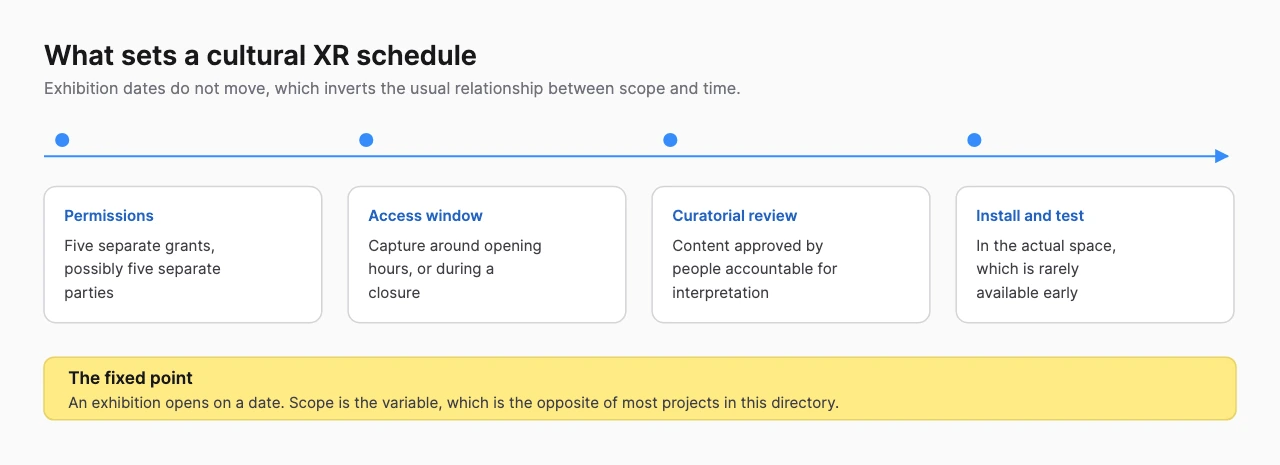
An exhibition opens on a date, and that date does not move. This inverts the usual relationship between scope and time: in most projects in this directory, scope is fixed and the schedule slips. Here the schedule is fixed and scope is the variable.
Permissions come first and are the least predictable. Capture access is negotiated around opening hours or a closure. Curatorial review is content approval by people accountable for interpretation, and it is not a formality. Install and test happens in the actual space, which is rarely available until late.
A supplier who has delivered into a gallery will build float into the last of these, because it is the one that cannot be compressed.
What the institution owns at the end

Ask for the capture data at archival resolution, the right to reuse it in future interpretation, documentation of how it was made and a file format that will still open in ten years.
Without those, the record leaves with the supplier, the next project recaptures from scratch, the provenance of any reconstruction is lost and a proprietary format eventually becomes unreadable.
This matters more here than in any other category in this directory. Heritage capture is frequently the only record of a site in a given state, and sites are lost to conflict, climate and development. Losing the record is not a commercial inconvenience.
What you can check, and where
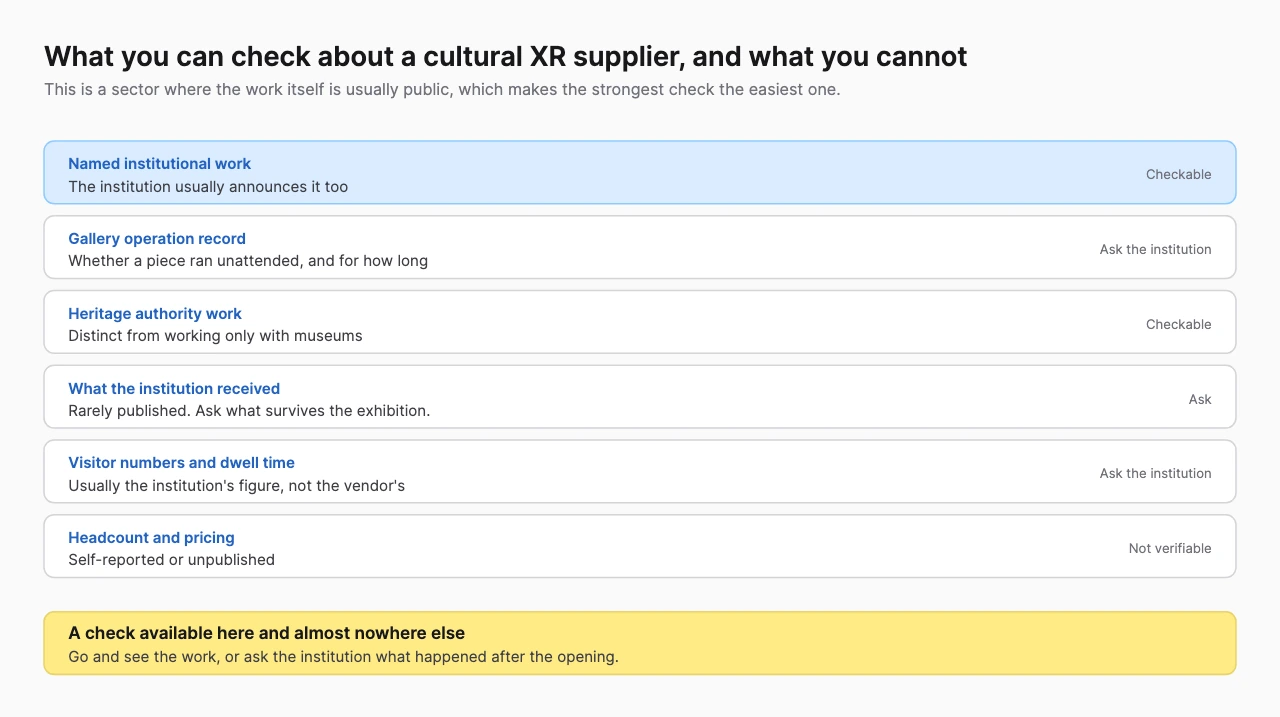
This sector offers a check available almost nowhere else in the directory: the work is usually public, and you can go and see it. Failing that, the institution can be asked what happened after the opening, which is a different question from what the vendor says about the launch.
Visitor numbers and dwell time are usually the institution's figures rather than the vendor's, and the institution is the better source. A vendor quoting attendance is quoting someone else's measurement.
Reconstruction claims deserve particular care. A visual reconstruction of a site asserts what it looked like. Where that rests on published archaeology it is citable and should be cited. Where it rests on a studio's interpretation, that is legitimate and should be labeled, because a visitor cannot tell the difference and will assume the former.
No primary source exists for market size in cultural XR, and this site does not repeat projections.
How the rankings below were built
Every list linked here ranks on four published criteria and states what is not a ranking factor, set out in each post under How this list was built.
Across the culture lists the recurring four are named work with cultural institutions, whether the company designs whole exhibits or supplies a technology layer, evidence of operating in a gallery rather than a demo, and what the institution owns when the project ends.
The methodology page sets out how entries are assessed.
Where to start
Separate documentation from interpretation from reconstruction, then read the list covering your purpose.
- Best XR development companies for museums
- Best companies for VR and AR art exhibitions
- Best XR companies for cultural heritage experiences
- Best VR companies for virtual museum tours
- Best AR companies for interactive exhibits and artifact visualization
The directory lists developers, platforms and software with sourced entries.
Related reading. BestInXR's list of spatial computing companies explains why suppliers doing this work rarely use the term, and routes to the vertical list for each sector.
Frequently Asked Questions (FAQ)
1. What is XR used for in museums?
Interpreting a collection, reconstructing a place, recording a site as a measurable archive and reaching audiences who cannot visit. Those are four different purposes with different suppliers, and briefs that combine them without distinguishing them tend to get whichever the supplier is best at.
2. Which companies build XR for museums and galleries?
They divide by role. Local Projects and Bluecadet design whole exhibits, Marshmallow Laser Feast authors its own work, and Iconem, CyArk and Factum Arte work in heritage documentation and reproduction.
3. What is the difference between a studio and an artist collective?
A studio realizes someone else's vision for a fee and delivers a build. A collective authors its own work, which is exhibited, toured and sometimes licensed. The institution briefs the first and hosts the second, and the negotiation is entirely different.
4. What makes a heritage XR project produce a lasting asset?
Settling permissions early. Access, recording, publication, commercial reproduction and third-party reuse are five separate grants that may rest with different parties, and negotiating them before capture is done from a far stronger position than after.
5. What does a gallery exhibit need beyond a demo?
Unattended all-day operation, automatic reset between visitors, hygiene and throughput that does not create a queue, an alternative for visitors who cannot wear a headset, and visible rather than silent failure.
6. Should a reconstruction be labeled as interpretation?
Yes. A visual reconstruction asserts what a site looked like. Where it rests on published archaeology it should cite it, and where it rests on a studio's interpretation that should be stated, because a visitor cannot tell the two apart and will assume the former.
7. What should a museum receive at the end of a project?
The capture data at archival resolution, the right to reuse it, documentation of how it was made and a format that will open in ten years. Heritage capture is often the only record of a site in a given state, which makes this more consequential than in other sectors.
8. How are museum XR projects scheduled?
Backwards from a fixed opening date, which makes scope the variable rather than time. Permissions are the least predictable input, and install and test in the actual space is the step that cannot be compressed.