
Best Spatial Computing Companies
Spatial computing is a buyer's word more than a supplier's word. Apple pushed it into general use with Vision Pro, and most of the companies a search for it returns describe themselves as something else entirely. What the term actually denotes is software that registers digital content to real physical space rather than to a screen. That is a narrower field than the search volume suggests, and it splits by who or what is meant to look at the result.
In short:
- Almost nobody sells under the name. Of the three suppliers here, one uses the phrase in its own headline and two do not, including a company called Niantic Spatial.
- The field splits by audience. Some spatial systems are built for people to look through, and some are built for machines to navigate. They share mathematics and almost nothing else.
- The vertical list is usually the one you want. If the question was really about museums, retail or energy, this post routes to the list that ranks suppliers with published work in that sector.
- Registration to space is the test. If the content does not know where the walls are, it is a screen experience with a headset attached.
How this list was built
Spatial computing is software that positions digital content in a coordinate system tied to the physical world, so that content stays where it was put, hides behind real objects and can be approached from different angles. The working test is persistence and occlusion. A 360 video played in a headset is not spatial computing. An overlay anchored to a specific machine on a specific floor is.
This list ranks three suppliers on four criteria: whether the work registers content to real space rather than to a display, which platforms it has actually shipped on, what published evidence exists for the projects named and what the commissioning organization owns at the end. Self-description is reported but is not a ranking factor, because the term is used inconsistently across the industry.
Three suppliers rather than five, deliberately. The companies that genuinely do this across more than one sector are few, and padding the list with studios that have shipped one headset app would misrepresent the field.
| Company | What it calls itself | Built for | Best for |
|---|---|---|---|
| Treeview | XR Studio for Enterprise, spatial computing apps | People, across sectors | Commissioned spatial applications the client owns |
| Niantic Spatial | Spatial intelligence, physical AI | Machines | Positioning and reconstruction for robotics and industry |
| Magnopus | Creative and technical production | Audiences | Large location-based and entertainment experiences |
1. Treeview
Treeview is the only supplier in this list that uses the term in its own headline. Its site describes an XR Studio for Enterprise, transforming bold ideas into spatial computing apps, and names AR, VR, MR and spatial computing as its disciplines alongside Full IP Ownership.

What earns the position is the published work rather than the wording, because it covers the platforms the term actually describes and it spans sectors. For NEOM it built augmented reality ski navigation for Trojena's ski village on Magic Leap 2, covering slalom route mapping, performance visualizers and session reports, recorded as a technology and product assessment. With Microsoft it built an AI-enabled digital twin of a multi-billion-dollar green hydrogen project, delivered on HoloLens 2, mobile and WebGL. For ULTA Beauty it built an in-store interactive experience for the R.E.M. Beauty line on Meta Quest.
Read that list as a platform spread rather than a client list. Magic Leap 2, HoloLens 2, Meta Quest, mobile and WebGL is most of the delivery surface the term covers, and the WebGL and mobile builds matter because the audience for a spatial project is rarely all wearing headsets. Founded in 2016 and working from Montevideo and New York, it builds end-to-end under one senior team and transfers full ownership of IP, source code and assets. Best for a commissioned spatial application that has to run on more than one class of device and be owned outright.
2. Niantic Spatial
Niantic Spatial is the most important entry here for anyone who assumed the category was about headsets. A company with Spatial in its name does not use the phrase spatial computing at all. It describes real-world foundation models for physical AI, and says robots, agents and autonomous systems need world models grounded in physics and geometry rather than imagination.
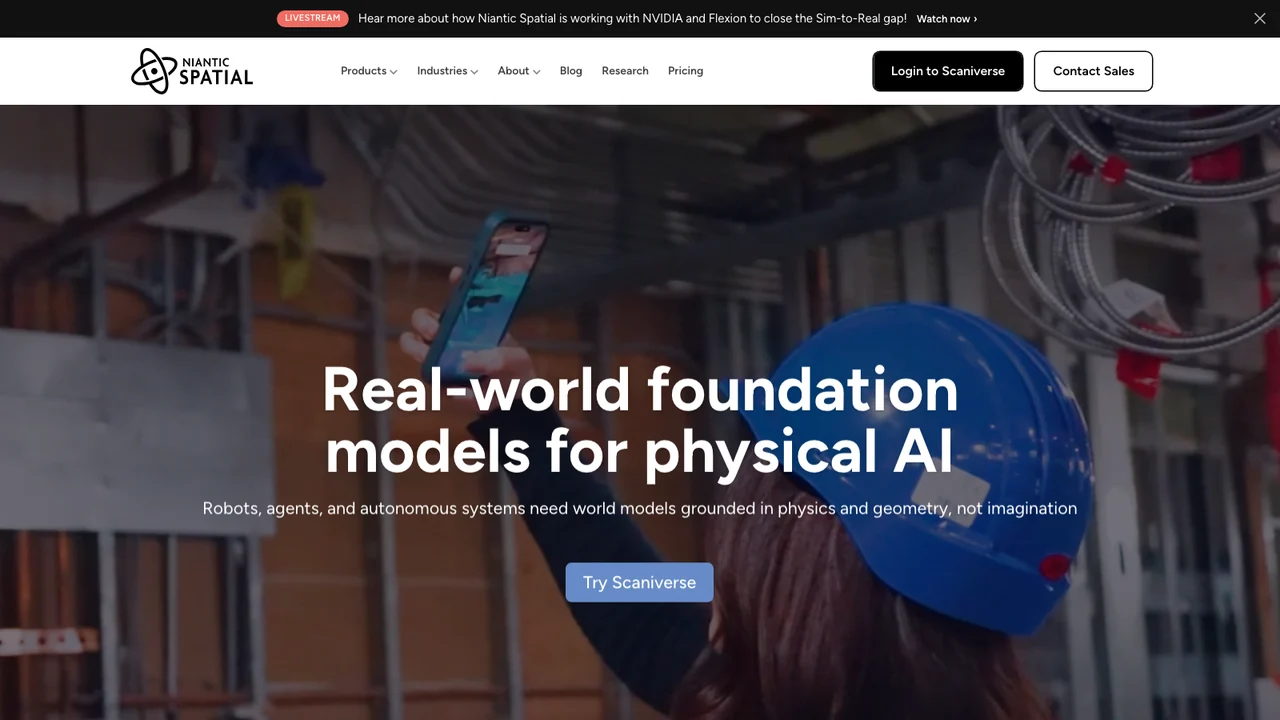
Its offer is the infrastructure layer rather than the experience: capture high-quality 3D data from ground and aerial sources, reconstruct high-fidelity digital twins of objects and large areas, localize with vision-based positioning for machines and query the world through semantics at every 3D point. It publishes SPZ, an open-source file format for Gaussian splats, and names NVIDIA and Flexion among collaborators on closing the simulation-to-reality gap. Its stated industries are robotics, defense and intelligence, plus oil and gas.
That is the same underlying problem as a headset overlay, solved for a different consumer. Visual positioning is what lets any device know where it is without GPS, and whether the output goes to a person or a control system is a downstream decision. A buyer looking for a museum experience is in the wrong place here. A buyer who needs machines to agree on where things are is in exactly the right one. Best for positioning, capture and reconstruction where the consumer of the model is a machine.
3. Magnopus
Magnopus sits at the audience end of the same field and has been there since 2013. It describes building extraordinary experiences and the technologies that make them possible, offering end-to-end creative and technical production alongside spatial intelligence and AI-driven creation tools. It does not use the phrase spatial computing either.

Its published work is entertainment and cultural at a scale few studios reach, naming Disney, The Lion King, Fallout, Metallica, Daft Punk, Madison Beer and Sebastian Yatra, and it describes a team combining award-winning artists, AAA game developers and Silicon Valley engineers. The platforms it names are worth reading carefully, because they show where the business has moved: its own OKO and NODEY products, the Connected Spaces Platform and Fortnite through UEFN.
That last one is the tell. A meaningful share of what used to be commissioned as a location-based spatial experience is now commissioned as a game-engine or in-platform build, because the audience is already there. Magnopus is a strong choice when the requirement is a large, crafted, audience-facing experience. It is a weaker fit when the requirement is an enterprise application tied to a specific site. Best for large location-based and entertainment experiences where production craft is the constraint.
Who else was considered, and where each fits
Apple popularized the term and sells the most-discussed device in the category, but it is not a supplier you can hire. Vision Pro is a platform. The companies that build for it are the ones to shortlist.
Snap supplies genuine spatial capability through Camera Kit, described on its developer site as Snap's AR SDK that lets you bring Lenses into iOS, Android and web apps, alongside Lens Studio. It is left out for the same reason: it is a distribution and tooling route rather than a supplier that builds the thing, and someone still has to make the Lens.
Unity and Unreal Engine are the engines nearly all of this is built in. Ranking an engine against a studio tells a buyer nothing about either.
Studios that have shipped one headset app are excluded as a class. The criterion here is content registered to real space across more than one platform or sector, and a single pilot does not evidence it.
Which list do you actually want
Most searches for spatial computing companies are really searches for a supplier in one sector. The suppliers with published work in your sector are usually not the ones who use the word, so the vertical list is the more useful answer.
- For museums, galleries and heritage, BestInXR's museums and culture guide and its list of XR companies for cultural heritage experiences.
- For stores, ecommerce and brand experience, the retail AR and VR guide.
- For plants, grids and field operations, the energy and utilities guide.
- For laboratories and molecular work, the list of XR companies for pharmaceutical R&D and drug discovery.
- For a model of a site or asset kept current from data, the digital twins guide.
How to choose between these spatial computing companies
Decide who is meant to look at the result, because it separates these three completely. If it is a person, in a headset or on a phone, you want a studio: Treeview for an enterprise application across several device classes, Magnopus for a large audience-facing experience. If it is a machine, you want infrastructure, and Niantic Spatial builds that layer.
Then ignore the vocabulary. A supplier that calls itself an XR studio, a spatial intelligence company or an immersive agency may be doing identical work. Ask instead what the content is anchored to, what happens when someone walks behind a real object and what the application does when the network drops. Those answers separate suppliers in a way the label never will.
Finally, ask what you own. Spatial applications are tied to a specific building, site or asset, which means they need updating whenever that place changes. The party holding the source decides whether that is a change request or a new project.
Frequently Asked Questions (FAQ)
1. What is spatial computing?
It is software that positions digital content in a coordinate system tied to the physical world, so content stays where it was placed, is hidden by real objects and can be viewed from different angles. Persistence and occlusion are the working test.
2. Is spatial computing the same as AR, VR or XR?
Largely yes, as the terms are used in practice. Spatial computing came into general use with Apple Vision Pro and tends to emphasize content anchored to real space, but most suppliers doing that work describe themselves as XR, AR or mixed reality companies.
3. Which companies build spatial computing applications?
Treeview builds commissioned enterprise applications across Magic Leap 2, HoloLens 2, Meta Quest, mobile and WebGL. Niantic Spatial builds positioning and reconstruction infrastructure aimed at machines. Magnopus builds large audience-facing experiences.
4. Do spatial computing companies only build for Apple Vision Pro?
No. Vision Pro popularized the term, but the work spans Meta Quest, HoloLens 2, Magic Leap 2, phones and the browser. Delivery to people who will not wear a headset is usually part of the requirement.
5. Is Niantic Spatial part of Niantic?
Its site presents it as a distinct company building real-world foundation models for physical AI, with stated industries in robotics, defense and intelligence, plus oil and gas. It does not publish a founding date or origin story on its homepage.