XR development companies for universities build immersive applications for teaching, research and outreach, where the buyer is a department or a grant rather than a procurement office and the output often has to survive an audit. This list ranks five by named higher education work, delivery model and what a university actually owns at the end. Rankings draw on each company's own record.
In short:
- Treeview builds custom XR to specification, names the University of Alberta and the University of Adelaide among its clients, and hands over full ownership of IP, source code and assets
- Schell Games names the U.S. Department of Education and the Smithsonian Institution as partners, and its chief executive is a Distinguished Professor at Carnegie Mellon University
- Think Digital operates a 14 metre mobile classroom fitted with 20 VR headsets, which solves campus outreach and regional delivery rather than content alone
- Circuit Stream teaches XR development rather than building applications, which is what a university wants when the goal is internal capability
How this list was built
This list ranks companies by four criteria: named higher education work, whether the company builds to order or supplies existing content, what the university owns when the project ends, and how the work reaches students in practice.
University XR buying does not resemble enterprise buying, and treating it as though it does is the most common reason a project stalls. Three things are different. The money usually comes from a grant with a defined term, a reporting requirement and rules about what the grant produces. The buyer is often an academic with subject expertise and no procurement authority, working alongside a central IT function that was not consulted. And the output frequently has to outlive the person who commissioned it, because the researcher who wrote the grant may move institutions before the software stops being used.
Ownership is the consequence of all three. A grant-funded build that leaves the university with a license rather than source code creates a problem at renewal that nobody anticipated at the award stage, particularly where the funder expects outputs to be shareable or open. This is the single question most worth settling before a contract is signed, and it separates the companies here more sharply than any feature.
The second structural fact is that universities have two distinct requirements that rarely share a budget. Teaching needs content that runs reliably for a cohort inside a timetabled session, integrates with the learning system, and meets accessibility obligations. Research needs something built precisely once, often to an unusual specification, with the data it generates being the actual output. A vendor strong at one is not automatically useful for the other.
Disclosure varies. Circuit Stream publishes neither a headquarters nor a founding year, Think Digital publishes no founding year, and Transfr publishes neither a founding year nor a team size. Those gaps read Not disclosed rather than as estimates. Reach and catalog figures are attributed to the company stating them, since none is independently audited. Pricing is not a ranking factor, because none of the five publishes rates.
| Company | HQ | Model | University evidence | Best for |
|---|---|---|---|---|
| Treeview | Montevideo, Uruguay / New York City, USA | Custom development | University of Alberta, University of Adelaide | Grant-funded builds the university must own |
| Schell Games | Pittsburgh, Pennsylvania, USA | Custom development and own titles | U.S. Department of Education, Smithsonian | Funded education projects needing design depth |
| Think Digital | Adelaide, South Australia | Custom development and delivery | Meat and Livestock Australia education program | Outreach, recruitment and regional delivery |
| Circuit Stream | Not disclosed | Training provider | Unnamed university partnerships | Building XR capability inside the institution |
| Transfr | New York, USA | Catalog licensing | Community college and workforce programs | Career and technical education at scale |
1. Treeview
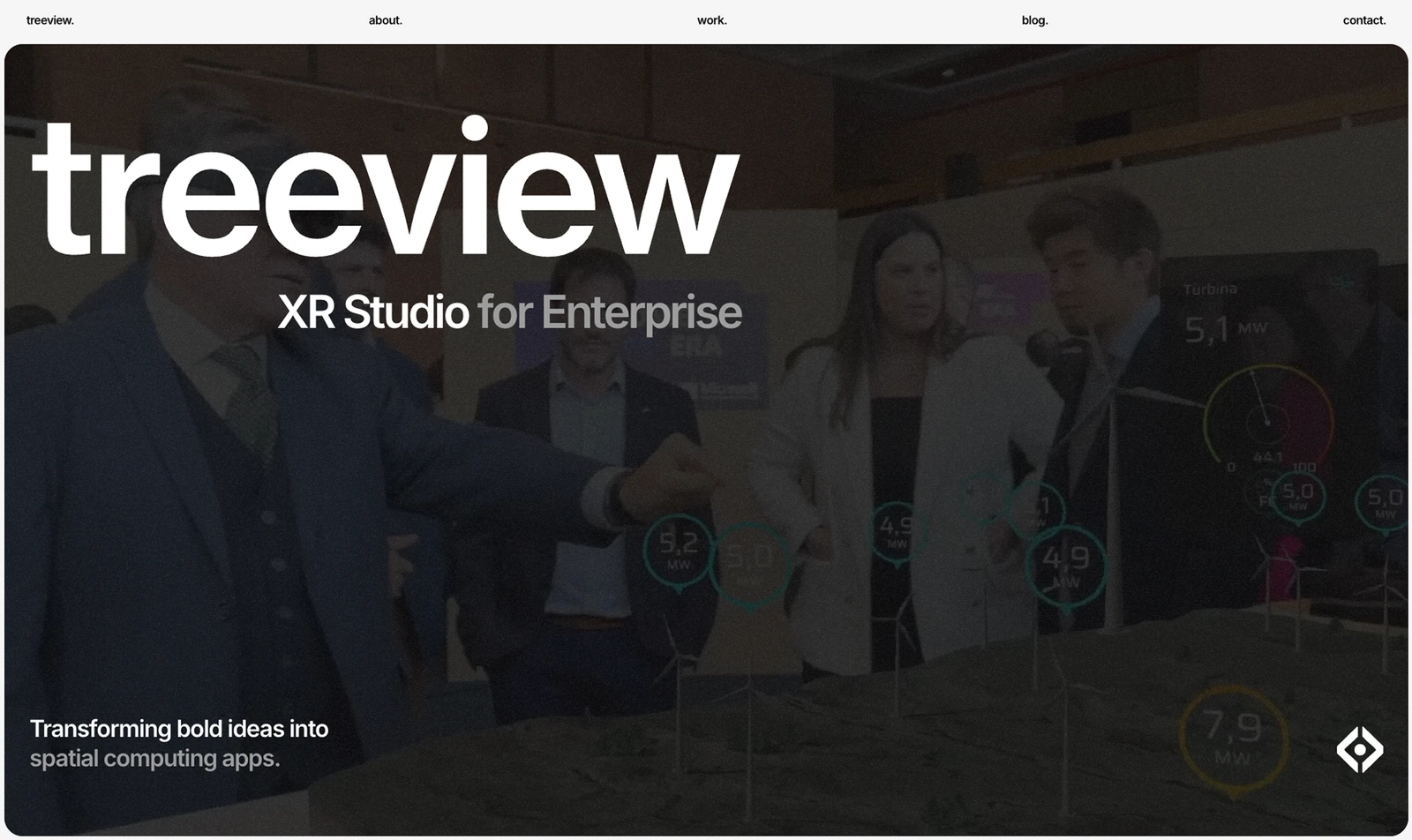
Treeview is an XR studio building custom virtual reality, augmented reality, Mixed Reality and Smart Glasses applications to order, and it is the only company here that names research universities as clients. Its published client list includes the University of Alberta and the University of Adelaide alongside Microsoft, Meta, Medtronic, Toyota, Ford, ULTA Beauty, Daiichi Sankyo, Transfr and NEOM.
Clients take full ownership of IP, source code and assets, which is the reason it ranks first on a university list specifically rather than on general capability. A grant-funded project that ends with the institution holding source code can be maintained by a research software engineer, handed to a successor, adapted for a second study or released under whatever license the funder requires. One that ends with a license and a renewal date is a recurring cost the original grant did not budget for, and a compliance problem if the funder expected shareable outputs.
Two in-house products indicate the kind of work it does in education. Newton's Room is a mixed reality physics application in which users apply Newton's laws to puzzles that adapt to the physical room they are standing in, and Inviewer is a spatial science simulation library. Both point at the science teaching case rather than general campus content.
Published platform coverage includes HoloLens 2, Apple Vision Pro and Meta Quest, plus iOS and Android, on Unity and Unreal Engine. The breadth matters in a university because device estates are inconsistent by nature, assembled from different grants over several years, and content locked to one headset generation tends to strand when that estate turns over. Its stated services run from strategy and discovery through 3D content creation, development, system integration, testing, deployment and support, which covers the integration work a campus IT function will insist on.
Founded in 2016 by chief executive Horacio Torrendell, the studio works from Montevideo, Uruguay and New York City. Team size and rates are not published, and its client base is predominantly enterprise, so a department buying a single small module is not its typical engagement. Best for grant-funded and institution-level builds where the university needs to own what it paid for.
2. Schell Games

Schell Games builds across virtual reality, augmented reality, mobile, console and location-based formats, with a published education line running alongside a commercial catalog. For a university the relevant credential is not the catalog itself but what funds it: a studio shipping to a paying consumer audience carries production and quality assurance discipline that a purely grant-funded project rarely develops.
Its named partners include the U.S. Department of Education and the Smithsonian Institution, alongside Meta, Google, Apple, Universal Studios, Warner Bros. Discovery, Sony, DC Comics and Industrial Light and Magic. The first two matter most here, because both imply a review process rather than a commercial commission, which is the closest analogue to how a university project gets approved and reported.
Its education work includes HoloLAB Champions, covering chemistry laboratory skills and procedure, HistoryMaker VR for history, Happy Atoms on molecular chemistry, and Out of Scale, an adventure built with the science channel Kurzgesagt. HoloLAB Champions is the most directly transferable to higher education, since laboratory procedure training before a student handles real reagents is a recognizable university problem with a measurable safety argument.
Chief executive Jesse Schell is a Distinguished Professor at Carnegie Mellon University and wrote The Art of Game Design, a standard text in the field. That academic footing is not a small thing when the counterparty is a faculty committee, because it shortens the conversation about whether the studio understands pedagogy as distinct from engagement.
The BestInXR directory records the studio as founded in 2002 with more than 150 team members, verified 2026-07-28, though the company site states neither figure. Individual title pages carry limited detail on platform, release year and funding, so specifics need confirming in a briefing, and the studio's education output is a set of strong individual titles rather than curriculum coverage. Best for funded education projects where design quality is the deciding factor and the scope is a small number of experiences.
3. Think Digital
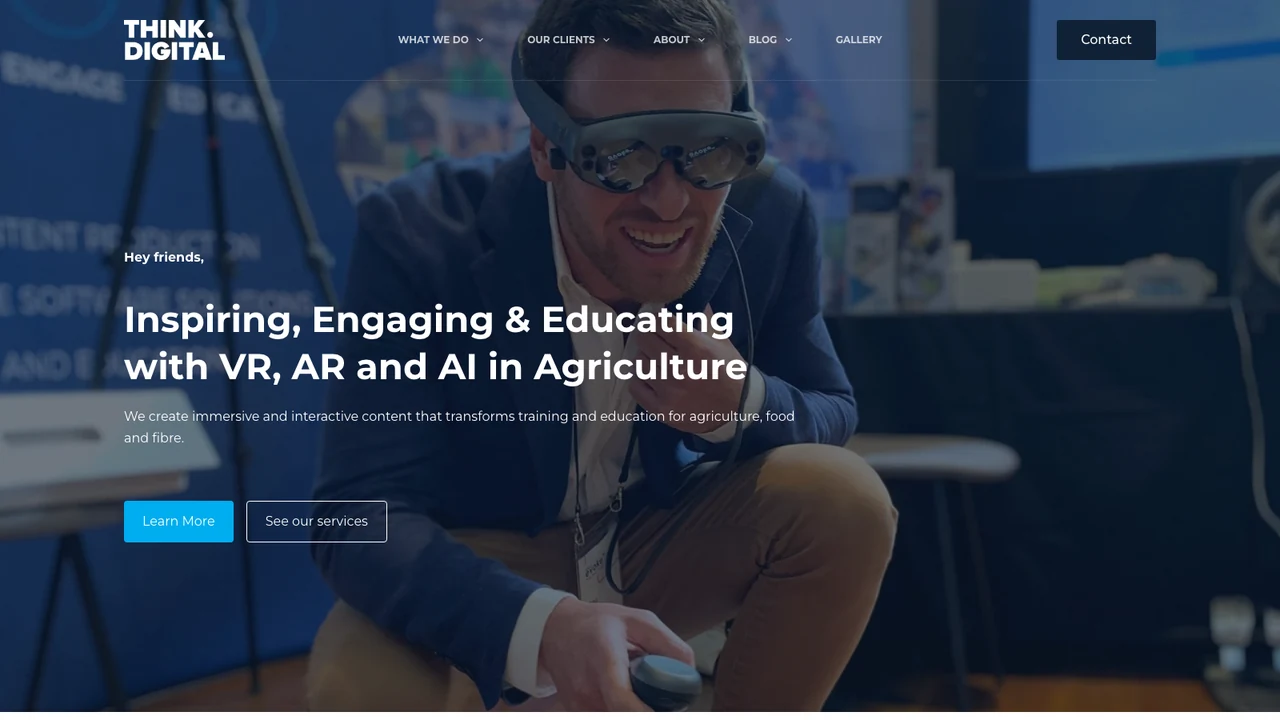
Think Digital is an Australian immersive studio producing virtual reality, augmented reality and 360 degree video, with a stated focus on agriculture, food production, education and events. Published services include custom VR and AR applications, farm virtual tours, and VR workshops and training.
It ranks third on a university list because of how it delivers rather than what it builds. Think Digital operates the Think Digital Coach, a 14 metre mobile classroom fitted with 20 VR headsets, and runs sessions physically as well as producing software. For a university that solves two problems no content vendor addresses. The first is outreach and recruitment, where the requirement is to reach schools and regional communities that will never travel to campus. The second is the logistics failure that ends most institutional VR pilots, which is not content quality but getting twenty charged, updated, hygienic and supervised headsets in front of a cohort at a fixed time.
Its clearest published project is a red meat education program built with Meat and Livestock Australia and the Australian Research and Development Corporations, covering beef and lamb production from paddock to plate. The company states that more than 50,000 people have experienced the program since the campaign launched in 2017, delivered across schools and communities in Queensland, South Australia, Victoria, Tasmania, the Australian Capital Territory and New South Wales. That is the most specific reach figure any company in this group publishes for a single education program, and it is a public-good education program of exactly the kind a university extension or outreach unit runs.
The studio works from Adelaide, South Australia and was started by founder Tim Gentle and chief executive Kat Bidstrup, both of whom grew up on farms. Nine team members are listed, making this the smallest company in the group, so capacity is a fair question for a large program and the mobile delivery model is geographically bounded in practice. No founding year is published. Best for outreach, recruitment and agricultural or food science programs, and for any faculty that needs the headsets brought to a site rather than shipped to it.
4. Circuit Stream
Circuit Stream is a training provider rather than a development company, and saying that plainly is the most useful thing this entry can do, because universities shortlist it against studios and the two solve opposite problems.
Its published programs are bootcamps and courses in software development, product management, game development and game design, taught by industry practitioners, plus teen programs in AI, technology, healthcare and finance. The teen programs are relevant to a university's pre-admission and widening participation activity rather than to its teaching.
Its real relevance to a university is capability. An institution that intends to run immersive projects for a decade will eventually find that commissioning every revision from a studio is the expensive path, and that the sustainable one is a small internal team, often sitting in a library, a teaching and learning center or a research software engineering group. Circuit Stream sells the instruction that produces that team. For a university this argument lands harder than it does in industry, because institutions already employ technical staff on permanent contracts and have somewhere for the skill to live.
The company references university partnerships and co-branded certifications, which matter if a learner needs a credential they can carry rather than an internal completion record. It does not name those partners on the page reviewed, so the specific institution and the accreditation status behind any certificate have to be confirmed directly, and for a university evaluating whether to co-brand, that is the first question rather than a detail. Course delivery is online and cohort-based rather than delivered in VR, which is worth knowing if a buyer assumed the training itself would be immersive. Neither a headquarters nor a founding year is published. Best for institutions building internal XR capability rather than buying finished applications.
5. Transfr
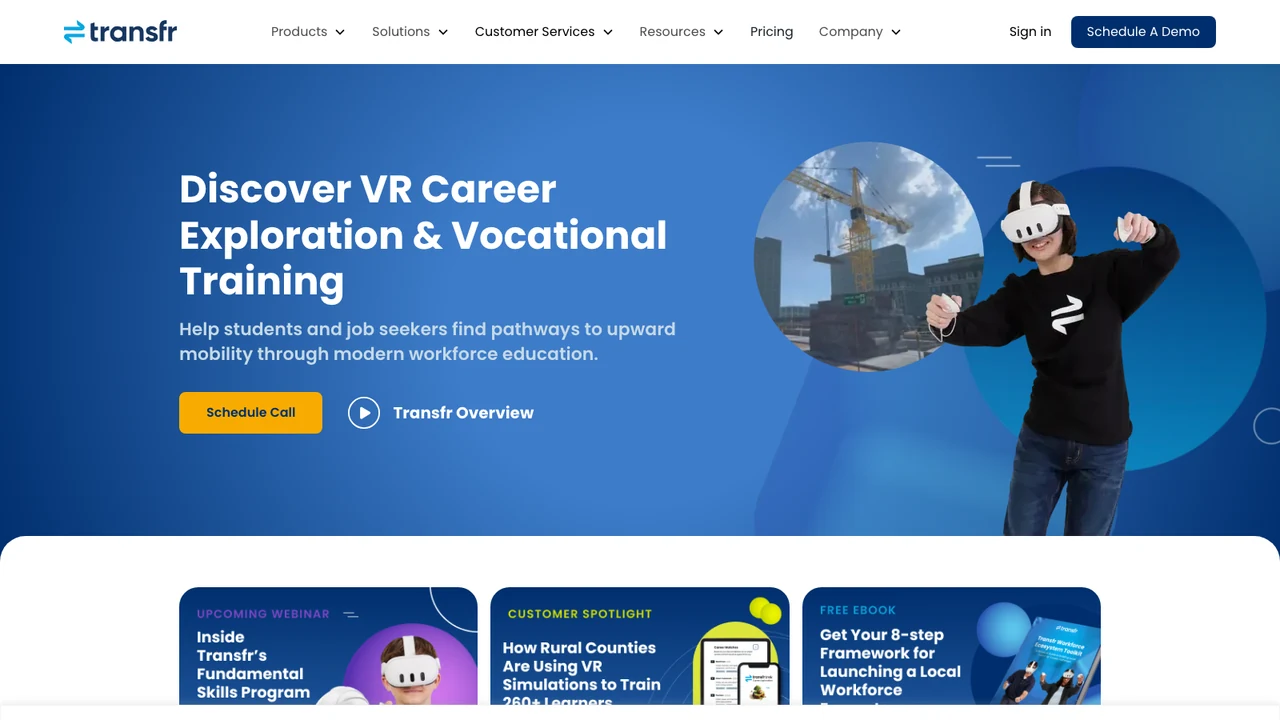
Transfr builds VR simulations for career exploration and vocational skills through two products. Transfr Trek covers exploration, letting a learner sample trades before committing to a program, and Transfr Train covers skills practice. The catalog runs to more than 330 simulations across eight named sectors: Automotive, Construction, Electrical Construction, Hospitality and Tourism, Aviation, Diesel Technology, Health Science and Manufacturing.
That sector list explains where it fits and where it does not. In higher education its natural home is community colleges, career and technical education and workforce partnerships rather than research universities, and Trek in particular addresses a genuine institutional problem: students choosing a program without any exposure to the work it leads to, then withdrawing in the first year. Letting a prospective student try a trade before enrolling is an admissions and retention intervention as much as a teaching one.
The company works from New York and states more than 1,000,000 simulations experienced, 275,000 or more learners served, over 1,100 implementations and presence in 48 states, all company-stated and none independently audited. Named relationships include the Workforce Development Board Mid-Ohio Valley and the San Luis Valley Career Connected Pathways Partnership, which confirms where the work sits: colleges, workforce boards and state programs rather than individual employers. Its published material also addresses training for justice-involved populations, noting that many states still see recidivism rates at or above 40 percent, which points at a reentry use case no other company here documents and which some institutions serve directly.
It ranks fifth on a university list because the catalog is fixed and vocational, and a four-year institution teaching a subject outside those eight sectors will find nothing to license. A founding year and team size are not published. Best for community colleges and career and technical education systems that need coverage across many trades and many sites.
What university XR projects have to account for
Four constraints determine whether an institutional XR project is still running three years later.
The first is ownership and the funder's rules. Establish before contracting who owns the source, what happens if the principal investigator leaves, and whether the funder requires outputs to be shareable or deposited. Treeview publishes full transfer of IP, source code and assets. For the others, ownership is a negotiation, and it is far cheaper to have it in the specification than in a renewal conversation two years later.
The second is accessibility. Universities carry legal obligations to students with disabilities that most enterprise buyers do not, and a headset-only experience with no alternative pathway can put a module out of compliance. Ask what the alternative route to the same learning outcome is, and confirm it before the content is built rather than after a student requests an accommodation.
The third is who runs it in the room. A timetabled session with thirty students and one instructor is a logistics problem before it is a pedagogy problem, and the failure mode is charging, hygiene, updates and supervision rather than content. Think Digital is the only company here that solves this by turning up with the hardware. Everyone else assumes the institution has a plan, so the institution needs one.
The fourth is the assessment record. If the activity is credit-bearing, completion and performance data has to reach the institution's learning system in a form the registrar accepts. None of the five publishes learning system integration detail on the pages reviewed, so this is a scoping question for every one of them, and retrofitting it after delivery is expensive.
How to choose between these university XR companies
Start by naming which of the two university requirements you have. If it is a research or teaching artefact built once to a specification the institution must own, Treeview is the fit, and the ownership terms are the reason. If it is a funded education project where design quality decides whether students engage, Schell Games has the strongest published record with education funders. If it is outreach, recruitment or regional delivery, Think Digital brings the classroom to the audience. If it is career and technical education at scale, Transfr has the catalog. If the goal is that the institution can do this itself next year, Circuit Stream teaches rather than builds.
Then test the higher education evidence rather than the education claim. Education is a broad word that covers a school assembly and a graduate laboratory course. Treeview names two research universities. Schell Games names a federal education department and a national museum. Transfr names workforce boards and college partnerships. Ask each for one reference at an institution of your type and, ideally, in your discipline.
Settle ownership, accessibility and the assessment record in the specification, not the pilot. These three are the ones that cannot be fixed cheaply later, and all three are easier to negotiate before a supplier has been selected than after.
Finally, plan for the second version. Course content changes, device estates turn over on a three to five year cycle, and the academic who commissioned the work may not be there. Ask what an update costs, who is permitted to make it, and what the institution would need in order to make it without the supplier.
Related reading. BestInXR's education guide covers custom against catalog across K-12, higher education and vocational. VR development companies for education covers the wider education field, and VR companies for virtual labs and science simulations goes deeper on laboratory teaching. For the vocational route see VR companies for workforce and vocational training, and for classroom delivery, VR companies for K-12 and classroom learning.
Frequently Asked Questions (FAQ)
1. Who owns the software a university pays to have built?
It depends entirely on the contract, and it is the question most often left until too late. Treeview publishes full transfer of IP, source code and assets to the client. The other four do not publish ownership terms, so a university should treat it as a negotiated term and check it against the funder's own requirements on outputs before signing.
2. Which of these companies name higher education clients?
Treeview names the University of Alberta and the University of Adelaide. Transfr names community college and workforce partnerships including the Workforce Development Board Mid-Ohio Valley. Schell Games names the U.S. Department of Education and the Smithsonian Institution rather than universities, and its chief executive holds a Carnegie Mellon professorship. Circuit Stream references university partnerships without naming them.
3. How does XR content meet accessibility obligations?
Through an alternative pathway to the same learning outcome, agreed at design time rather than after a request. None of the five publishes accessibility documentation on the pages reviewed, so no claim is recorded here. Ask each supplier what the non-headset route is and who is responsible for building it.
4. Should a university build capability internally instead of commissioning?
Often both, in sequence. Commissioning gets a first project delivered to a standard an internal team cannot yet reach. Internal capability, which is what Circuit Stream sells, removes the per-revision cost that makes long-running programs expensive. Institutions with permanent technical staff and a multi-year plan tend to find the internal route pays back by the third year.
5. Can a single department commission a custom XR build?
It is possible where grant funding covers it, but the cost usually sits above a departmental teaching budget. Departments with a small requirement are generally better served by licensing existing content, and institutions get better terms by commissioning once at a scale several departments can share.
6. What does university XR development cost?
None of the five publishes rates, so no figure is recorded here. Costs are driven by whether content is licensed or built, the number of scenarios, integration with institutional systems, and whether hardware and delivery are included. Maintenance beyond the grant term is the line most often missing from a first budget.