Companies for VR and AR art exhibitions fall into two groups that get confused constantly: studios you commission to build an artist's or institution's idea, and artist collectives whose own work you exhibit. This list ranks five across both, by named exhibition record, delivery model and what an institution actually receives. Rankings draw on each company's own record.
In short:
- Treeview builds custom XR to specification and hands over full ownership of IP, source code and assets, which is the position an institution wants for a commissioned artwork
- Marshmallow Laser Feast is an artist collective, not a studio for hire, with works exhibited at ACMI, the Barbican Centre, Kew, Sundance and SXSW, and gallery representation by bitforms
- Nexus Studios is director-led and names Barbican commissions including Your Inner Symphony and AI: More than Human
- Magnopus has the strongest engineering record, including the Academy Museum of Motion Pictures and work at Sphere
How this list was built
This list ranks companies by four criteria: named exhibition record with galleries and art institutions, whether the company builds to commission or authors its own work, evidence of running in a gallery rather than a festival demo, and what an institution receives at handover.
The distinction between a studio and an artist collective is the single most important thing to establish before any conversation, and it is routinely missed because both appear on the same shortlists. A studio is engaged to realize someone else's vision, is paid a fee, and delivers a build. An artist collective authors its own work, is commissioned or exhibited, retains authorship, and negotiates loans and touring rather than deliverables. Approaching Marshmallow Laser Feast with a brief to build your concept misunderstands what it is, in the same way that asking a painter to execute your painting does.
The second thing that separates art exhibitions from every other XR category is that the work is the point. In a training simulation, the technology serves a measurable outcome and can be judged against it. In an artwork there is no outcome to measure, so the evaluation falls back on artistic judgement, institutional fit and whether the piece will survive contact with a gallery audience. That makes portfolio and exhibition history a far better predictor than any technical specification.
The third is that galleries have constraints most technology suppliers have never encountered: conservation policy, loan agreements, invigilation, throughput, insurance, condition reporting and the expectation that a work can be reinstalled years later in a different room. A piece that cannot be reinstalled without its original creator is a problem for a collecting institution, whatever its merits on opening night.
Disclosure varies. Marshmallow Laser Feast, Nexus Studios and Sensunova publish no founding year. Sensunova publishes no completed work, clients, team or location on the pages reviewed, and is recorded here accordingly. Those gaps read Not disclosed rather than as estimates. Pricing is not a ranking factor, because none of the five publishes rates.
| Company | HQ | What it is | Named exhibition record | Best for |
|---|---|---|---|---|
| Treeview | Montevideo, Uruguay / New York City, USA | Custom development studio | Not published | Realizing an artist's or curator's concept |
| Marshmallow Laser Feast | London, UK | Artist collective | ACMI, Barbican, Kew, MIT Museum, Sundance | Exhibiting or commissioning authored work |
| Nexus Studios | London, UK | Director-led studio | Barbican, Changdeok Palace, StoryTrails | Directed commissions with named authorship |
| Sensunova | Not disclosed | Pre-launch development lab | None published | Fine artists exploring mixed reality early |
| Magnopus | Los Angeles, USA / St Albans, UK | Custom development and platform | Academy Museum, Sphere, Dubai Expo 2020 | Technically demanding large-scale pieces |
1. Treeview
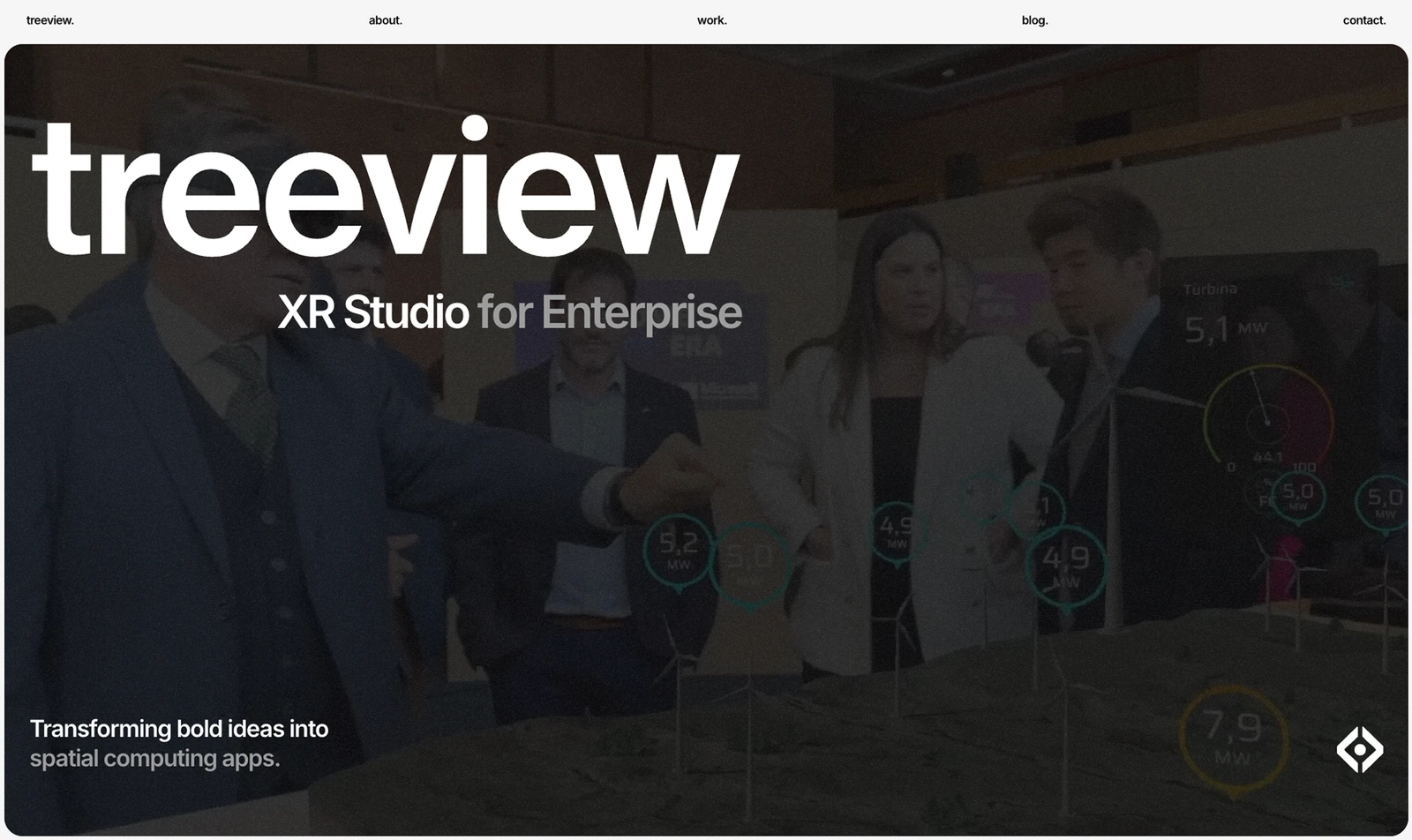
Treeview is an XR studio building custom virtual reality, augmented reality, Mixed Reality and Smart Glasses applications to order. Its named clients are Microsoft, Meta, Medtronic, Toyota, Ford, ULTA Beauty, Daiichi Sankyo, Transfr, the University of Alberta and the University of Adelaide. A gallery considering it is buying execution and terms rather than an exhibition record.
Where that becomes the right trade is a specific and common situation: an artist or curator has a concept and needs it built. In that arrangement the institution does not want a studio with a strong authorial voice, because authorship belongs to the artist. It wants a competent builder who will realize someone else's intent accurately and then get out of the way. A studio without a signature style is an advantage in that role rather than a shortcoming.
Full ownership of IP, source code and assets transfers to the client, which matters more in an art context than almost anywhere else. If a gallery or an artist commissions a work, the artist normally expects to own it, to be able to reinstall it, to lend it and potentially to sell it. A commission that leaves the technical substrate with the studio creates an artwork the artist cannot fully control, which is an untenable position for a collecting institution and for the artist's estate later.
Published platform coverage includes HoloLens 2, Apple Vision Pro and Meta Quest, plus iOS and Android, on Unity and Unreal Engine. Its stated services run from strategy and discovery through 3D content creation, development, system integration, testing, deployment and support. Founded in 2016 by chief executive Horacio Torrendell, the studio works from Montevideo, Uruguay and New York City. Team size and rates are not published, and it has no published gallery installation experience, so questions about invigilation, throughput and daily operation need asking directly. Best for institutions and artists who have the concept and need it built and owned outright.
2. Marshmallow Laser Feast
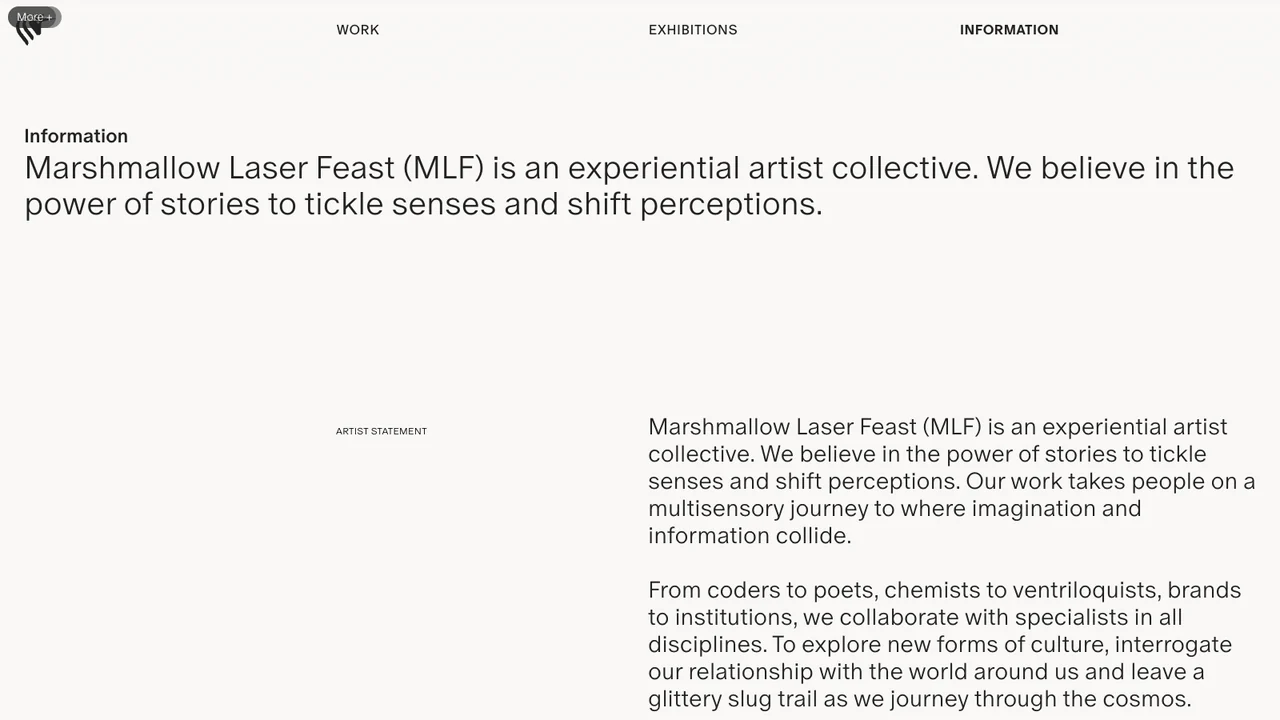
Marshmallow Laser Feast describes itself as an experiential artist collective, and taking that description literally is the most useful thing an institution can do. It is not a studio for hire. Its works are authored, exhibited and toured, and an institution engages it by commissioning, borrowing or presenting rather than by writing a brief.
Its published works include In the Eyes of the Animal, a multisensory XR installation, Evolver, Sanctuary of the Unseen Forest, Seeing Echoes in the Mind of the Whale, Of the Oak, YOU:MATTER, Poetics of Soil: Fly Agaric I and Sweet Dreams. The consistent subject is the natural world and human perception of it, and the collective states its work is grounded in research.
Its exhibition record is the strongest in this list and includes ACMI, Aviva Studios, the Barbican Centre, DDB Seoul, Fundación Telefónica, the Museum of the Future, the Phi Centre, the Royal Botanic Gardens Kew, YCAM, Quartier des Spectacles in Montreal, the Lisbon Architecture Triennale, Sundance Film Festival and SXSW. Its published forward program includes Seeing Echoes in the Mind of the Whale in Sensing Oceans at the MIT Museum from 28 September 2026 to 21 February 2027, All That Is Unseen at the Media Majlis Museum in Qatar from 5 October 2026 to 21 January 2027, and Poetics of Soil: Fly Agaric I in More than Human at the ArtScience Museum in Singapore from 20 November 2026 to 28 February 2027.
The touring history deserves particular attention from any institution planning an exhibition. All That Is Unseen is a touring exhibition originated by ACMI in Melbourne under the title Works of Nature, since presented internationally including at the Museum of New Zealand Te Papa Tongarewa, and reimagined for each context. A body of work that has already been reinstalled in multiple venues has demonstrated the thing most immersive art cannot: that it survives being moved.
The collective is represented by bitforms Gallery, with works available at Gazelli Art House, which is the clearest signal of its position in the art market rather than the technology market. It works from a London studio and states that its artworks and exhibitions can be presented internationally. It publishes no founding year, team size or fee structure. Best for institutions programming exhibitions who want work with an established critical and touring record.
3. Nexus Studios
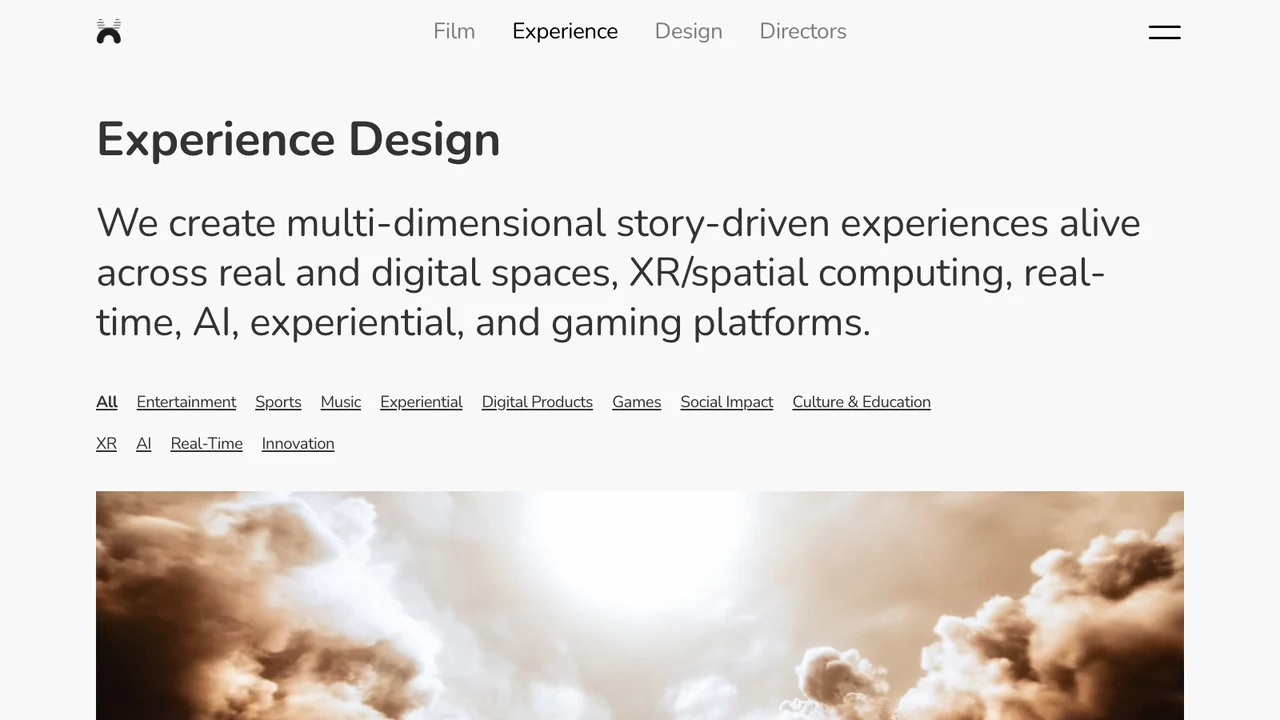
Nexus Studios is an award-winning studio in film and experience design, creating story-driven experiences across real and digital spaces, XR and spatial computing, real-time, AI, experiential and gaming platforms. It sits between the two poles of this list: a studio that takes commissions, but a director-led one where authorship is part of what is being bought.
Its published cultural work includes Your Inner Symphony and AI: More than Human, both with the Barbican, StoryTrails with StoryFutures, and Changdeok ARirang, an augmented reality experience at Changdeok Palace produced with SK Telecom and Google. It maintains a Culture and Education category alongside Entertainment, Sports, Music, Experiential, Digital Products, Games and Social Impact, and its site also lists Superblue x JR with JR Studio, which places it directly in the contemporary art exhibition circuit.
The director-led model is the thing to weigh. Nexus represents directors, and a commission is shaped by whoever leads it, which is closer to how a gallery commissions a film or a moving image work than to how it procures an interactive. For an institution that wants a named authorial voice attached to a piece, that is precisely the offer. For one that wants its own curatorial concept executed neutrally, it is the wrong shape and Treeview is the better fit.
Its wider portfolio is heavily brand and entertainment: ABBA Voyage, UFC, Gorillaz with Google, Marvel's Eternals AR, The Lion King at Outernet, Kung Fu Panda with NBCUniversal and DreamWorks, and campaigns for Mercedes-Benz, PUMA, Nissan, Kia and Samsung. That is a commissioning rhythm built around fixed-run campaigns rather than permanent collection pieces, which suits temporary exhibitions well and permanent installation less naturally.
The company operates as Nexus Productions Ltd from London. It publishes no founding year, team size, headquarters address or ownership terms on the pages reviewed. Best for temporary exhibitions and headline commissions where a named director's authorship is part of the proposition.
4. Sensunova
Sensunova describes itself as a future development lab building for a better tomorrow, working at the intersection of frontier technology and creative practice. Its published position on art is specific: Initiative One is Fine Art and Spatial Computing, described as leveraging frontier spatial technology to enable fine artists to extend their work off the canvas into high fidelity mixed reality experiences, under the label MR Enabled Art, with early access stated for March 2026. Initiative Two is listed as in development.
That premise is worth taking seriously on its merits, because it names a real and underserved problem. Painters and sculptors who want to work spatially generally have no route in that does not require them to learn a game engine or hand their concept to a technical studio. A service built specifically to extend an existing studio practice into mixed reality, rather than to produce digital art from scratch, addresses a genuine gap in the market.
What has to be stated equally plainly is how little is published. Sensunova lists no completed work, no exhibitions, no named artists, no institutional partners, no team, no founding year and no location on the pages reviewed, and its site carries a 2025 copyright with an early access date in the future. Nothing here is evidence of a delivered project, because none is published.
For an institution that changes what the engagement is. This is not a supplier to place on a shortlist against the others in this list for a scheduled exhibition, because there is no delivery record to assess and no completed work to view. It is a conversation worth having if you are an artist or a gallery interested in early access to a tool of this kind, on the understanding that you would be an early participant rather than a client buying a proven service. Ask to see work in progress, ask which artists are involved, and treat any timetable as provisional.
It ranks fourth here on the published specificity of its stated art focus, which is narrower and more relevant than a general studio's, while carrying the least evidence of any company in this list. Best for artists and galleries willing to engage with an unproven offer early, and not for a programmed exhibition with a fixed opening date.
5. Magnopus
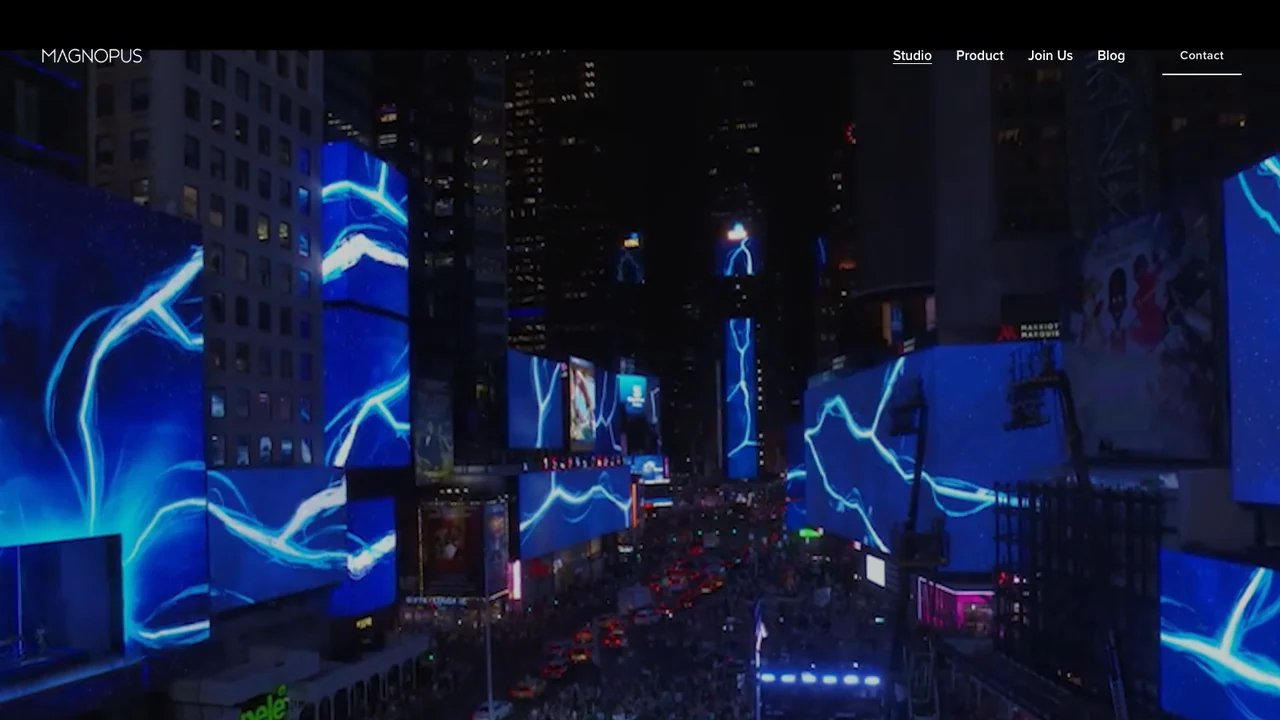
Magnopus builds immersive experiences and the technology beneath them, and it has the deepest engineering capability in this group. Its published cultural work includes Cyberpunk: A Virtual Production Experience at the Academy Museum of Motion Pictures and an augmented reality education application for the Holocaust Museum Los Angeles.
Its most relevant credential for exhibitions is scale under public conditions. The Wizard of Oz at Sphere, the Dubai Expo 2020 cross-reality experience and its virtual production work on Fallout and The Lion King all involve systems running continuously in front of large audiences on fixed dates. An institution planning a high-throughput installation with queueing, timed entry and daily operation is asking an engineering question, and this is the company here with the most direct evidence of answering it.
It also builds OKO, a spatial intelligence platform for persistent, real-time collaborative environments spanning web, mobile and XR headsets, with support for CAD models and Gaussian splats and AI scripting features developed with Google. For an artwork, a platform dependency is a preservation question as much as a technical one, since a piece built on a proprietary platform can only be reinstalled while that platform is maintained. Establish at contract stage which parts of the deliverable are owned and which are licensed.
It ranks fifth on this particular list rather than lower down on capability. Its portfolio is dominated by entertainment and brand work, and an art institution is buying a different thing from a film studio or a live venue: not spectacle delivered reliably, but a work that holds up to critical reading. Magnopus can build almost anything in this list, and its published record does not establish that it authors work in an art context. That is exactly the right shape when an artist supplies the authorship.
Founded in 2013, it works from 523 W. 6th Street, Suite 330, Los Angeles and 20 High Street, St Albans in the United Kingdom. Team size, rates and IP terms are not published. Best for large-scale, technically demanding installations where an artist or curator brings the concept.
What XR art commissions have to account for
Four questions decide whether a commissioned immersive work becomes part of a program or a one-off that quietly disappears.
The first is authorship, and it should be settled in writing before anything is built. Who is the work by, who is credited, who may exhibit it, who may modify it, and what happens if the artist and the technical studio disagree later. Immersive work has more contributors than a painting and the credit conventions are still unsettled, which makes ambiguity expensive rather than merely awkward.
The second is reinstallation. Ask what it takes to install the work again in three years, in a different room, without the people who made it. That means documentation, source files, asset libraries, dependency lists and a written installation specification covering dimensions, lighting, sound bleed and sightlines. Marshmallow Laser Feast's touring record is the clearest demonstration in this list that a body of work can meet that test.
The third is throughput and invigilation. A headset piece serving one visitor at a time with a five minute duration and a staff member fitting each headset has a hard ceiling on daily attendance, and that ceiling determines both the visitor experience and the staffing budget. Projection, phone-delivered AR and room-scale sensor work scale differently. Decide the attendance target first and let it constrain the format, rather than the reverse.
The fourth is preservation. Collecting institutions acquire works and are expected to keep them, and software-based art is the hardest category in that field. Platform dependencies, licensed middleware and discontinued hardware all shorten a work's life. If the institution intends to acquire rather than borrow, involve a conservator in the commission and not after it.
How to choose between these VR and AR art companies
Decide first whether you are commissioning a work or exhibiting one. If you want an existing body of work with a critical and touring record, Marshmallow Laser Feast is the entry to approach, and the conversation is a loan or a presentation rather than a brief. If you want a new piece with a named author, Nexus is director-led and has Barbican commissions on record. If you have the concept and want it executed and owned, Treeview builds to specification and transfers everything. If the piece is technically hard or high-throughput, Magnopus has the engineering record. Sensunova is an early conversation rather than a supplier for a dated program.
Then read exhibition history rather than showreels. A festival demo, a brand activation and a gallery installation are three different disciplines, and only the third tells you a work will survive twelve weeks of public opening hours. Ask where a piece has run, for how long, and how many people passed through it in a day.
Settle authorship, credit and reinstallation rights in the commissioning agreement. These are cheap to agree at the outset and close to impossible to renegotiate once a work has been shown.
Finally, decide whether you are borrowing or keeping. Borrowing shifts the maintenance and preservation problem to the lender. Acquiring makes it yours permanently, and the acquisition budget should carry documentation, source files and a conservation assessment rather than only the fee.
Related reading. BestInXR's museums and culture guide covers what a cultural institution is actually buying. XR development companies for museums covers gallery exhibits and permanent installation, and XR development companies for universities covers institutional commissioning. For education programming see VR development companies for education, and for procurement, selecting XR developers for enterprise deployment.
Frequently Asked Questions (FAQ)
1. What is the difference between a studio and an artist collective here?
A studio is commissioned to realize someone else's concept and delivers a build for a fee. An artist collective authors its own work and is commissioned, borrowed or exhibited, retaining authorship. Marshmallow Laser Feast is a collective. Treeview and Magnopus are studios. Nexus sits between the two, taking commissions but attaching a named director.
2. Which of these have exhibited in galleries and museums?
Marshmallow Laser Feast names ACMI, the Barbican Centre, Royal Botanic Gardens Kew, YCAM, the Phi Centre, Fundación Telefónica, the Museum of the Future, Sundance and SXSW, with forthcoming shows at the MIT Museum, the Media Majlis Museum and the ArtScience Museum. Nexus names the Barbican and Changdeok Palace. Magnopus names the Academy Museum of Motion Pictures and the Holocaust Museum Los Angeles. Treeview and Sensunova publish no exhibition record.
3. Who owns a commissioned XR artwork?
It depends entirely on the agreement, and it is the term most worth settling first. Treeview publishes full transfer of IP, source code and assets to the client. The others do not publish ownership terms. An artist or institution that cannot reinstall or lend a work without the original studio does not fully control it.
4. Can an immersive artwork be toured or reinstalled?
Only if it was built to be. Marshmallow Laser Feast's All That Is Unseen, originated by ACMI as Works of Nature, has toured internationally including to Te Papa and been reimagined for each venue, which demonstrates it is possible. It requires documentation, source files and an installation specification, all of which are cheaper to require at commission than to reconstruct later.
5. How many visitors can a headset artwork serve in a day?
No source reviewed here publishes a figure, so none is recorded. The arithmetic is straightforward to do locally: divide opening hours by the sum of the piece's duration and the fitting and cleaning time, then multiply by the number of headsets and the staff available to invigilate them. Do it before choosing the format, because it usually decides it.
6. What is an interactive AR art installation, and who builds one?
An interactive AR art installation is artwork that responds to the people in the room, delivered through phones, headsets or projection rather than hung on a wall. It sits between two of the suppliers on this page: the studios build the software and the systems that keep it running unattended, and the artist collectives make the work itself. The distinction at the top of this post decides which you are commissioning. Ask who is responsible for invigilation, reinstallation and what happens when the hardware fails during a run, because an installation is a piece of operating equipment as well as a piece of art.
7. What does an XR art commission cost?
None of the five publishes rates, so no figure is recorded here. Cost is driven by whether you are borrowing an existing work or commissioning a new one, the duration and throughput required, hardware and invigilation, and whether documentation and preservation are in scope. Reinstallation and documentation are the lines most often missing from a first budget.