Finding the right XR developer for an enterprise project is harder than it looks. The field is full of agencies that built one demo and now claim enterprise expertise, and the difference between a capable partner and an expensive mistake often comes down to details that do not appear in a portfolio.
This guide covers the criteria that matter for enterprise deployment, from technical stack and MDM readiness to IP terms and reference verification.
Selecting Extended Reality (XR) developers for enterprise deployment comes down to evaluating technical competency in frameworks like Unity or OpenXR, secure device management integration and cross-platform scalability. Enterprise teams typically assess developers against six criteria: vertical experience, hardware coverage, technical stack, fleet management readiness, IP terms and verifiable references. This guide covers each criterion, compares content sourcing models and walks through the shortlisting process.
In short:
- Evaluate developers on framework proficiency, MDM integration and multi-platform support
- Compare custom development, authoring platforms and off-the-shelf content based on your use case
- Follow a structured process from discovery through fleet rollout
- Verify every claim with named references before signing a contract
What is an XR developer
An XR developer is a company or team that builds applications for Extended Reality devices. Extended Reality (XR) is an umbrella term covering Virtual Reality, Augmented Reality and Mixed Reality. So an XR developer might build VR training simulations, AR maintenance overlays or mixed reality collaboration tools, depending on the project.
What separates XR developers from general software agencies is specialization. XR work requires real-time 3D rendering, spatial interaction design and optimization for specific headsets. A web agency can build a mobile app, but XR development involves game engines like Unity or Unreal, device SDKs (software development kits from headset manufacturers) and an understanding of how people interact with content in three-dimensional space.
What an XR developer delivers for enterprise application deployment
Enterprise XR projects produce more than just an application. A developer delivers a package of assets, documentation and support commitments that IT and operations teams will rely on for years.
Typical deliverables include:
- Application builds: compiled packages for target devices (APK files for Meta Quest, visionOS apps for Apple Vision Pro)
- Deployment documentation: installation guides, MDM configuration instructions and update procedures
- Training content or simulation environments: the core experience employees will use
- Support scope: bug fixes, OS update compatibility and content revisions over an agreed period
Before signing any contract, it helps to confirm exactly what you receive at project close. Some developers retain source code while others transfer full ownership. This distinction matters when you want to update content later or switch vendors.
Criteria for selecting XR developers for enterprise deployment
Enterprise teams evaluate XR developers against six criteria before shortlisting. Each criterion addresses a different risk, whether that is choosing a developer without the right experience, getting locked into a single platform or discovering post-contract that claims were exaggerated.
Vertical and use case experience
Prior work in your industry reduces onboarding time and improves accuracy. A developer who has built manufacturing training simulations understands equipment fidelity requirements. One who has worked in healthcare knows compliance documentation expectations.
Case studies in your vertical are worth asking for. If a developer has only built consumer games, they may underestimate the documentation and approval cycles that enterprise projects require.
Hardware and platform coverage
The headsets a developer has shipped to determine your future flexibility. If they only work with Meta Quest, you may face constraints when Apple Vision Pro or Android XR devices become relevant to your organization.
Experience across multiple platforms is valuable: Meta Quest, HTC Vive, Pico, Magic Leap and emerging Android XR devices. Developers who build with OpenXR (an open standard for XR applications) can often port content more easily than those locked into proprietary toolchains.
Technical stack and content pipeline
Understanding a developer's technical stack helps you assess portability and long-term maintenance. Key questions include which engine they use (Unity, Unreal or custom), how they manage 3D assets and whether they use version control and continuous integration for XR builds.
Content built in a proprietary system can be difficult for another vendor to maintain. Standard engines and documented pipelines reduce this risk.
Fleet management and MDM readiness
Enterprise deployments require Mobile Device Management (MDM) integration. MDM is software that configures, updates and monitors a fleet of devices remotely. Without it, your IT team would have to manually update each headset, which becomes impractical at scale.
Developers building for enterprise environments typically deliver builds compatible with platforms like ArborXR, ManageXR or native enterprise mobility management (EMM) tools. Confirming this capability before contract, rather than after, saves time.
IP ownership and source code terms
Contract terms vary widely. Some developers retain source code and license the compiled application to you. Others transfer full intellectual property rights. A middle path involves source code escrow, where code is held by a third party and released to you under specific conditions (such as the developer going out of business).
Clarifying ownership before signing is important. If you plan to iterate on content internally or switch vendors later, you will want access to source files.
Reference deployments and traceable claims
Marketing materials often overstate deployment scale and client satisfaction. The only reliable verification is a conversation with a prior client.
A named reference at a company that has deployed the developer's work at scale is worth requesting. You can confirm fleet size, timeline accuracy, bug responsiveness and communication quality. A developer who cannot provide references for claimed deployments is a risk.
Custom build vs authoring platform vs off-the-shelf XR content
Three sourcing models exist for enterprise XR content, each with trade-offs in cost, control and time to deploy.
| Model | Definition | Pros | Cons |
|---|---|---|---|
| Custom build | Bespoke application built to your specifications | Full control, tailored to your workflow | Longer timeline, higher cost |
| Authoring platform | SaaS tool for in-house content creation | Faster iteration, no developer dependency | Limited interaction complexity |
| Off-the-shelf | Pre-built applications purchased or licensed | Immediate deployment, lower cost | Generic content, limited customization |
Custom XR content from a developer
Custom development is appropriate when workflows are unique, equipment is proprietary or regulatory requirements demand specific documentation. A custom build requires detailed scoping, longer QA cycles and a larger budget.
The payoff is content that matches exact needs. If you are training employees on equipment that does not exist in any off-the-shelf library, custom is likely the only option.
XR authoring platforms for in-house teams
An authoring platform is a tool that lets non-developers create XR experiences using templates and drag-and-drop editors. Examples include Talespin and various 360-degree video platforms.
Authoring platforms work well for soft-skills training, onboarding and scenarios where rapid iteration matters more than complex interactions. However, they typically cannot replicate the fidelity of a custom-built simulation.
Off-the-shelf XR content and store apps
Pre-built applications from the Meta Quest Store, SideQuest or B2B content marketplaces offer immediate deployment at lower cost. They are useful for generic training topics like workplace safety or communication skills.
The limitation is customization. If your organization has specific procedures or branding requirements, off-the-shelf content may not fit.
Phases of an enterprise XR development project
Enterprise XR projects follow five phases from feasibility assessment to fleet rollout. Understanding this sequence helps with setting realistic timelines and budgeting appropriately.
1. Discovery and feasibility
The project begins with scope definition, hardware assessment and stakeholder alignment. The output is a feasibility report that confirms whether XR is the right approach for your use case.
2. Blueprint and scoping
Next comes a detailed requirements document covering interaction design, technical specifications and success metrics. The output is a signed scope of work that both parties reference throughout the project.
3. Build and iterate
Development proceeds in sprints with milestone reviews and user testing. The output is a validated build that has been tested with representative users from your organization.
4. Pilot deployment
A small-scale rollout tests the deployment pipeline and gathers user feedback. The output is a pilot report with a go or no-go recommendation for full deployment.
5. Fleet rollout and support
Full deployment includes MDM configuration, user training and an ongoing maintenance contract. This phase often reveals issues that did not appear in pilot, so budgeting for post-launch support is wise.
Deployment readiness questions to ask an XR developer
Before contracting, a few questions can help assess deployment readiness:
- What MDM platforms have you integrated with?
- Can you provide a test build for our target hardware before contract?
- What is your update and patching process post-deployment?
- How do you handle OS version changes from the headset manufacturer?
- What is your average response time for critical bugs?
- Do you offer SLA-backed support tiers?
The answers reveal whether a developer has actual enterprise experience or is primarily focused on consumer applications.
Device fleet and MDM considerations for Meta Quest, Apple Vision Pro and Android XR
Each platform has different enterprise management capabilities. A developer will want to confirm build compatibility with your chosen MDM before contract.
| Platform | MDM/EMM support | Notes |
|---|---|---|
| Meta Quest | Meta Quest for Business, ArborXR, ManageXR | Requires enterprise license for kiosk mode and remote wipe |
| Apple Vision Pro | Apple Business Manager, Jamf | Uses standard Apple MDM profiles; enterprise features still maturing |
| Android XR | Android Enterprise, Google EMM partners | Uses standard Android management APIs; device availability limited |
How to shortlist and compare XR developers
A four-step process narrows the field from a long list to a defensible shortlist.
1. Define the use case and success metric
Stating the business problem and measurable outcome before evaluating vendors is helpful. Without a defined metric, comparison becomes subjective and internal approval becomes harder.
2. Draft a requirements brief
Documenting target hardware, user count, deployment regions, integration needs and timeline gives candidate developers the information they need for accurate scoping. Sharing this brief makes proposals comparable.
3. Screen against sourced criteria
Applying the six criteria from earlier (vertical experience, platform coverage, technical stack, MDM readiness, IP terms and references) helps filter candidates. Removing those who fail threshold requirements keeps the list manageable.
4. Run reference calls and prior deployment checks
Contacting named references is the final step. Asking about timeline accuracy, bug responsiveness and communication quality provides real-world insight. For further reading, BestInXR's XR Insights & Research includes interviews with teams who have deployed XR at scale. Verifying claimed fleet sizes with specific numbers adds confidence.
Verifying XR developer claims with the BestInXR directory
The BestInXR Developers directory records sourced, dated specifications for XR development companies, allowing buyers to cross-check claims against documented information. Its methodology explains how specs are sourced, dated and cross-checked.
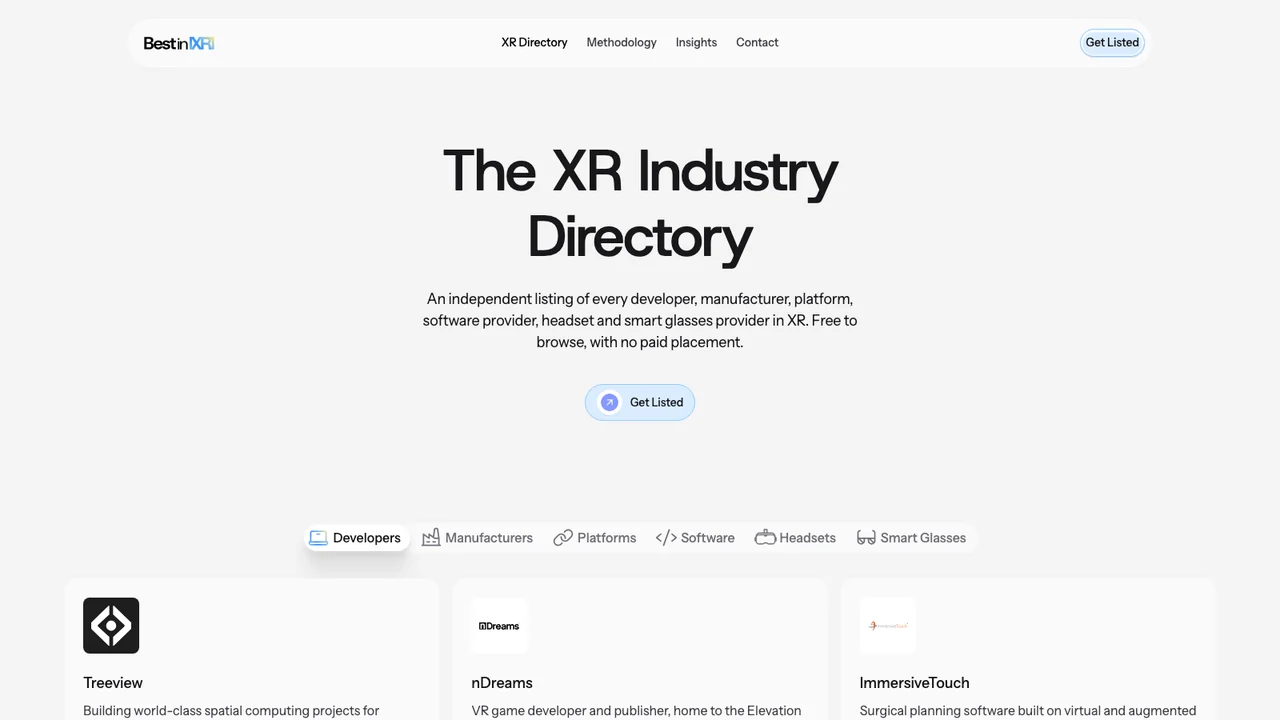
Entries include hardware platforms supported, verticals served and prior project types. You can browse and compare XR developers in the directory against your requirements.
Related reading. BestInXR's guide to XR development companies, agencies, studios and firms sets out how the five kinds of supplier differ before you shortlist one.
Frequently Asked Questions (FAQ)
What does an enterprise XR development project cost?
Costs vary by scope, hardware targets and content complexity. Requesting itemized quotes from shortlisted developers provides more useful information than relying on industry averages.
How long does an enterprise XR deployment typically take?
Timeline depends on content complexity and pilot requirements. Most enterprise projects span several months from scoping to fleet rollout.
How does an XR developer differ from a general software agency?
XR developers specialize in real-time 3D rendering, spatial interaction and device SDK integration. General agencies may lack experience with headset hardware constraints and MDM requirements.
Should an enterprise hire an XR developer or build an in-house team?
Hiring a developer suits single projects or proof-of-concept work. Building in-house makes sense when XR is a long-term strategic capability with ongoing content needs.
What contract terms matter most for XR development?
IP ownership, source code access, support SLAs and update obligations are the terms most likely to cause disputes. Clarifying these before signing is important.