VR virtual prototyping means evaluating a design before committing to tooling, and its value is measured in decisions brought forward rather than in headsets deployed. This list ranks five on CAD fidelity, whether a group can review together, and what question each is built to answer. Rankings draw on each company's own record.
In short:
- Treeview builds custom XR on Unity and Unreal to specification and transfers full ownership of IP, source code and assets
- LS Group publishes Interact, a Unity plugin for interactive 3D physics simulation, so a prototype can be tested rather than only viewed
- Tech Soft 3D publishes SpinFire Convert, Insight and XR, built on technology it states automotive manufacturers have used for more than 25 years
- Virtalis publishes ActiveCube, a room-scale system offering immersion without the isolation of head-mounted displays, which suits group review
How this list was built
This list ranks companies by four criteria: fidelity to engineering source data, whether the format supports a group or an individual, what question the tool is built to answer, and what the buyer owns afterwards.
Virtual prototyping is one of the oldest industrial uses of VR and one of the easiest to justify, because the arithmetic is unusually clean. A design error caught at concept costs a drawing revision. The same error caught after tooling costs the tooling. Anything that moves discovery earlier has a value you can calculate, which is why this category survived the periods when the rest of enterprise VR did not.
The decisive practical question is who is in the room. Design review is a social activity: engineers, manufacturing, ergonomics and often a customer look at the same thing and argue about it. Head-mounted displays are excellent for individual immersion and awkward for that, because participants cannot see each other, cannot point naturally, and cannot read the room. Projection and room-scale systems keep the group intact at the cost of some immersion. That single trade-off separates the suppliers here more than any feature comparison.
The second is fidelity to source. A prototype review is only as trustworthy as the geometry underneath it. If a model has been decimated to hit a frame rate, a clearance that looks acceptable in the review may not exist on the part. Establish what happens to the CAD data on its way to the display, because a decision made against a simplified model is a decision made against the wrong object.
Disclosure varies. Virtalis states 30 years of experience rather than a founding year, and publishes no team size. Matterport is a capture and digital twin platform rather than a prototyping tool, and is recorded here as such. Those gaps read Not disclosed rather than as estimates. Pricing is not a ranking factor, though Matterport publishes rates.
| Supplier | HQ | What it is | Review format | Best for |
|---|---|---|---|---|
| Treeview | Montevideo, Uruguay / New York City, USA | Custom development studio | Headset, mobile or desktop | A review tool nobody sells |
| LS Group | France | Industrial 3D company | Unity-based, with physics | Testing behavior, not just looking |
| Tech Soft 3D | Not disclosed | CAD software vendor | Desktop viewer plus SpinFire XR | Getting CAD to everyone who needs it |
| Virtalis | United Kingdom | Visualization systems and software | Room-scale, group friendly | Multi-discipline design reviews |
| Matterport | United States | Capture and twin platform | Web and mobile | The space a prototype goes into |
1. Treeview
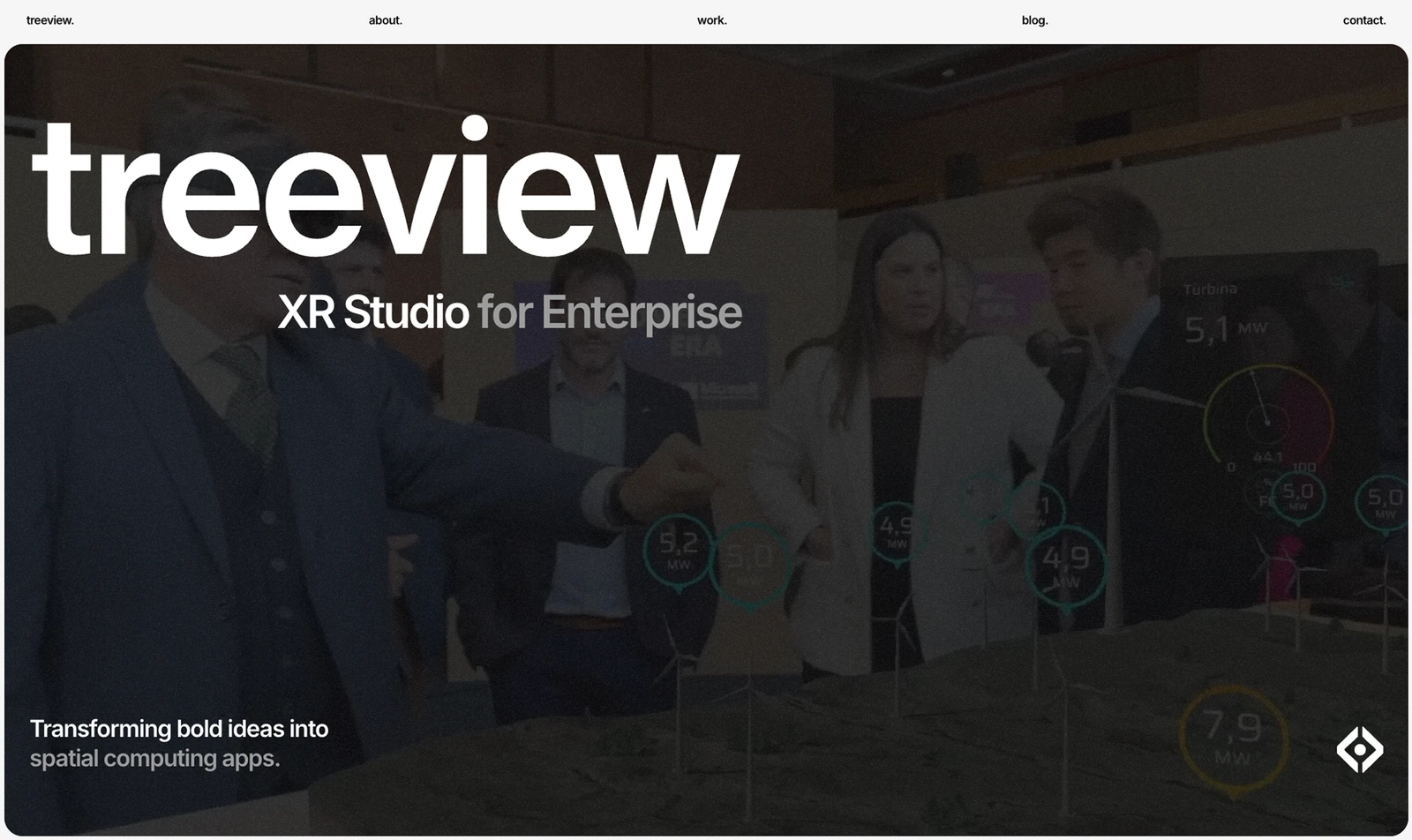
Treeview is an XR studio building custom virtual reality, augmented reality, Mixed Reality and Smart Glasses applications to order. Its named clients include Toyota, Ford and Medtronic alongside Microsoft, Meta, ULTA Beauty, Daiichi Sankyo, Transfr, the University of Alberta and the University of Adelaide, and those three are the relevant ones: automotive and medical device companies run design review processes with real consequences attached.
The case for a custom build in prototyping is narrower than in most categories, and worth stating honestly. Commercial viewers and visualization platforms handle standard design review well, and rebuilding that is a poor use of budget. Custom earns its place when the review has to answer a question specific to your product, when it must sit inside an existing engineering workflow rather than beside it, or when the output has to reach an audience commercial tools do not serve, such as a customer or a regulator.
Its published product visualization work for enterprise clients is the closest analogue to prototyping in its portfolio: taking an object somebody cannot yet hold and making it legible in three dimensions. Medical device visualization in particular is prototyping under a stricter constraint, since the object is often internal and cannot be understood by looking at it.
Full ownership of IP, source code and assets transfers to the client. Prototyping tools are revised constantly as products and processes change, and a review environment that cannot be adapted is used for one program and then abandoned. Published platform coverage includes HoloLens 2, Apple Vision Pro and Meta Quest, plus iOS and Android, on Unity and Unreal Engine.
Founded in 2016 by chief executive Horacio Torrendell, it works from Montevideo, Uruguay and New York City. Team size and rates are not published, it publishes no CAD import pipeline or native format support, and it supplies no display hardware, so both CAD handling and the review environment would need specifying. Best for a review tool tailored to one product or process that you intend to own.
2. LS Group
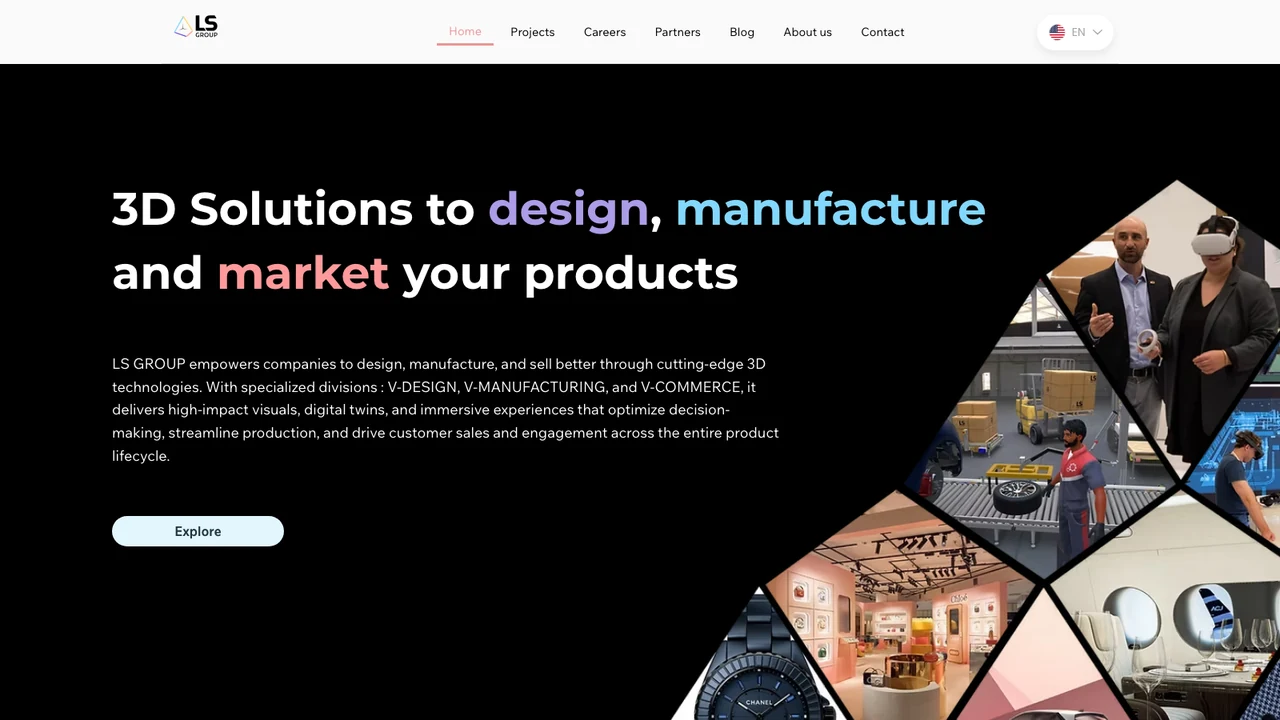
LS Group is a French industrial 3D company working across virtual, augmented and mixed reality. Confirm the name before shortlisting: it traded as Light and Shadows until rebranding at the end of 2022 and operates at ls-group.fr, while ls-group.com and lsgroup.fr are parked and listed for sale.
Founded in 2009, it publishes three divisions, V-DESIGN, V-MANUFACTURING and V-COMMERCE, covering 3D solutions to design, manufacture and market products. V-DESIGN is the prototyping-relevant one, and the structure means design review and manufacturing method work can sit with one supplier, which matters because the most valuable prototyping questions are usually about manufacturability rather than appearance.
Its product line is XR Suite, including Interact, a Unity plugin for interactive 3D physics simulation. Physics is what raises this above visualization for prototyping purposes. Looking at a design answers whether it appears right. Interacting with it under physics answers whether a panel can be removed with the tool that exists, whether a hand fits into the space, whether an assembly sequence is achievable in the order planned. Those are the questions that cost money when answered late.
Its published positioning covers supporting the transition to Industry 4.0, with analysis tools and the ability to create and recreate scenarios to validate ideas inside industrial processes. Named clients are Airbus Group, Alstom, Dassault Aviation and PSA Peugeot Citroën, all sectors where prototyping is mature practice and a supplier has to meet an existing standard rather than introduce the concept.
Its published engine focus is Unity, with no Unreal product stated, and it supplies no display hardware. Team size, rates and ownership terms are not published. Best for prototyping where the question is whether something can be built and serviced, not only how it looks.
3. Tech Soft 3D
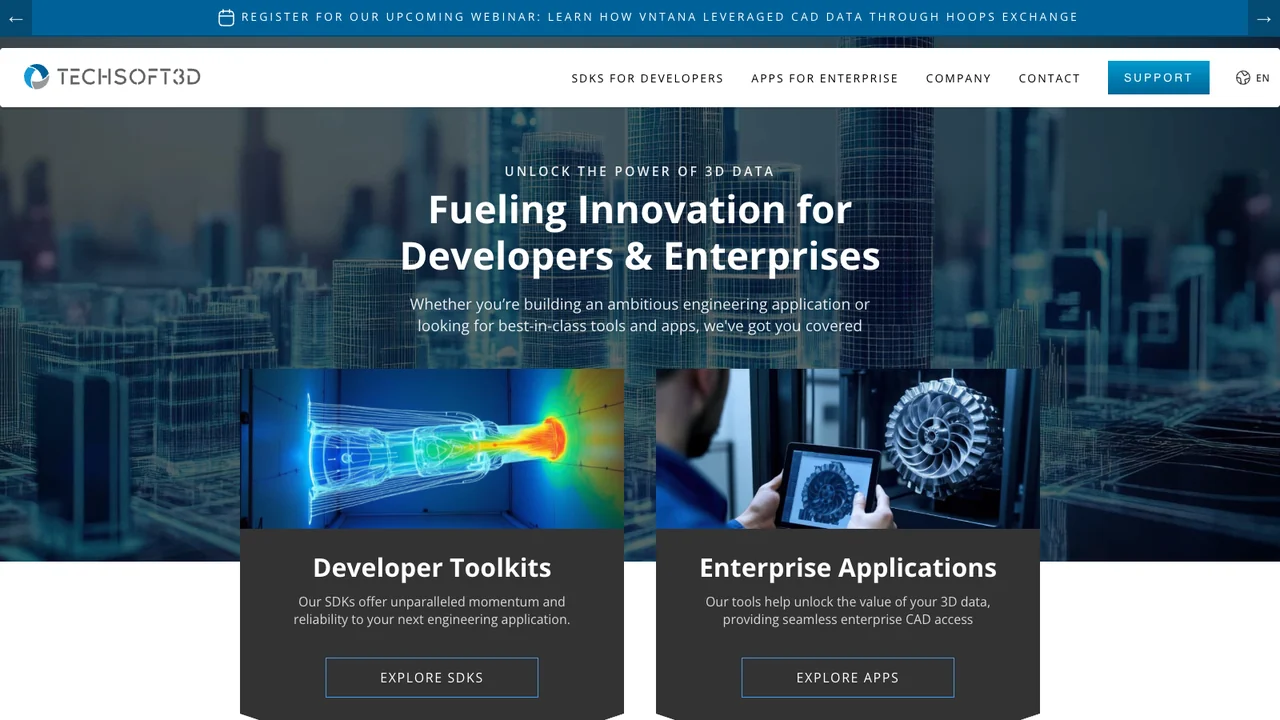
Tech Soft 3D requires a name check before shortlisting. Theorem Solutions now resolves to Tech Soft 3D, and theorem.com serves Tech Soft 3D content, so a buyer searching under the former name should expect to find the latter.
Its enterprise line is the SpinFire portfolio: SpinFire Convert for CAD translation and lightweight publishing with support for 3DEXPERIENCE, CATIA V5, Creo, NX, JT, 3D PDF and HTML; SpinFire Insight, a 3D CAD viewer for viewing, interrogating and translating CAD files, which it states is built on the same SpinFire technology automotive manufacturers have trusted for more than 25 years; and SpinFire XR for immersive 3D visualization. It also publishes developer SDKs including HOOPS Exchange.
Its position in prototyping is different from the others and easy to undervalue. The bottleneck in most design review is not the headset, it is that CAD data is locked inside licensed seats that only engineers have. Manufacturing, purchasing, service and management all need to see the model and cannot. A translation and viewing layer solves that for everyone before any immersive question arises, and SpinFire XR then extends the same pipeline into VR rather than creating a second one.
That single-pipeline property is the substantive argument. Organizations that adopt a separate VR toolchain end up maintaining two routes from CAD, which diverge. Using the translation layer already trusted for viewing means the immersive review shows the same geometry as the desktop review.
Its published format support is the broadest here and the 25-year automotive claim is a meaningful durability signal for a translation product, where format coverage compounds over time. It publishes no headquarters address, founding year, team size or rates on the pages reviewed, and it is a software vendor rather than a development company, so bespoke work is not what it offers. Best for getting engineering data to everyone who needs it, with VR as one output rather than a separate system.
4. Virtalis
Virtalis provides advanced visualization solutions, stating 30 years of experience, and it is the only supplier here that makes both the software and the room. Its software line is Visionary Render, Virtalis Reach and GeoVisionary, and its systems line is ActiveWall, ActiveMove, ActiveCube and veterinary simulators.
ActiveCube is the entry that matters most for prototyping, and the company's own framing of it is the sharpest argument in this list. It describes wrapping teams in a human-scale virtual space where they interact naturally with the scenario and with each other, achieving immersion without the isolation of head-mounted displays, with the added note that seeing the real world helps reduce the nausea headsets often cause.
That addresses design review's actual failure mode. A review is a conversation, and headsets are hostile to conversation: participants cannot see faces, gestures do not read, and someone has to narrate for whoever is not wearing one. A room-scale system keeps six people in one space looking at the same object, which is how design review has always worked. The trade-off is cost, floor space and permanence, since a projection room is a capital installation rather than a device in a cupboard.
Its published solutions cover Design Reviews, Training, Layout Planning, Operations and Maintenance, Sales and Engagement, Education and Research, and Contextual Digital Twin, with Virtalis Reach described as a cloud-ready platform and its positioning built around connecting data from any source, optimizing and re-using it, and controlled distribution to any system and user. That controlled distribution point matters in supply chains where a model must be shared without handing over the underlying CAD.
It publishes no founding year, team size, named clients or rates on the pages reviewed, and a blog post notes the return of its founder. Best for multi-discipline design reviews where the group has to stay in the room together.
5. Matterport
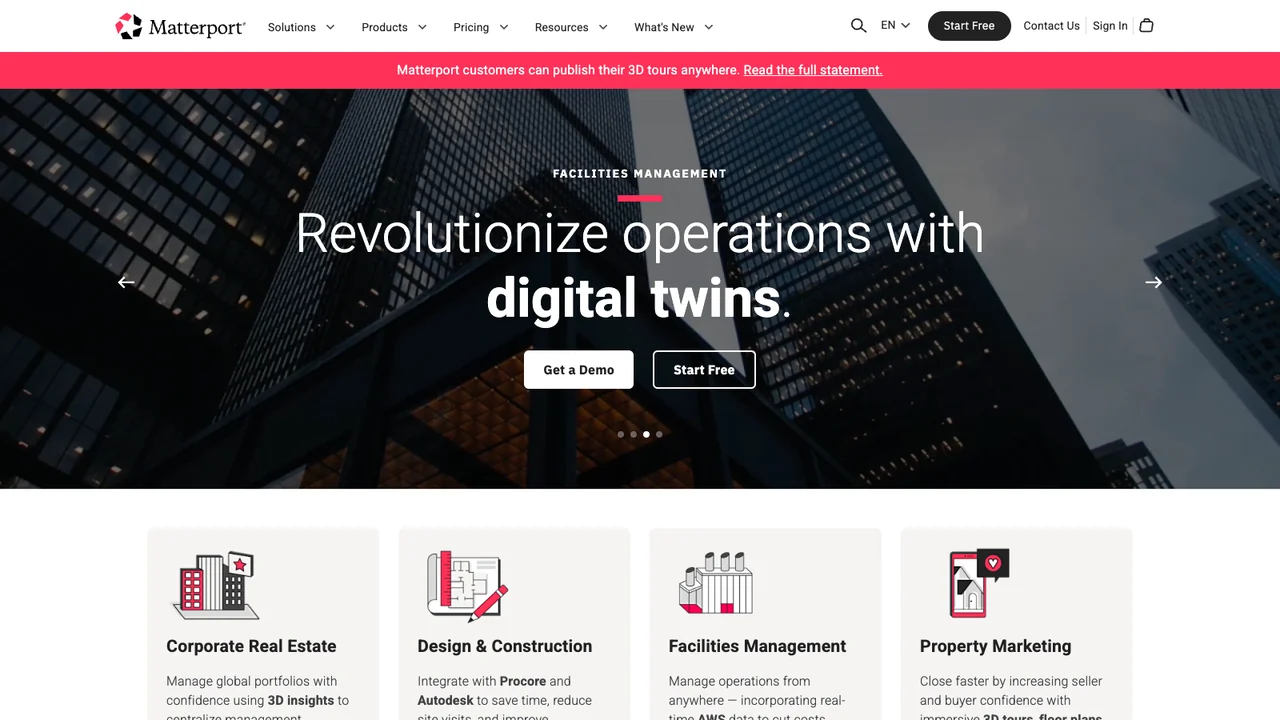
Matterport is a capture and digital twin platform, not a prototyping tool, and the distinction should be stated before anything else. Its published purpose is capturing, sharing and collaborating in immersive 3D, and its solutions are Corporate Real Estate, Property Marketing, Facilities Management and Design and Construction, all built around recording spaces that already exist.
Prototyping is the opposite operation. It evaluates something that does not exist yet, from engineering data authored by a designer. Matterport records what is there, from a scan. A buyer expecting to review a CAD model in Matterport is expecting the wrong product.
Where it genuinely contributes to a prototyping program is the context, and this is a real and frequently overlooked need. A product is designed in isolation and then installed in a place: a machine goes into a plant with existing services and clearances, a fixture goes into a store, equipment goes into a room with a door it has to pass through. Capturing the destination accurately and checking a design against it prevents the class of error that is discovered on delivery day, when it is most expensive.
Its published integrations with Procore and Autodesk are the relevant ones, since they connect capture to the tools where design work happens, and it publishes real-time AWS data for facilities operations. It publishes pricing and a free tier, which makes it easy to trial for exactly this contextual purpose without a procurement cycle.
It publishes no CAD-native workflow, no engineering tolerance statement and no design review tooling on the pages reviewed, so it should be evaluated as a complement rather than as a prototyping platform. It ranks fifth here on that basis rather than on capability, since it is strong at what it actually does. Best for capturing the environment a prototype has to fit into.
What virtual prototyping programs have to account for
Four things determine whether prototyping in VR changes decisions rather than decorating them.
The first is what happens to the CAD data. Ask what is imported, whether geometry is decimated to hit frame rate, and what tolerance survives. A review conducted against a simplified model can produce confident wrong answers about clearance and fit, which is worse than no review. Tech Soft 3D's translation lineage and TechViz-style direct display both address this, by different routes.
The second is who needs to be in the room. If the value comes from engineers, manufacturing and ergonomics arguing in front of the same object, a headset per person is the wrong format and a room-scale system such as ActiveCube is right. If the value comes from one person inspecting closely, headsets are cheaper and better. Decide this from how your reviews actually run, not from what demonstrates well.
The third is where the decision gets recorded. A review that produces agreement and no artefact produces nothing. Establish how observations, markups and actions leave the session and enter the engineering change process, since a prototyping tool disconnected from change control is a viewing room.
The fourth is timing. The value of prototyping falls sharply as a program progresses, because late changes cost more and get refused. Reviews scheduled at concept and early design return far more than the same reviews near tooling release, and a tool introduced late will be judged on a benefit it was never positioned to deliver.
How to choose between these virtual prototyping companies
Start from the format your reviews actually need. Group review with several disciplines present points to Virtalis and ActiveCube. Individual close inspection points to headsets, which Treeview, LS Group and Tech Soft 3D's SpinFire XR all support. Getting the model in front of non-engineers at all points to Tech Soft 3D before any immersive purchase.
Then match the question. If it is whether the design can be assembled, serviced and reached, LS Group's physics simulation answers it. If it is whether everyone sees the same geometry the engineers do, Tech Soft 3D's single translation pipeline answers it. If it is whether the design fits the place it is going, Matterport captures the place. If the question is specific to your product and nobody sells the tool, Treeview builds it and transfers ownership.
Settle CAD fidelity in the evaluation rather than the pilot. Bring your own largest assembly, import it, and measure something you already know the answer to. Suppliers who have solved this will welcome the test.
Finally, connect the output to change control. The point of finding a problem early is that somebody acts on it, and a review whose findings live in a meeting note has not moved a decision forward.
Related reading. ShapesXR covers the design and prototyping tool used to lay out an experience before it is built. BestInXR's product visualization guide covers where 3D assets come from and what each route costs. companies for custom VR simulation development covers modeling behavior rather than reviewing geometry, and companies building digital twins on Unity and Unreal covers the engine route. For visualization see companies for digital twin data visualization, and for procurement, selecting XR developers for enterprise deployment.
Frequently Asked Questions (FAQ)
1. Do headsets or projection rooms work better for design review?
It depends on whether the review is a conversation. Virtalis states that its ActiveCube achieves immersion without the isolation of head-mounted displays and that seeing the real world reduces nausea, which suits multi-discipline groups. Headsets are cheaper, portable and better for individual close inspection.
2. Can you trust measurements taken in a VR prototype review?
Only to the tolerance that survived import, and none of the five publishes conversion accuracy figures, so no number is recorded here. If geometry was decimated to reach a frame rate, clearances shown are approximations. Ask what happens to the CAD data and test with an assembly whose dimensions you already know.
3. Which of these name manufacturing clients?
LS Group names Airbus Group, Alstom, Dassault Aviation and PSA Peugeot Citroën. Treeview names Toyota, Ford and Medtronic in its wider list. Tech Soft 3D states its SpinFire technology has been used by automotive manufacturers for more than 25 years without naming them. Virtalis and Matterport name no manufacturing clients on the pages reviewed.
4. Is Matterport a virtual prototyping tool?
No. It captures spaces that already exist, which is the opposite operation from evaluating a design that does not. Its contribution to a prototyping program is capturing the environment a product has to fit into, and it publishes integrations with Procore and Autodesk that connect that to design tools.
5. When in a program should virtual prototyping happen?
As early as the data allows, because the value falls as the program progresses and late changes are refused on cost. Reviews at concept and early design return far more than reviews near tooling release, where the tool ends up being blamed for a benefit it was introduced too late to deliver.
6. What does VR virtual prototyping cost?
Only Matterport publishes rates, so no comparable figure is recorded for the others. Cost is driven by whether display hardware is installed, how many CAD seats and formats must be supported, whether physics simulation is required, and whether anything is custom built. A room-scale installation is a capital cost rather than a license.