Custom VR simulation development is distinct from custom VR training: a simulation models how something behaves, and a training application teaches a person. Buying one while describing the other is the most expensive confusion in this category. This list ranks five on modeling depth, delivery model and what the buyer holds afterwards.
In short:
- Treeview builds custom XR on Unity and Unreal Engine and transfers full ownership of IP, source code and assets
- ForgeFX Simulations has built custom simulation since 2002 for Komatsu, Caterpillar, Vermeer, JLG and Joy Global
- Tecknotrove manufactures physical simulators as well as VR, stating more than 1,000 projects across 28 countries
- Design Interactive, founded 1998, publishes XRMentor, BEAT, IMITATE and Nexora, with automated performance assessment as a named capability
How this list was built
This list ranks companies by four criteria: evidence of modeling behavior rather than only rendering it, whether the supplier builds software, hardware or both, named clients, and what the buyer owns at the end.
The word simulation is used loosely enough to hide a large cost difference, so it is worth being precise. A walkthrough shows an environment. A procedure trainer sequences steps and checks that a person performed them. A simulation models a system's behavior, so that inputs produce outputs governed by rules rather than by a script, and the same action can produce different results depending on state. The third is substantially harder and more expensive, and it is the only one that lets a person genuinely experiment.
The practical test is whether the thing can surprise you. If every path through the experience was authored by a designer, it is a training application however good it looks. If a trainee can do something nobody anticipated and the system responds correctly because it is computing rather than replaying, it is a simulation. Ask any supplier to demonstrate an unscripted action, because this distinction rarely survives a scripted demonstration.
The second thing that separates real simulation work is fidelity validation. A simulation is a model, and a model is wrong until someone checks it against reality. Establish who validates that the behavior is correct, against what reference, and what happens when it disagrees with the real equipment. Suppliers who have done this before will have an answer. Suppliers who have not will treat it as a testing detail.
Disclosure varies. ForgeFX publishes no headquarters address or team size, Motive.io publishes no founding year, named clients or rates, and Tecknotrove states a duration rather than a founding year. Those gaps read Not disclosed rather than as estimates. Project counts are attributed to whoever states them, since none is independently audited. Pricing is not a ranking factor, because none of the five publishes rates.
| Company | HQ | Model | Named clients | Best for |
|---|---|---|---|---|
| Treeview | Montevideo, Uruguay / New York City, USA | Custom development | Microsoft, Toyota, Ford, Medtronic | Simulations you intend to own |
| ForgeFX Simulations | San Francisco Bay Area, USA | Custom development | Komatsu, Caterpillar, JLG, Joy Global | Equipment behavior to OEM standard |
| Motive.io | Not disclosed | Authoring platform | Not published | Building many scenarios in house |
| Tecknotrove | Mumbai, India | Simulators and VR | Categories rather than names | Simulation with physical controls |
| Design Interactive | United States | Research-led products and services | Not published, holds contract vehicles | Measuring whether it worked |
1. Treeview
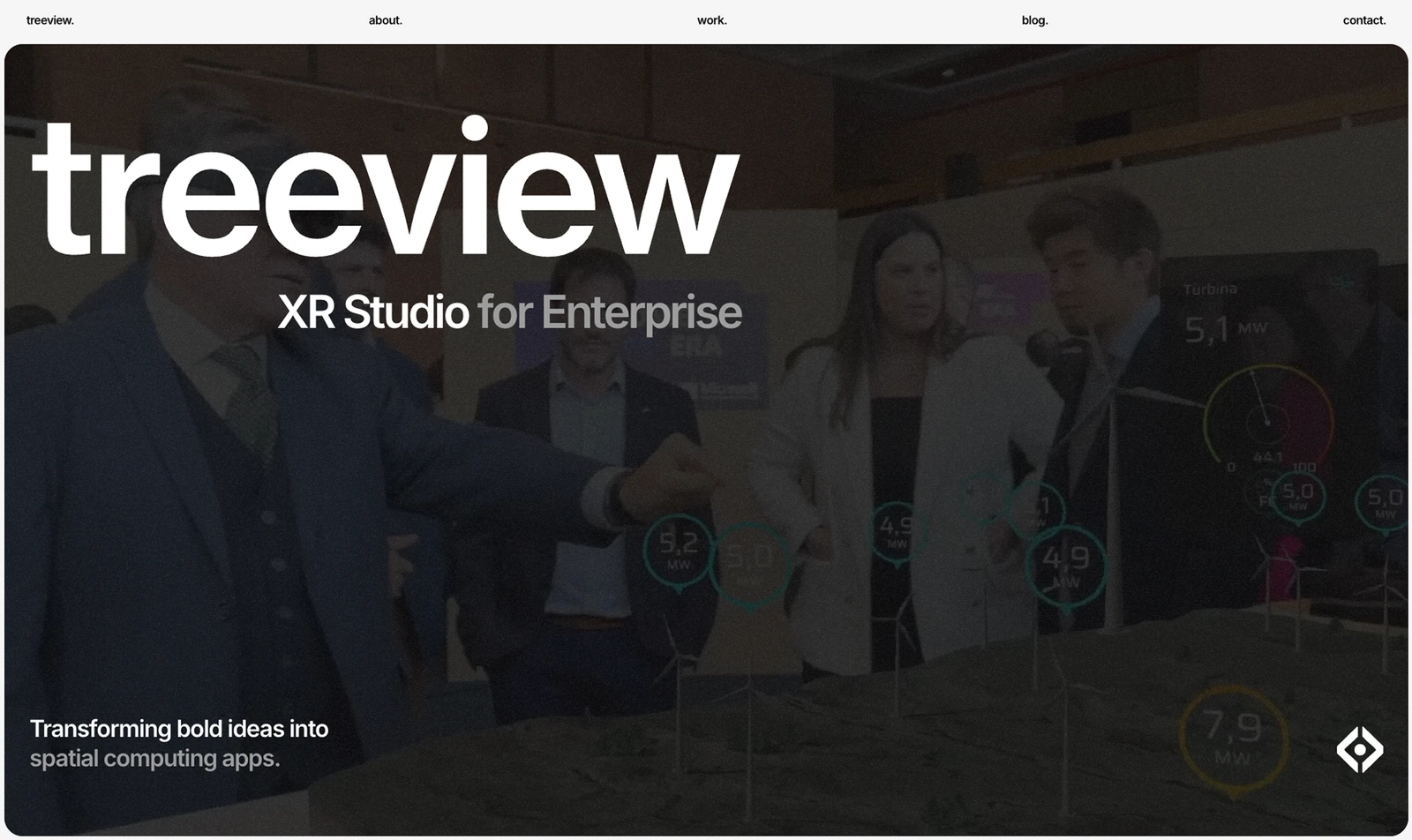
Treeview is an XR studio building custom virtual reality, augmented reality, Mixed Reality and Smart Glasses applications to order. Its named clients include Microsoft, Meta, Medtronic, Toyota, Ford, ULTA Beauty, Daiichi Sankyo, Transfr, the University of Alberta and the University of Adelaide, and Medtronic, Toyota and Ford are the three most relevant to simulation work, since all three operate technical review processes a supplier has to satisfy.
Its published work that comes closest to simulation is the AI-enabled digital twin designed and developed with Microsoft for a multi-billion dollar green hydrogen renewable energy project, which involves live operational data and a real-time environment rather than a scripted experience. Its in-house product Newton's Room, a mixed reality physics application in which users apply Newton's laws to puzzles that adapt to the room they are standing in, is a small but genuine demonstration of behavior computed rather than authored.
Full ownership of IP, source code and assets transfers to the client, which matters more for simulation than for most software. A simulation embodies a model of how something behaves, and that model is refined over years as it is compared against real outcomes. An organization that cannot modify the model cannot improve it, and a simulation that stops being refined stops being trusted by the people using it.
Published platform coverage includes HoloLens 2, Apple Vision Pro and Meta Quest, plus iOS and Android, on Unity and Unreal Engine, and its stated services span strategy and discovery, 3D content creation, development, system integration, testing, deployment and support. Founded in 2016 by chief executive Horacio Torrendell, it works from Montevideo, Uruguay and New York City.
Team size and rates are not published, it builds no physical simulator hardware, and it publishes no dedicated simulation engine or physics product, so modeling depth is a question to establish concretely against your domain rather than assume. Best for simulations built to a specification that you intend to own, maintain and refine.
2. ForgeFX Simulations
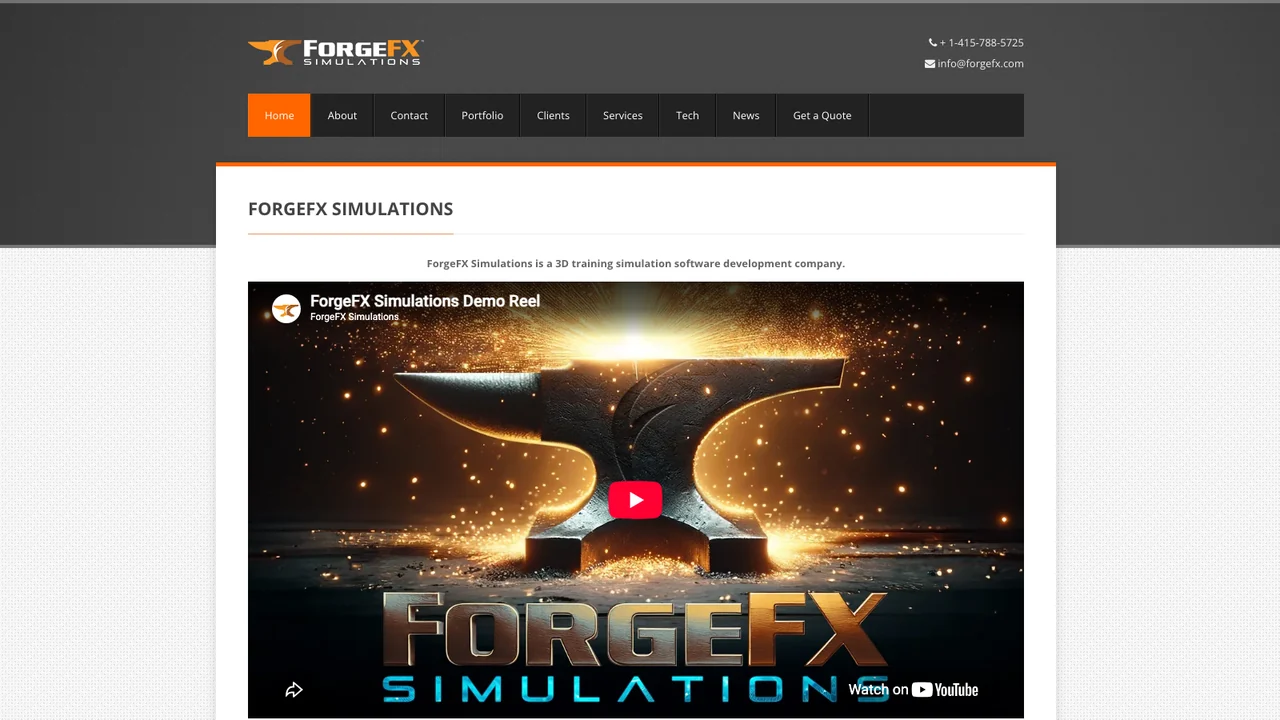
ForgeFX Simulations has built custom 3D training simulation software and custom virtual and augmented reality applications since 2002, from the San Francisco Bay Area. Simulation is in its name and in its published record, and more than two decades of continuous custom simulation work is the strongest longevity credential in this list.
Its named clients are what make the modeling claim credible. Komatsu, Caterpillar, Vermeer Corporation, JLG Industries, Joy Global and Pierce Manufacturing are equipment manufacturers, and a simulation built for the company that engineers the machine has been checked against how that machine actually behaves. That is the fidelity validation problem solved in the strongest available way, because the reference is the manufacturer's own engineering knowledge rather than a developer's assumption.
Its published projects show real modeling variety: a horizontal directional drill simulator, OcuWeld for welding, an aircraft deicing simulator, HazOps training for hazard and operability studies, CyberLab, Virtual Walking the Pens, and a heavy rail operator training simulator. Directional drilling and welding are both cases where the physics has to be right for the training to transfer, since a trainee learns by feeling how the system responds.
Its wider client list includes StrataTech Education Group, MRIGlobal, General Electric Healthcare, Pearson Education, Adobe, Farmers Insurance, Zoetis, SAK Construction, WMATA and Global Ground Support. Published device targets span VR headsets and stereoscopic 3D displays, augmented reality spatial computing devices and traditional desktop platforms, and its stated industries include heavy equipment, welding, aviation, healthcare, construction, transit, agriculture and CBRN detection.
Team size, headquarters address, rates and ownership terms are not published, so IP should be settled explicitly, and it builds software rather than physical simulator hardware. Best for equipment and process simulation where behavior has to match a real machine.
3. Motive.io
Motive.io is an authoring platform rather than a development studio, and on a custom simulation list it is the entry that questions the premise. Instead of commissioning a simulation, you license tools and your own team builds.
The volume logic is the same as it is for training, and it is worth restating because organizations discover it late. A commissioned simulation has a fixed cost each time, so twenty scenarios cost roughly twenty times one. A platform costs a license plus internal effort, making the first scenario expensive in learning time and the twentieth comparatively cheap. Organizations that commission each scenario separately for three years usually wish they had run that arithmetic at the start.
The constraint is more binding for simulation than for training, and this is the honest caveat. Authoring platforms are generally strong at scenarios, branching, triggers and assessment, and weaker at novel physics or bespoke system behavior. If your requirement is a scenario in which trained people make decisions, a platform is likely sufficient. If it is modeling how a specific machine responds to inputs nobody has authored, you are probably outside what any authoring tool covers, and ForgeFX or Treeview is the right call.
It also requires an internal owner, permanently. The platform produces nothing without someone whose job includes building with it, and programs that lose that person quietly stop producing content while the license continues to be paid.
Motive.io publishes no founding year, headquarters address, team size, named clients or rates on the pages reviewed, so capability limits and support arrangements have to be established directly. The right evaluation is to build a real scenario from your own material during the trial rather than watch one demonstrated. Best for organizations producing many scenarios who can staff the work internally.
4. Tecknotrove
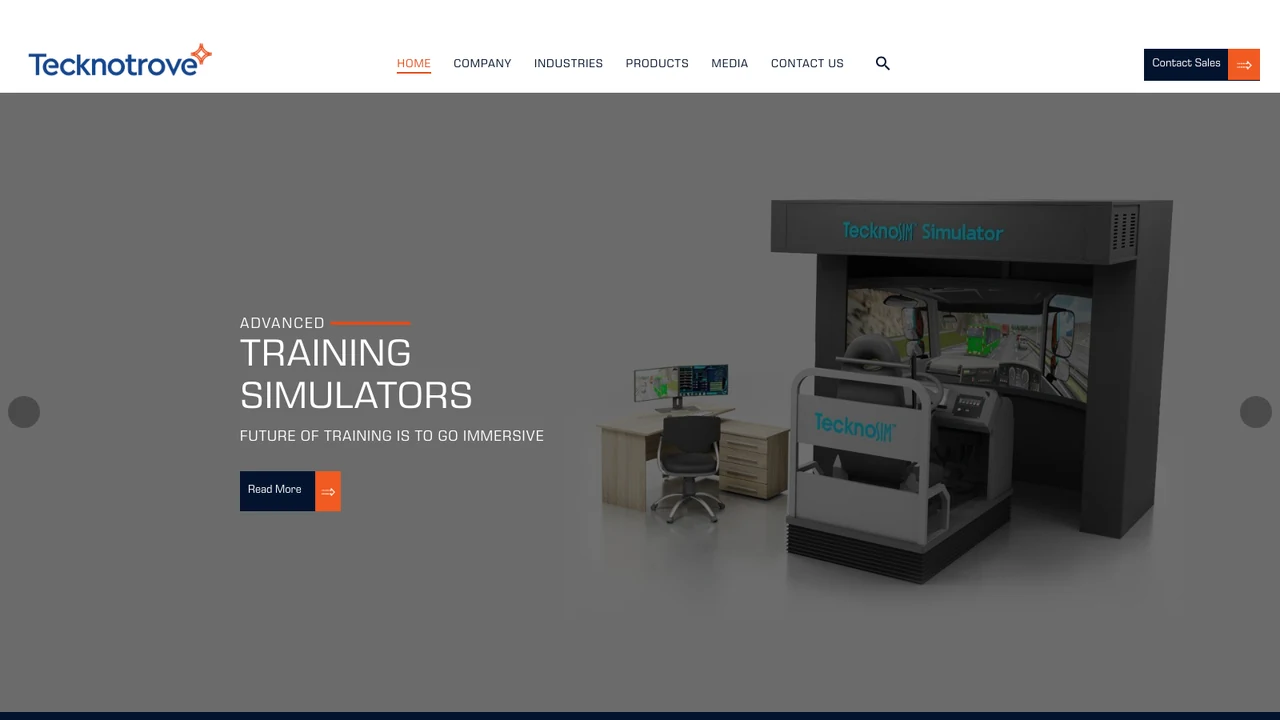
Tecknotrove designs and manufactures training simulators alongside VR training solutions, and it is the only company here producing physical hardware. On a simulation list that carries specific weight, because a simulator with real controls forces a level of behavioral fidelity that a headset experience can avoid.
The reason is that a physical control set gives immediate feedback a trainee can judge. If a joystick moves a virtual excavator arm at the wrong rate, an experienced operator notices within seconds. A headset experience with hand tracking has more latitude, because there is no physical reference to contradict it. Building to hardware raises the modeling standard whether the supplier intended it or not.
Its published simulator lines include excavator and forklift simulators, car, truck, bus and motorcycle driving simulators, aircraft pushback and cargo loader products, and a defense range covering a military tank driving simulator and an 81mm mortar simulator. Vehicle dynamics across that many classes is substantial modeling work, and driving simulators in particular require credible physics to be useful at all.
Its stated industries include Oil and Gas, Mining, Ports, Nuclear, Construction, Logistics, Warehousing, Aviation, Automobile and Emergency Services. The company states more than 1,000 projects delivered, operations in 28 countries and over 20 years of experience in design and manufacturing, all company-stated and not independently audited, and works from 505 Windfall, Sahar Plaza Complex, Andheri East, Mumbai.
Its published customer categories are corporates, contractors, OEMs, governments, dealers and training institutes rather than named accounts, so references need requesting directly. Hardware brings shipping, installation, floor space, calibration and maintenance costs, and a fixed simulator does not travel. Best for simulation where physical controls are part of the requirement.
5. Design Interactive
Design Interactive is a research-led company founded in 1998 that optimizes and enhances human performance through technology, research and digital transformation. It is the entry here most concerned with whether the simulation worked, which is a different discipline from building one.
Its published solutions are Human Systems Integration, Extended Reality, Digital Twins and Automated Performance Assessment, and the last is the one worth attention. Automated performance assessment means the system evaluates how a person performed rather than only recording that they finished. For simulation that is the missing half of most programs: a simulation that produces no measurement produces no evidence, and a training budget defended by completion counts is defended weakly.
Its published products are XRMentor, BEAT, IMITATE and Nexora. XRMentor is described as one platform with multiple modalities, including ClassroomXR for instructor-led immersive lessons, ProceduresXR for self-guided AR-enhanced workflows with step-by-step guidance, LessonsXR as a library of ready-made XR learning modules, and a Pre-Trip Trainer for driver preparation. That mixture of custom capability and productised modules means a buyer should establish early which parts of a proposal are configuration and which are built.
Its published emphasis on mission-relevant research, data science and user-centered design, together with listed contract vehicles, indicates United States government and defense contracting as a significant channel. For a public sector buyer that is an advantage, since contract vehicles shorten procurement considerably. For a commercial buyer it signals a company whose processes are shaped by government requirements, which brings rigor and overhead in equal measure.
It publishes no named clients, team size, headquarters address or rates on the pages reviewed. It ranks fifth for custom simulation specifically because its published center of gravity is human performance measurement and productised XR rather than bespoke system modeling. Best for programs that must prove performance improvement rather than only deliver a simulation.
What custom simulation projects have to account for
Four things determine whether a commissioned simulation is trusted by the people who use it.
The first is fidelity validation. Name who confirms the model behaves correctly, against what reference, and what happens when it does not match the real equipment. Without that, a simulation is a plausible animation, and experienced operators detect the difference immediately and stop taking it seriously. ForgeFX's manufacturer clients represent the strongest version of this reference.
The second is how much is computed and how much is scripted. Ask for an unscripted action during evaluation, something the demonstration was not built around, and watch what happens. This single test separates simulation from a well-produced training application, and the cost difference between them is large.
The third is measurement. Decide before the build what the simulation must evidence and how, because assessment designed afterwards tends to record completion rather than performance. Design Interactive publishes automated performance assessment as a named capability, and it is the differentiator most worth borrowing even if you buy elsewhere.
The fourth is the model's life. Simulations are refined as they are compared with real outcomes, and that refinement requires access to the model. Establish who can change behavior parameters, how, and at what cost. Treeview publishes full transfer of IP, source code and assets; the others do not publish ownership terms.
How to choose between these custom VR simulation companies
Start by deciding honestly whether you need a simulation or a training application, because the price difference is substantial and the requirement is often the cheaper one. If people need to learn a sequence and be checked on it, that is a training application and an authoring platform such as Motive.io will serve it. If they need to experiment with a system that responds correctly to actions nobody anticipated, that is a simulation and it is a development project.
Then match the fidelity reference. If the simulation must behave like a specific machine, ForgeFX has built for the companies that engineer machines. If physical controls are part of it, Tecknotrove manufactures them. If it must integrate with your systems and be owned by you, Treeview builds and transfers everything. If the program has to prove a performance improvement, Design Interactive's assessment work is aimed at exactly that.
Run the volume arithmetic before committing to a model. One deep simulation is a development project. Twenty scenarios is a content operation, and content operations want tools and a permanent internal owner rather than a series of contracts.
Finally, settle ownership and the refinement path in the specification. A simulation you cannot adjust is frozen at the moment it was delivered, and the real world it models will not stay still.
Related reading. BestInXR's VR simulation guide covers fidelity, validation and what simulation actually means. companies for custom VR training development covers the training half of this decision, and VR companies for manufacturing and equipment operation training covers equipment specifically. For heavy industry see VR companies for oil and gas simulation and training, and for procurement, selecting XR developers for enterprise deployment.
Related reading. BestInXR's driving and crash simulation list separates the four products that term covers, and the firefighter training list covers the fire service vertical.
Frequently Asked Questions (FAQ)
1. What separates a simulation from a training application?
Whether behavior is computed or authored. In a training application every path was designed by someone, so it can only respond to anticipated actions. In a simulation, rules govern outcomes, so an unanticipated action still produces a correct result. Ask for an unscripted action during evaluation, because the distinction rarely survives a scripted demonstration.
2. How is simulation fidelity validated?
Against a reference, and the reference should be named in the contract. ForgeFX's simulations for Komatsu, Caterpillar, Vermeer, JLG and Joy Global were built for the manufacturers of the equipment, which is the strongest available form of validation. None of the five publishes a formal validation methodology, so make it a scoping question.
3. Can an authoring platform build a real simulation?
For scenario-based work with decision points, generally yes. For novel physics or bespoke system behavior, generally no, since authoring tools are strong at branching and assessment and weaker at modeling. If your requirement is how a specific machine responds to arbitrary inputs, that is development work rather than authoring.
4. Which of these name clients?
ForgeFX names Komatsu, Caterpillar, Vermeer, JLG, Joy Global, Pierce Manufacturing and others. Treeview names Microsoft, Meta, Medtronic, Toyota, Ford and Transfr. Tecknotrove publishes customer categories rather than named accounts. Motive.io and Design Interactive name no clients on the pages reviewed, though Design Interactive lists contract vehicles.
5. Does the simulation measure performance or just completion?
Only if it was designed to. Design Interactive publishes automated performance assessment as a named capability. For the others, assessment is a scoping question, and one worth settling before the build, since measurement designed afterwards tends to record that someone finished rather than how well they did.
6. What does custom VR simulation development cost?
None of the five publishes rates, so no figure is recorded here. Cost is driven by modeling depth, whether physical hardware is involved, how many scenarios are in scope, validation effort, and whether assessment is built in. Ongoing refinement of the behavioral model is the line most often missing from a first budget.