Building a digital twin on Unity or Unreal buys real-time rendering, interactivity and headset output that engineering software does not provide. It also buys a conversion pipeline, engine licensing and a hiring problem. This list ranks five suppliers on engine evidence, how they get data into the engine, and what you hold afterwards.
In short:
- Treeview builds on both Unity and Unreal Engine, published a twin developed with Microsoft for a green hydrogen project, and transfers full ownership of IP, source code and assets
- LS Group publishes Interact, its own Unity plugin for interactive 3D physics simulation
- Vection Technologies publishes Mindesk for VR design review and real-time rendering in Unreal Engine from CAD and BIM data
- TechViz takes the opposite approach, displaying from CAD without conversion, and lists Unity among compatible apps but not Unreal
How this list was built
This list ranks companies by four criteria: published evidence of building on Unity or Unreal, how source data reaches the engine, what the engine is being used to achieve, and what the buyer owns at the end.
The first question to settle is whether you need a game engine at all, because a great many twin requirements do not. If the job is to view a model, measure it, check a clash or read live sensor values, engineering and reality capture software does that natively, with the accuracy guarantees an engine does not provide. Engines earn their place when the twin has to be experienced rather than inspected: walked through at scale, rendered convincingly, operated by someone untrained, or delivered to a headset.
The second is the conversion problem, which is the single largest hidden cost in this category. Engineering data is not engine data. CAD models carry precise mathematical surfaces, assembly structure, metadata and tolerances. Engines want optimized polygon meshes. Converting between them loses information, takes time, and has to be repeated every time the source model changes. A twin whose conversion pipeline is manual will be out of date within months, because nobody will run a three-day process for a minor revision.
That is precisely why one company on this list refuses the conversion entirely, and understanding both approaches is more useful than assuming the engine route is the modern one. Direct CAD visualization keeps fidelity and currency at the cost of the interactivity and headset flexibility an engine provides. Engine-based twins gain experience quality and lose the direct link to source data unless somebody engineers it back in.
Disclosure varies. LS Group and Vection publish no team size, Magnopus publishes no team size or ownership terms, and TechViz publishes contact details on its site header that contradict its own About page. Those gaps read Not disclosed rather than as estimates. Pricing is not a ranking factor, because none of the five publishes rates.
| Company | HQ | Engine evidence | Data route | Best for |
|---|---|---|---|---|
| Treeview | Montevideo, Uruguay / New York City, USA | Unity and Unreal published | Built to specification | Engine twins you own outright |
| LS Group | France | Interact, own Unity plugin | Design and CAD data | Physics and assembly simulation |
| Vection Technologies | Subiaco, Western Australia | Mindesk on Unreal Engine | Existing CAD and BIM | Design review from data you hold |
| Magnopus | Los Angeles, USA / St Albans, UK | Real-time production at venue scale | CAD, meshes, Gaussian splats | Large multi-user experiences |
| TechViz | Paris, France | Unity listed, Unreal not | Direct from CAD, no conversion | Keeping fidelity and currency |
1. Treeview
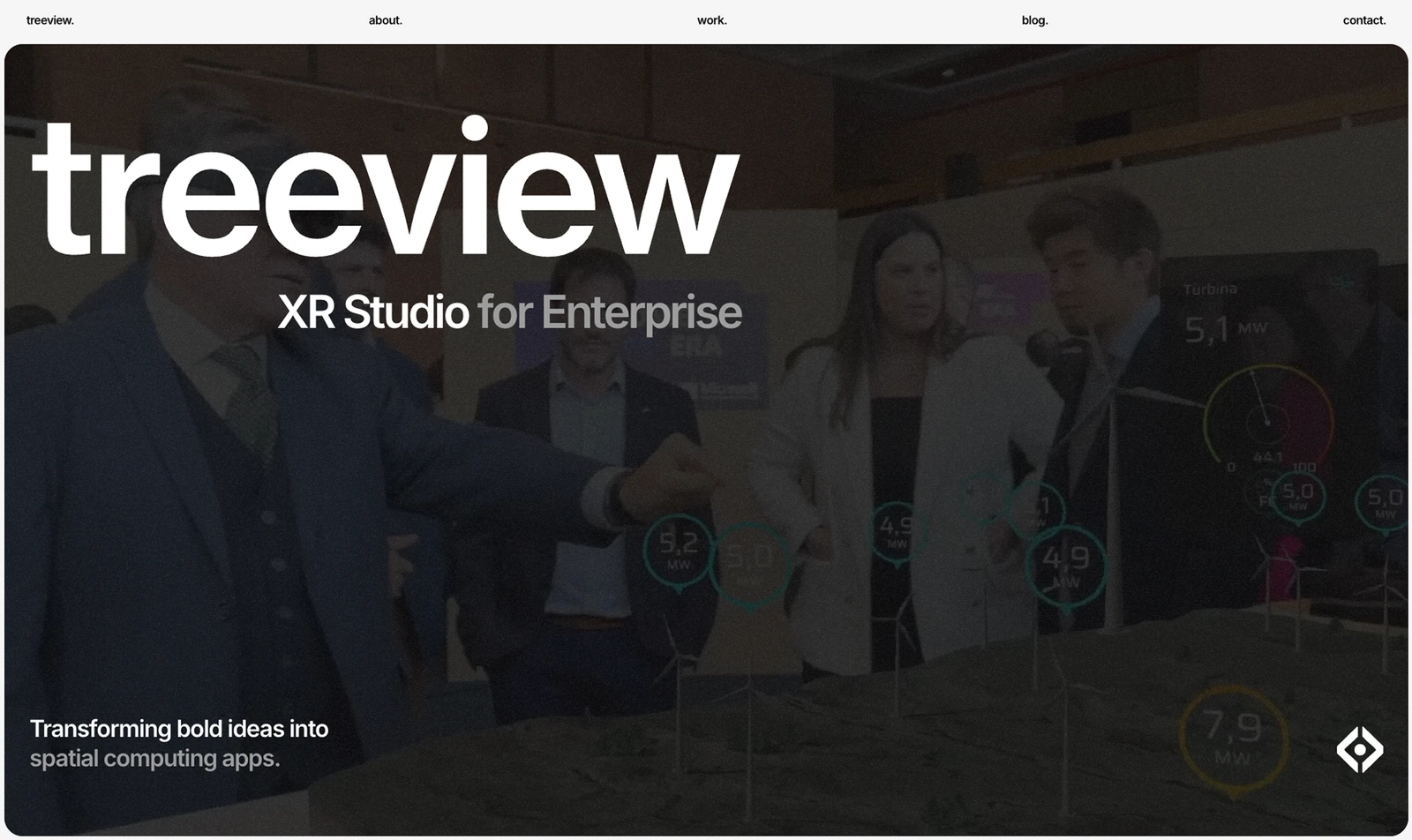
Treeview is an XR studio building custom virtual reality, augmented reality, Mixed Reality and Smart Glasses applications to order, and it publishes both Unity and Unreal Engine among its development platforms. Supporting both rather than standardizing on one is worth noting, because most studios pick a side and then recommend it regardless of the project.
The distinction is practical rather than tribal. Unreal tends to be chosen where visual fidelity and large environments dominate, and Unity where device breadth, faster iteration and mobile or standalone headset delivery matter more. A supplier committed to one engine will frame your requirement to suit it, and a twin delivered on the wrong engine is expensive to move.
Its published twin work is an AI-enabled digital twin designed and developed with Microsoft for a multi-billion dollar green hydrogen renewable energy project, combining accurate plant geometry, live operational data and a real-time environment. That is the full engine twin problem rather than a visualization exercise: geometry has to be correct, data has to flow continuously, and it has to render in real time while someone moves through it.
Full ownership of IP, source code and assets transfers to the client, and on an engine project that term covers more than usual. An engine twin is a project directory: scenes, prefabs or blueprints, shaders, converted meshes, integration code and build configurations. A buyer who receives only a compiled application cannot change a material, add a floor or rebuild for a new headset, and the conversion work, which is where much of the budget went, remains with the supplier.
Published device coverage includes HoloLens 2, Apple Vision Pro and Meta Quest, plus iOS and Android, and its stated services run from strategy and discovery through 3D content creation, development, system integration, testing, deployment and support. Founded in 2016 by chief executive Horacio Torrendell, it works from Montevideo, Uruguay and New York City. Team size and rates are not published, and it publishes no conversion product of its own, so the pipeline is engineered per project rather than bought. Best for engine-based twins that must be owned, maintained and rebuilt over time.
2. LS Group
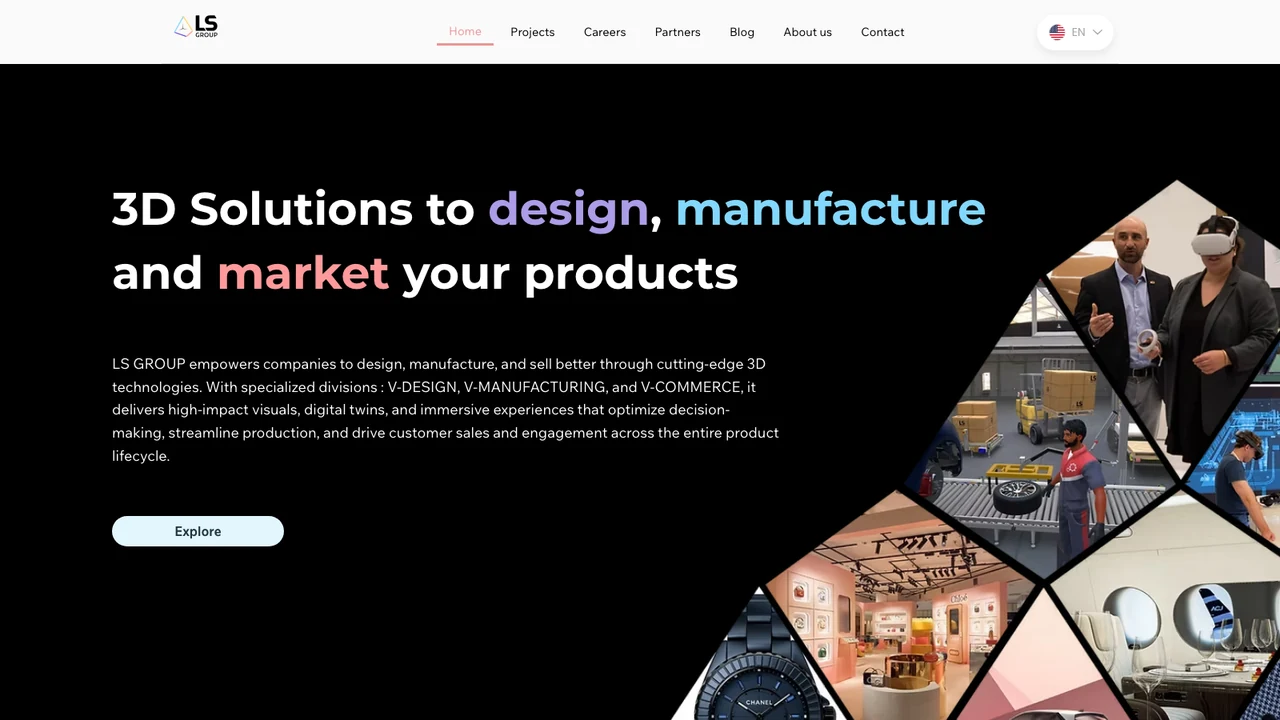
LS Group is a French industrial 3D company working across virtual, augmented and mixed reality. Confirm the identity before shortlisting: it traded as Light and Shadows until rebranding at the end of 2022 and operates at ls-group.fr, while ls-group.com and lsgroup.fr are parked and listed for sale.
Founded in 2009, it publishes three divisions, V-DESIGN, V-MANUFACTURING and V-COMMERCE, and its product line is XR Suite, which includes Interact, a Unity plugin for interactive 3D physics simulation. Shipping its own engine plugin is the strongest Unity credential in this list, because a plugin is a maintained software product rather than project work, and it means the company's engine expertise is productised rather than resident in whichever developer is available.
The physics element defines what its engine twins are for. Rendering a model in Unity shows what something looks like. Simulating physics inside Unity lets you ask whether a part fits, whether an assembly sequence is achievable in the available space, and how a component behaves under load. That converts a twin from a viewer into a validation tool, which is a materially different justification and one that survives budget scrutiny better.
Its published positioning covers supporting the transition to Industry 4.0, with analysis tools and the ability to create and recreate scenarios to validate ideas inside industrial processes. Named clients are Airbus Group, Alstom, Dassault Aviation and PSA Peugeot Citroën, all sectors with complex assembly and high consequences for method errors.
Its published engine focus is Unity, with no Unreal product stated, so a buyer committed to Unreal should confirm capability directly. Team size, rates and ownership terms are not published. Best for Unity twins where physics and assembly validation are the purpose.
3. Vection Technologies

Vection Technologies is an XR and AI company listed on the Australian Securities Exchange under the ticker VR1, working from Subiaco, Western Australia. Its published Unreal credential is Mindesk, which provides virtual reality design review and real-time rendering in Unreal Engine for CAD and BIM data.
Mindesk addresses the conversion problem directly, which is what makes it relevant here rather than just present. Its stated purpose is taking CAD and BIM into a real-time Unreal environment for review, which is exactly the pipeline that costs the most and breaks most often when built bespoke. A productised route from engineering data into an engine is worth more than an equally capable one built by hand, because it is maintained by someone else and it runs again next month.
Its wider platform is INTEGRATEDXR, with EnWorks for augmented reality visual assistance in training, manufacturing and maintenance, 3DFrame as a no-code application for immersive product presentation, and XRKiosk for in-store 3D and augmented reality. Its stated positioning, helping organizations get value from 3D data they already own, is a narrower and more honest claim than most in this market.
The exchange listing is a genuine procurement advantage for a multi-year twin program, since audited accounts can be read rather than taken on trust. The counterweight is the usual one for a product company: establish which parts of a proposal are configuration of an existing product and which are bespoke, because the two differ in cost, timeline and what you own.
Its stated industries span healthcare and pharma, real estate and BIM, architecture and engineering, fashion and retail, museums and education, defense and aerospace, industrial and manufacturing, transportation and public sector, so sector references need requesting directly. Best for Unreal-based design review built from CAD and BIM you already hold.
4. Magnopus

Magnopus builds immersive experiences and the technology beneath them, and its relevance here is engine work at a scale most twin suppliers never attempt. Its published projects include The Wizard of Oz at Sphere, the Dubai Expo 2020 cross-reality experience, Mission:ISS, virtual production on the Fallout television series and The Lion King, and Cyberpunk: A Virtual Production Experience at the Academy Museum of Motion Pictures.
Virtual production is the credential worth understanding, because it is real-time engine rendering under the hardest conditions there are. An LED volume renders an environment live, at film quality, while a camera moves through it and a crew waits. A company operating that has solved performance, asset pipelines and reliability at a level industrial twin projects rarely demand.
It also builds OKO, described as a spatial intelligence platform for building Connected Spaces, persistent real-time collaborative environments unified across devices and platforms. Its published support for CAD models and Gaussian splats alongside conventional assets is directly relevant to twin work, since splats offer a route from captured reality into a real-time environment that avoids much of the mesh conversion problem. OKO publishes live IoT data connections, delivery across web, mobile and XR headsets, and AI scripting features developed with Google.
Two caveats belong on an industrial shortlist. Its published portfolio is entertainment, live events and cultural work rather than industrial twins, so a buyer should ask how a project would be staffed rather than assuming the relevant experience transfers. And a twin built on OKO carries a platform dependency, so establish which parts of the deliverable are owned and which are licensed before committing.
Founded in 2013, it works from 523 W. 6th Street, Suite 330, Los Angeles and 20 High Street, St Albans in the United Kingdom. Team size, rates and IP terms are not published. Best for large, multi-user, visually demanding real-time environments.
5. TechViz
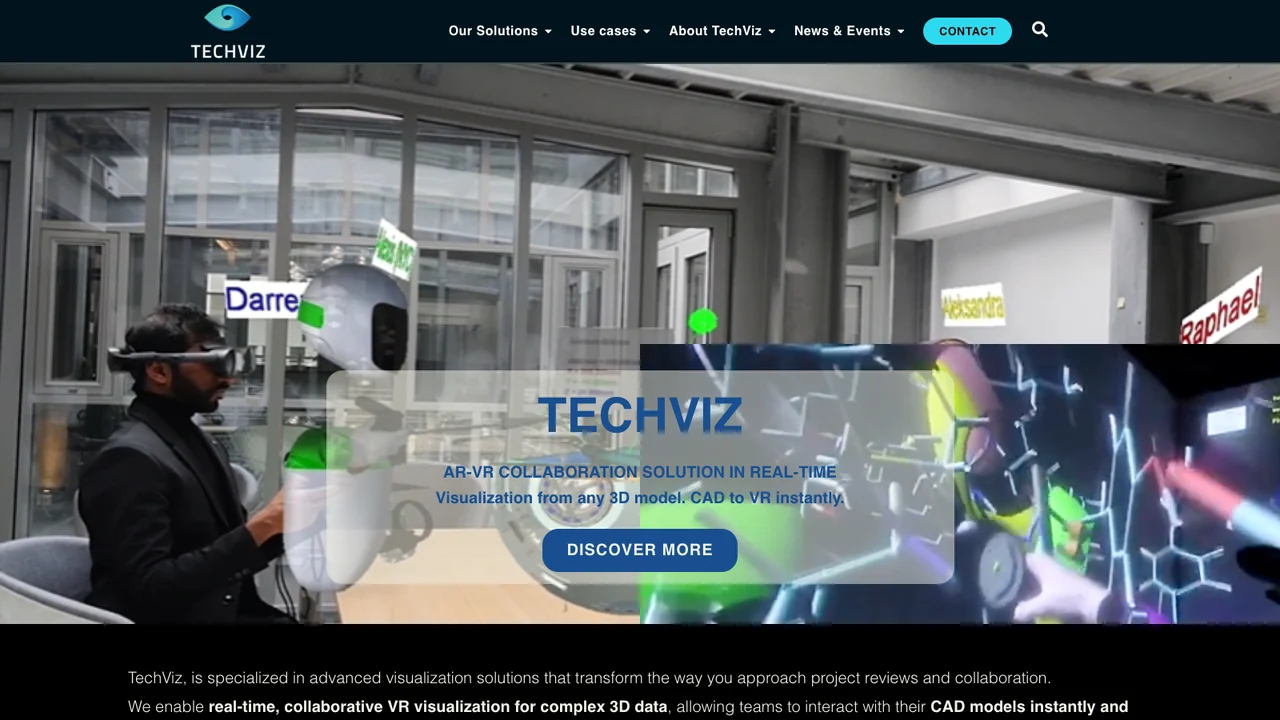
TechViz belongs on this list as the counter-argument, and reading it that way is more useful than scoring it against the others. Founded in 2004 and headquartered in Paris, with offices in Chicago, Beijing and Bangalore, it describes itself as a software editor providing advanced visualization for 3D applications.
Its published approach is the opposite of engine-based twin building. TechViz displays virtual prototypes directly from desktop 3D CAD, PLM, geospatial and simulation applications into a virtual environment, and it states that this happens without conversion and in real time. Its compatible applications are CAD systems including CATIA, Creo, NX and SolidWorks, and its compatible apps page lists Unity but makes no mention of Unreal.
For a list about building twins on Unity and Unreal, that is a partial fit and should be stated plainly. TechViz is not primarily an engine company, and a buyer expecting an Unreal deliverable will not get one. What it offers instead answers the objection that engine twins struggle with: the model you view is the live CAD model, so it cannot drift from the source, and no polygon budget or conversion step has degraded the geometry.
Its published product offer is TechViz XL, Share&Viz and Cloud&Viz, with features including virtual assembly, virtual reviews, human factors, human body tracking, finger tracking, automated reporting, video recording and a TVZLib API. Use cases cover digital mock-up, ergonomics, immersive design reviews, operability, maintainability and manufacturability, and training. Stated industries include aeronautics and aerospace, automotive, military and defense, energy oil and gas, shipbuilding, architecture and construction, pharmaceutical and transportation.
One disclosure note. Its site header publishes a phone number, email and address that appear to be unfilled template placeholders and contradict its own About page, which states the Paris headquarters. That affects nothing material about the product, but a buyer should use the details on the About page. Team size, rates and pricing are not published. Best for keeping CAD fidelity and currency where an engine's interactivity is not the requirement.
What engine-based twin projects have to account for
Four things decide whether an engine twin is still usable a year after delivery.
The first is the conversion pipeline, and it should be a named deliverable rather than an implicit task. Ask how source data becomes engine data, how long it takes, how much is automated, and who runs it when the model changes. A twin whose refresh requires a specialist and three days will not be refreshed. This is the most common reason engine twins are abandoned, and it is entirely foreseeable at contract stage.
The second is engine licensing. Unity and Unreal both have commercial terms that depend on how software is distributed and monetised, and those terms change. Establish who holds the license, what it costs at your deployment scale, and what happens if terms change mid-program. It is a question for your commercial team as much as your engineers.
The third is accuracy. Engines render, they do not certify. A converted mesh is an approximation, and measuring inside it is not equivalent to measuring in CAD. If anyone will make a dimensional decision from the twin, establish what tolerance survives conversion and say so in the interface, because users will otherwise assume what they see is exact.
The fourth is who can open the project. An engine twin is a project directory that requires a licensed engine, matching version, plugins and often specific assets. Confirm you receive the project rather than a build, that it opens on a stated engine version, and that any third-party plugin licenses transfer. Treeview publishes full transfer of IP, source code and assets; the others do not publish ownership terms.
How to choose between these Unity and Unreal twin companies
Decide first whether an engine is genuinely required. If people need to inspect, measure and check a model, engineering and capture software does it better and more accurately, and TechViz's no-conversion approach is the most direct expression of that. If the twin must be walked through, operated by untrained people or delivered to headsets, an engine is the right runtime.
Then match engine to supplier honestly. Unity with physics and assembly validation points to LS Group and its Interact plugin. Unreal for design review from existing CAD and BIM points to Vection and Mindesk. Either engine, built to your specification and owned by you, points to Treeview. Large multi-user environments where real-time performance is the hard part point to Magnopus.
Make the conversion pipeline a contract item. Ask for it to be demonstrated on your own data during evaluation, timed, with the refresh procedure written down. Suppliers who have solved this will show you. Suppliers who have not will describe it.
Finally, confirm what arrives at handover: the project directory, the engine version, plugin licenses, converted assets, integration code and the documentation to rebuild. An engine twin delivered as an executable is a demonstration with a long lifespan, not an asset.
Related reading. BestInXR's digital twins guide covers what separates a twin from a model or a shadow. companies for custom digital twin development covers the build against platform decision, and digital twin platforms and development companies for energy covers the sector case. For capture-led environments see VR companies for virtual site tours of energy facilities, and for procurement, selecting XR developers for enterprise deployment.
Frequently Asked Questions (FAQ)
1. Why build a digital twin on a game engine at all?
For real-time rendering at scale, interactivity, and output to headsets and mobile devices, none of which engineering software provides natively. If the requirement is inspection, measurement or clash detection, engineering and reality capture software does those better and with accuracy guarantees an engine does not offer.
2. Unity or Unreal?
Unreal is generally chosen where visual fidelity and large environments dominate, Unity where device breadth, iteration speed and mobile or standalone headset delivery matter more. Treeview publishes both. LS Group publishes a Unity plugin. Vection publishes Unreal through Mindesk. A supplier committed to one will frame your requirement to suit it.
3. What is the conversion problem?
CAD carries precise surfaces, assembly structure and metadata; engines want optimized meshes. Converting loses information, takes time and must be repeated whenever the source changes. If the pipeline is manual, the twin goes stale. TechViz avoids it entirely by displaying directly from the CAD application without conversion.
4. Can you take measurements from an engine-based twin?
Only within the tolerance that survived conversion, and none of the five publishes conversion accuracy figures, so no number is recorded here. Engines render rather than certify. If dimensional decisions will be made from the twin, establish the tolerance and state it in the interface, because users assume what they see is exact.
5. Who pays the engine license?
That depends on the agreement and on how the software is distributed. Unity and Unreal both have commercial terms tied to distribution and revenue, and those terms change over time. Establish who holds the license, the cost at your deployment scale, and what happens if terms change during the program.
6. What should you receive at handover?
The project directory rather than a build: scenes, blueprints or prefabs, shaders, converted assets, integration code, build configurations, the engine version it opens on, and any transferable plugin licenses. Treeview publishes full transfer of IP, source code and assets. The others do not publish ownership terms.