
VR Simulation: What It Is and How to Evaluate It
The word simulation hides a large cost difference. A walkthrough shows an environment. A procedure trainer sequences steps and checks a person performed them. A simulation models a system's behavior, so inputs produce outputs governed by rules rather than by a script, and the same action can produce different results.
In short:
- What it is: Virtual reality that models how a system behaves, used for training, prototyping, medical practice, engineering review and emergency rehearsal.
- What it is not: A walkthrough. If nothing the user does changes the outcome, it is an environment rather than a simulation, and it costs a fraction as much to build.
- What decides the shortlist: Evidence of modeling behavior rather than only rendering it, whether the supplier builds software, hardware or both, named clients and what the buyer owns at the end.
- What kills credibility: No fidelity validation. Experienced operators detect a plausible-but-wrong simulation immediately and stop taking it seriously.
What a simulation actually is
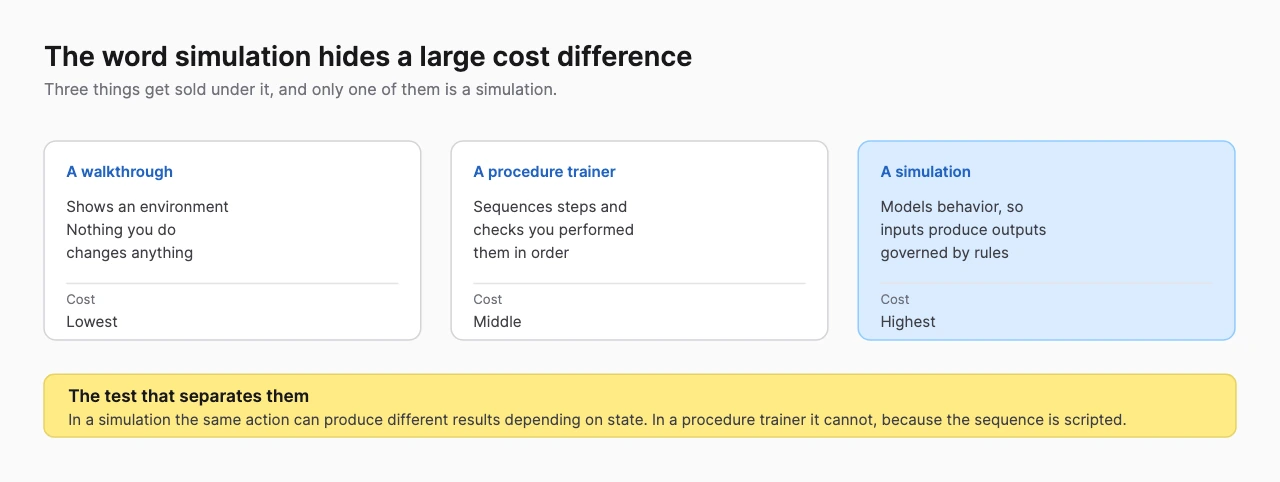
Three things are sold under this word, and only one of them is a simulation.
A walkthrough shows an environment and nothing the user does changes anything. A procedure trainer sequences steps and confirms the person performed them in order. A simulation models a system's behavior, so that inputs produce outputs governed by rules, and the same action can produce different results depending on state.
The test that separates them: ask whether the same action can produce different outcomes. In a procedure trainer it cannot, because the sequence is scripted. In a simulation it can, because the model is computing rather than replaying.
The cost difference between the three is a multiple, and the most common way to overspend in this category is to commission the third when the second would have taught the same thing.
Fidelity validation
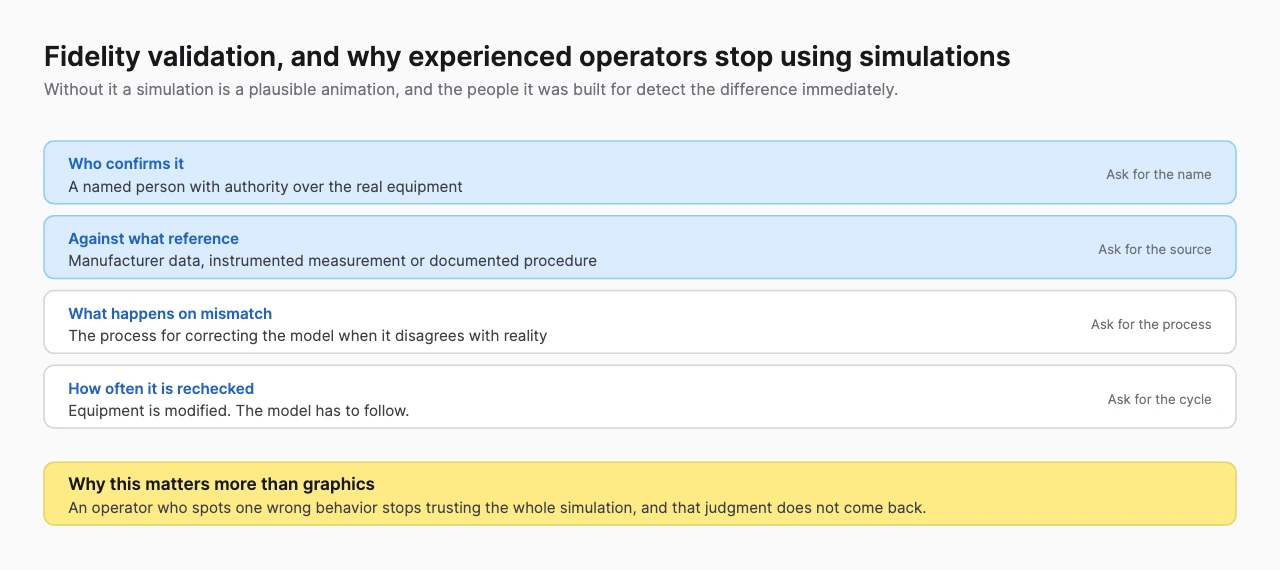
Name who confirms the model behaves correctly, against what reference and what happens when it does not match the real equipment.
Without that, a simulation is a plausible animation. Experienced operators detect the difference immediately, and once one person spots a wrong behavior they stop trusting the whole thing. That judgment does not come back, which makes validation more consequential than any visual decision.
Four questions cover it: who confirms it, against what reference, what the correction process is and how often it is rechecked as equipment is modified. A supplier who has done this will describe the process rather than assert the outcome.
The question worth asking in every demo
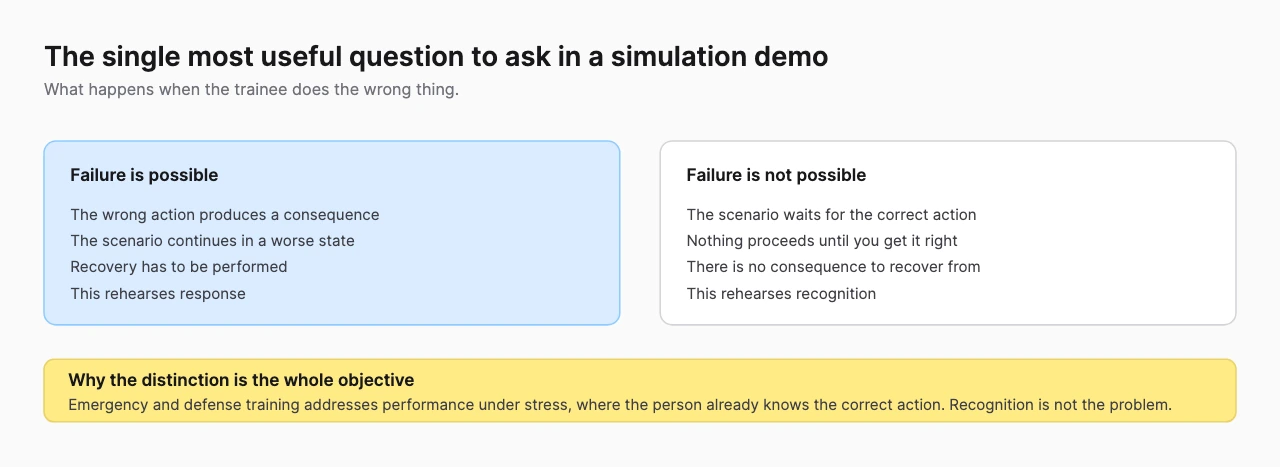
Ask what happens when the trainee does the wrong thing.
A scenario that waits for the correct action rehearses recognition. A scenario where the wrong action produces a consequence, and the trainee has to recover from a worse state, rehearses response.
For emergency and defense training the distinction is the entire objective. That work addresses performance under acute stress, where the person already knows the correct action and the question is whether they will execute it. Recognition was never the problem.
Best companies for VR emergency response and defense simulation ranks on documented work in the sector, whether the supplier builds to order or ships a product line, how performance is assessed and what the buyer holds afterwards.
Why virtual prototyping justifies itself
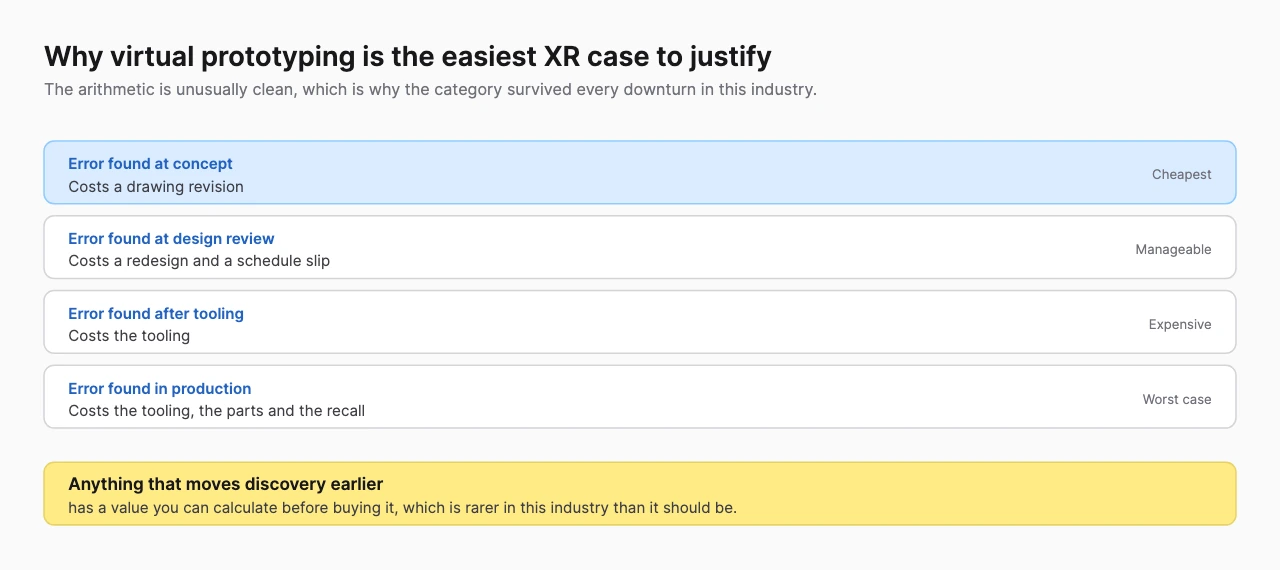
Virtual prototyping is one of the oldest industrial uses of VR and one of the easiest to justify, because the arithmetic is unusually clean.
A design error caught at concept costs a drawing revision. The same error caught after tooling costs the tooling. Anything that moves discovery earlier has a value you can calculate before buying it, which is rarer in this industry than it should be, and it is why this category survived the periods when the rest of enterprise VR did not.
Best companies for VR virtual prototyping ranks on fidelity to engineering source data, whether the format supports a group or an individual, what question the tool is built to answer and what the buyer owns.
The CAD question that decides whether a review is trustworthy
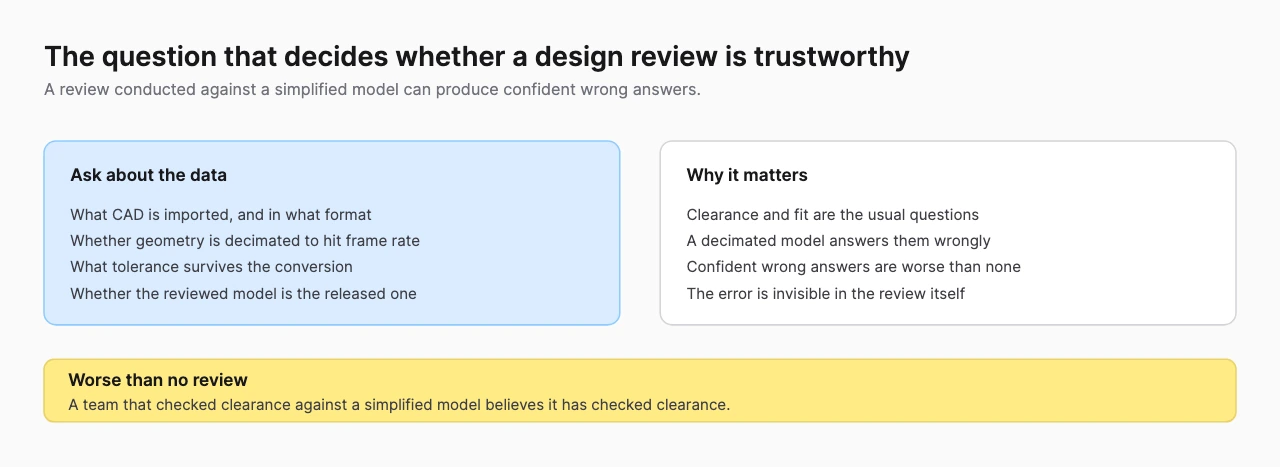
Ask what CAD is imported, whether geometry is decimated to hit frame rate and what tolerance survives.
A review conducted against a simplified model can produce confident wrong answers about clearance and fit, which is worse than no review at all. A team that checked clearance against a decimated model believes it has checked clearance, and the error is invisible in the review itself.
Where simulation earns its cost
Four conditions make the case straightforward. Where none holds, a cheaper method usually teaches the same thing.
The real thing is dangerous. Practicing on live equipment risks people, and the alternative is not practicing at all. This is the strongest case in the category, because the comparison is with nothing.
The real thing is productive. A machine taken out of service to train on has a cost per hour that is already tracked, which makes the business case arithmetic rather than argument.
The event is rare. Emergencies, failures and edge cases cannot be scheduled. A simulation is the only way to rehearse something that happens twice a decade.
The error is expensive and late. Prototyping in particular, where the cost of discovering a problem rises by an order of magnitude at each stage.
Where the task is common, safe, cheap to practice and forgiving of error, simulation is usually the wrong instrument. That is not a criticism of the technology. It is the same judgment that decides against building a test rig.
What happens after the simulation ships
Two decay patterns, and the first is specific to this category.
Equipment is modified and the model is not. A plant changes a valve, a manufacturer revises a control panel, a vehicle gets a new interface. The simulation now teaches something subtly wrong, and the people who notice are the experienced operators whose trust the program depends on. Whoever owns the equipment change has to own the trigger to update the model, and that link is rarely made at purchase.
Assessment drifts from competence. What counted as competent when the simulation was built may not be what counts now, particularly where a regulator or professional body has revised a standard. A simulation assessing against an old standard produces records that look valid and are not.
Both are ownership questions. Both are cheaper to settle in the contract than in the second year, and both are invisible until someone senior asks whether the training still reflects the job.
Simulation by application
Five distinct purchases, each with its own ranked list.
Custom simulation development
Best companies for custom VR simulation development ranks on evidence of modeling behavior rather than only rendering it, whether the supplier builds software, hardware or both, named clients and what the buyer owns at the end.
Virtual prototyping
Best companies for VR virtual prototyping covers engineering design review, where fidelity to source CAD is the deciding technical question.
Medical simulation
Best companies for custom medical simulation in VR covers clinical procedure practice. It overlaps with the healthcare guide, where the evidence standard rather than the modeling is the constraint.
Engineering simulation
Best VR companies for engineering simulation covers behavior modeling for engineering rather than for training, which is a different buyer with a different tolerance for approximation.
Emergency and defense
Best companies for VR emergency response and defense simulation covers performance under stress, where whether failure is possible decides whether the training does anything.
Who builds simulations
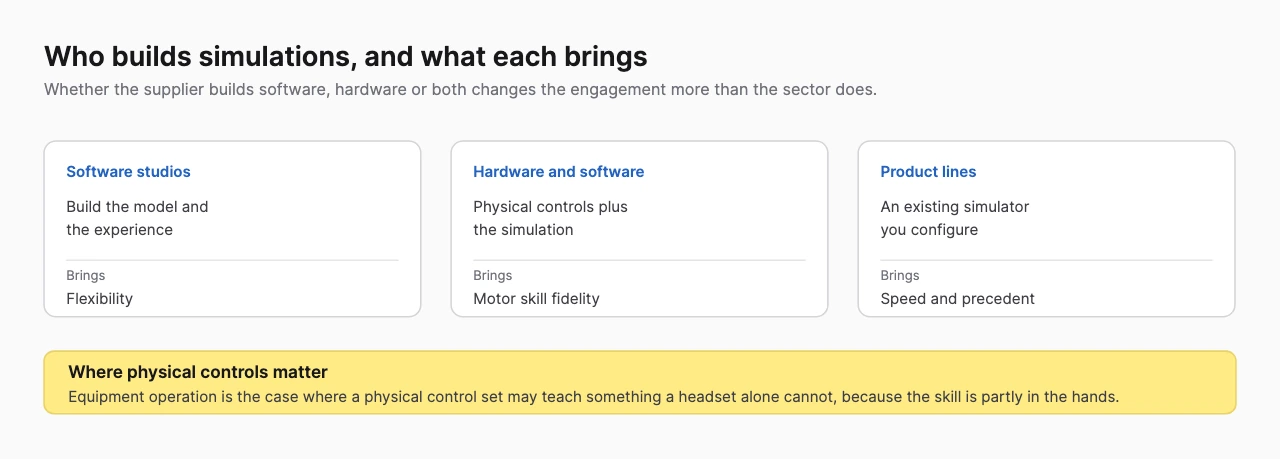
Software studios build the model and the experience. ForgeFX Simulations works this way, and flexibility is what they bring.
Hardware and software vendors supply physical controls alongside the simulation. Tecknotrove and MILO Range sit here. Equipment operation is the case where a physical control set may teach something a headset alone cannot, because part of the skill is in the hands.
Product lines ship an existing simulator you configure. Speed and precedent are the arguments, and the constraint is that you are adapting to their model of the task rather than the reverse.
| Software studio | Hardware and software | Product line | |
|---|---|---|---|
| You get | A model built to your task | Controls plus simulation | A configured existing simulator |
| Strongest at | Fit to your equipment | Motor skill fidelity | Speed and precedent |
| Weakest at | Physical controls | Cost and flexibility | Anything outside their model |
| Time to deploy | Months | Months | Weeks |
| Ownership | Varies, ask | Usually licensed | Licensed |
What sets a simulation schedule
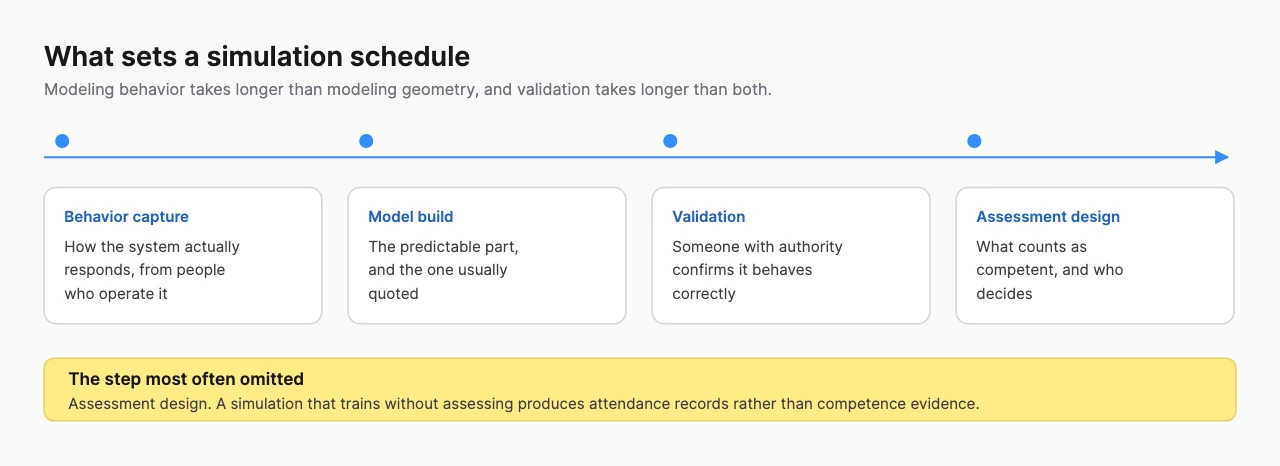
Modeling behavior takes longer than modeling geometry, and validation takes longer than both.
| Cost center | Scales with | Usually quoted | Notes |
|---|---|---|---|
| Behavior capture | Number of systems modeled | Sometimes | Needs time from people who operate the real thing |
| Model build | Complexity and fidelity | Yes | The predictable part |
| Fidelity validation | Who validates, how formally | Rarely | The step that decides whether it is trusted |
| Assessment design | What competence means here | Rarely | Most often omitted entirely |
| Hardware | Physical controls, if any | Yes, when included | Changes the cost shape completely |
Assessment design is the step most often omitted. A simulation that trains without assessing produces attendance records rather than competence evidence, and the difference matters at exactly the moment somebody asks whether the training worked.
What you can check, and where
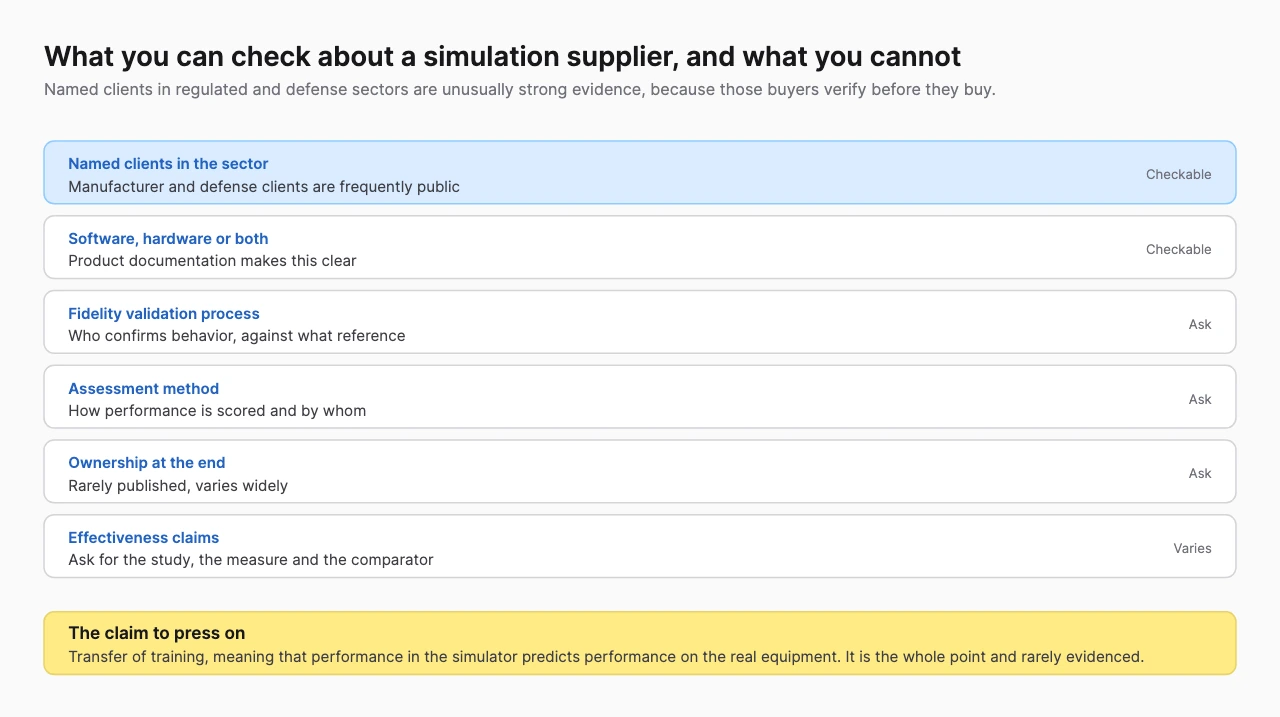
Named clients in regulated, manufacturing and defense sectors are unusually strong evidence here, because those buyers verify capability before purchasing and their procurement is frequently public.
Transfer of training is the claim to press on. It means that performance in the simulator predicts performance on the real equipment, and it is the entire point of the category. It is also rarely evidenced. Where a published study exists, with a named measure and a comparator against conventional training, it is citable. Where the claim rests on trainee satisfaction or on completion rates, it is measuring something else.
Fidelity validation is checkable by asking, and a supplier who has done it will name the person, the reference and the correction process without hesitating.
No primary source exists for market size in VR simulation, and this site does not repeat projections.
How the rankings below were built
Every list linked here ranks on four published criteria and states what is not a ranking factor, set out in each post under How this list was built.
Across the simulation lists the recurring four are evidence of modeling behavior rather than only rendering it, whether the supplier builds software, hardware or both, named clients and what the buyer owns at the end. In the emergency and defense list the criteria shift to how performance is assessed, because assessment rather than content is what that sector buys.
The methodology page sets out how entries are assessed.
Where to start
Establish whether you need a walkthrough, a procedure trainer or a simulation, then read the list covering your application.
- Best companies for custom VR simulation development
- Best companies for VR virtual prototyping
- Best companies for custom medical simulation in VR
- Best VR companies for engineering simulation
- Best companies for VR emergency response and defense simulation
The directory lists developers, platforms and software with sourced entries.
Related reading. BestInXR's list of spatial computing companies explains why suppliers doing this work rarely use the term, and routes to the vertical list for each sector.
Related reading
Each of these covers one part of this subject in depth, with the suppliers ranked on criteria stated in the post.
Frequently Asked Questions (FAQ)
1. What is a VR simulation?
An application that models how a system behaves, so that inputs produce outputs governed by rules rather than by a script. If the same action always produces the same result regardless of state, it is a procedure trainer rather than a simulation.
2. What is the difference between a simulation and a walkthrough?
A walkthrough shows an environment and nothing the user does changes anything. A simulation computes behavior, so actions have consequences that depend on the state of the system. The cost difference between them is a multiple.
3. Which companies build VR simulations?
They divide by what they supply. ForgeFX Simulations builds software, Tecknotrove and MILO Range supply physical controls alongside it, and Virtalis and Treeview work in engineering and custom development.
4. How do you verify that a simulation is accurate?
Ask who confirms the model behaves correctly, against what reference, what happens when it does not match the real equipment and how often it is rechecked. A supplier who has done this describes the process rather than asserting the outcome.
5. What is the most useful question to ask in a simulation demo?
What happens when the trainee does the wrong thing. A scenario that waits for the correct action rehearses recognition. One where the wrong action produces a consequence to recover from rehearses response, which is what emergency and defense training is for.
6. Why is virtual prototyping easy to justify?
Because the arithmetic is clean. An error caught at concept costs a drawing revision, the same error caught after tooling costs the tooling. Anything that moves discovery earlier has a calculable value, which is unusual in this industry.
7. Can a design review be done against a simplified model?
Only carefully. If geometry is decimated to hit frame rate, clearance and fit answers may be confidently wrong, which is worse than not reviewing at all because the team believes the check was made. Ask what tolerance survives the conversion.
8. What is transfer of training and can it be verified?
It means performance in the simulator predicts performance on the real equipment, and it is the point of the category. It is rarely evidenced. Where a published study exists with a named measure and a comparator it is citable, and where the claim rests on satisfaction or completion rates it is measuring something else.