Best VR Companies for Firefighter Training
This search returns two different markets. One teaches an office worker to aim an extinguisher. The other trains a professional firefighter to advance a charged hose line into a structure, read a thermal image and command a scene. The equipment, the price and the buyer are different, and most comparison articles list them together.
In short:
- The reason this category exists is now formally classified. The World Health Organization's cancer agency evaluated occupational exposure as a firefighter as carcinogenic to humans in 2022. Live fire training is exposure.
- Ask what the trainee holds. A controller trains decisions. A weighted nozzle with reactive pressure trains the body. Both are legitimate and they cost very different amounts.
- One supplier here has been tested by somebody else. Independent validation is almost unheard of in immersive training, and it is the single most useful fact on this page.
- The incumbent sells both sides. The largest maker of live fire training props also sells the VR product that replaces some of them.
How this list was built
VR firefighter training is a simulation used to rehearse fire ground tasks without setting a fire. BestInXR's VR simulation guide sets out what separates a simulation that models behavior from a training application that replays an authored path, which is the distinction that decides what any of this is worth.
This list ranks five suppliers on four criteria: which of the two markets the product actually serves, what physical equipment the trainee handles, what evidence the supplier publishes beyond its own marketing and who can author a new scenario without going back to the vendor.
Not a ranking factor: how convincing the fire looks. Every product in this category renders fire well, and none of the failures in it are rendering failures.
Where the requirement is broader than fire, BestInXR's emergency response and defense simulation list covers multi-agency and tactical work, and the hazardous environment and safety training list covers industrial safety.
| Company | Which market | What the trainee handles | What it publishes |
|---|---|---|---|
| FLAIM Systems | Fire service | Industry-standard hose and equipment | An independent TEEX-Tested report |
| Treeview | Commissioned | Whatever the brief specifies | Enterprise clients and full transfer of IP, source and assets |
| XpertVR | Fire service | Hose lines, nozzles, thermal imaging camera | A scenario authoring tool for instructors |
| LION | Both | Digital nozzle, or an extinguisher | A live fire prop catalogue alongside the digital one |
| Ludus Global | Workplace HSE | Hands, no controllers on newer modules | Customer counts and renewal rate |
Why fire services buy this, and it is not the travel budget
The strongest argument for the category is an occupational health argument, and it is the one buyers most often leave out of a business case.
In July 2022 the International Agency for Research on Cancer, the World Health Organization's cancer agency, published Volume 132 of the IARC Monographs, evaluating occupational exposure as a firefighter as carcinogenic to humans, Group 1, on the basis of sufficient evidence in humans. The working group found that the exposure causes mesothelioma and cancer of the bladder, with limited evidence for cancers of the colon, prostate and testis, for melanoma of the skin and for non-Hodgkin lymphoma. The summary was published in The Lancet Oncology on 30 June 2022.
Group 1 is the agency's highest classification and it is a statement about the strength of the evidence rather than about the size of the risk. What it changes for a training officer is the framing. Every live burn is an exposure event, and a simulation that removes one burn from a recruit's year removes an exposure.
That is why FLAIM leads its own product page with reducing carcinogen exposure rather than with cost. Treat the rest of the category's savings claims as secondary, because they are the easier argument and the weaker one.
What the two markets actually differ on
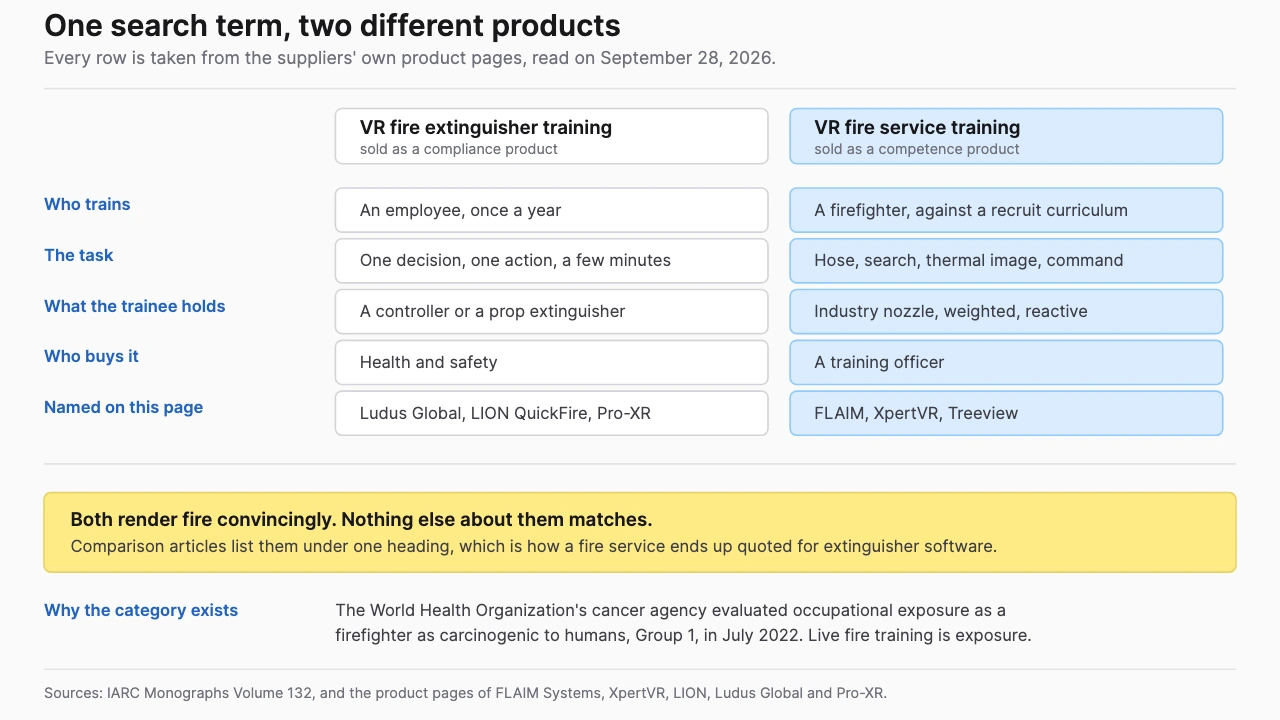
Extinguisher training is a compliance product. The trainee is an employee, the task is one decision and one action, the session is a few minutes and the hardware is a headset and a prop extinguisher. It scales to thousands of people and it is bought by a health and safety function.
Fire service training is a competence product. The trainee is a firefighter, the tasks are hose handling, door control, search patterns, thermal image interpretation and incident command, the session runs long enough to fatigue somebody and the hardware may include a weighted nozzle that pushes back. It is bought by a training officer and it is measured against a recruit curriculum.
The two get listed together because both render fire. Nothing else about them matches.
1. FLAIM Systems
FLAIM Systems is ranked first because it is the only supplier here whose product has been assessed by somebody other than itself.
Its FLAIM FTS is described as a mixed reality firefighter training system that blends virtual fire scenarios with industry-standard equipment, which is the distinction that puts it at the fire service end rather than the compliance end. The product line covers firefighter training, fire extinguisher training, counter EOD search training and a data and reporting layer, across emergency services, defense, industrial firefighting and workplace safety.
The validation is the reason for the position. FLAIM published a TEEX-Tested report on 19 May 2023, generated by the Testing and Innovation Center at the Texas A&M Engineering Extension Service, which trains emergency responders. FLAIM's release states the report concludes the FLAIM Trainer performs as designed, can offer training and ongoing education to the firefighter community and provides a valid medium for conducting training where live training is otherwise too hazardous, costly or hard to access.
Read what that claim is and is not. It is an assessment that the system does what the vendor says it does, by an organization with no commercial interest in the answer. It is not a finding that VR training produces the same competence as a live burn, and FLAIM does not claim that it is.
No price is published. Best for fire services and industrial brigades that need hose work in the loop, and for any procurement that has to survive a question about evidence.
2. Treeview
Treeview is the option when the requirement does not match a product, which in this category is more often than buyers expect.
Working since 2016, it publishes custom application development across virtual, augmented and mixed reality, with XR software engineering and spatial product design as named services, and names Microsoft, Meta, Medtronic, Toyota, ULTA Beauty, Daiichi Sankyo, Transfr, Stanford Medicine and NEOM among its clients.
The case for commissioning here is specific rather than general. Fire services run on local standard operating procedures, local building stock and local apparatus, and a product built around a generic residential structure will not rehearse a crew on the industrial site down the road or on the apparatus they actually ride. A commissioned build is also the route when the scenario has to sit inside something else, such as a plant's own induction system or a multi-agency exercise that includes police and ambulance roles.
Ownership is the practical difference. Treeview transfers full ownership of IP, source code and assets, which on a scenario library built around your own procedures decides whether you can revise it when the procedures change. BestInXR's custom VR simulation list covers that purchase across industries.
Best for scenarios tied to your own sites, apparatus and procedures, and for fire training that has to be one part of a larger application.
3. XpertVR
XpertVR is ranked third on the strength of its authoring model and its scenario coverage at the command end.
XpertFire publishes an authoring tool that lets trainers design and share their own scenarios, which is the feature that decides whether a library goes stale. Its published scenario set covers structure fires across residential, multi-story and industrial environments, search and rescue with visibility challenges and multiple victim profiles, incident command with multi-unit coordination and communication drills, and electric vehicle and lithium-ion fires, which is the hazard the rest of the category has been slowest to add.
On equipment it lists hose lines and nozzles for water management and stream application, and a thermal imaging camera, so it sits at the fire service end rather than the compliance end.
Its published performance figures are its own and are not sourced on the page: it states trainees train four times faster, that costs fall by 40 to 80 percent and that trainees report 275 percent higher confidence. Those are vendor claims, and the absence of a stated method is the reason the TEEX report above is worth more than any of them.
Best for training officers who want to write their own scenarios, and for services adding lithium-ion and EV fire response to a curriculum.
4. LION
LION is on this list because of what else it sells.
Its digital line includes QuickFire XR, a VR fire extinguisher training system, alongside the ATTACK Digital Fire Training System, HyperFire and the ATTACK Digital Nozzle. Its live fire line includes a hose line training system, vehicle, pressure vessel, dumpster, propane cylinder, fuel spill, helicopter and aircraft wing burn props, SG1000 and SG4000 smoke generators and the SmartDummy rescue and extrication manikins.
That combination is the useful thing on the page. The company with the most to lose from simulation replacing live burns sells the simulation, which tells you the two are being bought together rather than one instead of the other. It also makes LION the supplier most likely to answer honestly about which tasks still need a real fire, because it will sell you the prop either way.
The digital products span both markets, so establish which one a quote covers. QuickFire XR is named as an extinguisher system. Best for services and facilities already buying props from LION, and for anyone who wants one supplier across the physical and digital sides of the same curriculum.
5. Ludus Global
Ludus Global is the clearest example of the workplace end of this market, and it is here so the distinction has a name.
It publishes a platform of 23 immersive simulations for enterprise health, safety and environment teams and states 250 customers across 18 countries, 94,750 training sessions completed annually and a 97 percent subscription renewal rate. It was shortlisted for the IOSH Awards 2026 in Digital Transformation of the Year for behavioral analytics in XR safety training. A recent module moved to hand tracking, so the trainee uses their own hands with no controllers.
Its fire content sits inside a broader safety catalogue that includes working at height and electrical work. That is the right shape for an employer training a workforce and the wrong shape for a fire service training recruits, which is precisely the confusion this post exists to resolve.
Its claim that workers learn four times faster is its own and carries no method on the page. Best for enterprise HSE teams covering fire among other risks, and for organizations that need renewal and usage figures for a budget case.
Who is not on this list, and why
Vector Solutions is a substantial supplier to fire departments and is left out because its center of gravity is training management, records and course delivery rather than simulation. A service already running Vector should ask what its VR content covers before buying a second platform.
Pro-XR sells FAST XR with a mixed reality fire scenario editor on a subscription, through a distributor network. It sits at the extinguisher and workplace end alongside Ludus and was left out for overlap rather than for any fault.
FAAC is already ranked in BestInXR's emergency response and defense list through MILO Range, and its fire work is pump operator and apparatus simulation, which is a different task from interior firefighting.
One note on sourcing. Several of the most cited pages for this query are comparison articles published by networks that generate one page per phrase, and several others are published by vendors ranking themselves against competitors. Everything above was read from the supplier's own pages and dated, and the one independent assessment in the category is named as such.
How to choose between these firefighter training companies
Decide which market you are in before you take a demo, because the demos look alike and the products do not.
If the trainees are firefighters and the tasks involve a charged line, FLAIM is the only supplier here with third-party testing and it builds around real equipment. If the scenarios have to match your own buildings, apparatus and procedures, commission them and Treeview transfers the source. If the priority is a growing library your own instructors write, XpertVR publishes the authoring tool and the widest command and EV fire coverage. If you already buy burn props, LION covers both sides of the curriculum from one supplier. And if the trainees are employees rather than firefighters, Ludus Global is built for that and the fire module sits inside a wider safety catalogue.
Then ask every shortlisted supplier the same two questions. Who can author a new scenario, and what happens the first time a trainee does something the scenario did not anticipate. The second question separates a simulation from a video, and it is the one BestInXR's simulation guide recommends asking in every demo.
Frequently Asked Questions (FAQ)
1. What companies make VR firefighter training?
Five cover the range: FLAIM Systems for hose-based fire service training with independent TEEX testing, XpertVR for instructor-authored scenarios including EV and lithium-ion fires, LION for digital training alongside live fire props, Ludus Global for workplace fire safety inside a wider HSE catalogue and Treeview for scenarios built around a service's own sites and procedures.
2. Does VR firefighter training replace live fire training?
No supplier in this category claims it does. The TEEX-Tested report on the FLAIM Trainer concluded the system provides a valid medium for training where live training is too hazardous, costly or hard to access, which is a claim about extending training rather than replacing it. Treat any supplier that claims full replacement as overstating what is published.
3. Why do fire services use VR training?
The strongest documented reason is exposure. The International Agency for Research on Cancer classified occupational exposure as a firefighter as carcinogenic to humans in 2022, with sufficient evidence for mesothelioma and bladder cancer, and live burns are exposure events. Cost and travel savings are real but secondary.
4. What is the difference between VR fire extinguisher training and VR firefighter training?
Extinguisher training teaches an employee one decision and one action in a few minutes, usually with a headset and a prop extinguisher, and it is bought for compliance. Firefighter training rehearses hose handling, search, thermal imaging and command over longer sessions, sometimes with weighted equipment, and it is bought against a recruit curriculum. Comparison articles routinely list both under one heading.
5. Has VR firefighter training been independently tested?
One product has. FLAIM published a TEEX-Tested report in May 2023 produced by the Testing and Innovation Center at the Texas A&M Engineering Extension Service, concluding the FLAIM Trainer performs as designed and is a valid training medium where live fire is not practical. Every other performance figure found in this category is published by the vendor that benefits from it.
6. Can a fire service write its own VR scenarios?
With some suppliers. XpertVR publishes an authoring tool for trainers to design and share scenarios and Pro-XR publishes a mixed reality scenario editor. Where no authoring tool exists, new scenarios are vendor work and priced as such, so ask what a new scenario costs and how long it takes before signing.