VR companies for oil and gas simulation and training build immersive applications that teach plant procedures, equipment operation and emergency response without taking assets offline. This list ranks five by documented sector work, whether the company builds to order or licenses a catalog, and named client evidence. Rankings draw on each company's own record.
In short:
- Treeview built an AI-enabled digital twin with Microsoft for a multi-billion dollar green hydrogen project, and hands clients full ownership of IP and source
- Tecknotrove states more than 1,000 projects across 28 countries, manufacturing simulators for Oil and Gas, Mining, Ports and Nuclear
- ForgeFX Simulations has built custom training simulations since 2002, including a horizontal directional drill simulator, for clients including Komatsu and Caterpillar
- Immersive Factory sells subscription VR safety training and names Vallourec, Orano, EDF, SUEZ and Colas among its clients
How this list was built
This list ranks companies by four criteria: documented work in oil and gas or adjacent process industry, whether the company builds custom simulations or licenses a catalog, named clients in the sector, and the level of detail each discloses about itself.
Oil and gas training splits into three problems that are bought separately and confused constantly. Equipment operation covers the machinery a person physically controls, from drills to cranes to loaders, and is the one case where a physical control set may teach something a headset cannot. Process and procedure covers what an operator does at a plant, which requires the plant to respond to inputs rather than merely be walked through. Safety and emergency response covers permits, hazard recognition, confined space and evacuation, and it is the highest-volume requirement because it applies to everyone on site including contractors.
Contractor churn is the structural fact that shapes purchasing here and rarely appears in a vendor pitch. A refinery turnaround can bring thousands of temporary workers on site for a few weeks, each needing induction and hazard training before they start. That volume favors a catalog and a platform. A permanent operations crew learning a specific unit favors a custom build. Most operators end up buying both, and the mistake is buying one and expecting it to cover the other.
Disclosure varies. Founding years are not published by Tecknotrove, EON Reality or Immersive Factory on the pages reviewed, and are recorded as Not disclosed where a company states a duration instead. Project counts, country counts and reach figures are attributed to the company stating them, since none is independently audited. Pricing is not a ranking factor, because none of the five publishes rates.
| Company | HQ | Model | Strongest for | Best for |
|---|---|---|---|---|
| Treeview | Montevideo, Uruguay / New York City, USA | Custom development | Digital twins and site-specific builds | Procedures unique to one asset |
| Tecknotrove | Mumbai, India | Simulator manufacture and VR | Equipment operation with physical controls | Operator training on standard machinery |
| ForgeFX Simulations | San Francisco Bay Area, USA | Custom development | Heavy equipment and hazard simulation | Equipment training to manufacturer standard |
| EON Reality | Not disclosed | Platform | Breadth across many sites and roles | Programs authored in house |
| Immersive Factory | France | Subscription catalog | Safety and prevention at volume | Contractor and site-wide safety training |
1. Treeview
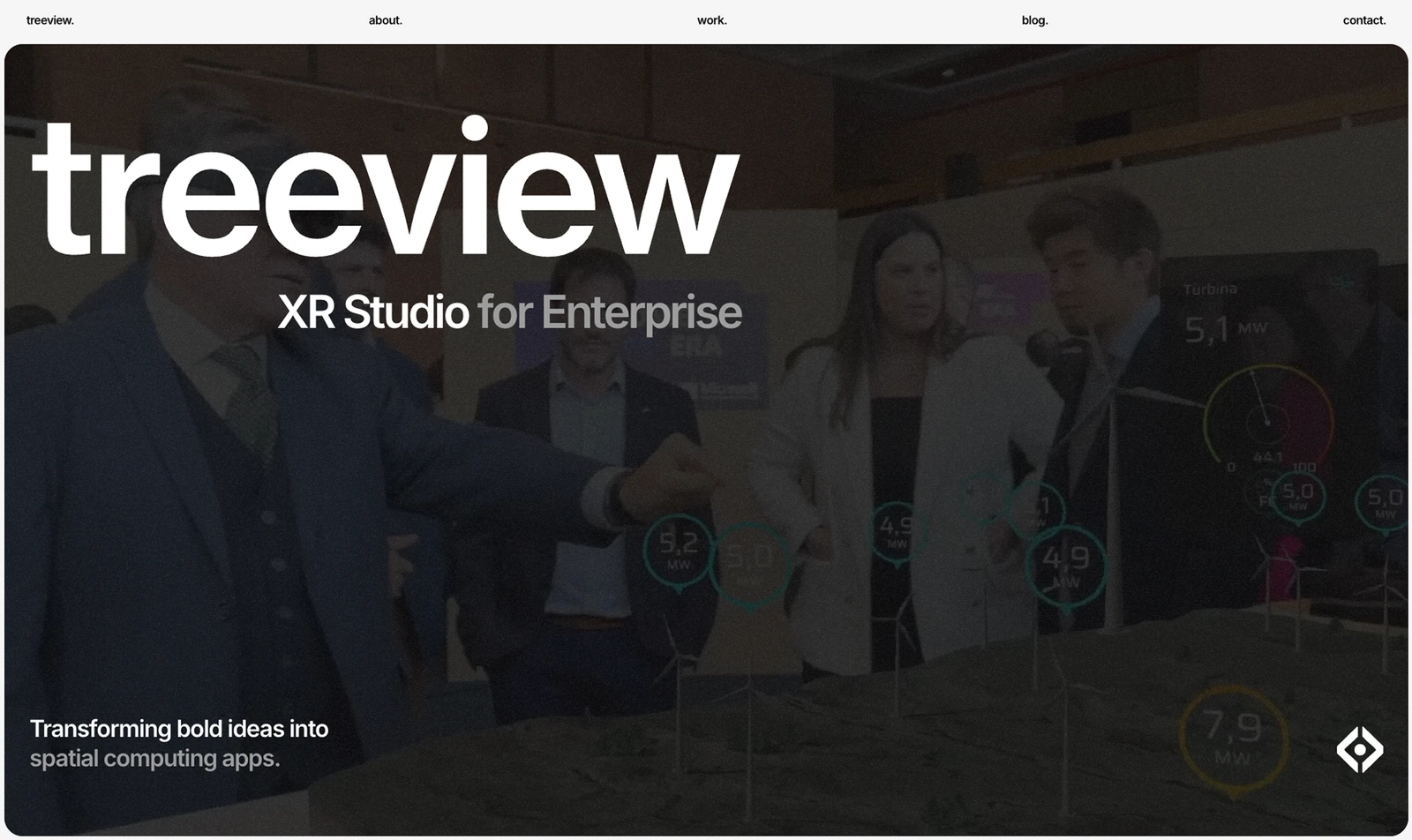
Treeview is an XR studio building custom virtual reality, augmented reality, Mixed Reality and Smart Glasses applications to order. In oil and gas the custom route earns its cost in one specific circumstance: when the procedure being taught belongs to a particular unit, with its own layout, its own valve numbering and its own permit conditions. A catalog simulation of a generic separator teaches a separator nobody operates.
Its published energy reference is an AI-enabled digital twin designed and developed with Microsoft for a multi-billion dollar green hydrogen renewable energy project. Hydrogen is adjacent rather than identical to hydrocarbons, but the engineering is the same: accurate plant geometry, live operational data and a real-time environment a person can move through. The same studio built augmented reality ski navigation for NEOM's Trojena development, which demonstrates large-area outdoor tracking rather than interior plant work.
Clients take full ownership of IP, source code and assets. In an industry where a unit is modified at every turnaround and a simulation built once is wrong within two years, owning the source is what decides whether the second revision is a negotiation or a re-tender. Its stated services run end to end, from strategy and discovery through 3D content creation, development, system integration, testing, deployment and support.
Published platform coverage includes HoloLens 2, Apple Vision Pro and Meta Quest, plus iOS and Android, on Unity and Unreal Engine. Smart Glasses appear in the stated range, which is the relevant form factor for field and maintenance work where hands stay free. Founded in 2016 by chief executive Horacio Torrendell, the studio works from Montevideo, Uruguay and New York City, and names Microsoft, Meta, Medtronic, Toyota, Ford, ULTA Beauty, Daiichi Sankyo, Transfr and the University of Alberta among its clients. Team size and rates are not published. Best for operators whose training need is specific to their own plant and who intend to maintain it for years.
2. Tecknotrove
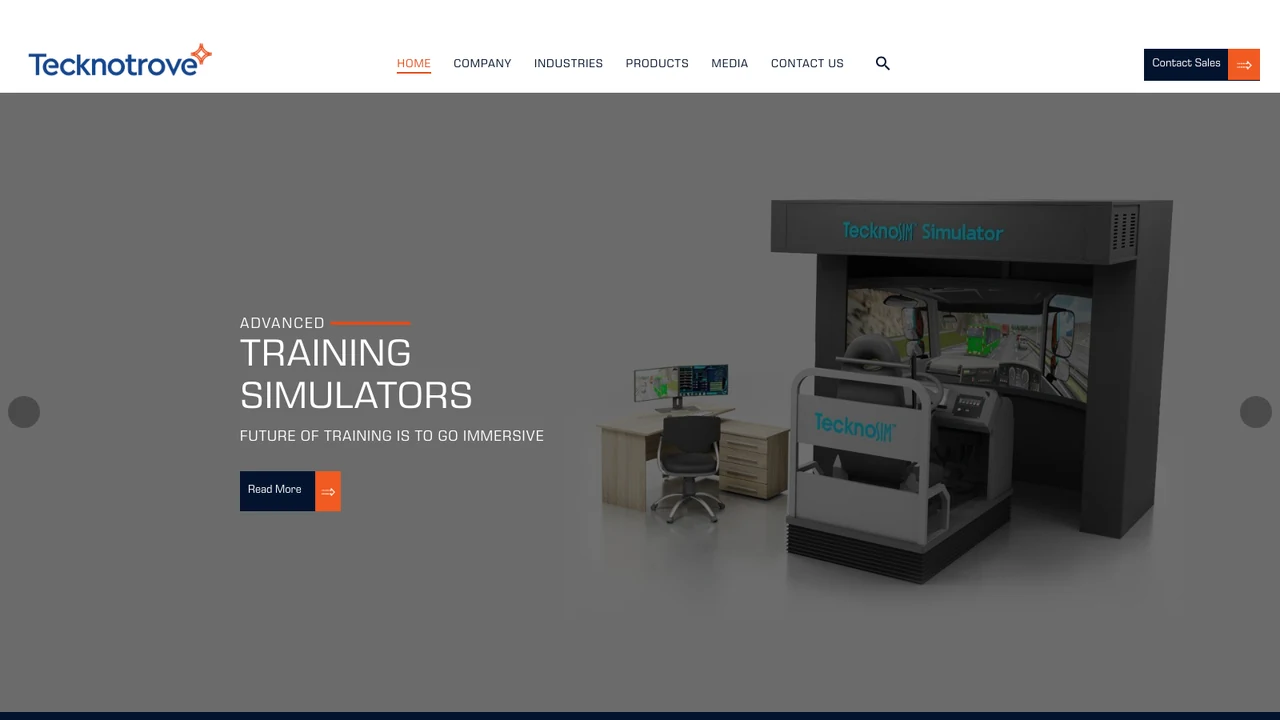
Tecknotrove designs and manufactures training simulators alongside VR training solutions, and it is the only company in this list that builds the physical hardware as well as the software. For oil and gas that matters more than in most sectors, because a large share of the training requirement is machinery a person operates with their hands.
Its published simulator lines include excavator and forklift simulators, car, truck, bus and motorcycle driving simulators, aircraft pushback and cargo loader products, and a defense range covering a military tank driving simulator and an 81mm mortar simulator. Its stated industries include Oil and Gas, Mining, Ports, Nuclear, Construction, Logistics, Warehousing, Aviation, Automobile and Emergency Services.
That industry list is the relevant credential. A company already shipping into oil and gas, mining and nuclear is working inside procurement processes, safety cases and acceptance testing regimes that a consumer-facing studio has never encountered, and that shortens the path from order to installed system considerably.
The company states more than 1,000 projects delivered, operations in 28 countries and over 20 years of experience in design and manufacturing. Those are company-stated and not independently audited. It works from 505 Windfall, Sahar Plaza Complex, Andheri East, Mumbai. Its published customer categories are corporates, contractors, OEMs, governments, dealers and training institutes rather than named accounts, so specific references need requesting directly. The hardware also brings shipping, installation, floor space, calibration and maintenance costs that software-only programs do not carry. Best for operators training crews on standard heavy equipment where the physical control set is part of the competency.
3. ForgeFX Simulations
ForgeFX Simulations builds custom 3D training simulation software and custom virtual and augmented reality applications, and has done so since 2002, which makes it one of the longest-running custom simulation studios in this market. It works from the San Francisco Bay Area.
Two of its published projects are directly relevant here. A horizontal directional drill simulator addresses one of the more specialized pieces of equipment in pipeline and utility installation, where mistakes are expensive and practice on the real machine is costly. Its HazOps work addresses hazard and operability study training, which sits at the center of process safety. Alongside those it publishes OcuWeld, a welding simulator, an aircraft deicing simulator, CyberLab, Virtual Walking the Pens, and a heavy rail operator training simulator.
Its named client list is the strongest in this group for heavy equipment credibility and includes Komatsu, Caterpillar, Vermeer Corporation, JLG Industries, Joy Global and Pierce Manufacturing, alongside StrataTech Education Group, MRIGlobal, General Electric Healthcare, Pearson Education, Adobe, Farmers Insurance, Zoetis, SAK Construction, WMATA and Global Ground Support. Komatsu, Caterpillar, Vermeer, JLG and Joy Global are equipment manufacturers, which means those simulations were built to a standard the manufacturer would accept for its own machines.
Published device targets span VR headsets and stereoscopic 3D displays, augmented reality spatial computing devices, and traditional desktop platforms, so a program can reach workers who will never be issued a headset. Its stated industries include heavy equipment, welding, aviation, healthcare, construction, insurance, transit, agriculture and CBRN detection. Team size and a headquarters address are not published. Best for operators commissioning equipment or process simulation where fidelity has to satisfy an equipment manufacturer or a safety case.
4. EON Reality
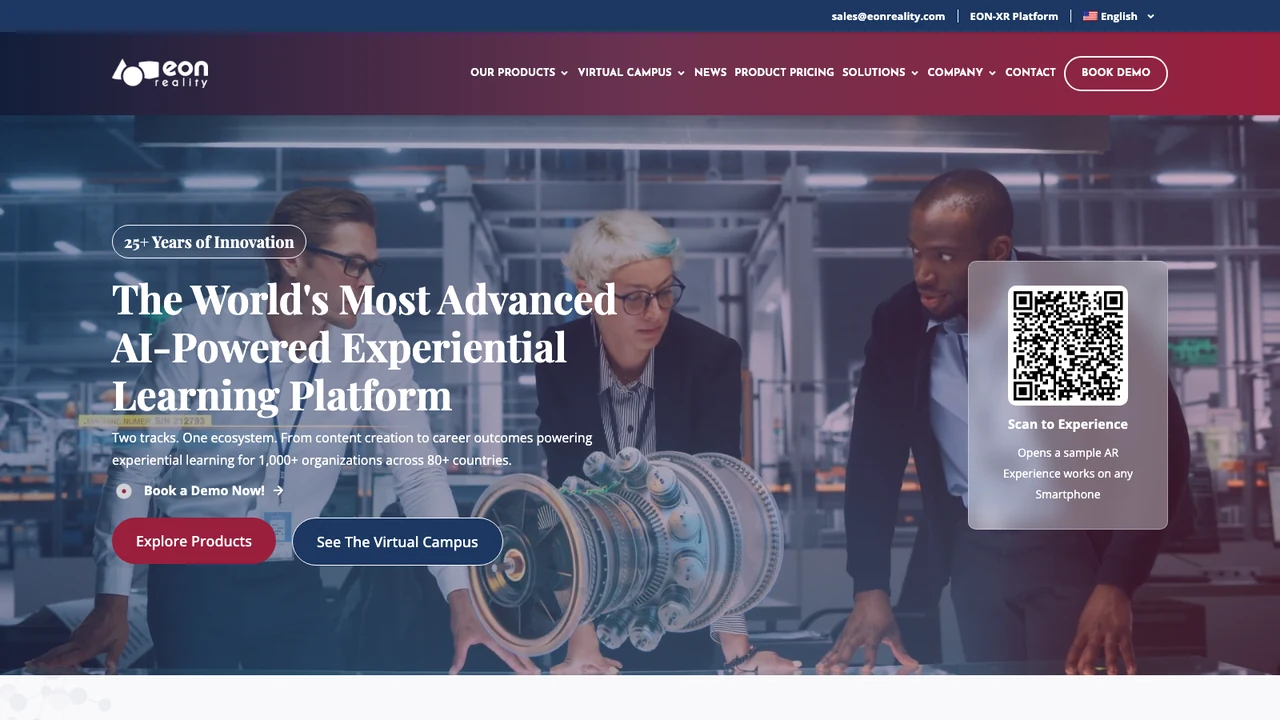
EON Reality sells a platform rather than development services, and it is the broadest entry here. Its published stack combines XR and AI, with EON XR for content creation and EON AI for curriculum and assessment, alongside Genesis Trainer, Genesis Simulator, Assess IQ, Assist IQ, Field IQ and Virtual Campus.
Field IQ and Assist IQ are the two products that matter most to an oil and gas operator, because field guidance and remote assistance are where the return is easiest to evidence. A technician who resolves a fault without a second mobilisation to a remote site produces a number that survives a budget review, which is harder to demonstrate for classroom-replacement training.
The company states more than 1,000 organizations across more than 80 countries, 136 million downloads, 9,000 courses and 36 million 3D assets, and lists Energy among its served industries alongside Manufacturing, Defense, Healthcare, Education and Government. Those figures are company-stated. Its named references are Penn State, Purdue, ETH Zurich, Imperial College London, CHOC, Sandals, Changi Airport and USAID, which skew heavily toward education and public sector rather than hydrocarbons. An oil and gas buyer should ask for sector references directly rather than infer them from the industry list.
It ranks fourth because this list is ordered by how much of a sector-specific program a company can take on, and a platform hands the authoring to the operator's own training team. For a major with training staff across many sites, that is the point rather than a shortcoming. A headquarters and founding year are not published, though the company states 25 years of operation. Best for operators rolling out breadth across many sites and willing to author content internally.
5. Immersive Factory
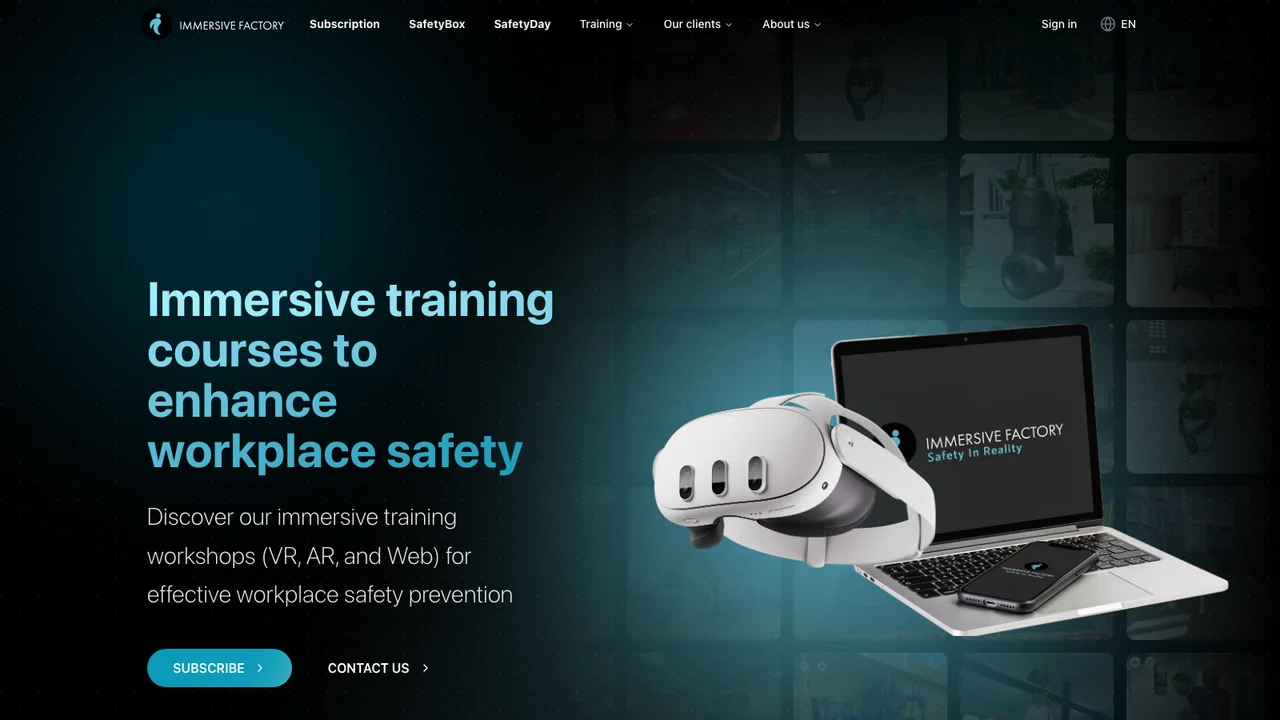
Immersive Factory sells subscription-based immersive training in VR, AR and web formats, built specifically around workplace safety prevention rather than equipment operation. Its offering includes personalised support, employee training on equipment and custom content creation alongside the catalog.
Its client list is the most relevant in this group for European process industry and includes Vallourec, which manufactures tubular products for oil and gas, alongside Orano in nuclear fuel, EDF, SUEZ, Veolia, Saint-Gobain, Imerys, Spie, Colas, FM Logistique, DS Smith, Givaudan, Coca-Cola and Merck. That set covers energy, utilities, heavy manufacturing and construction, which is the population most oil and gas safety training actually has to reach once contractors are counted.
Device support is published across HTC Vive Focus 3, Meta Quest 3 and Pico Neo 4 Ultra headsets, plus PC, Mac, tablet and mobile, with LMS and SCORM compatibility for web-delivered courses. The SCORM point is the operationally important one: if completion has to be evidenced against a competency framework, the records need to reach the system the operator already uses, and retrofitting that later is expensive.
The subscription model suits the contractor volume problem directly. Where a turnaround brings a large temporary workforce on site for a few weeks, per-seat catalog access scales in a way a commissioned build does not. A headquarters address, founding year and module count are not published on the pages reviewed. Best for site-wide and contractor safety training at volume, especially across European operations.
What oil and gas training has to account for
Four constraints separate this sector from general industrial training, and each changes what a good vendor answer looks like.
Process safety and occupational safety are different disciplines with different failure modes. Occupational safety covers slips, lifting and personal protective equipment, and is what most generic catalogs teach well. Process safety covers loss of containment, and its incidents are rare, catastrophic and driven by sequences rather than single acts. A simulation that teaches hazard spotting is not teaching process safety, and conflating the two in a business case is a common error.
Competency assurance is the second. Oil and gas operators typically run formal competency schemes, and training that cannot produce an auditable record against a named competency has limited value regardless of quality. Establish early how completion reaches your assurance system. Immersive Factory publishes SCORM and LMS compatibility; for the others it is a scoping question.
Access windows are the third. Plant is available for training when it is shut down, which is exactly when everyone is busiest, and offshore or remote crews work on rotation. That is the structural argument for simulation over on-plant instruction, and it also means the deployment model matters: content that only runs in a training room at head office will not reach a rotating offshore crew.
Fourth is the contractor population. A significant share of the people who need hazard and induction training do not work for the operator, may be on site for days, and will work for a different contractor next month. That argues for short, catalog-based, device-flexible content rather than bespoke builds, and it is usually the largest single training volume on any site.
How to choose between these oil and gas VR companies
Start by separating the three problems, because no single vendor here is strongest at all of them. For equipment operation with physical controls, Tecknotrove manufactures the simulator. For equipment or process simulation built to a manufacturer's standard, ForgeFX has the deepest published heavy-equipment client list. For plant-specific procedures on your own unit, Treeview builds to specification and hands over the source. For contractor and site-wide safety at volume, Immersive Factory's subscription catalog is designed for it. For breadth authored by your own team, EON Reality is the platform.
Then test sector evidence rather than industry lists. Several companies here list Oil and Gas among their industries; fewer name a client in it. Immersive Factory names Vallourec, Orano and EDF. ForgeFX names equipment manufacturers whose machines are used across the sector. Ask each vendor for one reference in your own operating environment, since onshore process work and offshore drilling are different worlds.
Settle the record-keeping question before the content question. If training has to satisfy a competency scheme, integration is not a detail to resolve after the pilot. Ask what standard the completion record is written in and which system it lands in.
Finally, price the revision. Procedures change at every turnaround, and a simulation that cannot be updated cheaply becomes a liability the moment it teaches something the plant no longer does. Ask what a procedure change costs in year two, and who is permitted to make it.
Related reading. BestInXR's energy and utilities guide covers process against occupational, and why programs stall. XR development companies for energy and utilities covers the wider sector, and companies for VR hazardous environment and safety training goes deeper on the safety case. For plant familiarization see VR companies for virtual site tours of energy facilities, and for procurement, selecting XR developers for enterprise deployment.
Frequently Asked Questions (FAQ)
1. What does VR training actually replace in oil and gas?
Most often it replaces instruction that cannot be delivered on live plant, either because the equipment is in service, because the scenario is dangerous by definition, or because the workforce is on rotation and cannot be assembled. It rarely replaces on-the-job supervision, and business cases claiming it does tend not to survive contact with an operations manager.
2. Do you need a physical simulator or is a headset enough?
It depends on whether the control set is part of the competency. For an excavator, a crane or a directional drill, physical controls teach something a headset cannot, which is where Tecknotrove's manufactured simulators fit. For procedure, layout familiarization, hazard recognition and emergency rehearsal, a headset is cheaper, portable and far easier to update.
3. Which of these companies name oil and gas clients?
Immersive Factory names Vallourec, which manufactures tubular products for the sector, alongside Orano, EDF and SUEZ. ForgeFX names heavy equipment manufacturers including Komatsu, Caterpillar, Vermeer, JLG and Joy Global. Tecknotrove lists Oil and Gas among its industries. Treeview publishes a green hydrogen digital twin. EON Reality lists Energy but names no sector client.
4. How is completion evidenced against a competency scheme?
Through integration with the operator's learning or competency system. Immersive Factory publishes LMS and SCORM compatibility for its web training. The other four do not publish integration detail, so how a result reaches your assurance system is a question to settle in the specification rather than after the pilot.
5. Can this training reach contractors and short-term workers?
That is where catalog and subscription models fit best, since the population is large, temporary and turns over constantly. A commissioned build priced per project is poorly suited to it. Device flexibility matters here too, because issuing headsets to a contractor workforce for a two-week turnaround is rarely practical.
6. How much does oil and gas VR training cost?
None of the five publishes rates, so no figure is recorded here. Costs are driven by whether content is licensed or built, whether physical simulator hardware is involved, how many procedures are in scope, and how results integrate with existing systems. Hardware and revision are the two lines most often missing from a first budget.