AR product visualization puts a product in front of someone at real scale, on their own device, before they own it. The work that decides whether it succeeds happens upstream of the AR: where the 3D comes from, and whether producing it scales past a demo of twelve products. This list ranks five on exactly that.
In short:
- Treeview builds custom XR to specification, publishes medical device visualization work, and transfers full ownership of IP, source code and assets
- Emersya publishes AR Product Visualization as a named product line alongside 3D configuration, viewers and 3D product photography
- Kaon Interactive is built for complex B2B products, with 3D Product Tours, Demo360 and both B2B augmented and virtual reality
- VNTANA attacks the upstream problem directly, converting and optimizing the CAD an organization already owns
How this list was built
This list ranks companies by four criteria: where the 3D assets come from, whether asset production scales, where the visualization is delivered, and what evidence each publishes.
Everyone selling in this category demonstrates the same thing: a product appearing convincingly in a room through a phone. That part is close to solved and it is not where projects fail. They fail on the catalog. A retailer with eight thousand SKUs, or a manufacturer with configurable products in thousands of variants, cannot hand-model its way to coverage, and a pilot covering twelve hero products proves nothing about the ninth thousand.
So the question that separates these suppliers is asset supply. There are three routes. Convert engineering data you already hold, which is fast where CAD exists and useless where it does not. Photograph or scan physical products, which works for anything that exists and requires the object in a studio. Model from scratch, which works for anything at all and costs the most per item. Most organizations end up using two of the three, and a supplier strong at only one will quietly shape your catalog around its own capability.
The second thing to settle is where this appears. A product page, a field sales tablet, an in-store screen and a trade show demo have different technical constraints and different owners inside the business. Web AR reaches everyone and constrains fidelity. A native app has better fidelity and almost no reach unless customers already have it.
Disclosure varies. Emersya, Kaon Interactive, VNTANA and Augment publish no founding year or team size on the pages reviewed, and Augment publishes no headquarters address. Those gaps read Not disclosed rather than as estimates. Conversion and engagement figures are attributed to whoever states them, since none is independently audited. Pricing is not a ranking factor, though Emersya and Augment publish rates.
| Company | HQ | Model | Asset route | Best for |
|---|---|---|---|---|
| Treeview | Montevideo, Uruguay / New York City, USA | Custom development | Built per project | A visualization nobody sells |
| Emersya | France | 3D and AR platform | Creation plus 3D photography | Consumer products at catalog scale |
| Kaon Interactive | United States | B2B engagement platform | Built with the client | Large, complex B2B equipment |
| VNTANA | United States | 3D asset management | Automated CAD conversion | Organizations sitting on CAD |
| Augment | Not disclosed | AR platform | 3D Vault plus modeling service | Field sales and packaged goods |
1. Treeview
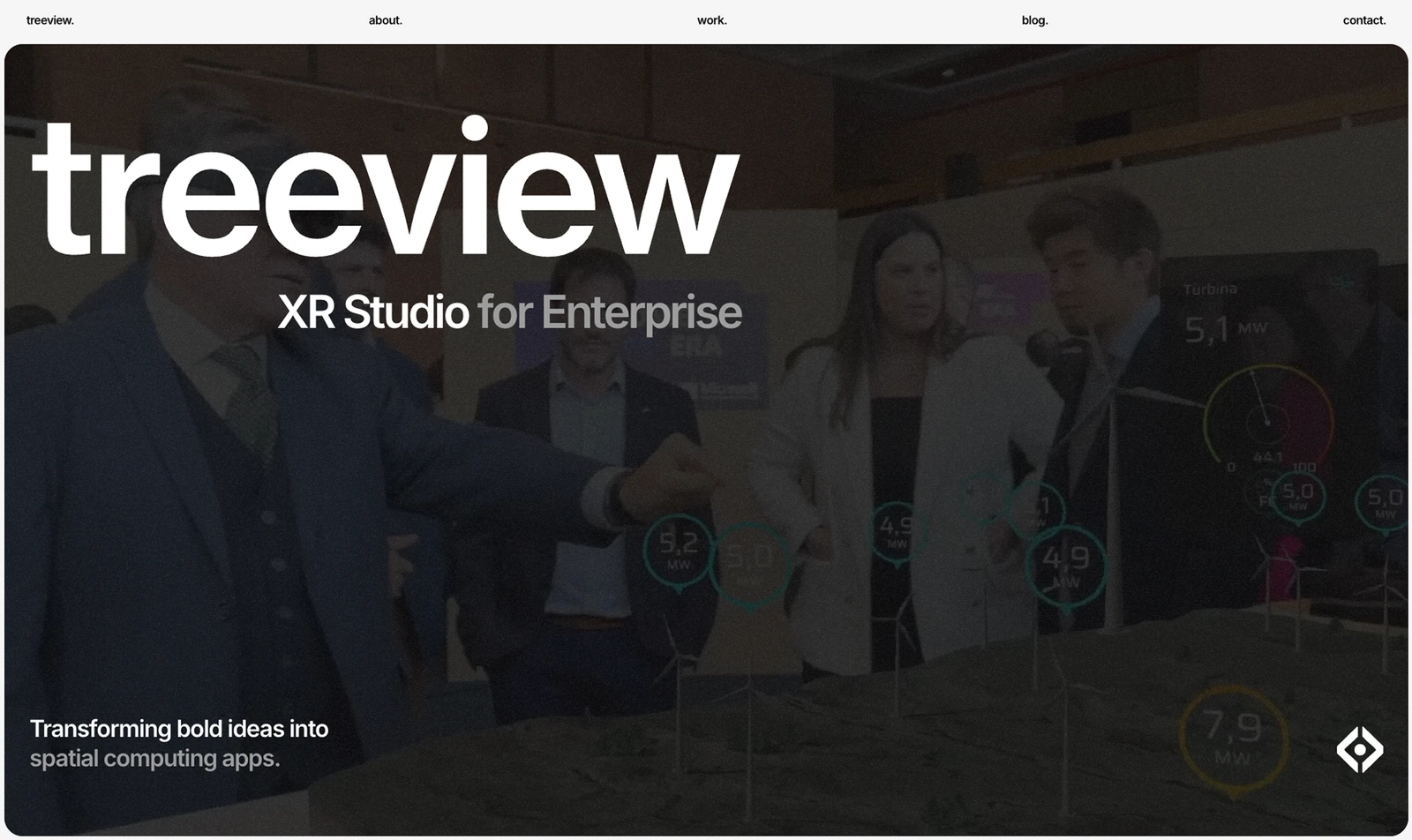
Treeview is an XR studio building custom virtual reality, augmented reality, Mixed Reality and Smart Glasses applications to order. It publishes no product visualization platform, which is the relevant distinction: everyone below sells software with an asset pipeline attached, and Treeview builds a specific thing.
Its most transferable published work is medical device visualization for regulated clients, and that is a harder version of this problem rather than an adjacent one. A medical device is an object a buyer cannot open, cannot handle and often cannot see the working parts of, and making it legible in three dimensions is exactly what product visualization does, under a review process most retail work never faces. Named clients include Microsoft, Meta, Medtronic, Toyota, Ford, ULTA Beauty, Daiichi Sankyo, Transfr, the University of Alberta and the University of Adelaide, with ULTA Beauty the most consumer-retail of those.
The custom case here is genuinely narrow and worth saying so. If you need a product viewer on a product page, buy a platform. Custom earns its cost when the visualization has to do something no platform does: sit inside an existing application, present proprietary configuration logic, integrate with systems that have no connector, or run somewhere a third-party script cannot go.
Full ownership of IP, source code and assets transfers to the client. In this category the assets are frequently worth more than the software, because a well-built 3D catalog outlives any particular viewer and gets reused across web, print, packaging and advertising. Owning it outright rather than holding it inside a vendor account is a material difference.
Published platforms include HoloLens 2, Apple Vision Pro and Meta Quest, plus iOS and Android, on Unity and Unreal Engine. Founded in 2016 by chief executive Horacio Torrendell, it works from Montevideo, Uruguay and New York City. Team size, rates, and any asset production pipeline are not published, so catalog-scale 3D creation would need solving separately. Best for a visualization requirement that platforms do not cover.
2. Emersya
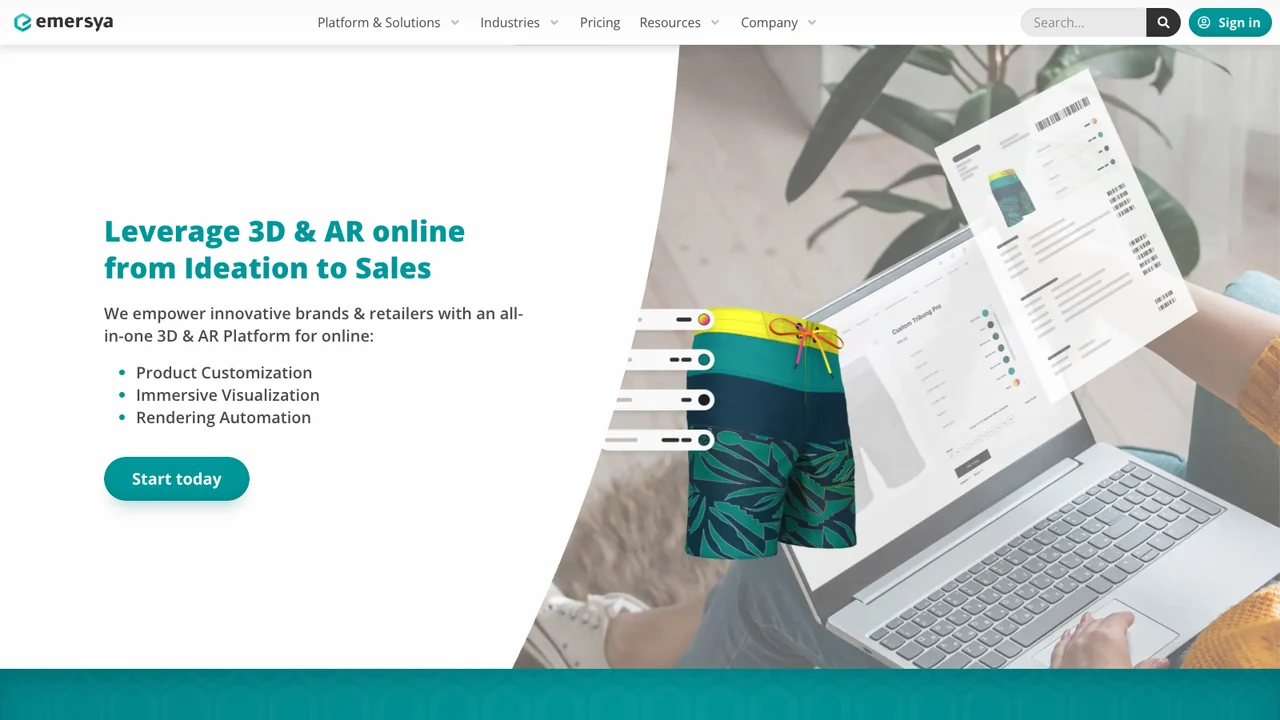
Emersya publishes a 3D and AR platform whose product line maps unusually cleanly onto the problem: 3D Product Platform, 3D Product Configurator, 3D Product Viewers, AR Product Visualization, Digital Product Creation and 3D Product Photography.
The last two are what make it credible at scale, and they are the entries most buyers skim past. Digital Product Creation and 3D Product Photography mean the company addresses asset supply, not only asset display. A platform that shows your 3D models is only useful once you have 3D models, and the gap between a pilot and a catalog is almost entirely production capacity. Publishing both the tooling and the creation service is a more complete answer than either alone.
3D Product Photography deserves particular note. Once a product exists as a 3D asset, rendering marketing imagery from it replaces conventional photography for catalog and variant shots, and that displaces a real, recurring cost. For businesses with heavy variant counts, that saving frequently funds the 3D program by itself, which changes the business case from a conversion bet into a cost substitution.
Its stated industries are Fashion, Furniture, Sports Equipment, Luxury and Electronics, which is consumer goods with visual and material variation, exactly where 3D pays. It publishes pricing, case studies, testimonies, documentation, embedding guidance and an API, and that documentation depth signals a product intended for customer self-service rather than agency-only delivery.
It publishes no founding year or team size on the pages reviewed, and its focus is consumer product rather than heavy industrial equipment. Best for consumer brands taking a real catalog to 3D, especially where photography costs are already high.
3. Kaon Interactive

Kaon Interactive builds digital customer engagement for B2B, and it is the entry here aimed at a completely different buyer from the rest. Its published framing is that today's buyers complete 83 percent of their problem-solving journey independently, and the question it poses is how to tell a complex product story when your team is not in the room.
That framing identifies its actual market. Kaon's products are for equipment that is large, expensive, technically complicated and frequently impossible to bring to a customer. Its published solutions are Storytelling, 3D Product Tours, Demo360, Fast Launch, Kaon Lab and a Design Tool, with Kaon v-Draw, B2B Augmented Reality and B2B Virtual Reality alongside a content experience platform with integrations and collaboration tools.
Its stated industries are Life Science, Information Technology and Industrial Manufacturing, and its buyer roles are Marketing Leaders, Sales Enablement and C-Suite and Revenue Leaders. Read together, this is a sales enablement company that happens to use 3D, rather than a visualization company that happens to sell to B2B. That is a meaningful distinction: the measure of success is pipeline and deal progression, not conversion rate on a product page.
Placing a full-scale MRI scanner, semiconductor tool or industrial machine in a customer's actual room through AR solves a concrete problem that consumer AR does not have. The alternative is a trade show, a flight, or a brochure, and all three are worse.
It publishes no founding year, team size, rates or ownership terms on the pages reviewed, and its model is engagement-led rather than self-service, so a small catalog operation will find it heavier than needed. Best for complex, high-value B2B equipment where the product cannot travel.
4. VNTANA
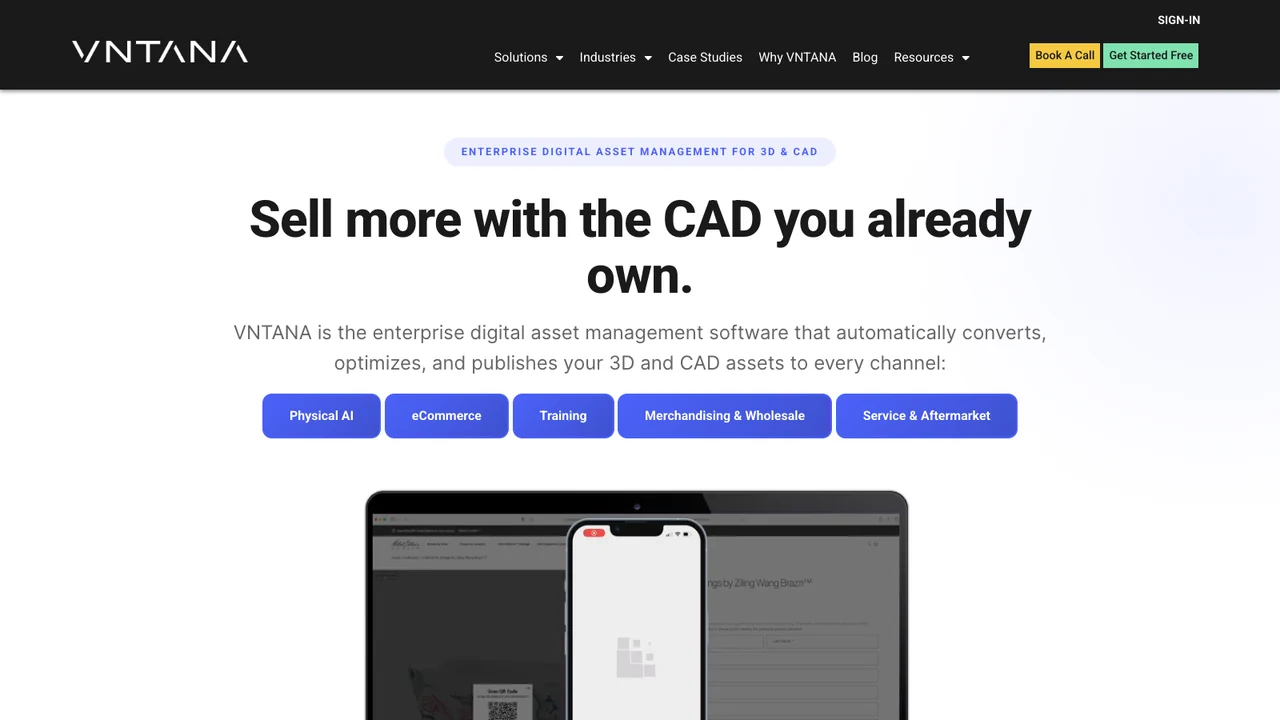
VNTANA publishes enterprise digital asset management for 3D and CAD, and it is the only company here whose pitch is entirely about the upstream problem this category actually fails on.
Its published framing names it precisely as the 3D bottleneck: 3D and CAD files live in engineering and design tools, every other team has to ask for them, wait for them and often never receives them in a usable format, and every channel update requires an engineer to manually intervene. Anyone who has tried to take a manufacturer's catalog to 3D will recognize that as the real obstacle rather than a marketing construct.
Its answer is automation: software that automatically converts, optimizes and publishes 3D and CAD assets to every channel, with published destinations covering Physical AI, eCommerce, Training, Merchandising and Wholesale, and Service and Aftermarket. Optimization is the technically hard part and the one most often underestimated. Engineering CAD carries precision and detail that no browser can render in real time, and reducing it to a web-ready asset without wrecking its appearance is a specialist operation that, done by hand, costs more per model than most catalogs can absorb.
Its stated positioning, selling more with the CAD you already own, is the sharpest articulation of the strongest case in this whole category. An organization that has spent decades producing engineering models is sitting on the asset supply that everyone else has to create from nothing, and unlocking it is cheaper than any modeling program.
The obvious limit is that it presupposes CAD. A fashion or homeware brand with photographs and no engineering models gets nothing from this route and should look at Emersya's creation services instead. It publishes no founding year, team size or ownership terms on the pages reviewed. Best for manufacturers whose 3D is trapped in engineering.
5. Augment
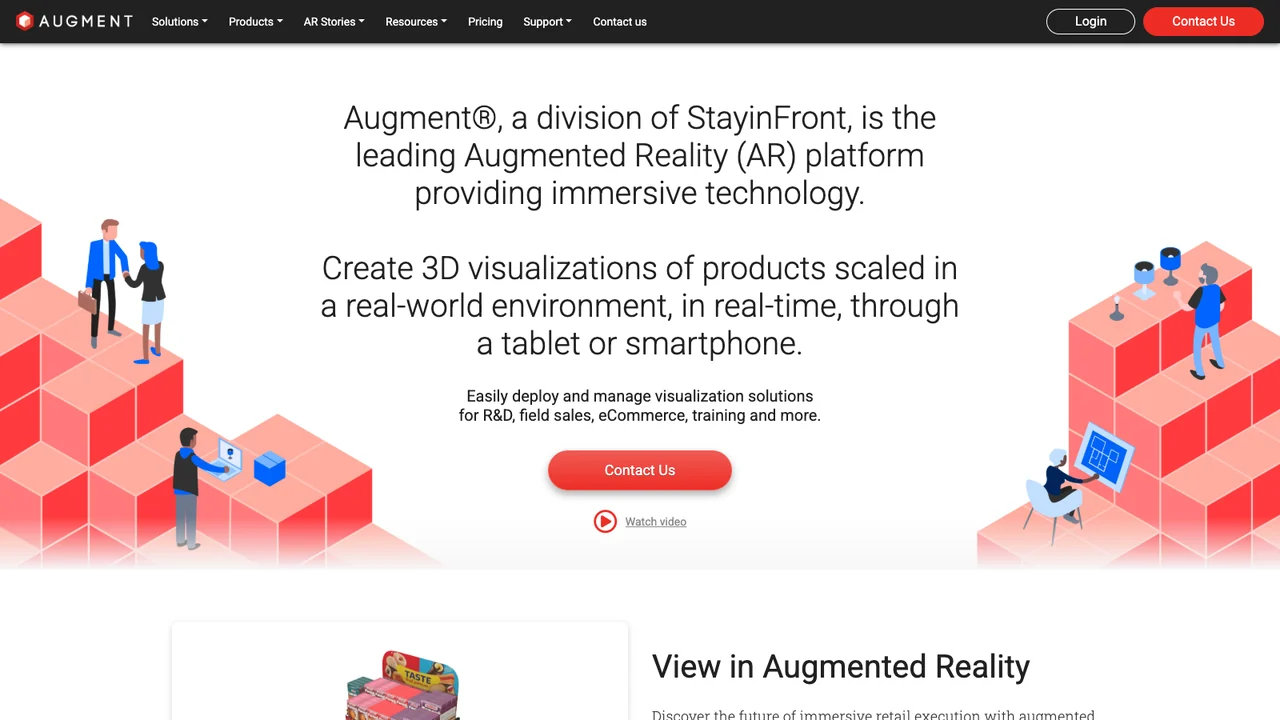
Augment publishes a 3D and augmented reality product visualization platform and states that it is a division of StayinFront, describing itself as a leading AR platform providing immersive technology. Its published purpose is creating 3D visualizations of products scaled in a real-world environment in real time through a tablet or smartphone.
Its parent's field is the context that explains the product. StayinFront works in field sales and retail execution, and Augment's published solutions are eCommerce and Field Sales, with an AR Stories case study on increasing in-store sales through augmented reality for consumer packaged goods. Field sales is an underserved use of this technology and a genuinely strong one: a representative visiting a retail buyer can place a display unit, cooler or shelf configuration at full scale in the actual aisle, which resolves the space objection that otherwise ends the conversation.
Its published products are AR Viewer, 3D Viewer, 3D Vault for uploading, storing and managing 3D models, Teams for managing user access, and Places for capturing AR simulations. The 3D Vault and Teams pairing indicates it treats models as managed corporate assets with access control rather than as loose files, which matters once several departments use the same catalog.
It also publishes a 3D Designers service creating quality 3D models for its customers, which addresses asset supply directly, and developer integration documentation for embedding the experience. Publishing pricing is helpful in a market where most competitors do not.
It publishes no founding year, headquarters address, team size or ownership terms on the pages reviewed, and its consumer packaged goods and field sales emphasis makes it a narrower fit for high-variant configurable products. It ranks fifth on published breadth rather than capability. Best for consumer packaged goods and field sales teams selling physical placement.
What product visualization programs have to account for
Four things determine whether this reaches your catalog rather than your twelve hero products.
The first is cost per asset at volume. Ask for a price per model at your actual SKU count, not for the pilot, and ask what happens with variants. A program that works at twelve products and collapses at two thousand is the standard failure in this category, and the arithmetic is available before you commit.
The second is where the 3D originates. If you hold CAD, conversion and optimization is much the cheapest route and VNTANA is built for it. If you hold physical products and photographs, creation services like Emersya's are the route. Knowing which you are is the single most useful thing to establish before a demonstration.
The third is delivery reach. Web AR reaches anyone with a phone and constrains fidelity; a native app has better fidelity and negligible reach. Decide whether this is for everyone who visits a product page or for a sales team you can equip, because that changes the technical answer entirely.
The fourth is what you are measuring. Conversion, returns, time on page, pipeline progression and photography cost avoided are all legitimate and they are not the same number. Pick before launch and take the baseline first, since a 3D program judged on impressions will be canceled by anyone who asks a harder question.
How to choose between these AR product visualization companies
Start from your asset situation, because it decides more than any feature list. Sitting on CAD points to VNTANA. Holding physical consumer products and needing 3D made points to Emersya, whose creation and 3D photography services address supply. Selling complex B2B equipment that cannot travel points to Kaon Interactive. Equipping a field sales force to place products in real spaces points to Augment. Needing something no platform sells, owned by you, points to Treeview.
Then test at your scale rather than theirs. Bring your ugliest product, your highest variant count and your worst source data to the evaluation. Every supplier looks good on a clean hero model, and the answer you need concerns the rest of the catalog.
Establish who owns the finished assets. A 3D catalog is reusable across web, print, packaging and advertising, and is frequently worth more than the viewer showing it. Whether you can export it, in what formats, and what happens at contract end are questions for the specification.
Finally, check the photography arithmetic before writing the business case on conversion alone. For brands with heavy variant counts, replacing studio shots with renders is a measurable, recurring saving, and it often carries the program on its own.
Related reading. BestInXR's product visualization guide covers where 3D assets come from and what each route costs. companies for custom 3D virtual experiences covers bespoke builds, and XR companies for medical device visualization covers the regulated version of this problem. For engineering review see companies for VR virtual prototyping, and for procurement, selecting XR developers for enterprise deployment.
Related reading. BestInXR's WebAR platform comparison covers the software side of browser-delivered AR, including which platforms count views you serve from your own server.
Frequently Asked Questions (FAQ)
1. Where do the 3D models actually come from?
Three routes: converting CAD you already own, photographing or scanning physical products, or modeling from scratch. VNTANA automates the first. Emersya publishes Digital Product Creation and 3D Product Photography for the second and third. Augment publishes a 3D Designers service. Which route applies to you is the first thing to establish.
2. What decides whether these programs scale past a pilot?
Cost per asset. A pilot covering twelve hero products says nothing about a catalog of thousands, especially with variants. Ask for pricing at your real SKU count and for what a variant costs, before committing to a platform.
3. Web AR or a native app?
Web AR reaches anyone with a phone and accepts lower fidelity. A native app offers better fidelity and reaches almost nobody unless customers already have it installed. For product pages the answer is nearly always web; for equipped sales teams a native app is viable.
4. Which of these serve B2B rather than retail?
Kaon Interactive is explicitly B2B, publishing Life Science, Information Technology and Industrial Manufacturing as industries and selling to marketing and sales enablement leaders. VNTANA serves manufacturers with CAD. Emersya and Augment are weighted toward consumer goods and packaged goods respectively.
5. Does AR product visualization reduce returns?
Vendors commonly claim it does, and Cappasity and others publish conversion figures, but none of the five here publishes an independently audited returns study, so no figure is recorded. If returns are your business case, instrument it yourself with a baseline before launch rather than accepting a vendor benchmark.
6. What does AR product visualization cost?
Emersya and Augment publish pricing; the others do not, so no comparable figure is recorded here. Cost is driven by catalog size, variant count, whether assets are converted or created, delivery channels, and whether anything is custom built. Asset production at full catalog scale is the line most often missing from a first budget.