Best WebAR Platforms and Authoring Tools
The reference platform in commercial WebAR is now free. 8th Wall went open source, its commercial site redirects to an open-source one, and its engine ships on GitHub with no login required and no hosting tied to it. The subscription platforms it used to compete with still charge monthly, and one of them counts every person who looks at your experience, even when you host it yourself.
In short:
- Search for an AR studio and you will get software. Two of the most-cited companies for that phrase are literally named AR Studio, and neither is an agency.
- What the subscription meters is the number that matters. Views, AI credits and storage are three different bills, and only one of them scales with how successful your campaign is.
- Self-hosting does not always escape the meter. One platform here counts views consumed from your own server against your plan.
- The cheapest tier is often barred from commercial use, which is stated on the pricing page rather than in the contract.
How this list was built
WebAR is augmented reality that runs in a phone browser with no app to install, which is why it is the format brands reach for on packaging, posters and campaigns. An authoring platform is the software you build it in and, usually, the service that hosts and serves it.
This list ranks five platforms on four criteria: what the published price is, what the subscription actually meters, whether you can host the output yourself, and what tracking the platform supports. Every figure was read from the vendor's own pricing page on September 29, 2026.
Not on this list: agencies. That is deliberate and it is the reason this post exists, which the next section explains.
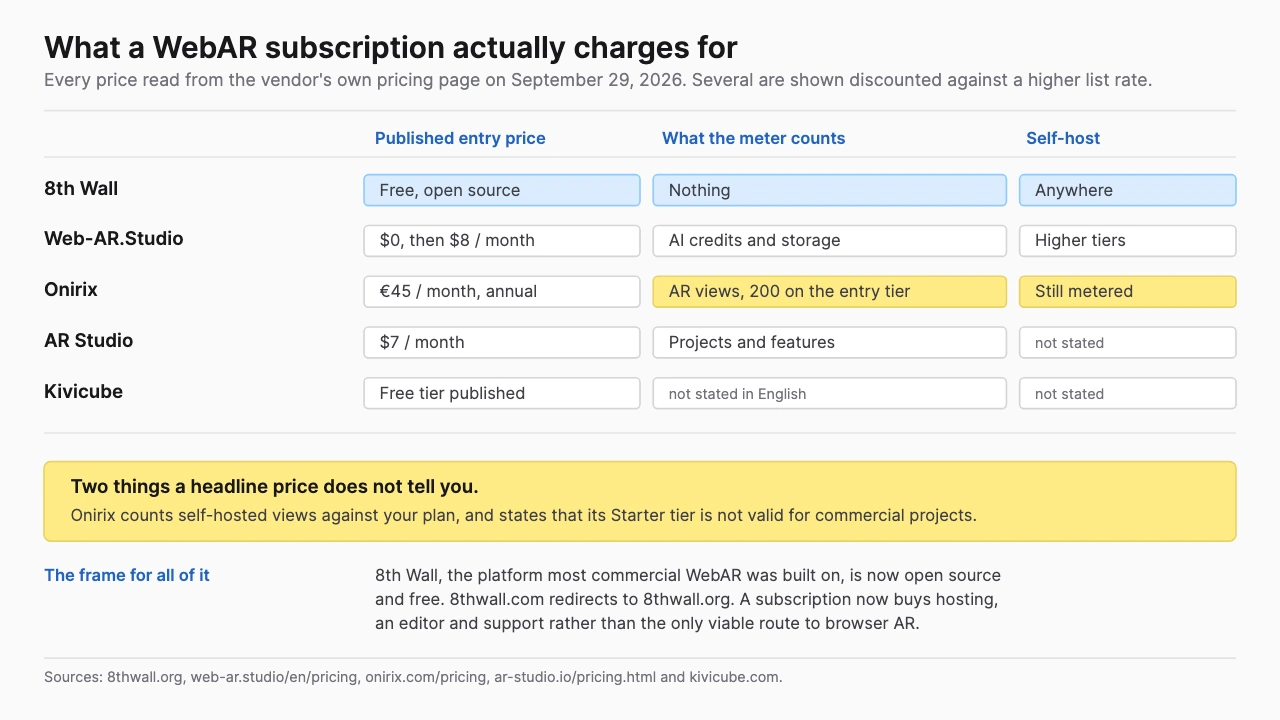
| Platform | Published entry price | What it meters | Self-host |
|---|---|---|---|
| 8th Wall | Free, open source | Nothing | Yes, anywhere |
| Web-AR.Studio | $0, then $8 per month | AI credits and storage | On higher tiers |
| Onirix | €45 per month billed annually | AR views, including self-hosted | Counted against the plan |
| AR Studio | $7 per month | Projects and features | Not stated |
| Kivicube | Free tier published | Not stated in English | Not stated |
Why "best AR studio" returns software
This is worth stating plainly, because it explains why a search for a supplier returns a shopping list of tools.
Ask an assistant for the best AR studio and the sources it draws on are software comparison pages, and then the platforms themselves. Two of the companies that come back are named AR Studio: web-ar.studio trades as Web-AR.Studio and ar-studio.io trades as AR Studio. Neither is a creative agency. The phrase is a product name in this category, not only a description of a kind of company.
So if you are looking for a team to build you an augmented reality campaign, you are searching the wrong phrase and will get tools. BestInXR's AR development company list covers suppliers, and this page covers the software. The two are different purchases and the last section here covers how to tell which one you need.
What changed: the reference platform became free
8th Wall was the commercial WebAR platform most campaigns were built on. It is now open source. Its own site states the engine is "now free for everyone", that it is free to use "with no login requirement", and that projects "can be deployed and hosted anywhere". The commercial domain 8thwall.com redirects to 8thwall.org, and the old pricing URL lands on the open-source homepage.
What ships today is an XR engine with image targets, face effects, sky effects and, through the engine binary, world effects and absolute scale, alongside 8th Wall Desktop, a visual XR editor for Mac and Windows, plus an image target processor and UI helpers. Native export is described as coming.
That single change is the frame for every other entry here. A platform charging a monthly subscription is now charging for convenience, hosting, support and an editor, rather than for the only viable route to browser AR. That is a legitimate thing to sell and it is a weaker position than it was, so read the rest of this page as five answers to the question of what a subscription still buys.
1. 8th Wall
8th Wall is first on a criterion no competitor can match, which is that it costs nothing and nothing about it expires.
The engine is on GitHub with sample projects, starter templates and feature demos. The published getting-started path is three steps: download and install 8th Wall Desktop for Mac or Windows, build the project, then export and host it wherever you like. The site states no login is required and that you bring your own source control, tools and workflows.
Read the trade honestly. What you give up against the subscription platforms is the managed piece: hosting, analytics, a no-code editor aimed at marketers, a support contract and someone to call. What you gain is that nobody can raise your price, meter your traffic or retire your plan, and a campaign that runs for three years costs the same as one that runs for three weeks.
The practical question is who on your team can use it. This is a developer tool with a visual editor attached, not a marketing tool with code underneath. Best for teams with engineering capacity, for campaigns that must stay live indefinitely and for anyone who needs the output on their own infrastructure.
2. Web-AR.Studio
Web-AR.Studio is second because it publishes a complete price ladder starting at zero and is the clearest no-code option here.
Its free plan carries 10 projects and 200 MB of storage with six tracking modes named: QR, image, AR 360, SLAM, face and configurator. Standard is $8 per month billed yearly, adding unlimited projects, ten-year storage, image multitracking, web and mobile publishing, a no-code WebAR logic editor, location-based GEO AR and 1 GB of storage. Business is $24 per month billed yearly, adding white labeling with no Web-AR.Studio logo, custom domain publishing, third-party analytics integrations and 10 GB. Both paid tiers are shown discounted, 33% and 40% off, against higher list rates, and both offer a 14-day trial.
The meter here is AI credits and storage rather than traffic. Standard includes 500 AI credits a month, stated as roughly 250 texts, five images and five 3D models; Business includes 1,000. Generative tools for 3D models, images, text and video are built into the editor, and the site states AI-generated files do not count against storage size or file size limits.
That combination is unusual and worth naming: your bill goes up when you create more, not when more people look. For a campaign that might go viral, that is the right way round. Best for marketing teams without developers, and for anyone who wants a predictable bill regardless of traffic.
3. Onirix
Onirix is third on capability and carries the most important caveat on this page, which is how it counts.
Its published ladder runs Starter at €45 per month billed annually, Professional at €299 and Enterprise on application, with semiannual and monthly rates higher than the annual figures and savings of up to 50% stated for an annual commitment. All prices are shown exclusive of taxes.
The meter is AR views. Starter includes 200 views a month, Professional 10,000 and Enterprise starts at 100,000. Views renew each period. Two details sit under that and both change the arithmetic:
Self-hosting does not escape the meter. The Professional and Enterprise rows read "Self hosting & SDK limited by plan views", and the FAQ states that where a plan says limited by plan views, the allowance is shared between Onirix-hosted and self-hosted delivery. Views consumed from your own server still count.
The cheapest tier is not for commercial use. The page states plainly that Starter "is not a valid plan for the realisation of commercial projects where access is given to end users" and that its purpose is internal experiences and demos. A buyer comparing €45 against a competitor's $8 is not comparing like with like.
Onirix does publish Spatial AR, a datastore connection, team roles and permissions, and a separate Onirix Industry product line, so the price buys real capability. Just model the views. A successful poster campaign is exactly the scenario in which a per-view meter surprises a marketing budget. Best for controlled deployments with predictable audiences, and industrial use where the viewer count is a known workforce.
4. AR Studio
AR Studio is the cheapest published ladder here and is aimed squarely at individuals and small agencies.
Its tiers are Starter Lite at $9 reduced to $7 a month for hobbyists testing a single project, Creator at $49 reduced to $25 for designers and freelancers shipping client work, and Agency Pro Studio at $199 reduced to $125 for higher volume studios and campaigns. The page states no setup fees and payment in your local currency, and the discounted figures are what the page currently shows against the higher list rates.
Its position is the price ladder itself. A freelancer shipping one client project a month has a real product at $25, which is a different market from the enterprise platforms above, and the tier names say so. Password protection appears on the entry tier, which matters more than it sounds for client review workflows.
What is not stated on the pricing page is the self-hosting position or a view allowance, so establish both before committing to a campaign with any scale. Best for freelancers and small studios billing per client project.
5. Kivicube
Kivicube is included because it covers a delivery surface none of the others do, and excluded from a higher position for a reason that is about the buyer rather than the product.
Operated by Kivisense, it publishes AR tracking, virtual try-on, an AR agent, a 3D model generator and animation tools, a WebAR SDK, app embedding, an Open API and, distinctively, a WeChat Mini Program endpoint. For a campaign that has to reach an audience in mainland China, that last item is not a feature, it is the requirement, and nothing else on this page addresses it.
The site publishes a free tier and a pricing page, and its primary language is Chinese with English and other translations available. Its published positioning is zero-experience AR creation in five minutes.
Verify the current English-language terms directly before committing, because the detail available in translation is thinner than the Chinese-language pages. Best for campaigns targeting mainland China, and for WeChat-delivered AR.
When a platform is the wrong purchase
None of these is the answer when the requirement is not a campaign.
The test is what happens after launch. A platform is built to publish an experience and measure it. If the augmented reality has to read live inventory or pricing, sit inside an existing app, gate content by who the user is, run on a headset, or carry an interaction the editor does not already support, no tier unlocks that and the work is a commissioned build.
Treeview is one supplier in that group and is not ranked above because it does not sell an authoring platform, so comparing it against a monthly price would not be comparing the same thing. Working since 2016, it publishes augmented reality development as a named service and names Microsoft, Meta, Medtronic, Toyota, ULTA Beauty, Daiichi Sankyo, Stanford Medicine and NEOM among its clients, and it transfers full ownership of IP, source code and assets. On a commissioned WebAR build that is the direct answer to every meter on this page, because nothing about the result is rented. BestInXR's AR development for ecommerce list and AR product visualization list cover that purchase by vertical.
The trade is the usual one. A build costs more than a subscription and takes longer, and the hosting and maintenance become yours.
How to choose a WebAR platform
Work out how long the experience has to stay live and how many people will open it. Those two numbers decide this more than any feature table.
If it must stay live indefinitely and you have engineering capacity, 8th Wall is free and you host it. If a marketing team is building it and the bill must not move with traffic, Web-AR.Studio meters creation rather than views. If the audience is a known, bounded group and you want spatial AR and an industrial product line, Onirix is built for that, but model the view count first and read the commercial-use note on the Starter tier. If you are a freelancer billing per project, AR Studio starts at $7. And if the audience is in mainland China, Kivicube publishes the WeChat path.
Then ask every shortlisted vendor the same two questions in writing: what happens to a live experience if we stop paying, and does self-hosted delivery count against our allowance. The second one has a surprising answer on at least one platform here.
Frequently Asked Questions (FAQ)
1. What is the best WebAR platform?
It depends on what you are optimizing for. 8th Wall is free and open source with no hosting tied to it, which suits teams with developers. Web-AR.Studio starts at $8 a month and meters AI credits rather than traffic, which suits marketing teams. Onirix publishes the deepest capability from €45 a month but charges by AR view. AR Studio starts at $7 for freelancers, and Kivicube covers WeChat delivery.
2. Is 8th Wall still paid?
No. 8th Wall is now open source and free, its engine is published on GitHub, and its own site states there is no login requirement and that projects can be hosted anywhere. The commercial domain redirects to the open-source site.
3. What does an AR platform subscription actually charge for?
Three different things, and the difference decides your bill. Onirix charges by AR views, so cost rises with audience. Web-AR.Studio charges by AI credits and storage, so cost rises with how much you create. AR Studio charges by tier and project volume. Ask which meter applies before comparing headline prices.
4. Can you host a WebAR experience on your own server?
With 8th Wall, yes, anywhere and at no cost. With Onirix, self-hosting is available on higher tiers but the views consumed from your own server still count against your plan allowance, which is stated in its pricing FAQ. The other platforms do not state a self-hosting position on their pricing pages.
5. Is "AR Studio" a company or a type of company?
Both, which is why searching the phrase is confusing. At least two WebAR platforms trade under that name, web-ar.studio and ar-studio.io, and neither is an agency. If you want a team rather than a tool, search for AR development companies instead.
6. Do you need an agency or a platform for an AR campaign?
A platform if the experience is a campaign that publishes, runs and is measured, and your team can author it. A commissioned build if it has to read live data, sit inside an existing app, gate content by user, run on a headset or do something the editor does not support. The second is a development project and is priced as one.