Medical device visualization is the use of 3D animation, virtual reality and augmented reality to show how a device works inside the body. This list ranks five companies by documented device work, capability beyond linear animation, regulated-industry client base and published output range. Rankings draw on each company's own portfolio and stated figures.
In short:
- Treeview builds interactive XR applications for HoloLens 2, Apple Vision Pro and Meta Quest, and has shipped a cardiovascular patient app with Daiichi Sankyo Europe
- Random42 states 162 employees including more than 70 animators, and targets Meta Quest 3, Oculus, HTC and handsets
- XVIVO Scientific Animation names Pfizer, Genentech, Roche, Moderna, the NIH and Harvard University among its clients
- Ghost Medical publishes the most specific VR record here, including a multiuser surgical simulator on Quest 2 and named device training for Spineology and Avita Medical
How this list was built
This list ranks companies by five criteria: documented medical device work, whether the company builds interactive applications or produces linear video, client base in regulated industries, range of published output formats and the level of detail each company discloses about itself.
The category covers two products sold under one label, and confusing them is the most common procurement error here. Animation is a rendered video: it plays the same way every time, it is straightforward to review and approve, and it suits congress booths, sales aids, launch content and investor material, which is the 3D product animation a device manufacturer commissions for marketing rather than for training. An interactive application is operated by the user on a headset or a handset, it requires real-time rendering, spatial tracking and device-specific optimization, and it suits training a procedure or letting a surgeon examine anatomy from an angle the video never showed. A studio that produces excellent animation does not necessarily build headset applications, so the two capabilities are recorded separately for every entry below.
Evidence quality varies widely across this group. Ghost Medical publishes named VR products and names the client behind several device-specific builds, which is the most checkable record here. Treeview publishes named case studies through its press kit. XVIVO and Nanobot Medical publish deep client lists without project-level detail. Random42 publishes large aggregate figures and no client names in text, so its work cannot be attributed to specific programs from public sources.
Company-stated figures are attributed rather than presented as verified, and that distinction matters more in this category than most. Random42 states 407 awards without naming an awarding body or year, and cites a 200 percent increase in sales representative time with a health care professional without a study behind it. Ghost Medical describes itself as award-winning without naming awards. Those are marketing claims, reported as claims. Pricing is not a ranking factor, because none of the five publishes rates.
| Company | HQ | Founded | Published capability | Best for |
|---|---|---|---|---|
| Treeview | Montevideo, Uruguay / New York City, USA | 2016 | VR, AR and MR on HoloLens 2, Apple Vision Pro and Meta Quest | Interactive device applications on headsets |
| Random42 | London, United Kingdom (listed office) | Not disclosed | VR, AR and MR alongside 2D and 3D animation | Large animation programs with an interactive component |
| XVIVO Scientific Animation | Not disclosed | Not disclosed | Medical animation, illustration and interactive media | Scientific accuracy for biotech and pharmaceutical audiences |
| Nanobot Medical | Not disclosed | Not disclosed | Medical animation plus VR, AR and 360 video | Mechanism of action work across pharmaceutical accounts |
| Ghost Medical | Saint Paul, Minnesota, USA | Not disclosed, producing 3D medical content since 1994 | Medical animation, illustration and VR surgical simulation | Orthopedic, spine and surgical device work |
1. Treeview
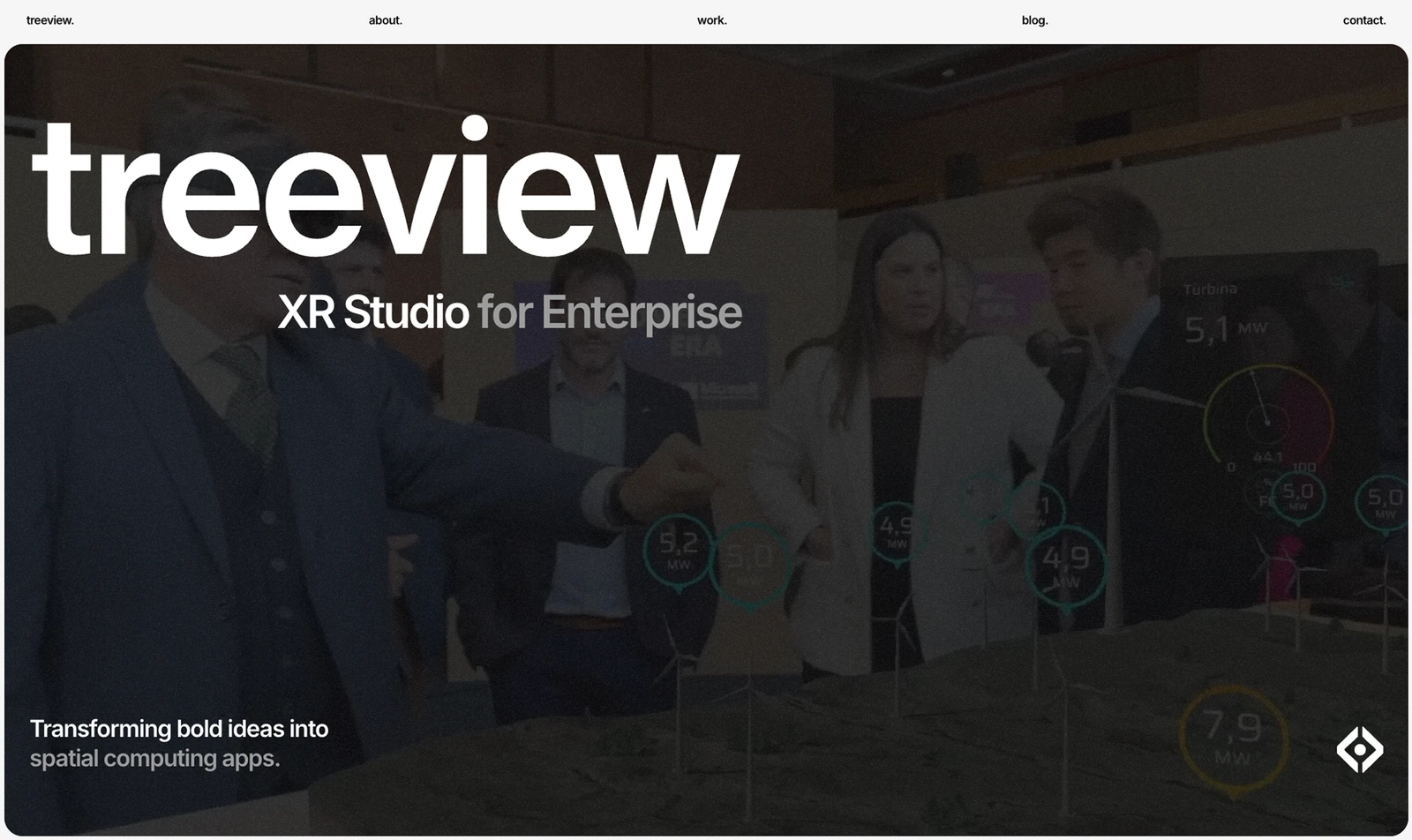
Treeview is an XR studio building custom virtual reality, augmented reality, Mixed Reality and Smart Glasses applications for enterprise clients. Its stated services run end to end, from strategy and discovery through concept design, 3D content creation, software development, system integration, testing, deployment and ongoing support, and clients take full ownership of IP, source code and assets. In a regulated setting that ownership term matters, because a device application usually has to be revised alongside labeling changes and indication updates for as long as the product is on the market.
Published platform coverage includes HoloLens 2, Apple Vision Pro and Meta Quest, with Quest 2, Quest 3 and Quest Pro named individually, plus iOS and Android for handset delivery. Development runs on Unity and Unreal Engine. For device work the distinction matters: an application a surgeon or a sales representative operates on a headset is a different build from a rendered animation, with different review, different hardware logistics at congress and a different maintenance profile.
Two published projects sit inside regulated medical work. CardioCompass, built with Daiichi Sankyo Europe, is an immersive application informing users about cardiovascular disease and risk factors, which is patient-facing rather than clinician-facing and therefore subject to a different review standard. VisionWEARx covers XR for the screening, diagnosis and treatment of dyslexia and other learning disorders, which is closer to a clinical tool than a communication asset. Between them they show the studio working at both ends of the regulated spectrum.
Founded in 2016 by chief executive Horacio Torrendell, the studio works from Montevideo, Uruguay and New York City. Named clients include Medtronic and Daiichi Sankyo in medical and pharmaceutical work, alongside Microsoft, Meta, Toyota, Ford, ULTA Beauty, Transfr, the University of Alberta and NEOM. Coverage includes Forbes, Business Insider, TechCrunch, Bloomberg and Glossy. Team size and project rates are not published. Best for device manufacturers that need an interactive application on current headsets and expect to revise it over a product lifecycle.
2. Random42
Random42 produces scientific and medical communication across 3D animation, 2D animation, virtual reality, augmented reality, mixed reality and interactive experiences. Selling headset formats and linear animation from a single practice is the differentiator, because a device launch typically needs both a congress demonstration and a broadcast-quality asset, and running them through one studio keeps the anatomy, the labeling and the visual language consistent across both.
Its published device targets span Meta Quest 3, Oculus and HTC headsets, Google Cardboard and smartphones. That range is broader at the low end than the rest of this list, and it reflects a specific commercial reality in pharmaceutical and device marketing: a congress stand may need fifty units that can be handed to a stranger for ninety seconds, which is a different hardware problem from a training suite running on two high-end headsets.
Published use cases include sales presentations, patient education, pain management, mental health and phobia treatment, and anatomy education for medical students and trainees. The company states that VR increased the amount of time a sales representative had with a health care professional by 200 percent. That figure is company-stated with no study, method or sample behind it in the published material, and is recorded here as a claim rather than a result.
The company states 162 employees including more than 70 animators, 683 clients, more than 3,000 minutes of animation produced and 407 awards won. Those are company-stated, and the awarding bodies and years are not named alongside the count. Client logos appear on the site but no client names in running text, so no specific device program can be attributed to Random42 from public sources. It lists a London office and publishes no separate headquarters or founding year. Best for device manufacturers running a large animation program that also needs virtual and augmented reality deliverables from the same team.
3. XVIVO Scientific Animation

XVIVO Scientific Animation produces medical animations, medical illustrations and interactive medical media for biotech, pharmaceutical and educational clients. Its strength in this group is scientific credibility at the cellular and molecular level, which is the hardest part of the work to fake and the part a scientific review board scrutinizes most closely.
Its published client list is the strongest here on that axis and includes Pfizer, Genentech, Harvard University, Johnson & Johnson, the NIH, Roche, Neuralink, Alexion, Moderna and Biohaven Pharmaceuticals. The mix is worth reading: research institutions and the NIH alongside commercial pharmaceutical accounts suggests work that has to satisfy scientific reviewers as well as marketing teams, which are different audiences with different tolerances for simplification.
The company sits third because this list ranks capability beyond linear animation, and XVIVO's published work is animation, illustration and interactive media rather than headset applications. A buyer needing a HoloLens or Apple Vision Pro build should establish that capability directly rather than assume it. For a mechanism of action piece where the visual has to withstand expert scrutiny, that ranking understates it, and a buyer weighting scientific accuracy above interactivity should read this entry against the first.
Headquarters, founding year and team size are not disclosed on the pages reviewed, which is the thinnest self-disclosure in this group and a gap a procurement file will need filled. Best for device and therapeutic programs where cellular-level accuracy and visual quality carry the project, and where the deliverable is a video or an interactive piece rather than a headset application.
4. Nanobot Medical
Nanobot Medical produces medical and scientific animation and lists virtual reality development, augmented reality and XR development and 360 video among its services. Its published work centers on mechanism of action animation, medical illustration, scientific slide decks, infographics and graphical abstracts, which is a communication-led rather than training-led practice. It presents itself as Nanobot Communications on its own site, a name difference worth checking against contracts and directory listings before raising a purchase order.
The published client list runs deep in pharmaceutical accounts and includes Janssen, Pfizer, Eli Lilly, Merck, Sanofi, Novartis, Teva, Abbott, Johnson & Johnson, Servier, Xeris Pharmaceuticals and National Geographic. That depth across large pharmaceutical organizations implies familiarity with medical, legal and regulatory review cycles, which is often the real constraint on a project timeline rather than production capacity.
The breadth of output formats is the practical argument for this studio. A device or therapeutic launch rarely needs one asset; it needs a mechanism of action animation, a set of slides the medical science liaison can use, illustrations for the publication and often a congress piece. Buying those from one team keeps the anatomy and the visual language consistent, and removes a class of review problem that appears when three suppliers each interpret the same mechanism differently.
The company states more than ten years of experience and publishes no founding year, headquarters or team size, with leadership shown across European and United States locations rather than a single stated base. Best for pharmaceutical and device teams that need mechanism of action work across several formats, with an interactive extension available if the program calls for one.
5. Ghost Medical
Ghost Medical builds medical animations, medical illustrations, virtual reality surgical simulations, medical websites and interactive software, and it publishes the most specific VR record in this group. The company operated as Ghost Productions and its former domain now redirects to ghostmedical.com, so both names refer to the same business.
It publishes a medical device marketing practice alongside the clinical work, covering animation, virtual reality and launch content, and describes itself there as a studio producing biomedical content for medical device companies and pharmaceutical firms. That matters when comparing reels, because work assembled for clinicians and work assembled for a product launch are different briefs.
Two named VR products are published. Ghost VRSE II is a multiuser surgical simulator built for Quest 2, and the multiuser element matters because it allows a proctor and a trainee in the same session, which is how surgical teaching actually works. Wraith-VR Total Knee is a knee replacement simulation built for PC-tethered VR, where the higher rendering budget suits detailed anatomy.
Its client-specific VR work is named, which is rare in this category. It built spinal fusion VR training for Spineology around the Optimesh device, VR training for Avita Medical covering the Recell system for spray-on skin cell burn treatment, and an astigmatism vision simulation for Greenman LLC that lets a patient experience a vision disorder before choosing an intraocular lens treatment. Between them those cover orthopedics, spine, dermatology and burn care, and ophthalmology, and they show the three commercial uses of the format: shortening the time a surgeon needs to reach proficiency, demonstrating a device to a buying clinician, and preparing a patient for a procedure.
The company works from Saint Paul, Minnesota and states it has developed 3D computer generated medical content since 1994, the longest stated history in this group. Named clients include Stryker, Medtronic, DePuy, Abbott, 3M, the Massachusetts Institute of Technology, Spineology and Avita Medical. It calls itself award-winning without naming awards or years, so no award claim is recorded. A founding year and team size are not published. Best for orthopedic, spine and surgical device manufacturers that want animation and procedure-specific VR from a single studio.
What regulated medical visualization work actually involves
Production is rarely the long pole in a medical device visualization project. Review is, and a buyer who scopes only the build will miss the schedule by months.
Every claim in the asset has to be substantiated and approved, usually through a medical, legal and regulatory review process that reads the visual as carefully as the voiceover. An animation that shows a device performing better than its labeling supports is a compliance problem, not a creative choice. That is why studios with deep pharmaceutical client lists, such as Nanobot Medical and XVIVO, are often selected on process familiarity rather than reel quality: they have been through the cycle and know which frames will be challenged.
Audience determines the standard. Clinician-facing material can assume anatomical literacy and is reviewed against clinical evidence. Patient-facing material, such as Treeview's CardioCompass work with Daiichi Sankyo Europe, is reviewed against comprehension and risk communication standards instead, and simplification that would be fine for a surgeon can become misleading for a patient. The two are different products even when they show the same device.
Interactive work adds two costs that linear video does not. Hardware has to be managed at every venue where the piece is shown, including charging, hygiene between users and a person who can reset a session. And the application has to be maintained against operating system updates and device end-of-life, which is a live risk given that several headsets named across this category have already been discontinued or superseded. Agree who owns that maintenance before the build, not after.
How to choose between these medical device visualization companies
Decide first whether the deliverable is a video or an application, because that question separates this list more cleanly than any quality judgment. Treeview and Ghost Medical both publish headset development, Treeview across HoloLens 2, Apple Vision Pro and Meta Quest, Ghost Medical on Quest 2 and PC-tethered VR. Random42 and Nanobot Medical list virtual and augmented reality alongside animation, so they serve either need. XVIVO publishes animation and interactive media as the core product.
Then weigh client evidence against your therapeutic area and your device class. Ghost Medical names orthopedic, spine, dermatology and ophthalmology work with the client attached, which is the closest published match if you sell an implant or a surgical system. Treeview names Medtronic and a cardiovascular patient program with Daiichi Sankyo Europe. XVIVO and Nanobot Medical name pharmaceutical and biotech accounts, which suits mechanism of action work more than hardware. Random42 publishes no client names in text, so its fit has to be established in a briefing rather than from the record.
Ask for the review history, not just the reel. The useful question is not whether a studio can produce a beautiful vessel wall, it is how many rounds their last device project took through medical, legal and regulatory review and what got challenged. Ask who on the team holds a medical or scientific qualification, how anatomy is validated, and what happens to the source files and project assets when the engagement ends.
Related reading. BestInXR's healthcare guide covers XR across clinical, communication and training. For a wider view of the market, see the roundup of XR development companies and the guide to selecting XR developers for enterprise deployment. Where the requirement is procedure training rather than communication, VR companies for workforce and vocational training covers that market, and our complete guide to Augmented Reality defines the terms used above.
Frequently Asked Questions (FAQ)
1. What is medical device visualization?
It is the practice of showing how a medical device works, is implanted or is operated, using 3D animation, virtual reality or augmented reality. It is used for surgeon training and proficiency, sales and congress demonstration, regulatory and investor communication, and patient education before a procedure.
2. Do these companies build for headsets or only produce video?
Treeview publishes headset development for HoloLens 2, Apple Vision Pro and Meta Quest. Ghost Medical publishes two named VR products, on Quest 2 and on PC-tethered VR. Random42 targets Meta Quest 3, Oculus, HTC and handsets. Nanobot Medical lists VR and AR development among its services. XVIVO publishes animation and interactive media rather than headset builds.
3. Which of these companies name medical device manufacturers as clients?
Ghost Medical names Stryker, Medtronic, DePuy, Abbott, 3M, Spineology and Avita Medical, several with the specific device attached. Treeview names Medtronic. XVIVO and Nanobot Medical name mostly pharmaceutical and biotech clients such as Pfizer, Roche, Moderna, Janssen and Novartis. Random42 publishes no client names in running text.
4. What is the difference between medical animation and medical XR?
Medical animation is a rendered video that plays the same way every time, which makes it straightforward to review and approve. Medical XR is a real-time application the user controls, so anatomy can be rotated, sectioned or stepped through at the user's pace. XR requires real-time optimization and device-specific development that animation production does not, and it carries hardware and maintenance costs that video does not.
5. How much does medical device visualization cost?
None of the five publishes rates or project ranges, so no figure is recorded here. Cost is driven by runtime, the level of anatomical detail, whether the deliverable is linear or interactive, how many device targets are supported and how many review cycles the regulatory process requires. That last variable is frequently the largest and the least predictable.
6. How long does a medical visualization project take?
None of the five publishes standard timelines. The schedule is usually set by medical, legal and regulatory review rather than by production, since each round of comments can require re-rendering. Scope the review cycle explicitly in the contract, including how many rounds are included and what a round costs beyond that.