AR companies for interactive exhibits and artifact visualization build the layer that sits between a visitor and an object, whether that is a phone held up to a case, a touch table, a projection or a physical facsimile. This list ranks five by named institutional work, what each actually produces, and what the museum receives at the end. Rankings draw on each company's own record.
In short:
- Treeview builds custom AR to specification and hands over full ownership of IP, source code and assets, which matters for an exhibit expected to run for years
- Local Projects designs whole galleries and names Planet Word, the International Spy Museum, the Theodore Roosevelt Presidential Library and London Mithraeum
- Bluecadet names the Metropolitan Museum of Art, the MIT Museum, the Folger Shakespeare Library and the Cleveland Museum of Art, and publishes digital accessibility as a named service
- Tellart, founded 2000 and based in Amsterdam, names the V&A Museum, Science Museum London with Google, OMSI, and pavilions at World Expo 2020 and 2025
How this list was built
This list ranks companies by four criteria: named work with museums and cultural institutions, what the company actually produces, evidence of exhibits running in front of the public rather than in a demo, and what an institution owns afterwards.
Artifact visualization is a narrower problem than general museum XR, and it has a specific shape. There is an object, usually behind glass, usually fragile, and there is a visitor who cannot touch it, cannot turn it over, cannot see inside it and often cannot tell what it is for. Every technique in this list exists to close that gap. Augmented reality overlays context onto the object in place. Touch and screen interactives let a visitor manipulate a surrogate. Projection reveals what the surface no longer shows. A facsimile lets them handle a copy.
Choosing among those is not primarily a technology decision, and treating it as one produces the familiar failure: a beautifully built AR layer that visitors never trigger because holding a phone up to a case in a crowded gallery is awkward and nobody does it unprompted. The practical constraints are physical. Where does the visitor stand, what is the lighting, how many people are in the room, is there a network, is the object reflective behind glass, and will anyone have downloaded anything before they arrive.
The second structural fact is that most institutions cannot install their own AR marker on a wall without an internal conversation about the gallery's visual design, and cannot change the case lighting without a conservator. Exhibit constraints outrank technical preferences, which is why the studios that design galleries and the studios that build components are genuinely different suppliers rather than competitors.
Disclosure varies. Bluecadet and Factum Arte publish no headquarters address or founding year on the pages reviewed, and Local Projects publishes no founding year. Those gaps read Not disclosed rather than as estimates. Pricing is not a ranking factor, because none of the five publishes rates.
| Company | HQ | What it produces | Named institutional work | Best for |
|---|---|---|---|---|
| Treeview | Montevideo, Uruguay / New York City, USA | Custom AR and XR builds | Not published | A defined AR component, owned outright |
| Local Projects | New York City, USA | Whole galleries and interpretation | Planet Word, Spy Museum, London Mithraeum | Narrative-led galleries and memorials |
| Bluecadet | Not disclosed | Interactives and digital products | The Met, MIT Museum, Folger, Cleveland | Gallery interactives plus digital estate |
| Tellart | Amsterdam, Netherlands | Multisensory installations | V&A, Science Museum London, OMSI | Physical interactives and pavilions |
| Factum Arte | Not disclosed | High-resolution recording and facsimiles | New Museum, Royal Academy, Venice Biennale | Objects visitors can approach or handle |
1. Treeview
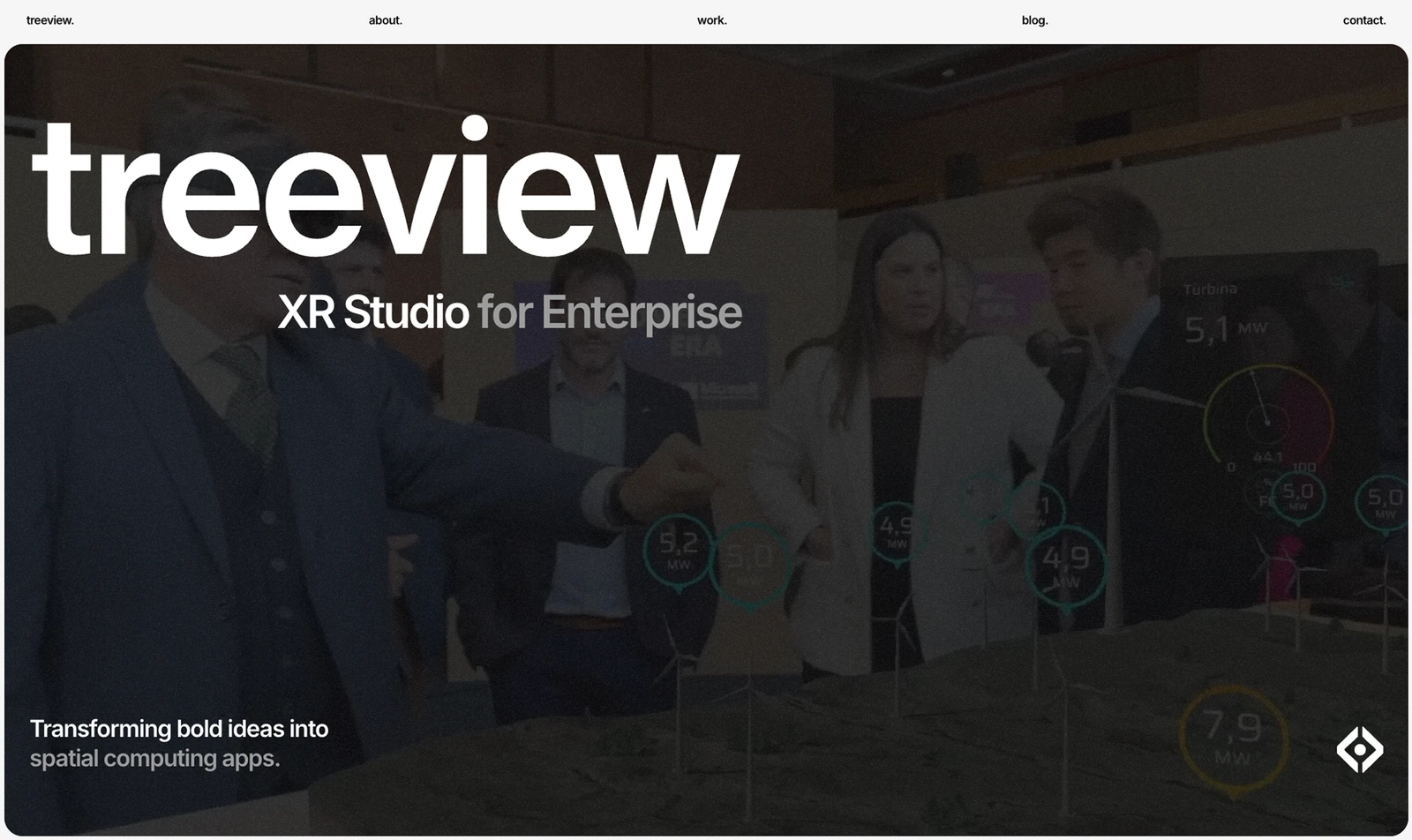
Treeview is an XR studio building custom virtual reality, augmented reality, Mixed Reality and Smart Glasses applications to order. It publishes no museum exhibit work, and an institution should read that first: its named clients are Microsoft, Meta, Medtronic, Toyota, Ford, ULTA Beauty, Daiichi Sankyo, Transfr, the University of Alberta and the University of Adelaide. What it offers a museum is build capability and terms rather than a gallery portfolio.
Its most relevant published work is not a museum project but an adjacent one. Medical device visualization and product visualization for enterprise clients are the same technical problem as artifact visualization: take an object somebody cannot open, cannot handle and cannot see inside, and make it legible in three dimensions. A studio that has done that repeatedly for manufacturers is solving a museum's problem in a different context.
Full ownership of IP, source code and assets transfers to the client. For an exhibit this is the difference between an asset and a countdown. Galleries are rehung, objects are lent out and returned, interpretation is revised after visitor research, and operating systems stop supporting old builds. An institution holding source code can commission any competent developer to make those changes. One holding a license is tied to a supplier that may no longer prioritize it or exist.
Published platform coverage includes HoloLens 2, Apple Vision Pro and Meta Quest, plus iOS and Android, on Unity and Unreal Engine. The iOS and Android targets are the relevant ones for artifact AR, since visitor-owned phones are the only delivery route that scales in a gallery without staffing. Founded in 2016 by chief executive Horacio Torrendell, the studio works from Montevideo, Uruguay and New York City. Team size and rates are not published, and it publishes no gallery installation, exhibit design or accessibility experience, so an institution engaging it needs its own exhibit designer. Best for a defined AR or visualization component inside someone else's exhibit design.
2. Local Projects
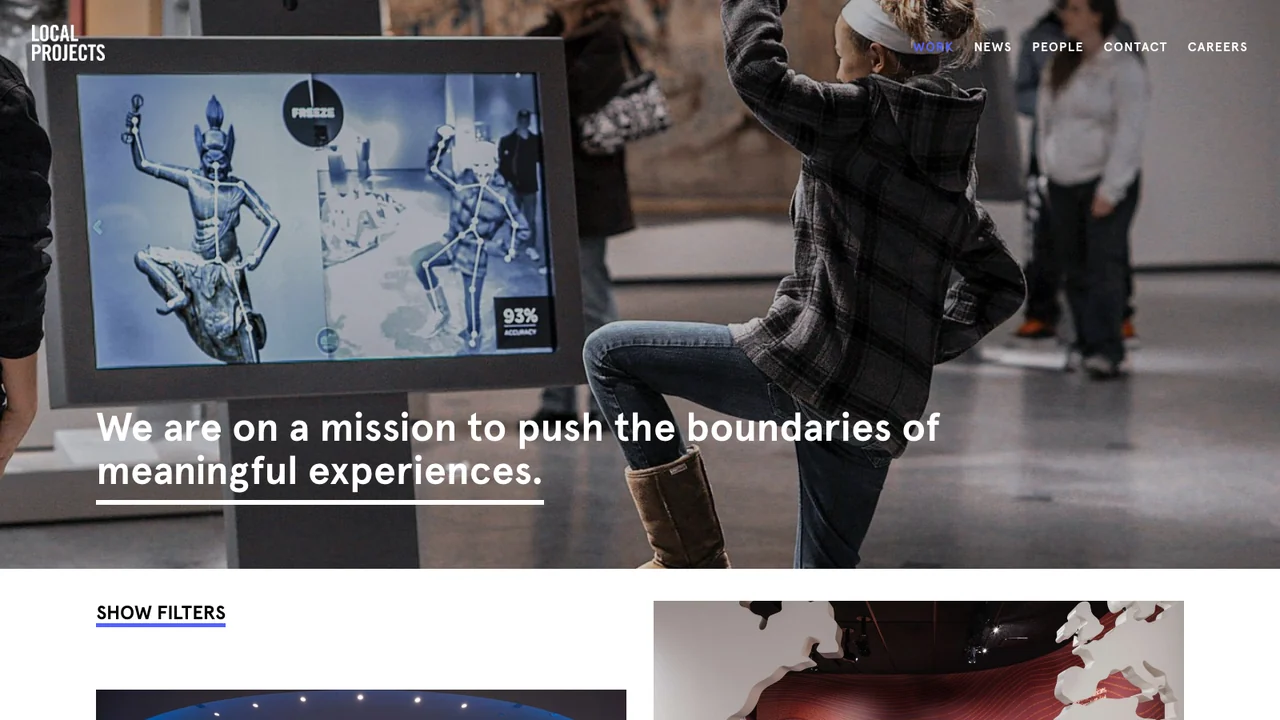
Local Projects is an experience design studio whose published work is overwhelmingly cultural institutions, memorials and civic interpretation. Its work categories are Civil Rights and Memorials, Museums and Attractions, Public Art, Higher Education, Institutional, Interactive Installations, Corporate Experience, Event and Retail.
Its named projects include Planet Word, Greenwood Rising, the Hyde Park Barracks Museum with Sydney Living Museums, London Mithraeum with Bloomberg, the Theodore Roosevelt Presidential Library, the International Spy Museum exhibition Camouflage: Designed to Deceive, the Shockoe Institute, the UN Geneva Visitor Center, the Stonewall National Monument Visitor Center, the Louisiana State Museum, the Sydney Jewish Museum, the Museum of Jewish Heritage, the Norton Museum, the Columbus Museum and the Faith and Liberty Discovery Center.
For artifact interpretation specifically, London Mithraeum is the most instructive of those. It is a Roman temple beneath an office building in the City of London, and the interpretive problem is exactly the one this list is about: a visitor standing in front of remains that mean nothing without a great deal of context, in a space where the object cannot be moved or altered. Camouflage: Designed to Deceive at the International Spy Museum is a second useful reference, since camouflage is a subject where the objects only make sense when the visitor can manipulate and compare them.
What Local Projects is not is a component supplier. It leads galleries, shaping narrative, environment, interaction and media together, and engaging it to build an AR layer against someone else's exhibit design misuses it. Its concentration of memorial and civil rights work also signals a capability that rarely appears on a technology studio's website: running community consultation and review on projects where the interpretation itself is contested.
The studio works from 123 William Street, Suite 801, New York, NY 10038. It publishes no founding year, team size or ownership terms on the pages reviewed. Best for whole galleries where the objects and the story have to be designed together.
3. Bluecadet
Bluecadet is a design studio working across exhibitions and digital products for cultural institutions, with the strongest art and science museum client list here. Its published work includes a learning and play space at the Metropolitan Museum of Art, interactive media at the MIT Museum and the Folger Shakespeare Library, digital signage at the Cleveland Museum of Art, and website redesigns for the Princeton University Art Museum and the Buffalo AKG Art Museum.
The Met learning and play space is the most relevant entry for artifact interpretation, because it addresses the hardest version of the problem: children in a gallery, objects they cannot touch, and interaction that has to work without reading. Its published description includes turning dials, moving projected imagery, drumming and touchscreens, which is a deliberate range of physical inputs rather than a single screen.
The studio began as the freelance handle of Josh Goldblum after he left the Smithsonian American Art Museum, where he worked as a new media specialist, over 20 years ago. A studio founded from inside a museum starts with an understanding of curatorial review, collection data, registration and conservation that outside vendors take years to acquire, and in artifact work that shows up in practical places, such as how object records feed an interactive without being re-keyed.
Its published services span experience design covering visitor experience strategy, exhibition and gallery design, interactive and immersive installations and environmental storytelling; digital product covering websites, web platforms, CMS and editorial systems, digital accessibility and UX research; and content covering interpretive research, copywriting, motion graphics and photography. Digital accessibility as a named service is more than most studios in this market publish, and it matters because public institutions frequently carry statutory obligations that a screen-only or audio-only interactive can breach.
Bluecadet publishes no headquarters address, founding year, team size or ownership terms on the pages reviewed, and its published work is largely screen, touch and projection rather than headset or phone-based AR, so an institution specifically wanting AR should confirm recent work in that format. Best for institutions wanting gallery interactives and their digital estate handled coherently, with accessibility taken seriously.
4. Tellart
Tellart is a design studio founded in 2000 that invents new ways to communicate using design craft and emerging technology, creating spatial, interactive and multisensory experiences. It is the entry here most committed to physical interaction rather than screens, and that is its distinguishing quality.
Its published institutional work includes Designing Planets with Machine Learning at the V&A Museum, Chrome Web Lab: Making the Internet Physical with Google and the Science Museum London, and Sit Spot: Reconnecting with the Living World at the Oregon Museum of Science and Industry. Chrome Web Lab is the clearest demonstration of its method, since the entire premise was making abstract internet processes physical and observable in a gallery, which is the same interpretive move as making an artifact's function visible.
Its wider work is large-scale public commissions: the Netherlands Pavilion and the Philippine Pavilion at World Expo 2025, the UAE Pavilion and the Polish Pavilion at World Expo 2020, Dinner in 2050 at COP28, and the SAM AI Experience at Nxt Museum. It states that it designs for major international events including the World Expo, Olympic Games, COP climate conferences, the World Economic Forum and the World Government Summit.
Expo pavilion work is a meaningful credential for a museum and is often undervalued. A pavilion runs for six months, serves enormous unmanaged crowds with no shared language, and has to be legible in seconds. Anything that survives that has been tested against the harshest visitor conditions in the industry, and it is a better predictor of gallery robustness than a portfolio of controlled installations.
Tellart describes itself across three roles: strategic partner, design studio and production house, meaning it can take a project from concept to built and installed. It operates as Tellart B.V. from Arie Biemondstraat 111, 1054 PD Amsterdam. It publishes no team size, rates or ownership terms on the pages reviewed, and its published work is physical and multisensory rather than phone-based AR, so confirm the format directly. Best for physical, multisensory interactives that must work for large unprepared crowds.
5. Factum Arte
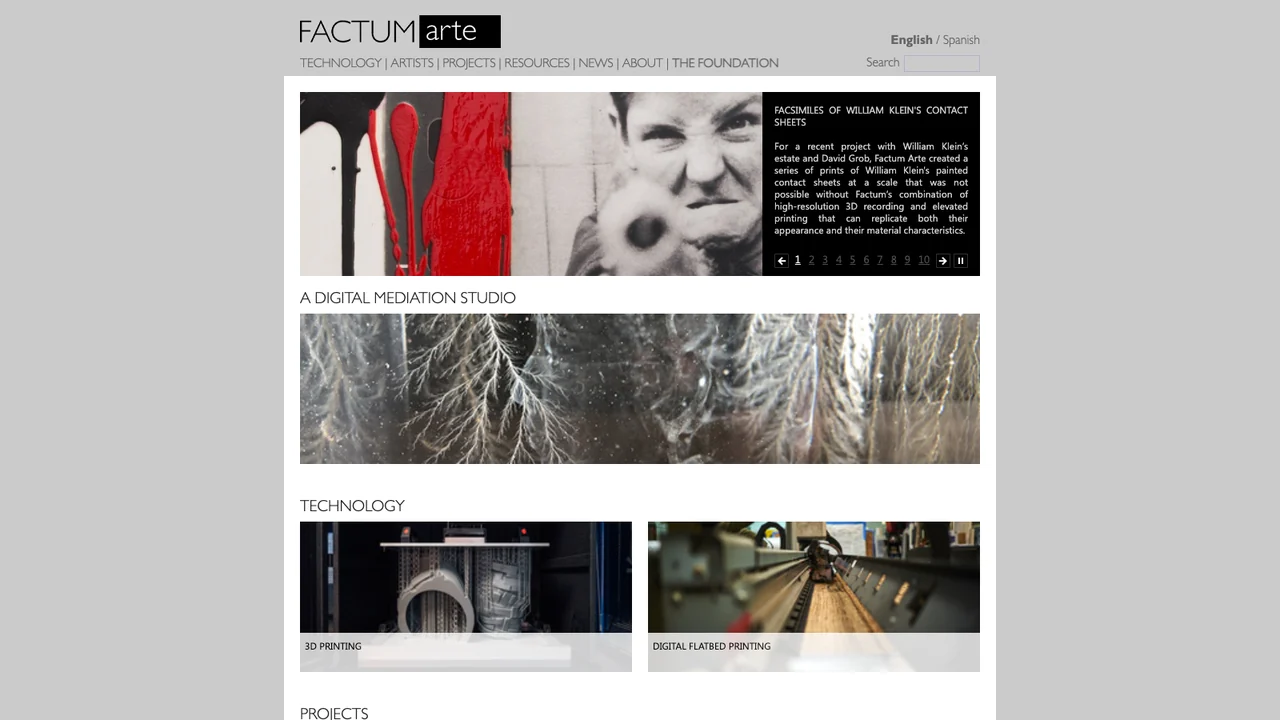
Factum Arte describes itself as a digital mediation studio, working across high-resolution 3D recording, 3D printing, digital flatbed printing and physical fabrication. It appears on an artifact visualization list because it answers the same question with the opposite technique: instead of adding a digital layer to an object a visitor cannot touch, it produces an object the visitor can approach.
Its published work includes facsimiles of William Klein's painted contact sheets, produced with the Klein estate and David Grob, using a combination of high-resolution 3D recording and elevated printing intended to replicate both appearance and material characteristics; Behold Humanity, a tapestry by Grayson Perry for the 2026 Royal Academy Summer Exhibition; a life-size lead cast of an Eskimo Curlew for Annalee Davis's installation at the 61st Venice Biennale; and Art Lovers by Tschabalala Self, installed on the façade of the New Museum in New York. It works alongside the Factum Foundation and publishes sections for Technology, Artists, Projects and Resources.
The recording standard is the part that matters for artifact work. Reproducing material characteristics, not only geometry and color, means capturing texture, gloss and the way light behaves across a surface. That is a substantially harder problem than producing a model for a screen, and the same records serve conservation documentation, condition monitoring and future reconstruction, which means the capture outlives the exhibit it was made for.
The interpretive case for facsimiles is straightforward and long established. A replica allows a fragile original to be removed from visitor pressure, a dispersed object to be shown in the context it came from, or a lost element to be returned to a site. For visitors it removes the glass, which no amount of augmented reality does. It also raises questions an institution should settle deliberately, about labeling, authenticity and whether the public is told clearly what they are looking at.
Factum Arte publishes no headquarters address, founding year, team size, rates or ownership terms on the pages reviewed, and it is a fabrication and recording studio rather than an AR developer, so it belongs on a shortlist as an alternative approach rather than as a competitor to the others here. Best for objects too fragile, too dispersed or too enclosed to be experienced any other way.
What interactive exhibits have to account for
Four things determine whether an artifact interactive is used by visitors rather than admired by the people who commissioned it.
The first is whether anyone will start it. Phone-based AR in a gallery requires a visitor to notice a prompt, be willing to hold a device up in a room full of strangers, and have either an app or a working network. Each of those loses a large share of the audience, and the losses compound. Interactives that are already running, already visible and require no equipment start at a much higher rate. If AR is the chosen route, plan the prompt and the onboarding as carefully as the content.
The second is the physical gallery. Case glass reflects, spotlighting defeats phone cameras, marble halls are acoustically hostile, and networks are often absent in basements and historic buildings. These constraints outrank technical preference, and they are known before design starts. Establish them early rather than discovering them at installation.
The third is accessibility. A single-sensory interactive can put a gallery out of compliance for institutions with statutory obligations, and retrofitting an alternative after opening is expensive. Bluecadet publishes digital accessibility as a named service. For everyone else it is a scoping question that belongs in the brief.
The fourth is the running cost. Interactives are handled by thousands of people and fail in mundane ways: worn buttons, failed projector lamps, drifting touch calibration, unresponsive sensors. Ask who fixes it in year three, what the annual cost is, and what the fallback state looks like when a component dies mid-day. A well-designed exhibit degrades into a simpler working state rather than a blank screen.
How to choose between these AR exhibit companies
Decide first whether you are commissioning a gallery or a component, since it splits this list cleanly. For a gallery where narrative, environment and media are designed together, Local Projects and Bluecadet should lead. For a component built into an existing exhibit design, Treeview builds and transfers ownership. For a physical interactive that must survive crowds, Tellart has the production and pavilion record. For an object problem that no screen solves, Factum Arte produces the object.
Then match the record to your institution type. Local Projects has the deepest memorial, civil rights and civic interpretation record. Bluecadet has the strongest art museum list and publishes accessibility as a service. Tellart has science museums and international pavilions. Factum Arte works with artists, estates and biennials. Treeview brings enterprise delivery experience and the clearest ownership terms.
Test the delivery assumption before committing. If the plan depends on visitors using their own phones, ask each supplier what proportion of visitors actually engaged in a comparable installation and how that was measured. If nobody can answer, treat projected take-up as an assumption rather than a plan, and design a version that works without it.
Finally, write the handover into the brief. Source code, project files, 3D assets, third-party licenses and documentation are cheap to require at tender and expensive to obtain later. An institution that can hand its exhibit to a different contractor in year five has an asset rather than a dependency.
Related reading. BestInXR's museums and culture guide covers what a cultural institution is actually buying. XR development companies for museums covers whole-gallery commissioning, and XR companies for cultural heritage experiences covers documentation and facsimiles. For visitor tours see VR companies for virtual museum tours, and for authored work, companies for VR and AR art exhibitions. Where the exhibit is a temporary stand rather than a gallery, the AR event guide covers entry flow, device compatibility and the route for visitors who decline the camera.
Frequently Asked Questions (FAQ)
1. Do visitors actually use AR in galleries?
Take-up is the central risk and none of the sources reviewed here publishes engagement figures, so no rate is recorded. What is known is that each step, noticing the prompt, being willing to hold up a phone, and having an app or a network, loses part of the audience. Ask any supplier for measured engagement from a comparable installation before assuming the plan works.
2. Which of these name museum clients?
Local Projects names Planet Word, the International Spy Museum, the Theodore Roosevelt Presidential Library, London Mithraeum and Greenwood Rising. Bluecadet names the Metropolitan Museum of Art, the MIT Museum, the Folger Shakespeare Library and the Cleveland Museum of Art. Tellart names the V&A Museum, the Science Museum London and OMSI. Factum Arte names the New Museum, the Royal Academy and the Venice Biennale. Treeview names enterprise clients across its portfolio, including Microsoft, Medtronic and Toyota.
3. Is a facsimile a legitimate way to show an artifact?
It is a long-established museum practice, used to protect fragile originals, reunite dispersed objects and restore lost elements to sites. Factum Arte publishes recording intended to reproduce material characteristics rather than only geometry and color. The question an institution should settle is labeling, so visitors know what they are looking at.
4. What do gallery conditions do to AR?
Case glass reflects, spotlighting interferes with phone cameras, and historic buildings frequently lack network coverage. These are physical constraints that outrank technical preference and are usually known before design begins. Establish them at the briefing stage rather than at installation.
5. Who maintains an interactive exhibit?
Whoever the institution contracts to, and it should be named before opening. Interactives fail through wear rather than software, and a maintenance budget, a named owner and a graceful fallback state matter more to a five-year exhibit than any feature. None of the five publishes maintenance terms on the pages reviewed.
6. What does an interactive exhibit cost?
None of the five publishes rates, so no figure is recorded here. Cost is driven by whether the engagement covers a gallery or a component, whether hardware and fabrication are involved, how many simultaneous visitors it serves, and the annual maintenance commitment. Running cost is the line most often missing from a first budget.