VR companies for virtual museum tours split between two very different products: large-format expeditions that groups walk through on site, and remote tours that reach people who will never travel. This list ranks five by documented tour work, delivery model and where the visitor actually is. Rankings draw on each company's own record.
In short:
- Treeview builds custom XR to specification and hands over full ownership of IP, source code and assets, which matters for a tour a museum expects to run for years
- Magnopus has the strongest record for large audiences under fixed operating conditions, including work at Sphere and Dubai Expo 2020
- Iconem, founded 2013, turns 3D surveys of real sites into immersive exhibitions with the British Museum, the Smithsonian, the Grand Palais and the Vatican
- Lithodomos states more than 500 high-resolution 360 degree reconstructions across more than 60 heritage sites in 18 countries, delivered on a visitor's own phone
How this list was built
This list ranks companies by four criteria: documented virtual tour or immersive expedition work, whether the tour is delivered on site or remotely, evidence of running for real audiences at volume, and what the institution receives at the end.
The phrase virtual museum tour covers at least three products that are bought by different departments for different reasons, and separating them first will save a procurement process. The first is the free-roam expedition, where a group in a large empty room wears headsets and walks physically through a reconstructed place. The second is the on-site companion, where a visitor standing at a real site sees a reconstruction of it on their own device. The third is the remote tour, where somebody who cannot travel visits from home, a classroom or another museum.
They share almost nothing operationally. A free-roam expedition needs several hundred square meters of clear floor, headsets for every visitor, staff to fit and clean them, and a ticketing model, and it is a venue business rather than a media project. An on-site companion needs no hardware at all but needs positioning to work outdoors, often without network coverage. A remote tour needs neither, but has to hold the attention of someone with a browser tab and no admission fee, which is the hardest audience of the three.
The second thing worth stating plainly is that throughput arithmetic decides the business case more often than content quality. A headset experience serving one person at a time for twenty minutes, with fitting and cleaning between visitors, has a ceiling that can be calculated on the back of an envelope, and that ceiling determines both the ticket price and the staffing bill. Do the calculation before choosing a format.
Disclosure varies. Lithodomos publishes no headquarters, founding year or team size on the pages reviewed, and Excurio publishes no headquarters address. Iconem publishes no team size. Those gaps read Not disclosed rather than as estimates. Reconstruction and site counts are attributed to the company stating them, since none is independently audited. Pricing is not a ranking factor, because none of the five publishes rates.
| Company | HQ | Model | Where the visitor is | Best for |
|---|---|---|---|---|
| Treeview | Montevideo, Uruguay / New York City, USA | Custom development | Wherever the brief says | Tours built to spec and owned outright |
| Magnopus | Los Angeles, USA / St Albans, UK | Custom development and platform | On site, at scale | High-throughput venue experiences |
| Iconem | France | Digitization and exhibitions | In a museum, in front of a survey | Tours of real places, accurately recorded |
| Excurio | France | Free-roam expedition producer | Walking, in a large empty hall | Ticketed group expeditions |
| Lithodomos | Not disclosed | Catalog on visitor devices | Standing at the real site | On-site reconstruction without hardware |
1. Treeview
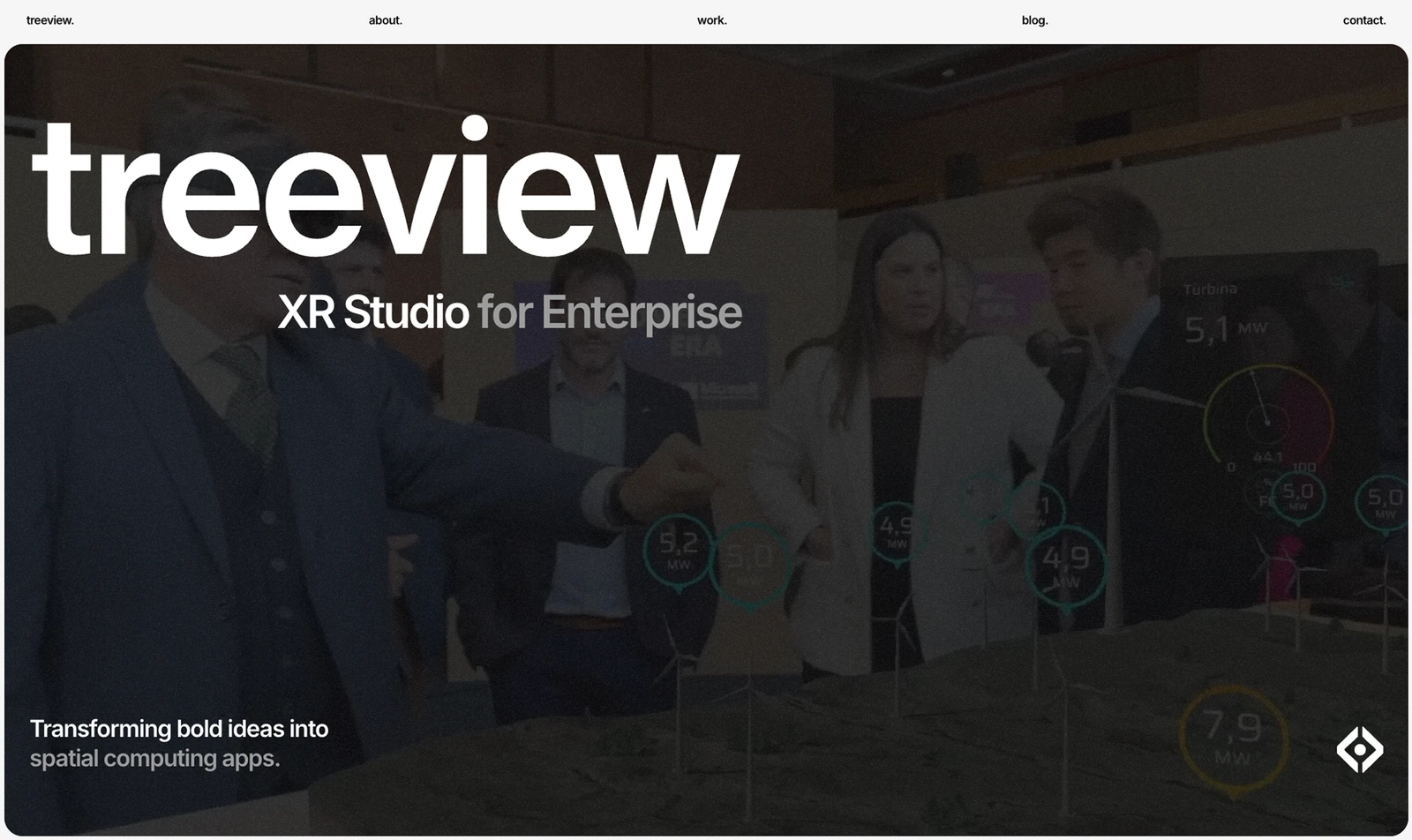
Treeview is an XR studio building custom virtual reality, augmented reality, Mixed Reality and Smart Glasses applications to order. It publishes no virtual museum tour, and that should be said before anything else: its named clients are Microsoft, Meta, Medtronic, Toyota, Ford, ULTA Beauty, Daiichi Sankyo, Transfr, the University of Alberta and the University of Adelaide. An institution evaluating it is buying build capability and contractual terms rather than a catalog of tours.
The case for it is that a virtual tour is one of the few XR products where an institution genuinely knows what it wants. A museum has its collection, its floor plan, its interpretation and its scholarship, and what it lacks is a team to build the thing. In that situation a studio with a strong house style is a liability and an accurate builder is an asset, which is a different procurement from buying a producer's existing format.
Full ownership of IP, source code and assets transfers to the client. A tour is not a one-off exhibition: it is infrastructure that a museum expects to run for years, update when a gallery is rehung, and translate when it opens to new audiences. Every one of those is a maintenance task, and whether the institution can perform it without renegotiating depends entirely on whether it holds the source.
Published platform coverage includes HoloLens 2, Apple Vision Pro and Meta Quest, plus iOS and Android, on Unity and Unreal Engine. The Android and iOS targets matter most for remote tours, because a tour intended for people who cannot visit has to run on the device they already own. Its stated services run from strategy and discovery through 3D content creation, development, system integration, testing, deployment and support. Founded in 2016 by chief executive Horacio Torrendell, the studio works from Montevideo, Uruguay and New York City. Team size and rates are not published, and it publishes no visitor operations experience, so throughput, staffing and daily running are questions to put directly. Best for institutions with a defined tour concept who want it built and owned.
2. Magnopus
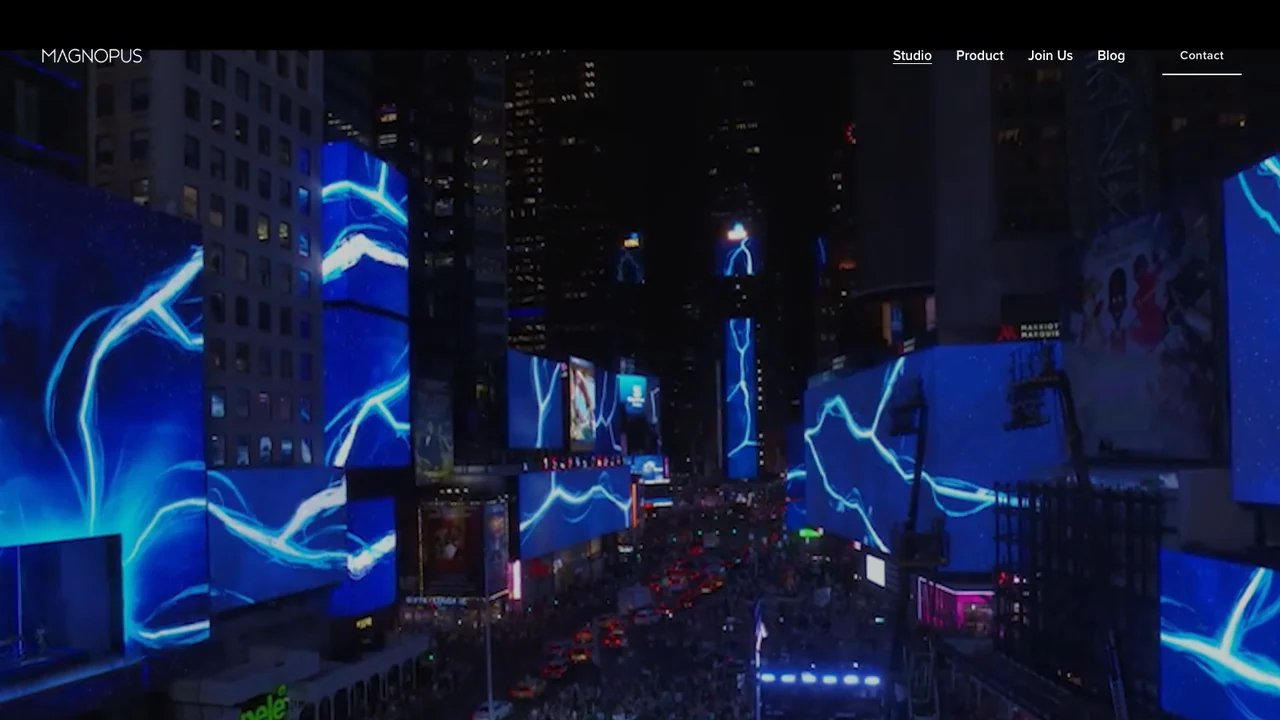
Magnopus builds immersive experiences and the technology underneath them, and its relevance to virtual tours is operational rather than curatorial. Its published work includes The Wizard of Oz at Sphere, the Dubai Expo 2020 cross-reality experience, Mission:ISS, and Cyberpunk: A Virtual Production Experience at the Academy Museum of Motion Pictures, alongside an augmented reality education application for the Holocaust Museum Los Angeles.
Sphere and Dubai Expo 2020 are the two entries that matter here, because both are venue-scale operations serving very large numbers of people continuously on fixed dates. That is the same engineering problem as a ticketed virtual tour: not whether the experience is good once, but whether it runs every twenty minutes, all day, for months, with staff who did not build it. Most studios have never had to answer that question.
It also builds OKO, described as a spatial intelligence platform for persistent, real-time collaborative environments spanning web, mobile and XR headsets, with support for CAD models and Gaussian splats and AI scripting features developed with Google. The multi-user, cross-device aspect is directly relevant to remote tours, where the interesting version is a guided group rather than a solitary visitor, and a docent leading twenty remote visitors through a gallery is a genuinely underserved product. The counterpart is dependency: a tour built on a proprietary platform runs while that platform is maintained, so establish what is owned and what is licensed.
Founded in 2013, Magnopus works from 523 W. 6th Street, Suite 330, Los Angeles and 20 High Street, St Albans in the United Kingdom. Team size, rates and IP terms are not published, and its portfolio is weighted toward entertainment rather than museum interpretation, so an institution should ask how a project is staffed. Best for high-throughput on-site experiences and multi-user remote tours where reliability under load is the hard part.
3. Iconem
Iconem specializes in the digitization of endangered cultural heritage sites in 3D, and it is the entry here whose tours are of real places recorded accurately rather than places reconstructed from research. Founded in 2013 and working from France, it produces both the survey and the exhibition built from it.
Its published exhibitions include I am Ashurbanipal at the British Museum, Age-Old Cities at the Arab World Institute in Paris and subsequently at the Bundeskunsthalle in Bonn, the National Museum in Riyadh and the Smithsonian's Freer Gallery of Art and Arthur M. Sackler Gallery, Venice Revealed at the Grand Palais Immersif, Pétros Ení at Saint Peter's Basilica in the Vatican, Salvaged from the Shadows at the National Museum of China, Changing Landscapes at the Museum of Science in Boston, Syria Matters at the Museum of Islamic Art in Doha, Syrian Symphony at the Aga Khan Museum in Toronto, and work at Carcassonne, Mont Saint-Michel and the Crac des Chevaliers.
The distinction between a survey-based tour and a reconstruction is worth dwelling on, because it changes what the tour can claim. A tour built from a laser scan or photogrammetric survey shows a place as it is, including damage, weathering and later additions, and its authority rests on the capture. A reconstruction shows a place as somebody has argued it once was, and its authority rests on scholarship and is contestable. Both are legitimate; they are not interchangeable, and visitors are rarely told which they are looking at.
The touring pattern is also the economically sensible one. The same body of capture has produced exhibitions in Paris, Bonn, Riyadh, Washington and Brussels, which spreads a single expensive survey across many venues. For a museum, that means the realistic offer is often to host or adapt an existing Iconem exhibition rather than to commission a new survey.
Iconem publishes no team size, rates, ownership terms or archival standards on the pages reviewed. Best for museums wanting a tour of a real site, and particularly for sites that are damaged, dangerous or closed to visitors.
4. Excurio
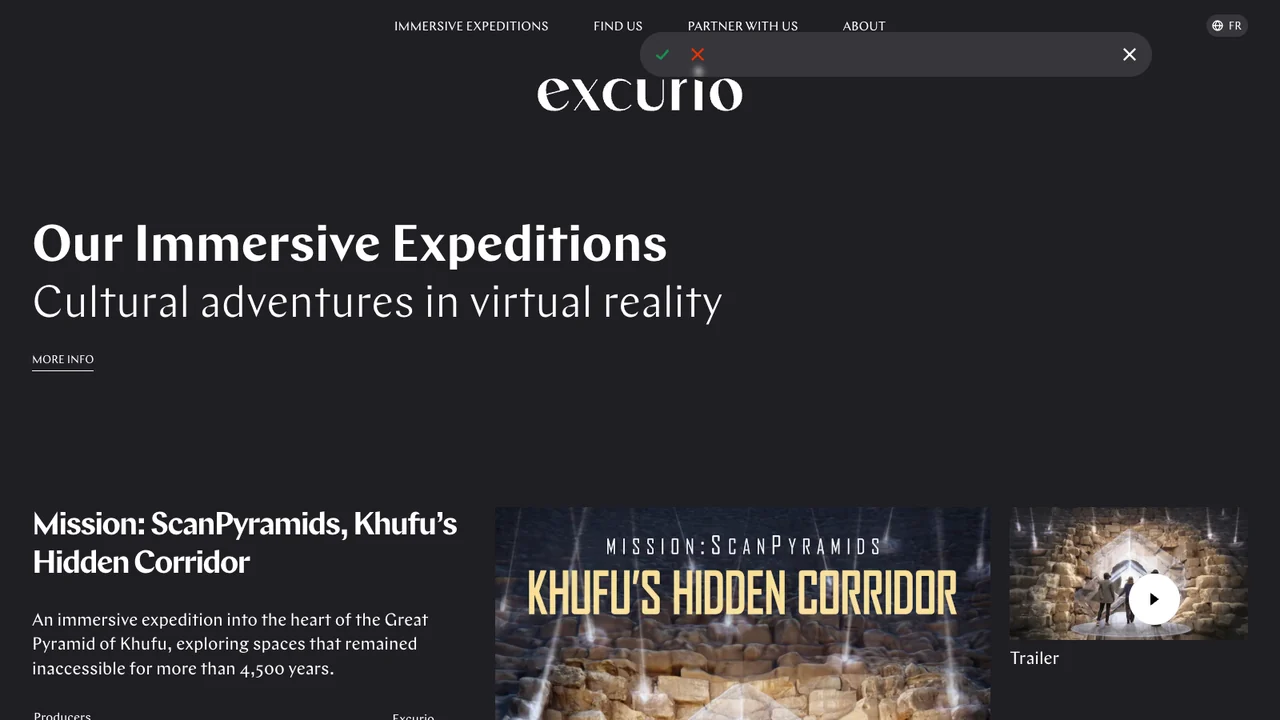
Excurio produces what it calls Immersive Expeditions, and it is the only company here whose entire product is the free-roam format. Born in 2020, it describes these as virtual reality adventures designed to be experienced by several people moving freely around locations spanning several hundred square meters.
Its published titles are Horizon of Khufu, Eternal Notre-Dame, Tonight with the Impressionists, Life Chronicles, The Last Stronghold set in Carcassonne in 1304, The Secret of the Pyramid Builders, and Mission: ScanPyramids, Khufu's Hidden Corridor. The subjects are recognizably museum territory, and Eternal Notre-Dame in particular addresses a building that visitors could not enter for years.
The free-roam format is the most physically convincing way to tour a place virtually, and it is worth being clear about why. Walking through a space using your own legs, at your own pace, with other visible people around you, produces a sense of scale and presence that seated or teleport-based VR does not. For architecture and archaeology, where scale is much of the meaning, this is a real difference rather than a marketing claim.
What an institution must understand is that this is a venue business. It requires a large empty hall, a headset per visitor, backpack or standalone hardware, staff to fit, clean and marshal, timed ticketing and a throughput model. A museum without several hundred square meters of clear floor cannot host one, and the operating cost is closer to running a temporary exhibition than to commissioning a film. Excurio's model is to produce and partner rather than to build bespoke tours to a museum's brief, and its site is organized around finding venues and partnering rather than commissioning.
It publishes no headquarters address, team size, rates or attendance figures on the pages reviewed. Best for institutions with the floor space and the appetite to run a ticketed expedition, and not for a museum wanting a tour of its own collection.
5. Lithodomos
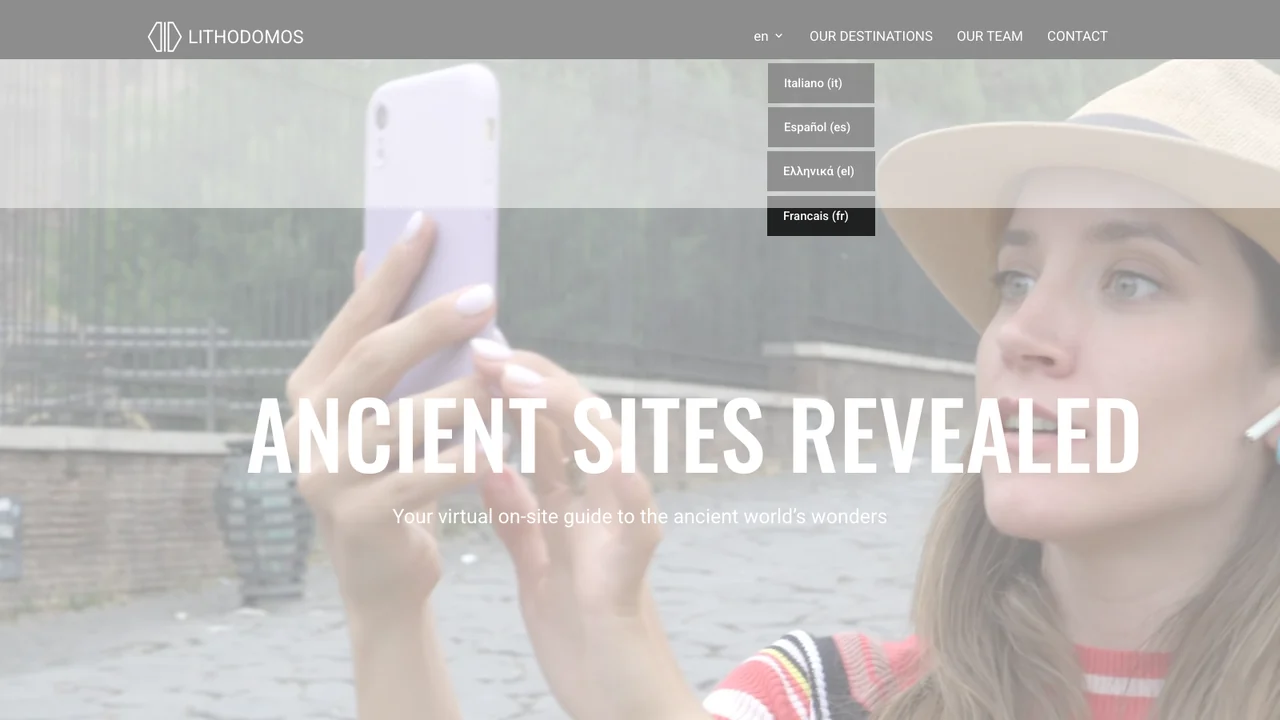
Lithodomos describes itself as a virtual on-site guide to the ancient world's wonders, and it solves the opposite problem to Excurio: no venue, no hardware, no staff. Visitors scan a QR code, load an Expedition in what the company states is 30 seconds or less, and view reconstructions on their own device.
It states more than 500 accurate, high-resolution 360 degree reconstructions across more than 60 cultural heritage sites in 18 countries. Its published destinations include Athens, Rome, Pompeii, Ostia, Paestum, Delphi, Olympia, Corinth, Epidauros, Sounion, Jerusalem, Masada, Stonehenge, London, Lyon, Nîmes, Split, Pula, the Via Appia, Medina Azahara, Barcelona, Madrid, Malaga, Valencia, Lisbon and Hobart. That is the largest published catalog of site reconstructions in this list.
Its published features are the ones that matter for on-site use rather than the ones that demonstrate best: 360 degree reconstructions that automatically locate and orient the image to where the visitor is standing, split screen comparison of the site today against its reconstructed past, custom itineraries with self-guiding maps, stories and legends in selectable languages with closed captions, and infographics. The split screen is the single most useful feature for interpretation at a ruin, because the interpretive problem at an archaeological site is that visitors cannot connect the stones in front of them to the reconstruction in the guidebook.
Closed captions and selectable languages are worth noting for institutions with accessibility obligations and international visitors, and running on a visitor's own device removes the hardware, hygiene and staffing costs that constrain every other model in this list. Its stated partners are cultural heritage sites, travel and tour operators, educators and content producers.
It ranks fifth because it is a catalog rather than a commissioning partner: an institution buys access to reconstructions that exist, and a site outside the 60 published locations has nothing to license. It publishes no headquarters, founding year, team size or rates on the pages reviewed. Best for archaeological and heritage sites wanting on-site interpretation with no hardware to run.
What virtual museum tours have to account for
Four things decide whether a virtual tour earns its place in a program.
The first is throughput, and it is arithmetic rather than judgement. Divide daily opening hours by the sum of the experience duration and the time to fit, brief and clean between visitors, then multiply by the number of headsets and the staff available to run them. That number sets the ceiling on both revenue and reach. Device-free models like Lithodomos have no such ceiling; free-roam expeditions have a hard one.
The second is what the tour claims to show. A survey-based tour shows a place as recorded. A reconstruction shows a place as argued. Both belong in museums, but the interpretation should tell visitors which one they are in, and the institution should know what evidence sits behind any reconstruction before it puts its name on it.
The third is who the tour is for. If the goal is reaching people who cannot visit, an on-site headset experience does not do it, whatever its quality, and the two are frequently confused in funding applications. Remote reach means a browser or a phone, no admission, and content that survives being viewed in a kitchen.
The fourth is who runs and maintains it. An institution needs to know who fixes the tour in year three, what it costs annually, what happens when the hardware or operating system moves on, and whether the museum can update the content itself when a gallery changes. Treeview publishes full transfer of IP, source code and assets. The other four do not publish ownership terms.
How to choose between these virtual museum tour companies
Start with where the visitor will be standing, because it eliminates most of the list immediately. Standing at a real archaeological site with a phone: Lithodomos. Walking through a large hall in a headset on a ticket: Excurio. In your museum, looking at an accurate survey of a place elsewhere: Iconem. At home or in a classroom: Treeview or Magnopus, built to a brief. In a venue serving very large numbers continuously: Magnopus.
Then decide whether you are commissioning or licensing. Excurio, Iconem and Lithodomos all have existing products, and the realistic engagement is hosting, licensing or partnering rather than briefing a bespoke build. Treeview and Magnopus build to order, which costs more and gives you exactly your collection rather than somebody else's.
Run the throughput calculation before you fall in love with a format. It is the number that determines whether a tour is a sustainable part of the offer or an expensive pilot, and it is easier to accept early than after a launch.
Finally, settle maintenance and ownership in the brief. A tour is infrastructure, and infrastructure needs an annual budget, a named owner and a route to update it. Institutions that fund the build and not the running of it end up with a tour that quietly stops being offered.
Related reading. BestInXR's museums and culture guide covers what a cultural institution is actually buying. XR companies for cultural heritage experiences covers documentation and preservation, and XR development companies for museums covers gallery exhibits. For authored work see companies for VR and AR art exhibitions, and for institutional buying, XR development companies for universities.
Frequently Asked Questions (FAQ)
1. What is a free-roam VR expedition?
A format where several visitors wear headsets and walk physically through a virtual place in a large empty hall, rather than sitting or teleporting. Excurio describes its Immersive Expeditions as designed for several people moving freely across locations spanning several hundred square meters. It needs floor space, headsets, staff and timed ticketing, so it is a venue operation rather than a media commission.
2. Can a virtual tour reach people away from the museum?
Only if it is built for that. An on-site headset experience reaches people already at the museum. Remote reach requires delivery on a browser or a personal phone with no admission and no equipment. Treeview and Magnopus both publish mobile and web-capable delivery. Confusing the two is the most common error in tour funding applications.
3. Which of these have named museum or heritage work?
Iconem names the British Museum, the Smithsonian's National Museum of Asian Art, the Grand Palais Immersif, the Vatican, the Museum of Islamic Art in Doha and others. Lithodomos names more than 60 heritage sites including Pompeii, Delphi, Masada and Stonehenge. Excurio names Notre-Dame, Carcassonne and the Giza pyramids. Magnopus names the Academy Museum of Motion Pictures and the Holocaust Museum Los Angeles. Treeview names enterprise clients across its portfolio, including Microsoft, Medtronic and Toyota, rather than sector-specific accounts.
4. Does a reconstruction count as evidence?
No. A reconstruction is an interpretation of evidence and it can be contested, revised or wrong, which is different from a survey that records a place as it stands. Iconem's work is survey-based. Lithodomos describes its reconstructions as accurate but publishes no methodology on the pages reviewed. Ask what evidence sits behind any reconstruction before an institution puts its name to it.
5. How many visitors can a headset tour serve per day?
No source reviewed here publishes a figure, so none is recorded. The calculation is straightforward locally: opening hours divided by experience duration plus fitting and cleaning time, multiplied by headsets and by the staff available. Do it before choosing a format, since it usually chooses the format for you.
6. What does a virtual museum tour cost?
None of the five publishes rates, so no figure is recorded here. Cost is driven by whether you license an existing product or commission one, whether hardware and floor space are involved, staffing and cleaning, and how many languages are required. Annual running cost is the line most often missing from a first budget.