
XR in Education: What It Is and How to Evaluate It
Education XR divides on one question before any other: are you commissioning content or licensing a catalog. The two are bought through different processes, on different budgets, over different timescales, and an institution that buys one expecting the other has bought the wrong thing at the right price.
In short:
- What it is: Virtual and augmented reality used to teach, covering K-12 classrooms, universities, vocational training and laboratory science.
- What it is not: A single market. A supplier serving a school day of 45-minute periods and one serving a university department are solving different problems.
- What decides the shortlist: Documented education work, whether the supplier builds custom or licenses a platform, named institutional clients and published device support.
- What kills deployments: Logistics, not content. A K-12 program fails on charging, timetabling and supervision far more often than on what the lesson teaches.
What education XR is
Education XR is the use of virtual and augmented reality to teach a subject, practice a procedure or reach a place a class cannot visit. It spans four buyers who sit in different budgets and answer to different people: schools, universities, vocational providers and laboratory science departments.
The division that matters is not the technology. It is whether the institution is buying a finished thing or a capability. A custom studio is commissioned to build a specific lesson, simulation or application, the work is scoped against a curriculum and the buyer usually owns the result. A platform vendor sells access to content that already exists and continues to be maintained.
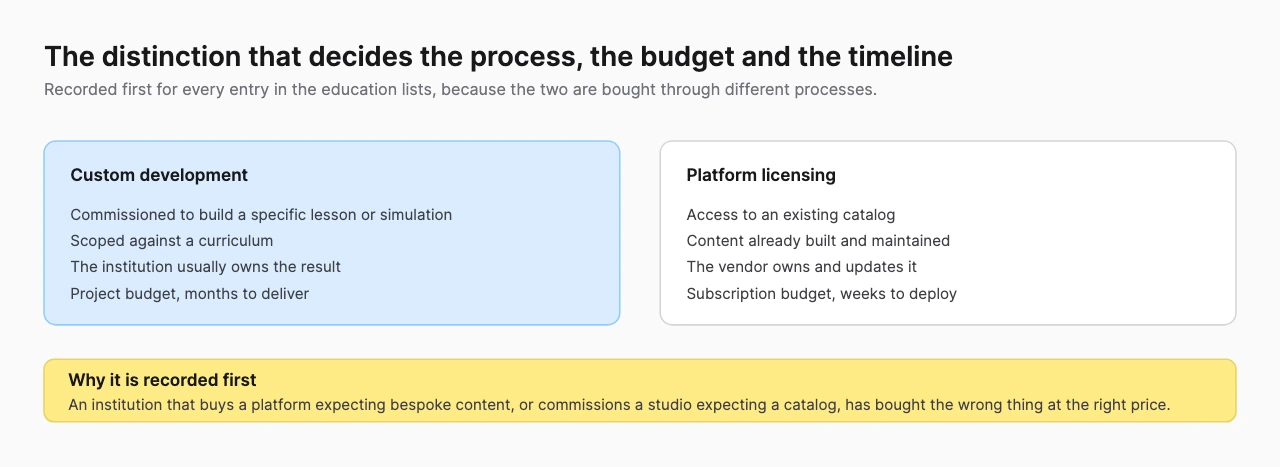
| Custom development | Platform licensing | |
|---|---|---|
| You are buying | A specific lesson or simulation | Access to an existing catalog |
| Scoped against | Your curriculum | A general syllabus |
| Owned by | Usually the institution | The vendor |
| Budget line | Project | Subscription |
| Time to deploy | Months | Weeks |
| Fails when | The subject was actually generic | The subject was actually specific |
Both are legitimate. Neither is more advanced than the other. But the process, the budget line and the timeline differ enough that establishing which one you are buying should precede any conversation about content.
Who buys education XR, and what each is measured on

K-12 schools buy for engagement and for access to things a classroom cannot contain. The buyer is usually a school or trust rather than a teacher, and the constraint is the school day.
Universities buy in several places at once, and rarely as one institution. A department buys teaching content, admissions buys a campus tour, estates buys a facilities twin and none of the three necessarily knows about the others.
Vocational providers buy for job-ready skill against an employer standard. This is the segment closest to enterprise training, and assessment matters more here than anywhere else in education, because the output is a person an employer will hire.
Laboratory science buys for procedure practice where bench time, reagents or safety limit repetition.
| Buyer | Bought for | Decided by | Measured on | Fails on |
|---|---|---|---|---|
| K-12 schools | Engagement and access | School or trust | Lesson delivery | Logistics |
| Universities | Teaching, admissions, estates | Several buyers at once | Varies by buyer | Nobody owning it |
| Vocational | Job-ready skill | Provider or employer | Assessment against a standard | Weak assessment |
| Science labs | Procedure practice | Department | Curriculum fit | Being a tour, not a lab |
What K-12 does to a shortlist

Classroom fit is weighted first in best VR companies for K-12 and classroom learning, and the reason is that a K-12 deployment fails on logistics far more often than on content quality.
A lesson has to fit a period of roughly 45 minutes including setting up and packing away. One teacher supervises thirty students rather than one facilitator supporting one user. Headsets have to be charged, cleaned, updated and accounted for by someone who already has a full teaching timetable.
None of that appears in a demonstration, and all of it decides whether the program survives a term.
What a virtual lab actually is
A virtual lab is a simulated laboratory environment where a student performs a procedure and sees the result of their decisions, including the wrong ones. The consequence is the point: a student who mis-sequences a titration should see what that produces.

It differs from a 360 degree tour of a laboratory, which shows a space. Both appear on the same shortlists and only one can carry an assessment. Best VR companies for virtual labs and science simulations records the custom-or-catalog distinction first for every entry, because it decides the timeline, the budget shape and how much of the work falls on the institution.
Labster licenses a catalog of laboratory simulations. A commissioned lab built to one department's protocol is a different purchase, and the arithmetic only favors it where the protocol is genuinely local.
Education XR by setting
Five distinct purchases, each with its own ranked list and criteria.
General education development
Best VR development companies for education ranks on documented education work, whether the company builds custom or sells a platform, named education clients and published device support. Each entry states which model it follows.
Virtual labs and science
Best VR companies for virtual labs and science simulations covers laboratory procedure practice, where the distinction between a simulation and a tour decides what the purchase can be used for.
Universities
Best XR development companies for universities covers the higher education market, which frequently overlaps with campus virtual tours bought by admissions rather than by a department.
Vocational and workforce
Best VR companies for workforce and vocational training sits between education and enterprise. Transfr works in this segment, and the criteria resemble those in the enterprise training guide more than the rest of education.
K-12 and classroom
Best VR companies for K-12 and classroom learning weights classroom fit first. Avantis Education and ClassVR build specifically around managed classroom sets, which is a different product from a headset with good content on it.
Who actually supplies education XR
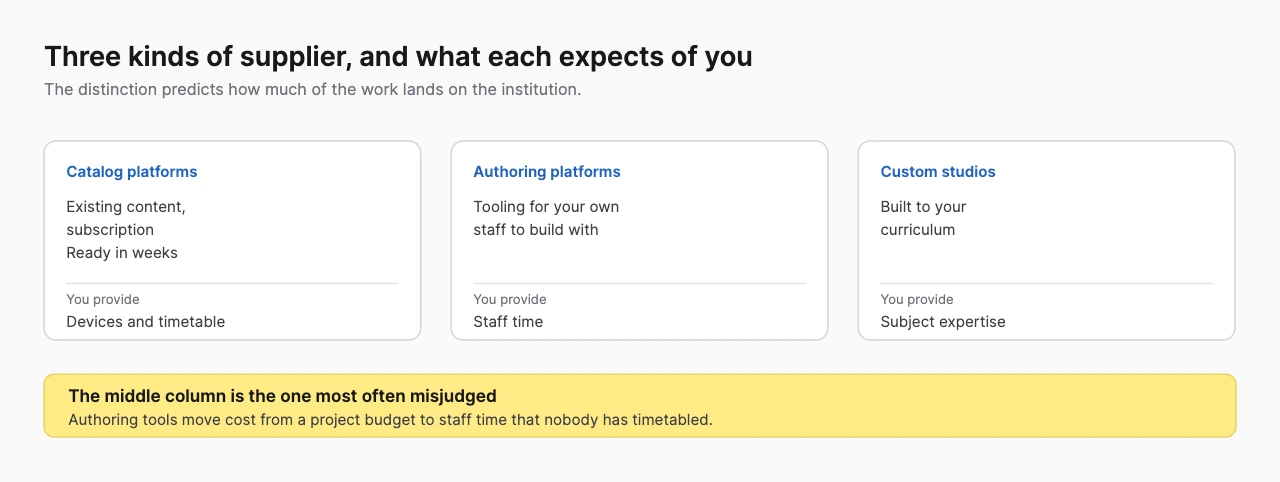
Catalog platforms license existing content on subscription. Labster and Engage XR work this way. You provide devices and timetable; they provide everything else. Deployment is measured in weeks.
Authoring platforms supply tooling for your own staff to build with. This moves cost from a project budget into staff time, which is cheaper across many lessons and more expensive across one, and it fails when nobody has timetabled the staff time.
Custom studios build to your curriculum. Schell Games, Filament Games and Treeview sit here. You provide subject expertise; they provide the build, and ownership terms vary.
Where education XR is actually used
Five uses account for most published deployment, and each one exists because something physical is scarce, dangerous or impossible.
Places a class cannot visit. Historic sites, ecosystems, the inside of a cell, orbit. The comparison is a textbook or a video, which is a low bar, and this is where the engagement argument is strongest and the assessment argument weakest.
Procedures with consequences. Laboratory work, clinical skills, machine operation. The value is repetition without cost or risk, and the comparison is bench time or supervised practice, which is expensive. This is where XR earns its budget most defensibly.
Scale and dexterity. Structures too small or too large to examine, from molecular assemblies to civil engineering. The argument is that manipulation at a comprehensible scale teaches something a diagram cannot.
Situations that cannot be staged. Emergency response, difficult conversations, hazardous conditions. Adjacent to enterprise soft skills work, and measured the same way, which is to say with difficulty.
Presence at distance. Shared virtual space for remote or distributed cohorts. This is the use most affected by whether the institution already has the hardware, since it needs everyone in a headset at once.
Which of the five justifies a budget
The middle three. Places-a-class-cannot-visit is the easiest to demonstrate and the hardest to defend at renewal, because the alternative is a video that costs nothing. Procedures with consequences is the strongest case in education XR, because the thing being replaced has a price: reagents, bench hours, supervised time on equipment.
That is worth knowing before a pilot, because pilots are usually chosen for how well they demonstrate rather than how well they defend.
What happens after the pilot
Content ages against the curriculum, not against the technology. A syllabus revision can invalidate a module that still runs perfectly, and the people who notice are the teachers using it.
Two questions decide whether that is survivable. Who updates the content, and on what cycle? And does the update arrive before or after the syllabus changes? A platform vendor tracking a national curriculum will usually answer both well. A commissioned build has whatever arrangement was written into the contract, which is frequently none.
The second decay is staff. Education XR programs are unusually dependent on individuals, because the person who champions it also tends to be the person who runs it. When they move, the program rarely transfers, and the defense is the same as everywhere else in this guide: a timetabled slot and a named owner, agreed while the enthusiasm is still available to arrange them.
What education XR projects have to account for
The academic calendar, not the project plan. Institutional procurement runs to terms and academic years. Missing a window means waiting twelve months, and nothing about the technology causes that.

Curriculum alignment as a deliverable. Content that does not map to a syllabus will not be timetabled, however good it is. Someone who teaches the subject has to sign that mapping off, and their time is a real input.
Safeguarding and consent. Cameras and accounts in a room of minors carry their own approval process, separate from IT security. It is slower than people expect and cannot be started late.
Who cleans and charges the headsets. In K-12 particularly, this decides everything. A set that is not reliably charged is a set that is not used, and the person responsible needs to be named before purchase rather than discovered afterwards.
What does education XR cost?
Published pricing is more common here than in most categories, because platform vendors sell on subscription and publish rates. Custom studios rarely do. The comparison below is about cost shape rather than figures.
| Cost center | Platform | Custom | Notes |
|---|---|---|---|
| Content | Included in the subscription | The project | The largest single difference |
| Devices | Yours | Yours | Rarely included in either |
| Staff time | Timetabling and supervision | Subject expertise and review | Custom needs more of it, earlier |
| Maintenance | Included | Yours after handover | The line most often forgotten |
| Exit cost | Content stops with the subscription | You keep what you own | Decides what survives a supplier change |
The row that catches institutions out is the last one. Licensed content disappears when the subscription lapses, which is correct and clearly stated, but it means a department that built a module around it has nothing to teach from the following year. A commissioned build survives, provided the ownership terms actually say so.
What good looks like in an education supplier
Four signals separate suppliers who have delivered into institutions from those who have sold into them.
They ask about the timetable before the curriculum. A supplier who establishes the period length, the class size and who supervises is working from experience of the setting rather than from the subject.
They distinguish custom from catalog without being pushed. Both models are legitimate, and a supplier confident in theirs will name it early. Vagueness here usually means the answer is inconvenient.
They can name institutions, and those institutions have said so publicly. Education is unusual in that deployments are frequently announced by the buyer as well as the seller. A supplier who can only point at its own case studies is a weaker signal here than elsewhere.
They are specific about assessment. Especially in vocational work, where the output is a person an employer will hire. A supplier who talks about engagement when asked about assessment is answering a different question.
What makes a program outlast its pilot
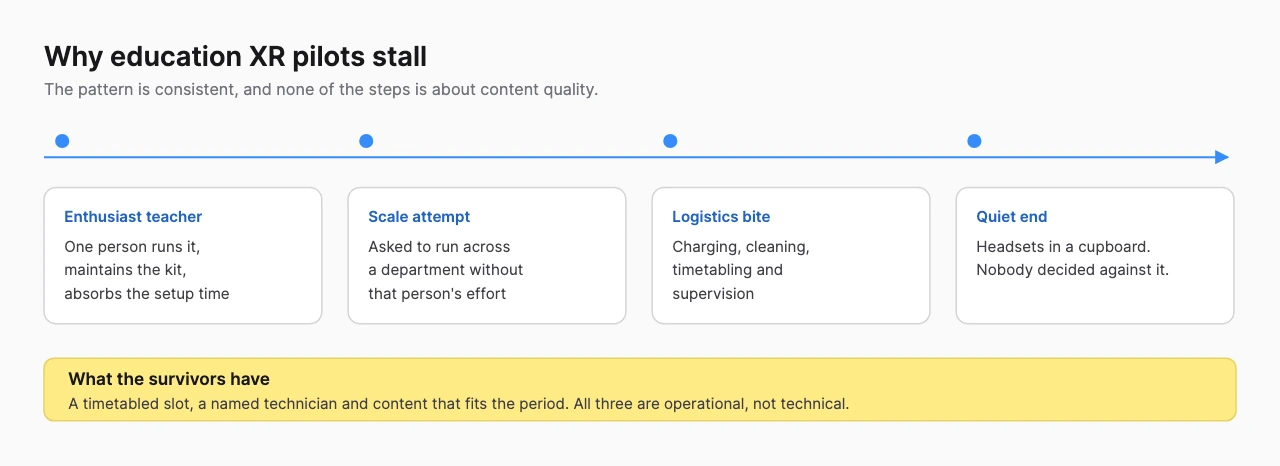
The programs that survive have three things: a timetabled slot, a named technician and content that fits the period. All three are operational rather than technical, and all three are cheaper to arrange at the start than to retrofit.
The pattern they are defending against is consistent. One enthusiastic teacher runs a pilot, maintains the kit personally and absorbs the setup time. The program is then asked to scale across a department without that person's effort. Charging, cleaning, timetabling and supervision all bite at once, and the headsets end up in a cupboard.
That ending is quiet rather than decisive, which is what makes it hard to catch: usage simply tapers until the kit is in a cupboard, and the three arrangements above are what hold it open.
What you can check, and where
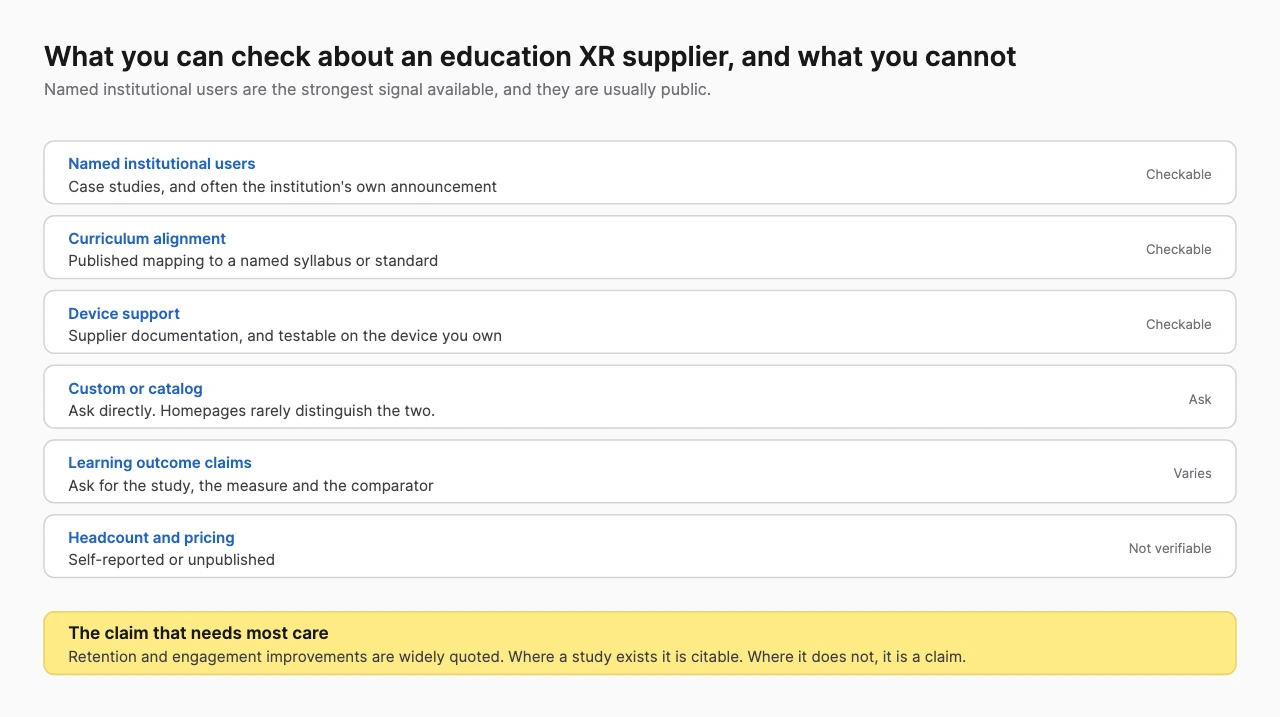
Education has one advantage over most markets in this directory: institutions announce their own deployments. A named university or school district is usually confirmable from the institution's side as well as the vendor's, which makes named client evidence unusually strong here.
Learning outcome claims need the most care. Retention and engagement improvements are widely quoted in this market. Where a study exists, with a named measure and a comparator, it is citable and we cite it. Where the figure rests on an unpublished internal evaluation or a vendor's summary of third-party research, it is a claim rather than evidence, and our rankings treat it as such.
No primary source exists for market size or adoption projections in education XR. They trace to commercial research whose methodology is not public, and this site does not repeat them.
How the rankings below were built
Every list linked here ranks on four published criteria and states what is not a ranking factor, set out in each post under How this list was built.
Across the education lists the recurring four are documented education project work, whether the company builds custom applications or sells a ready-made platform, named education clients and published device support. Each entry states which model it follows, because the two are bought through different processes and different budgets.
The methodology page sets out how entries are assessed.
Where to start
Establish whether you are commissioning content or licensing a catalog, then read the list covering your setting.
- Best VR development companies for education
- Best VR companies for virtual labs and science simulations
- Best XR development companies for universities
- Best VR companies for workforce and vocational training
- Best VR companies for K-12 and classroom learning
- Best companies for VR virtual field trips for schools
The directory lists developers, platforms and software with sourced entries.
Frequently Asked Questions (FAQ)
1. What is XR in education?
XR in education is the use of virtual and augmented reality to teach a subject, practice a procedure or reach a place a class cannot visit. It covers K-12 classrooms, universities, vocational training and laboratory science, which are four different buyers with different constraints.
2. Which companies build VR for education?
They divide by model. Labster and Engage XR license catalogs, Avantis Education builds around managed classroom sets, Transfr works in vocational skills, and Schell Games, Filament Games and Treeview build custom.
3. What is the difference between a virtual lab and a virtual tour of a lab?
In a virtual lab the student performs a procedure and sees the consequence of their decisions, including wrong ones, which makes assessment possible. A 360 degree tour shows the space and nothing the student does changes anything. Only one of the two can carry an assessment.
4. What makes a school VR program last?
Almost always on logistics rather than content. A lesson has to fit a 45-minute period including setup, one teacher supervises thirty students, and someone has to charge, clean and account for the headsets. Programs that survive have a timetabled slot and a named technician.
5. Should a university buy a platform or commission custom content?
It depends on whether the subject is specific to the institution. A widely taught procedure is usually better licensed. A protocol particular to one department cannot be licensed, because nobody else has built it. Buying one while describing the other is the common error.
6. Can you verify education XR learning outcome claims?
Sometimes. Where a published study exists, with a named measure and comparator, it is checkable. Claims resting on unpublished internal evaluations, or on a vendor's summary of third-party research, are claims rather than evidence.
7. How long does an education XR deployment take?
Longer than the build, because curriculum alignment and institutional procurement both run on academic cycles. Missing a procurement window can add a full year, which is why timeline questions should be asked before content questions.
8. What do you own at the end?
It varies by model. A commissioned build is usually owned by the institution, though terms differ. Platform content is licensed and stops when the subscription does. Establish this before signing, because it decides whether the material survives a change of supplier.