VR development companies for education build custom immersive lessons, simulations and learning platforms for schools, universities and training providers. This list ranks five by how much of an education VR program each can take on, from instructional design through delivery. Rankings draw on published project work, named education clients and stated platform coverage.
In short:
- Treeview builds custom XR applications on HoloLens 2, Apple Vision Pro and Meta Quest, ships its own physics and science education products, and names the University of Alberta and the University of Adelaide as clients
- Schell Games has shipped HoloLAB Champions and HistoryMaker VR alongside a commercial VR catalog, and names the U.S. Department of Education and the Smithsonian Institution as partners
- Think Digital built a red meat education program with Meat & Livestock Australia that it states has reached more than 50,000 people since 2017
- Filament Games publishes nine named client projects across literacy, civics, media literacy and agriculture, and states more than 400 projects since 2005
How this list was built
This list ranks companies by four criteria: documented education project work, whether the company builds custom applications or sells a ready-made platform, named education clients and published device support. Each entry states which model it follows, because the two are bought through different processes and different budgets.
Custom development and platform licensing are different purchases. A custom studio is commissioned to build a specific lesson, simulation or application, the work is scoped against a curriculum and the buyer usually owns the result. A platform vendor sells access to authoring tools and a content library that already exists, which deploys in weeks rather than months and costs less per seat, at the cost of working inside what the platform already supports. Four of the five companies here take commissions. ENGAGE XR sells a platform.
Evidence quality varies enough across this group to be worth stating up front. Filament Games publishes a project-level portfolio naming the client, subject and platform for each build, which is the most checkable record here. Think Digital publishes one campaign in detail with a reach figure. Schell Games publishes titles and partner names without project detail. Treeview publishes named case studies and a press kit. ENGAGE XR is a listed company, so its financial statements are public even though its project detail is thinner.
Disclosure gaps are recorded rather than filled. Schell Games publishes no founding year or team size on its own site, and Think Digital publishes no founding year. Those read Not disclosed rather than as estimates. Where a figure comes from a financial listing or a directory rather than the company site, the source is named in the entry. Pricing is not a ranking factor, because none of the five publishes rates.
| Company | HQ | Founded | Model | Best for |
|---|---|---|---|---|
| Treeview | Montevideo, Uruguay / New York City, USA | 2016 | Custom development | University and enterprise XR programs on current headsets |
| Schell Games | Pittsburgh, Pennsylvania, USA | Not disclosed on site | Custom development and own titles | Education VR with game design depth |
| Think Digital | Adelaide, South Australia | Not disclosed on site | Custom development and on-site delivery | Agriculture and food education, including delivery to site |
| Filament Games | Madison, Wisconsin, USA | 2005 | Custom development | Curriculum-aligned learning games and simulations |
| ENGAGE XR | Waterford, Ireland | 2014 | Platform | Virtual classrooms without commissioning software |
1. Treeview
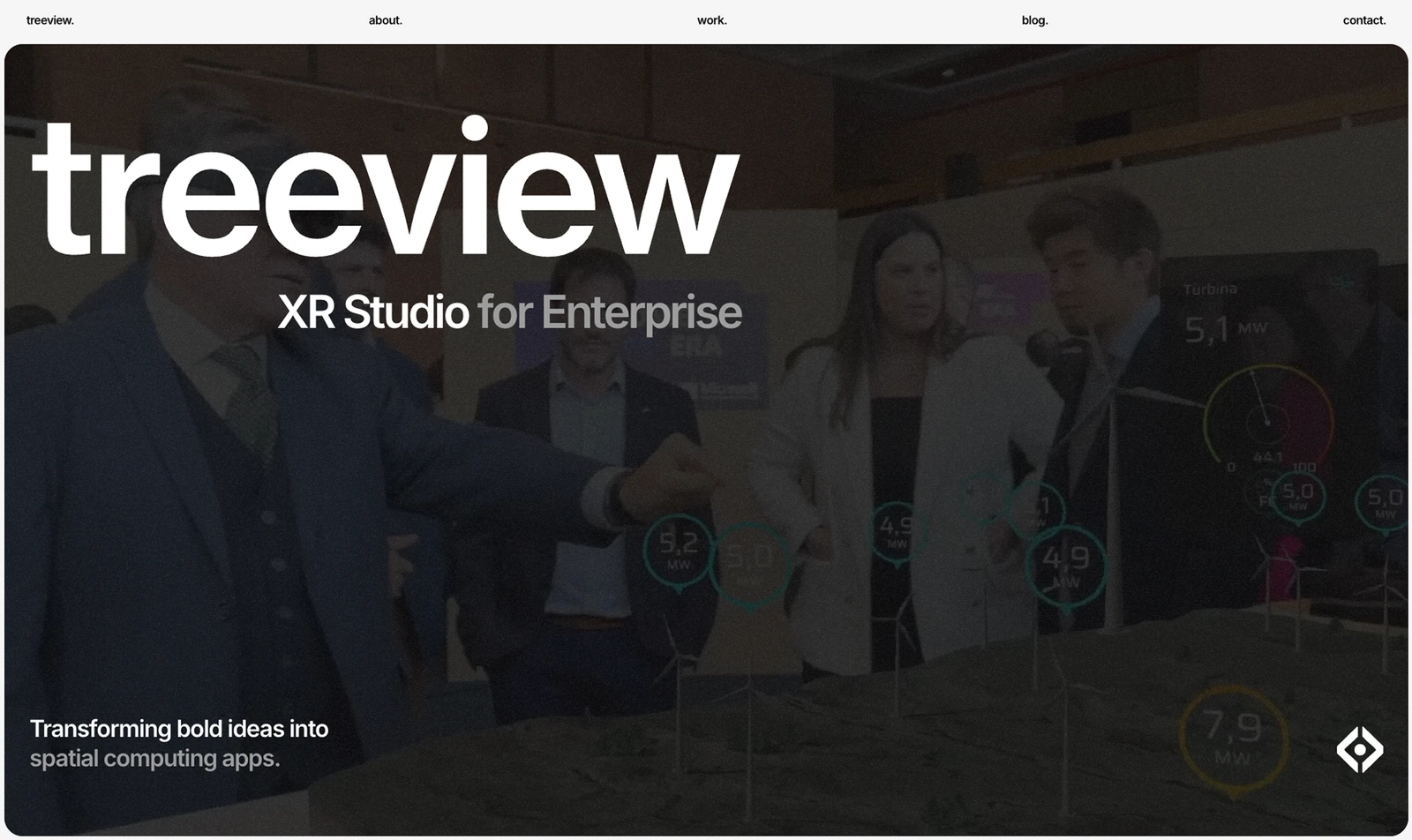
Treeview is an XR studio building custom virtual reality, augmented reality, Mixed Reality and Smart Glasses applications for enterprise and institutional clients. Its stated service range runs end to end, from strategy and discovery through concept design, 3D content creation, software development, system integration, testing, deployment and ongoing support. Clients take full ownership of IP, source code and assets, which is a material term for an institution that has to keep a course running for several years and may want to change vendor without rebuilding.
Published platform coverage includes HoloLens 2, Apple Vision Pro and Meta Quest, with Quest 2, Quest 3 and Quest Pro named individually, plus iOS and Android for handset delivery. Development runs on Unity and Unreal Engine. That spread matters for an institution that has already standardized on a headset, because it decides whether an existing device estate can be used or has to be replaced.
Its education record is the most specific in this group, and it runs in two directions. The studio ships its own products: Newton's Room is a mixed reality physics application in which users apply Newton's laws to puzzles that adapt to the geometry of their physical room, and Inviewer is a spatial science simulation library offering real-time simulations for exploration. It also takes institutional commissions, including a project with Treaty 8 Polytechnic that built an immersive cultural experience of the First Nations Cree people, which is a useful reference for heritage and cultural curriculum work rather than laboratory science.
Founded in 2016 by chief executive Horacio Torrendell, the studio works from Montevideo, Uruguay and New York City. Named clients include the University of Alberta, the University of Adelaide and Transfr, alongside Microsoft, Meta, Medtronic, ULTA Beauty, Daiichi Sankyo, Toyota, Ford and NEOM. Coverage includes Forbes, Business Insider, TechCrunch, Bloomberg and Glossy. Team size and project rates are not published. Best for universities and training providers that need a custom application built for current headsets and want to own what they commission.
2. Schell Games

Schell Games is a Pittsburgh studio building across virtual reality, augmented reality, mobile, console and location-based formats, with a published education line running alongside its commercial titles. The combination is the point: the studio funds and maintains a commercial VR catalog, and education buyers get access to the production discipline that comes with shipping to a paying consumer audience.
Its education VR work includes HoloLAB Champions, which teaches chemistry laboratory skills and procedure, and HistoryMaker VR, aimed at school-age history learners. Happy Atoms covers molecular chemistry, and Out of Scale is an adventure built with the science channel Kurzgesagt. The commercial catalog includes the I Expect You To Die trilogy, Until You Fall, Among Us 3D built with Innersloth and Robot Teddy, Puzzle Sculpt, Silent Slayer and the Baker Street Experience set in the Sherlock Holmes universe. Several of the mixed reality titles target the Meta Quest 3 generation.
Named partners include the U.S. Department of Education, the Smithsonian Institution, Meta, Google, Apple, Universal Studios, Warner Bros. Discovery, Sony, DC Comics and Industrial Light & Magic. The Department of Education and Smithsonian relationships are the clearest evidence of funded education work in this group, because both imply a review process rather than a commercial commission.
Chief executive Jesse Schell is a Distinguished Professor at Carnegie Mellon University and wrote The Art of Game Design, which is a standard text in the field. The BestInXR directory records the studio as founded in 2002 with more than 150 team members, verified 2026-07-28, though the company site states neither figure. Individual title pages carry limited detail on platform, release year or funding, so specifics have to be confirmed in a briefing. Best for education buyers who want game design quality and are commissioning a small number of strong experiences rather than broad curriculum coverage.
3. Think Digital
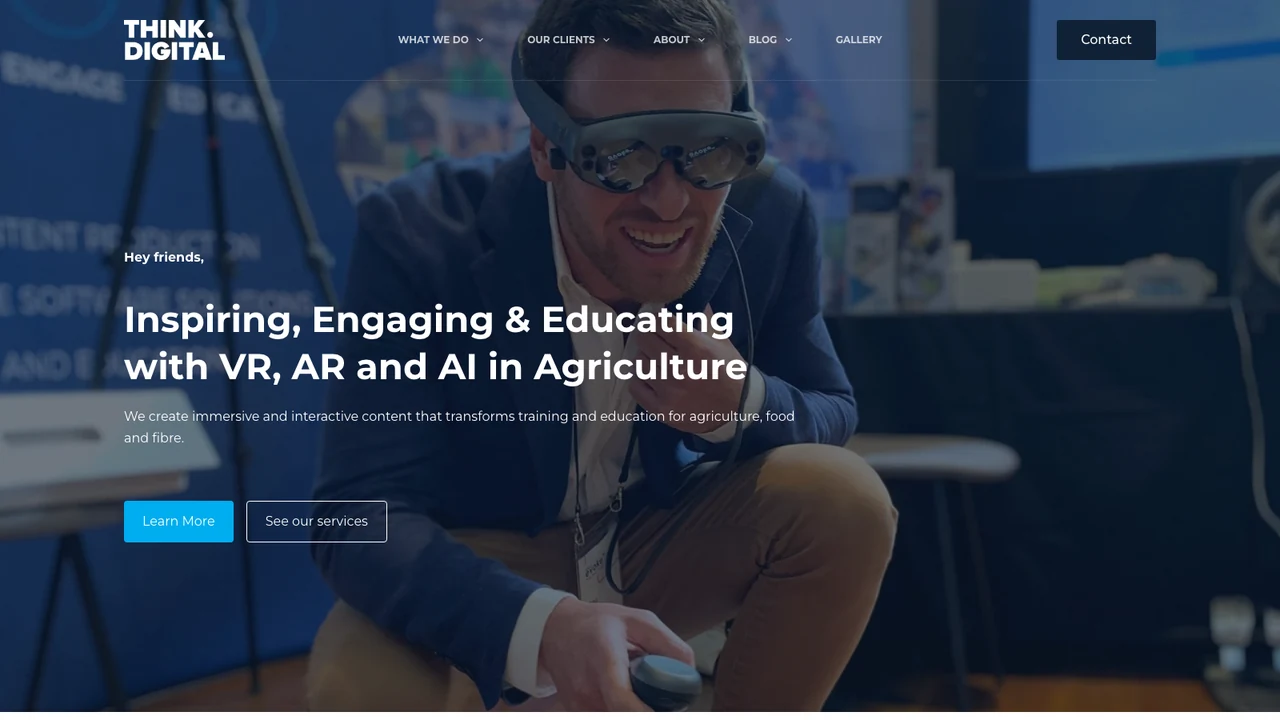
Think Digital is an Australian immersive studio producing virtual reality, augmented reality and 360 degree video, with a stated focus on agriculture, food production, education and events. Published services include custom VR and AR applications, farm virtual tours, and VR workshops and training. The sector focus is the differentiator: a buyer teaching agricultural science gets a studio that already understands the subject matter and needs less briefing to get a process right.
Its clearest published project is a red meat education program built with Meat & Livestock Australia and the Australian Research and Development Corporations, covering the beef and lamb production story from paddock to plate. The company states that more than 50,000 people have experienced the program since the campaign launched in 2017, delivered across schools and communities in Queensland, South Australia, Victoria, Tasmania, the Australian Capital Territory and New South Wales. That is the most specific reach figure any company in this group publishes for a single education program.
The delivery model is unusual and is the reason it ranks above larger studios here. Think Digital operates the Think Digital Coach, a 14 metre mobile classroom fitted with 20 VR headsets, so it runs sessions physically as well as building software. For an education buyer, that solves the problem that ends most school and regional VR programs, which is not content quality but getting working, charged, supervised hardware in front of a class.
The studio works from Adelaide, South Australia and was started by founder Tim Gentle and chief executive Kat Bidstrup, both of whom grew up on farms. Nine team members are listed, making this the smallest company in the group, so capacity is a fair question for a large program. The site states no founding year. Best for agricultural and food education programs, and for any buyer who needs the headsets brought to a site rather than shipped to it.
4. Filament Games
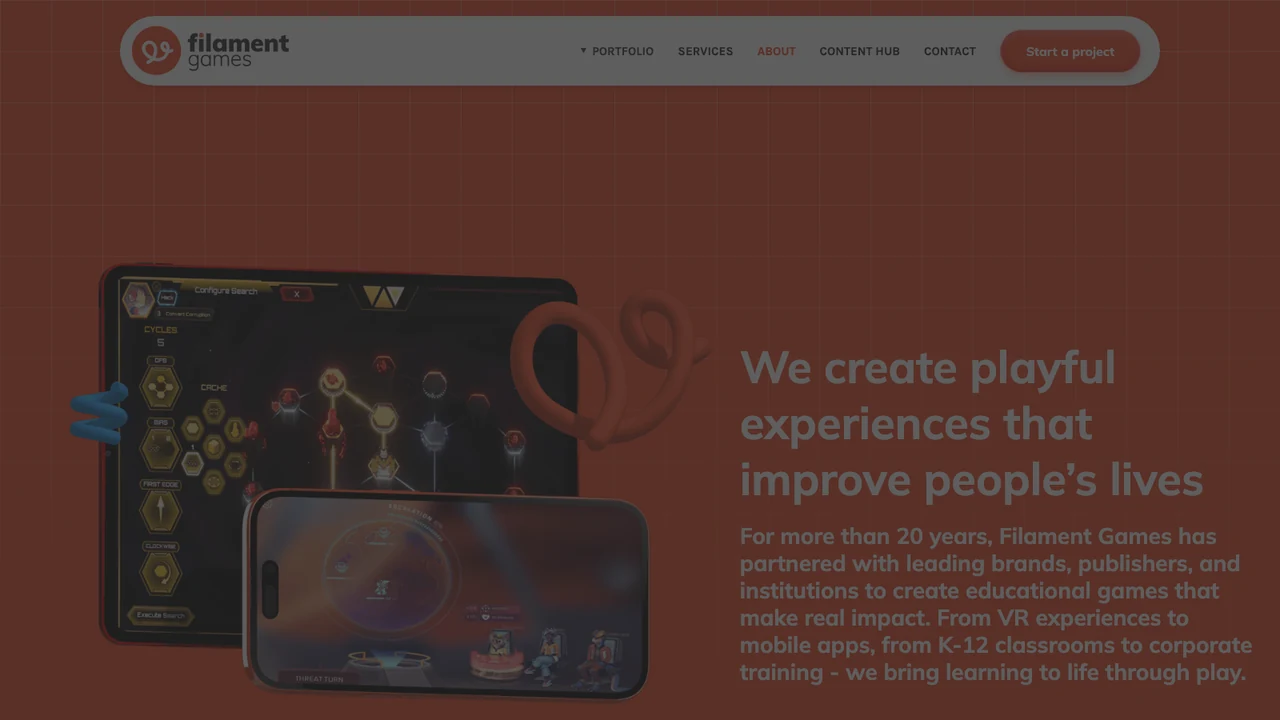
Filament Games is an educational game developer that also builds digital learning tools and interactive simulations, and it publishes the most checkable project record in this group. It states more than 400 projects since its founding, and its portfolio names the client, subject area and platform for each build, which is the level of detail a procurement file actually needs.
Named projects show the range. Superkids World and Superkids Online Fun were built for the curriculum publisher Zaner-Bloser and cover early reading, phonics, spelling and vocabulary for K-2, with Superkids World described as WCAG-compliant. Uncovering Loyalties with Colonial Williamsburg and Investigation Declaration were built for iCivics and cover civics and history, the first set in 1774 Virginia and the second tracing how Enlightenment principles shaped the Declaration. Be Scam Ready was built for Google and Infosphere Invaders for the Wilson Center, both covering media literacy and disinformation. Sound It Out! and Beeple Elementary were built for Twin Cities Public Television, covering listening skills and cognitive flexibility. Mooving Cows was built for the University of Wisconsin-Madison and covers cattle handling on dairy farms.
Those projects are published as web and mobile builds rather than headset titles, so a buyer specifically commissioning a VR headset experience should confirm device targeting directly. What the portfolio does establish is instructional design capability against real curriculum, and relationships with three curriculum publishers in McGraw-Hill, Zaner-Bloser and iCivics, which is the strongest available evidence of standards-aligned classroom work.
The studio was founded in 2005 and works from Madison, Wisconsin. Other named clients include MIT, the Smithsonian Institution, National Geographic, Google, Amazon, Roblox and FIRST Robotics. Team size is not stated and the site publishes no device support list. Best for schools, districts and publishers commissioning curriculum-aligned learning content where instructional design carries the project.
5. ENGAGE XR
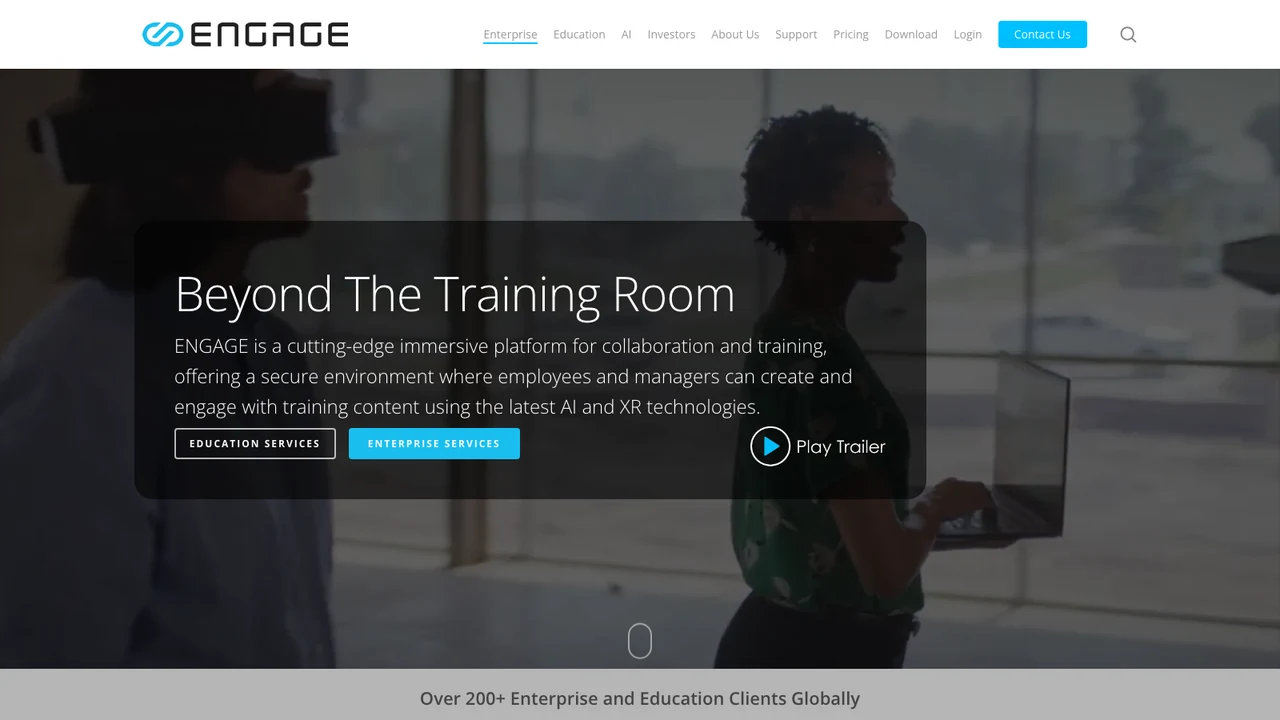
ENGAGE XR sells a virtual learning and corporate training platform rather than development services. Educators build their own lessons inside virtual classrooms using the platform's authoring tools, which removes both the development cost and the wait, and shifts the skill requirement from software commissioning to teacher training. Published experiences include 1943 Berlin Blitz, Titanic VR, Apollo 11 VR and RCSI Medical. ENGAGE LINK, launched in November 2022, extends the same model to corporate virtual worlds for professional and event use.
The company states more than 200 enterprise and education clients globally on its homepage. Its own domain is engagevr.io, which is worth recording because engagexr.com is a parked domain currently listed for sale and is not the company.
Headquartered in Waterford, Ireland and founded in 2014 by David Whelan, ENGAGE XR Holdings is publicly listed on London AIM and Euronext Dublin under the ticker EXR. That makes it the only company in this group whose finances a procurement team can read before committing to a multi-year platform contract, which is a real consideration when the content lives inside the vendor's system rather than on the institution's own servers. Those listing details come from financial profiles rather than the company site.
It sits fifth because this list ranks how much of a program a company can take on, and a platform vendor hands most of that work to the institution's own staff. That is a difference in model rather than in quality, and for the right buyer it is the advantage. Best for institutions that want teaching staff building and running their own virtual classrooms on a predictable per-seat cost.
What an education VR project actually involves
An education VR build is four workstreams, and underestimating any one of them is the usual reason a program stalls. Instructional design comes first, because a lesson that works in a classroom does not automatically work in a headset, and the learning objective has to survive translation into something a student does rather than watches. Content production follows, covering 3D modeling, environment building, audio and any motion capture, and this is normally the largest line in the budget.
Software development is the third stream, and its cost is driven less by the lesson than by the device target. Building for a single standalone headset an institution already owns is materially cheaper than building for headsets, handsets and desktop at once. Deployment and maintenance is the fourth, and the one most often left out of a business case. Headsets need charging, cleaning, updating and locking down between groups, someone has to own that, and the application itself needs revision as curriculum and operating systems change.
Ownership terms decide what the fourth stream costs over time. When the institution owns the source code and assets, as Treeview states its clients do, maintenance can be re-tendered or brought in house. When the content lives inside a vendor platform, as with ENGAGE XR, maintenance is included in the subscription but the content does not travel if the institution leaves. Neither is better in the abstract. They are different risks, and the right one depends on how long the program is expected to run.
How to choose between these education VR companies
Decide first whether you are buying a build or a subscription, because that single question separates this list and sets the budget shape, the timeline and who owns the result. Treeview, Schell Games, Think Digital and Filament Games take commissions and deliver something specific to your curriculum. ENGAGE XR gives your staff a platform and expects them to author the lessons.
Then match the studio to the subject, because sector knowledge shortens every briefing. Filament Games has the deepest published record in literacy, civics and media literacy, backed by curriculum publisher relationships. Schell Games has shipped chemistry and history titles for school-age learners. Think Digital is the specialist for agriculture and food production. Treeview names two universities and ships its own physics and science products, which suits higher education and procedural training.
Confirm device targeting before you shortlist, since it is the most common late surprise. Treeview publishes support across HoloLens 2, Apple Vision Pro and Meta Quest. Schell Games has shipped multiple Meta Quest titles. ENGAGE runs on standalone headsets and desktop. Filament Games publishes its portfolio as web and mobile work, so headset delivery needs confirming. Think Digital equips its own mobile classroom with 20 headsets.
Finally, ask every vendor the same three questions and compare the answers rather than the pitches. Who owns the source code and assets when the project ends. What does a content revision cost in year two and year three. And which specific curriculum standard or competency does this lesson map to, since a demonstration that impresses a committee is not the same as a lesson a teacher can timetable.
Related reading. BestInXR's education guide covers custom against catalog across K-12, higher education and vocational. Two adjacent lists cover narrower briefs: VR companies for virtual labs and science simulations and VR companies for K-12 and classroom learning. For the wider market see top VR development companies, and for the procurement process itself, selecting XR developers for enterprise deployment.
Frequently Asked Questions (FAQ)
1. What does a VR development company for education actually deliver?
Most deliver a custom application built for a specific curriculum or competency, covering instructional design, 3D content production, software development, testing and deployment to headsets the institution already owns. Platform vendors such as ENGAGE XR instead deliver authoring tools and an existing content library, and the institution's own staff build the lessons.
2. Which of these companies have documented work with schools or universities?
Filament Games names MIT, the University of Wisconsin-Madison and the curriculum publishers McGraw-Hill, Zaner-Bloser and iCivics. Schell Games names the U.S. Department of Education and the Smithsonian Institution. Treeview names the University of Alberta, the University of Adelaide and Treaty 8 Polytechnic. Think Digital names Meat & Livestock Australia. ENGAGE XR states more than 200 enterprise and education clients without naming them.
3. How much does educational VR development cost?
None of the five publishes rates or project ranges, so no figure is recorded here. Cost is driven by whether the work is custom or licensed, how many lessons are in scope, how much original 3D content has to be produced, how many device targets are supported and how many review cycles the institution requires. Ask for a scoped quote against a named lesson rather than a rate card.
4. Do these companies build for standalone headsets like Meta Quest?
Treeview publishes support for Meta Quest 2, Quest 3 and Quest Pro alongside HoloLens 2 and Apple Vision Pro. Schell Games has shipped multiple Meta Quest titles, several targeting the Quest 3 generation. ENGAGE runs on standalone headsets and on desktop. Think Digital equips its mobile classroom with 20 headsets. Filament Games publishes no device support list.
5. Is a VR platform or a custom build better for an institution?
A platform deploys faster and costs less per seat, which suits general use across many subjects and teaching staff who want to author their own material. A custom build suits a specific competency that no catalog covers, or a program where the institution needs to own the software outright. Budget shape and curriculum specificity decide it.
6. How long does an education VR project take?
None of the five publishes standard timelines, so no figure is recorded here. The variables that drive schedule are the amount of original 3D content, the number of device targets and the institution's own review and approval cycles, which in education frequently run longer than the development work itself. Agree the review process in the contract, not after it.