VR companies for K-12 build immersive lessons and classroom systems for primary and secondary schools, where the constraints are a timetable, a teacher and a class set of devices. This list ranks five by classroom fit, published reach into schools and whether the company builds custom lessons or supplies ready content. Rankings draw on published figures and named clients.
In short:
- Treeview builds custom XR applications on HoloLens 2, Apple Vision Pro and Meta Quest, and ships Newton's Room, a mixed reality physics app for school-age learners
- Filament Games publishes nine named client projects for curriculum publishers, public television and universities, and states more than 400 projects since 2005
- Schell Games has shipped HoloLAB Champions, HistoryMaker VR and Happy Atoms, and names the U.S. Department of Education as a partner
- Avantis Education states ClassVR reaches over 200,000 classrooms and 2,000,000 students in more than 90 countries, on hardware it manages
How this list was built
This list ranks companies by four criteria: fit with how a school day actually runs, published reach into schools, whether the company builds to order or supplies existing content and evidence of curriculum alignment. Classroom fit is weighted first, because a K-12 deployment fails on logistics far more often than on content quality.
K-12 VR carries constraints enterprise VR does not. A lesson has to fit a period of roughly 45 minutes including setting up and packing away. One teacher supervises thirty students rather than one facilitator supporting one user. Headsets have to be charged, cleaned between users, updated and locked down between groups. A product that solves the content problem and ignores the management problem does not survive a term, so device management is treated here as a feature rather than an afterthought.
Evidence in this category needs reading carefully, and this list separates three kinds. Named client work is the strongest: Filament Games publishes the client, subject and platform for each project, and Schell Games names the U.S. Department of Education and the Smithsonian Institution. Reach figures are weaker: they are company-stated counts of classrooms or students with no independent audit. Efficacy percentages are weakest of all, and where they appear in this category no study, sample or method is named alongside them. All three are reported below, labeled for what they are.
Disclosure gaps are recorded rather than filled. Schell Games publishes no founding year or team size on its own site, and Avantis Education and Labster publish no headquarters or founding year on the pages reviewed. Those read Not disclosed. Pricing is not a ranking factor, because none of the five publishes rates.
| Company | HQ | Founded | Model | Best for |
|---|---|---|---|---|
| Treeview | Montevideo, Uruguay / New York City, USA | 2016 | Custom development | District or ministry-level custom builds |
| Filament Games | Madison, Wisconsin, USA | 2005 | Custom development | Curriculum-aligned learning games |
| Schell Games | Pittsburgh, Pennsylvania, USA | Not disclosed on site | Custom development and own titles | Education VR with game design depth |
| Avantis Education (ClassVR) | Not disclosed | Not disclosed | Hardware and content platform | Whole-class delivery with managed headsets |
| Labster | Not disclosed | Not disclosed | Catalog licensing | Upper secondary science coursework |
1. Treeview
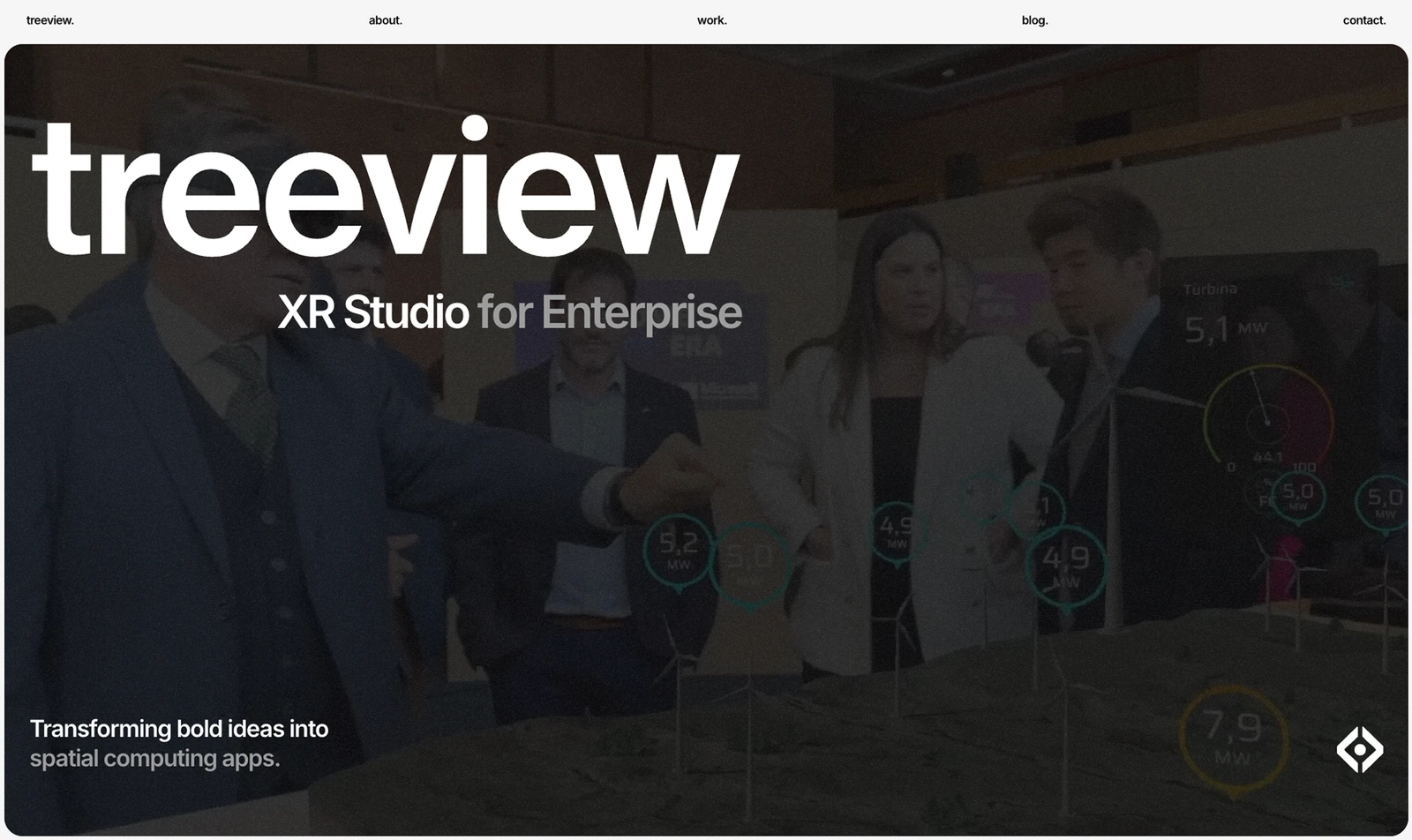
Treeview is an XR studio building custom virtual reality, augmented reality, Mixed Reality and Smart Glasses applications for institutional clients. Clients take full ownership of IP, source code and assets, which for a district or a ministry means the lesson can be maintained, extended or re-tendered without rebuilding it. Published platform coverage includes HoloLens 2, Apple Vision Pro and Meta Quest, with Quest 2, Quest 3 and Quest Pro named individually, plus iOS and Android.
Two in-house products are aimed at school-age learning. Newton's Room is a mixed reality physics application in which users apply Newton's laws to puzzles that adapt to the geometry of their physical room, which is closer to how a science teacher would want the subject taught than a screen-based demonstration: the room becomes the apparatus and the student is inside the problem. Inviewer is a spatial science simulation library offering real-time simulations for exploration.
A project with Treaty 8 Polytechnic built an immersive cultural experience of the First Nations Cree people, which is a useful reference for humanities and cultural curriculum rather than science, and for any school system with a heritage or indigenous education mandate.
Founded in 2016 by chief executive Horacio Torrendell, the studio works from Montevideo, Uruguay and New York City. Named clients include the University of Alberta, the University of Adelaide, Transfr, Microsoft, Meta, Medtronic, Toyota, Ford, ULTA Beauty, Daiichi Sankyo and NEOM. Its client work is weighted toward enterprise and higher education rather than primary classrooms, so for K-12 it fits a district, a publisher or a ministry commissioning something specific rather than a single school buying a class set. Team size and rates are not published. Best for large education buyers commissioning a custom build they intend to own.
2. Filament Games
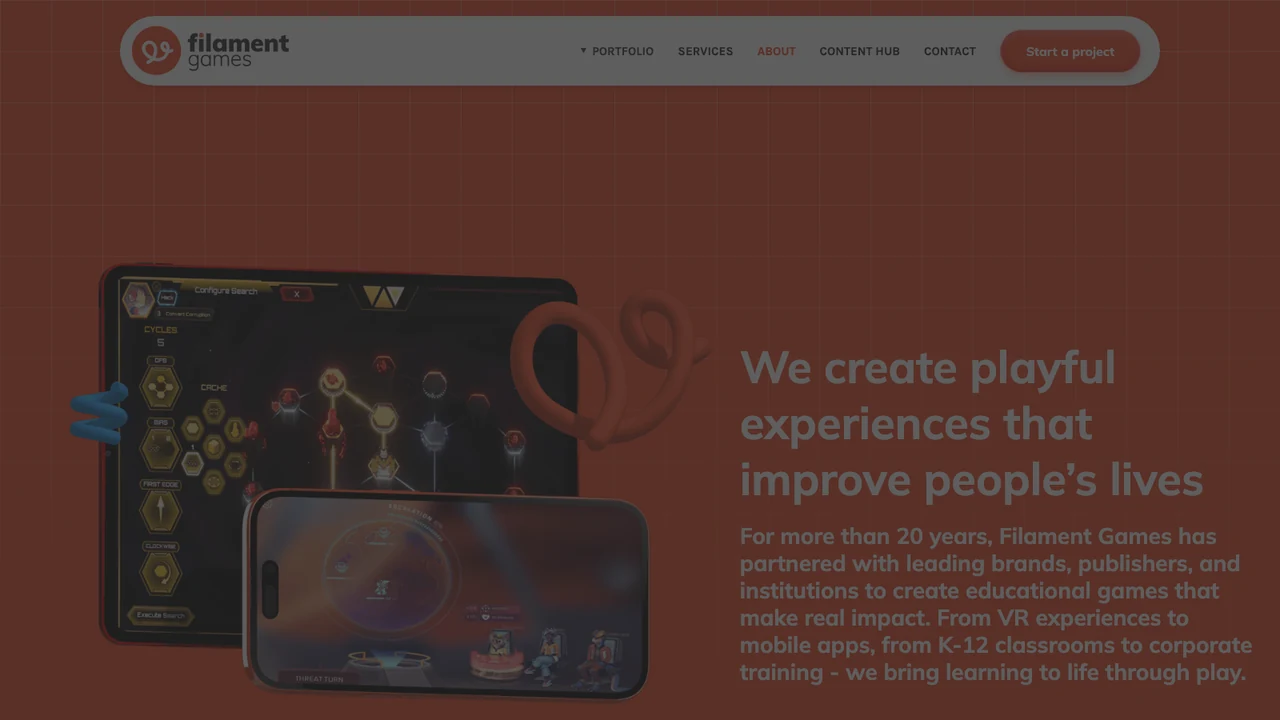
Filament Games builds educational games, digital learning tools and interactive simulations, and states more than 400 projects since its founding. Of the five here it has the longest published record of building specifically for learning rather than adapting entertainment work toward education, and its portfolio is the most useful document in this list for a curriculum committee.
The named projects show both range and depth against real curriculum. Superkids World and Superkids Online Fun were built for the curriculum publisher Zaner-Bloser, covering early reading, phonics, spelling and vocabulary for K-2, with Superkids World published as WCAG-compliant, which matters for any district with accessibility obligations. Uncovering Loyalties with Colonial Williamsburg and Investigation Declaration were built for iCivics, the first set in 1774 Virginia and the second tracing how Enlightenment principles shaped the Declaration. Be Scam Ready was built for Google and Infosphere Invaders for the Wilson Center, both covering media literacy and disinformation, which is curriculum many districts have added recently and have little material for. Sound It Out! and Beeple Elementary were built for Twin Cities Public Television.
Those builds are published as web and mobile rather than headset titles. For a K-12 buyer that is frequently an advantage rather than a limitation, because it removes the hardware problem entirely and runs on the devices a school already manages.
The studio was founded in 2005 and works from Madison, Wisconsin. Other named clients include MIT, the Smithsonian Institution, National Geographic, Amazon, Roblox, FIRST Robotics and the University of Wisconsin-Madison. Relationships with three curriculum publishers, McGraw-Hill, Zaner-Bloser and iCivics, are the strongest available evidence of standards-aligned classroom work. Team size and device support are not published. Best for schools, districts and publishers commissioning curriculum-aligned content.
3. Schell Games

Schell Games builds across virtual reality, augmented reality, mobile, console and location-based formats and maintains an education line alongside commercial titles. The education work benefits from the commercial practice: a studio shipping paid VR titles to a consumer audience carries production and usability standards that classroom software often lacks.
Its school-age titles are specific. HoloLAB Champions covers chemistry laboratory skills and procedure, HistoryMaker VR covers history, and Happy Atoms covers molecular chemistry. Out of Scale is an adventure built with the science channel Kurzgesagt. The commercial catalog includes the I Expect You To Die trilogy, Until You Fall, Among Us 3D built with Innersloth and Robot Teddy, Puzzle Sculpt, Silent Slayer and the Baker Street Experience, with several mixed reality titles targeting the Meta Quest 3 generation.
Named partners include the U.S. Department of Education, the Smithsonian Institution, Meta, Google, Apple, Universal Studios, Warner Bros. Discovery, Sony, DC Comics and Industrial Light and Magic. The Department of Education and Smithsonian relationships are the clearest evidence of funded education work in this group, because both imply a review process rather than a straightforward commercial commission.
Chief executive Jesse Schell is a Distinguished Professor at Carnegie Mellon University and wrote The Art of Game Design, a standard text in the field. The BestInXR directory records the studio as founded in 2002 with more than 150 team members, verified 2026-07-28, though the company site states neither figure, and individual title pages carry limited detail on platform, release year or funding. It sits third for K-12 because its education titles are individually strong but fewer in number than the catalogs above and below it. Best for schools commissioning a small number of high-quality VR lessons rather than broad coverage.
4. Avantis Education
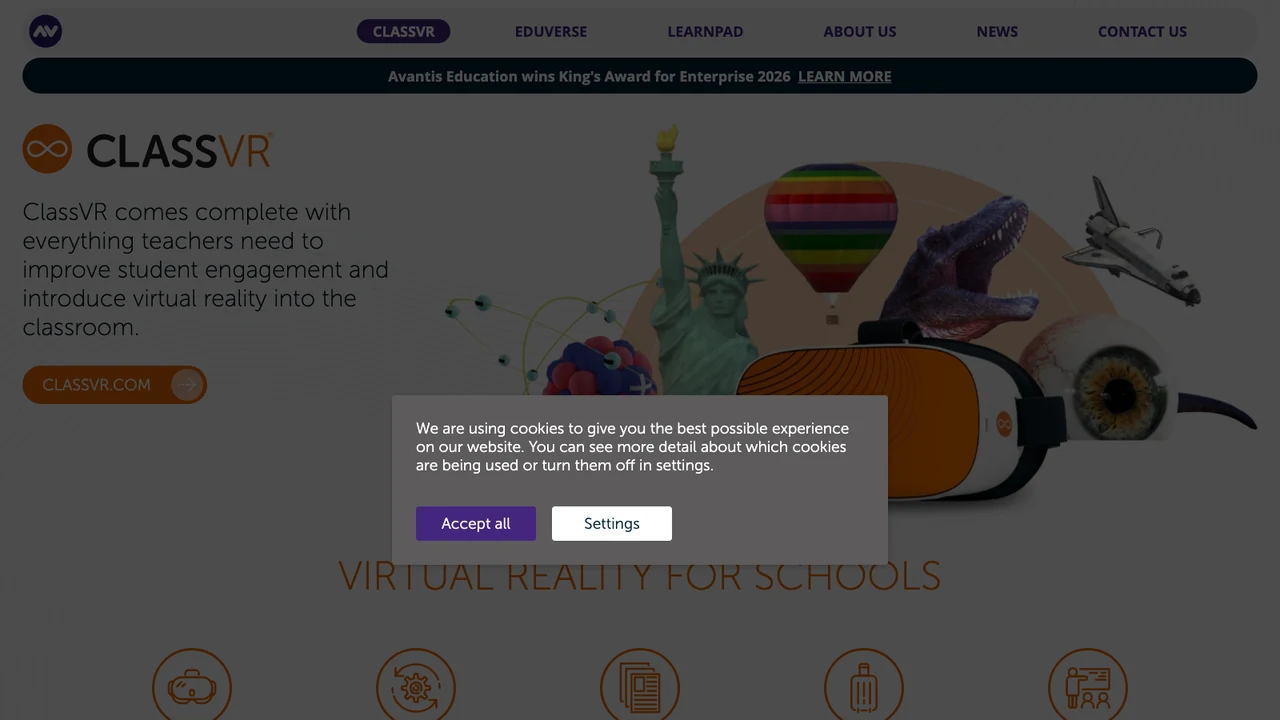
Avantis Education makes ClassVR, built around whole-class teaching rather than individual headset use, plus Eduverse and the Learnpad tablet range. The headset is published as the ClassVR Xplorer and the operating model is the reason it belongs in a K-12 list at all: a teacher portal with simple controls drives a class set through the same content simultaneously, and the headsets arrive managed rather than as loose consumer hardware.
That is a hardware and operations product as much as a content one, and in schools that is usually the binding constraint. Charging, hygiene between users, software updates and device lockdown are the tasks that quietly end pilots, and buying them as part of the system rather than as a technician's unpaid extra work is what makes a program survive a second term.
The company states its products reach more than 200,000 classrooms and over 2,000,000 students across more than 90 countries, and describes content as curriculum-aligned for students of all ages. It also publishes efficacy figures, citing retention of up to 75 percent and exam improvement of up to 20 percent. No study, sample or method is named alongside those figures on the pages reviewed, so they are recorded here as company claims. Any district putting them in a board paper should ask for the underlying research first.
Detailed headset specifications, content library size, specific curriculum subjects, named school customers, headquarters, founding year and team size are not published on the pages reviewed, and custom development is not among the advertised services. Best for schools and districts that want content and managed headsets from one supplier and cannot staff a device rollout themselves.
5. Labster
Labster licenses more than 300 laboratory simulations across biology, chemistry, physics and health sciences, with automated grading, unlimited attempts and quiz customization. In a K-12 context it fits upper secondary science, where students run experiments a school laboratory cannot safely or affordably stage, rather than general classroom use across subjects.
Unlimited attempts is the feature that matters most at this level. A school laboratory rations reagents, equipment and supervised time, so a student typically gets one attempt at a titration or a dissection. A simulation that allows repetition until the method is understood does something the physical laboratory structurally cannot, and for a stretched science department that is a stronger argument than cost.
Its published users are mostly higher education, including Johns Hopkins, ETH Zurich, University College London, the University of Washington, SUNY, Tulane University and Virginia's Community Colleges, which is why it ranks fifth on a K-12 list despite a deep catalog. A school buying Labster is buying into a university-oriented library, and the mapping to a secondary syllabus needs checking module by module rather than assumed. One published case study reports an online completion rate rising from 66 percent to 80 percent after implementation, which is a single institution's result reported by the vendor rather than a controlled study.
Standard Labster simulations are not indicated as requiring VR headsets, which for a school with no headset estate removes the largest cost in the business case. UbiSim by Labster is a separate VR product for nursing training. The company publishes no headquarters or founding year on the pages reviewed and custom development is absent from its stated services. Best for secondary science departments that need laboratory coverage without a laboratory.
What it takes to run VR through a school week
The pilot is not the hard part. Almost every school VR pilot goes well, because it is run by the one enthusiastic teacher who championed it, with a technician standing by and a fresh set of charged headsets. The second term is where programs fail, and the reasons are consistent enough to plan for.
Ownership is the first. Someone has to be accountable for charging, cleaning, updating and storing the hardware, and unless that is written into a role it becomes unpaid work for whoever cares most. Avantis Education sells the managed-hardware answer to this. Labster and Filament Games sidestep it by running on devices the school already has. The custom studios assume the school has solved it.
Timetabling is the second. A 45-minute period has to absorb distribution, fitting, the lesson, removal and cleaning. A lesson designed as a 30-minute experience does not fit, and a lesson that requires individual pacing does not work when one teacher supervises thirty students on a bell schedule.
Safeguarding and age suitability is the third and the one most often discovered late. Headset manufacturers set their own minimum age guidance and it has changed more than once, so verify the current policy for the specific device against your safeguarding requirements rather than relying on what was true at the last purchase. Content rated for a consumer audience also needs reviewing against school standards even when the subject matter is educational.
Evidence is the fourth. If the lesson is meant to count for anything, decide before purchase how completion and attainment are recorded and whether that reaches the school's existing systems. Labster publishes automated grading; for the others it is a scoping question.
How to choose between these K-12 VR companies
Answer the device management question before the content question, because it decides more outcomes than content quality does. Avantis Education is the only company here supplying managed class-set hardware alongside its content. Labster and Filament Games largely avoid the problem by running on existing devices. The three custom studios assume the school already has devices and a plan for running them.
Then decide whether you need coverage or depth. Avantis and Labster give breadth immediately across many classes or many experiments. Filament Games and Schell Games give a smaller number of stronger, standards-aligned experiences. Treeview builds one thing precisely, which suits a district or ministry commission rather than a single school budget.
Check curriculum alignment evidence rather than accepting the phrase. Filament Games names three curriculum publishers and publishes the subject and platform for each project. Schell Games names the U.S. Department of Education and has shipped chemistry and history titles. Treeview ships its own physics and science products. Avantis describes content as curriculum-aligned without naming the standards or partners on the pages reviewed, so ask which framework and which grade bands.
Finally, be disciplined about efficacy claims. Two companies in this category publish improvement percentages without naming a study. Those numbers may well be defensible, but until the research is produced they are marketing rather than evidence, and a business case built on them is fragile in exactly the meeting where it matters.
Related reading. BestInXR's education guide covers custom against catalog across K-12, higher education and vocational. VR development companies for education covers the wider education market including higher education, and VR companies for virtual labs and science simulations goes deeper on science specifically. For the wider market, see top VR development companies.
Frequently Asked Questions (FAQ)
1. Is VR effective in K-12 classrooms?
Effectiveness depends on whether the lesson replaces something a school cannot otherwise do, such as a hazardous experiment or an inaccessible location. Evidence on general subject teaching is mixed and is not settled by any source reviewed here, and the efficacy percentages published in this category name no study or method. Treat VR as a tool for specific lessons rather than a general upgrade.
2. How do schools manage a class set of headsets?
Avantis Education sells ClassVR as a managed class-set system with teacher control over what students see. Schools using other providers need their own plan for charging, hygiene, software updates and device lockdown between groups, and someone accountable for it, which is usually the deciding operational cost rather than the licensing.
3. Which of these companies show curriculum-aligned work?
Filament Games names the curriculum publishers McGraw-Hill, Zaner-Bloser and iCivics and publishes the subject and platform for each project. Schell Games names the U.S. Department of Education and has shipped HoloLAB Champions, HistoryMaker VR and Happy Atoms. Treeview ships Newton's Room and Inviewer. Avantis Education describes its content as curriculum-aligned without naming standards or partners on the pages reviewed.
4. Do these lessons need VR headsets?
Not all of them. Filament Games publishes its portfolio as web and mobile builds. Standard Labster simulations are not indicated as requiring a headset. Avantis sells its own managed headsets. Schell Games ships headset titles, several for the Meta Quest 3 generation. Treeview publishes coverage across HoloLens 2, Apple Vision Pro and Meta Quest.
5. Can a single school commission a custom VR lesson?
It is possible but rarely economical. Custom development from Treeview, Filament Games or Schell Games is normally funded at district, publisher or ministry level, where the cost spreads across many schools. A single school with a class-set budget is usually better served by Avantis Education or Labster.
6. What does classroom VR cost?
None of the five publishes rates, so no figure is recorded here. Costs fall into three parts: hardware, content licensing or development, and the staff time to run the program. The third is the one most often left out of a budget and the one that most often ends the program.