VR companies for virtual labs build simulated laboratory environments where students run experiments that would be too costly, too slow or too hazardous to stage physically. This list ranks five by whether they build custom simulations or license an existing catalog, the science coverage each publishes and the named institutions using them. Rankings draw on published figures and client lists.
In short:
- Treeview builds custom simulations on HoloLens 2, Apple Vision Pro and Meta Quest, and ships Inviewer, its own spatial science simulation library
- Filament Games publishes nine named client projects across science, civics and literacy, and states more than 400 projects since 2005
- Avantis Education states ClassVR reaches over 200,000 classrooms and 2,000,000 students in more than 90 countries
- Labster licenses more than 300 simulations across biology, chemistry, physics and health sciences to universities including Johns Hopkins, ETH Zurich and University College London
How this list was built
This list ranks companies by four criteria: whether the company builds custom simulations or licenses a catalog, published science and laboratory coverage, named institutional users and device support. The custom and catalog distinction is recorded first for every entry, because it decides the timeline, the budget shape and how much of the work falls on the institution.
A virtual lab is a simulated laboratory environment where a student performs a procedure and sees the result of their decisions, including the wrong ones. It differs from a 360 degree tour of a laboratory, which shows a space without letting anyone act inside it, and from a demonstration video, which shows a correct procedure without ever letting the student get it wrong. That distinction is the whole pedagogical argument for the format: the learning happens in the error, and a video cannot produce one.
Two of the five companies here build to order, two license a catalog that already exists, and one builds workforce simulations that are not science laboratories at all and is described on those terms below. Device requirements vary more than buyers expect. Some virtual labs run in a browser on existing hardware, some require a managed class set of headsets, and the difference is usually larger than the content difference in a first-year budget.
Disclosure is uneven and the gaps are recorded rather than filled. Labster and Avantis Education publish no headquarters or founding year on the pages reviewed. Those read Not disclosed rather than as estimates. Reach figures and efficacy percentages are attributed to the company stating them, because none of the ones published in this category names a study, a sample or a method. Pricing is not a ranking factor, because none of the five publishes rates.
| Company | HQ | Founded | Model | Best for |
|---|---|---|---|---|
| Treeview | Montevideo, Uruguay / New York City, USA | 2016 | Custom development | Bespoke laboratory or procedural simulations |
| Filament Games | Madison, Wisconsin, USA | 2005 | Custom development | Curriculum-aligned science simulations |
| Avantis Education (ClassVR) | Not disclosed | Not disclosed | Hardware and content platform | Whole-class science with managed headsets |
| Labster | Not disclosed | Not disclosed | Catalog licensing | University laboratory courses without a laboratory |
| Transfr | New York, New York, USA | Not disclosed | Catalog and implementation | Vocational skills simulation rather than science labs |
1. Treeview
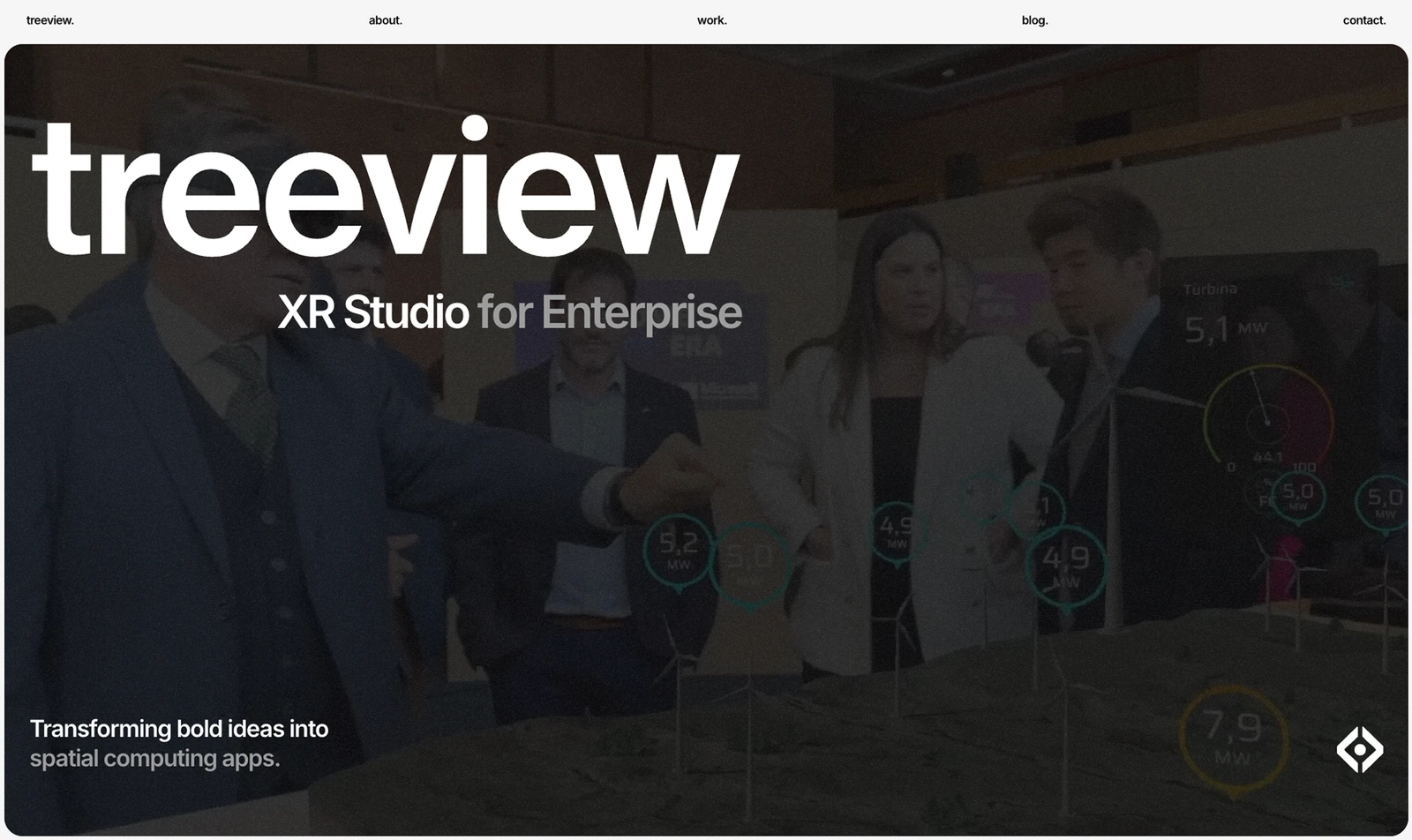
Treeview is an XR studio building custom virtual reality, augmented reality, Mixed Reality and Smart Glasses applications to order. For a virtual laboratory this means the simulation is written around a specific protocol, instrument or safety procedure rather than selected from a catalog, which is the deciding factor when the equipment is unusual or the procedure is institution-specific. Clients take full ownership of IP, source code and assets.
It is the only company in this group that ships its own science simulation products as well as taking commissions. Inviewer is a spatial science simulation library offering real-time simulations for immersive exploration and discovery. Newton's Room is a mixed reality physics application in which users apply Newton's laws to puzzles that adapt to the geometry of their physical room, which is a genuinely different pedagogical model from a screen-based simulation because the room becomes the apparatus.
Published platform coverage includes HoloLens 2, Apple Vision Pro and Meta Quest, with Quest 2, Quest 3 and Quest Pro named individually, plus iOS and Android. Development runs on Unity and Unreal Engine. For a science department that has already bought headsets, that coverage decides whether the existing estate can be used.
Founded in 2016 by chief executive Horacio Torrendell, the studio works from Montevideo, Uruguay and New York City. Named clients include the University of Alberta and the University of Adelaide in higher education, Daiichi Sankyo and Medtronic in regulated medical and pharmaceutical work, and Microsoft, Meta, Toyota, Ford, ULTA Beauty, Transfr and NEOM elsewhere. The pharmaceutical and medical device clients are the relevant reference for laboratory and procedural accuracy, since both involve processes that have to be depicted correctly rather than attractively. Coverage includes Forbes, Business Insider, TechCrunch, Bloomberg and Glossy. Team size and rates are not published. Best for departments with a protocol no catalog covers, or a procedure specific to their own instruments.
2. Filament Games
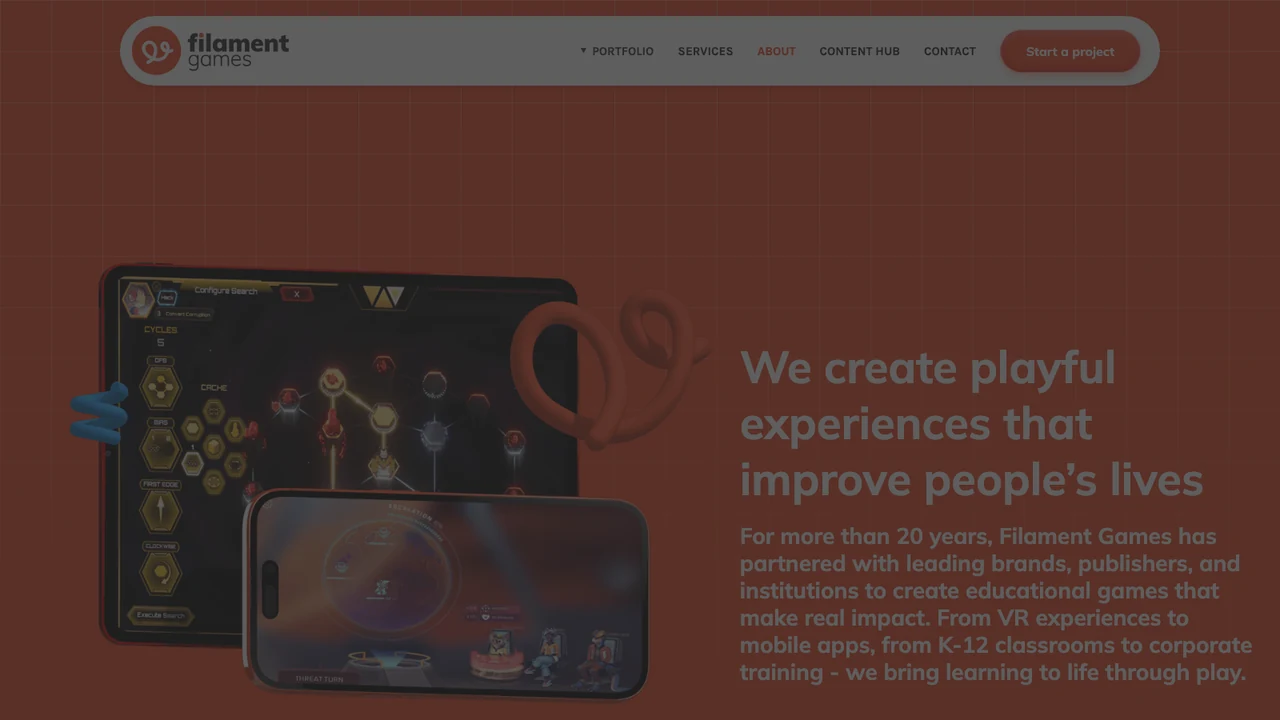
Filament Games builds educational games, digital learning tools and interactive simulations, and states more than 400 projects since its founding. Its simulations are built around curriculum standards, which is the difference between a science game and a science lesson a department can actually adopt and defend to an accreditor.
Its published portfolio names the client, subject and platform for each build, which is the most checkable record in this group. Mooving Cows was built for the University of Wisconsin-Madison and simulates best practice in cattle handling on dairy farms, which is the closest published example here of a procedural science simulation built for a university. Sound It Out! for Twin Cities Public Television covers listening skills and sound identification through collecting and editing environmental sounds. Other named projects span civics and history for iCivics, media literacy for Google and the Wilson Center, and early literacy for the curriculum publisher Zaner-Bloser.
Those projects are published as web and mobile builds, so a department specifically commissioning a headset experience should confirm device targeting directly. What the portfolio establishes is instructional design capability against real curriculum and a working relationship with three curriculum publishers in McGraw-Hill, Zaner-Bloser and iCivics, which is the strongest available evidence that the output maps to something a department is already required to teach.
The studio was founded in 2005 and works from Madison, Wisconsin. Other named clients include MIT, the Smithsonian Institution, National Geographic, Google, Amazon, Roblox and FIRST Robotics. Team size is not stated and no device support list is published. Best for schools, universities and publishers that need a science simulation mapped to a standard rather than a generic laboratory environment.
3. Avantis Education
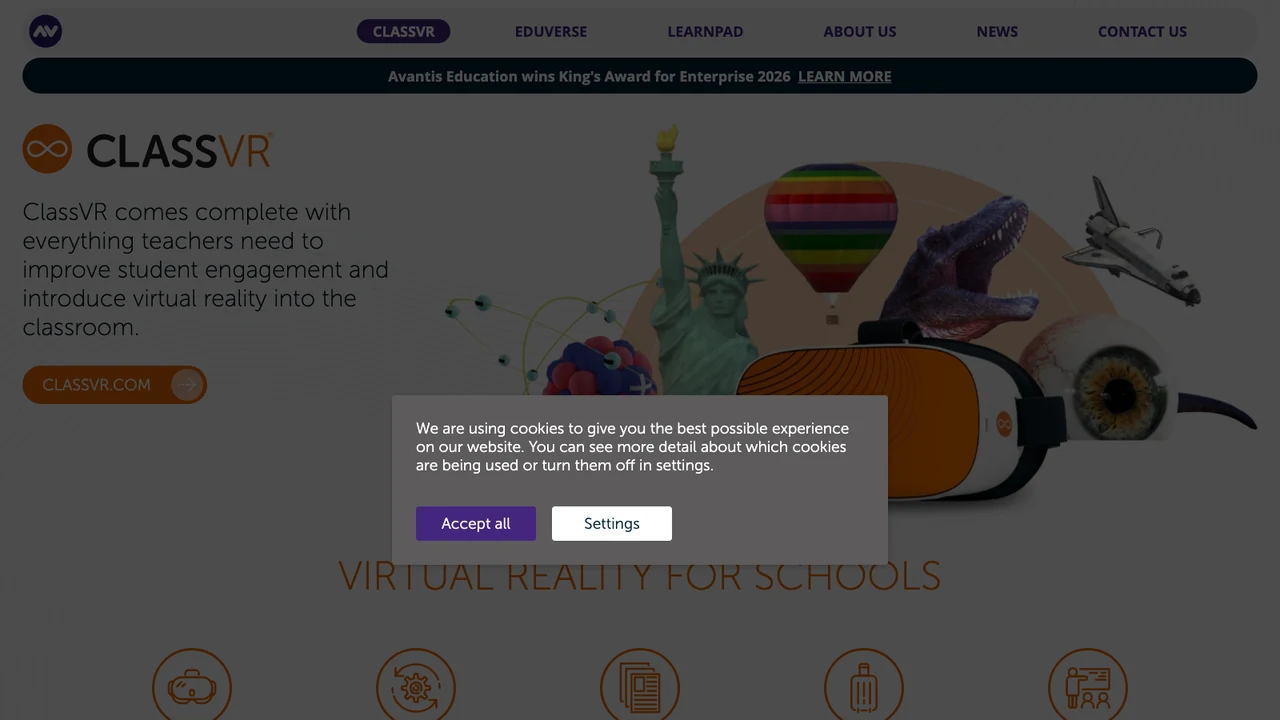
Avantis Education makes ClassVR, a headset and content system built for whole-class use rather than individual exploration, alongside Eduverse and the Learnpad tablet line. The headset is published as the ClassVR Xplorer, and the operating model is the distinguishing feature: a teacher portal with simple controls drives a class set through the same content at the same time, which fits a timetabled period in a way that unsupervised individual use does not.
That model solves the operational problem rather than the content problem, and in schools the operational problem is usually the one that ends a program. The headsets arrive managed rather than as loose consumer hardware, which removes the charging, updating and lockdown burden that falls on a technician nobody budgeted for.
The company states its products reach more than 200,000 classrooms and over 2,000,000 students across more than 90 countries, and describes its content as curriculum-aligned for students of all ages. It also publishes efficacy figures, citing retention of up to 75 percent and exam improvement of up to 20 percent. Those are company-stated and no study, sample or method is named alongside them on the pages reviewed, so they are recorded here as claims rather than findings. A department building a business case on them should ask for the underlying research before quoting them upward.
Detailed headset specifications, content library size, specific curriculum subjects, named school customers, headquarters, founding year and team size are not published on the pages reviewed. Custom development is not among the advertised services. Best for schools and departments running science across many classes that need managed hardware and content from one supplier.
4. Labster
Labster licenses more than 300 laboratory simulations covering biology, chemistry, physics and health sciences, with automated grading, unlimited attempts and quiz customization. The catalog model means a course can be running within a term, which no custom build can match, and the tradeoff is that the experiment is the one Labster already made.
Unlimited attempts is the pedagogically interesting feature rather than a convenience. A physical teaching laboratory rations reagents, equipment and supervised hours, so a student typically gets one attempt at a procedure. A simulation that allows repetition until the method is understood is doing something the physical laboratory structurally cannot, which is a stronger argument for adoption than cost substitution alone.
Institutions shown on its site include Johns Hopkins, ETH Zurich, University College London, the University of Washington, the University of Florida, Case Western Reserve University, SUNY, Tulane University, Florida State University and Virginia's Community Colleges. Published case studies name Yavapai College, the Massachusetts College of Pharmacy and Health Sciences, the University of Eastern Finland and Dundalk Institute of Technology, and one reports an online completion rate rising from 66 percent to 80 percent after implementation. That is the most specific outcome figure published in this category, though it is a single institution's result reported by the vendor rather than a controlled study.
Standard Labster simulations are not indicated as requiring VR headsets, which materially changes the deployment cost for a department without a headset estate. UbiSim by Labster is the exception, offering customizable VR simulations for nursing training. Labster publishes no headquarters or founding year on the pages reviewed, and custom development is absent from its stated services. Best for university laboratory courses that need coverage this term and can work within an existing catalog.
5. Transfr
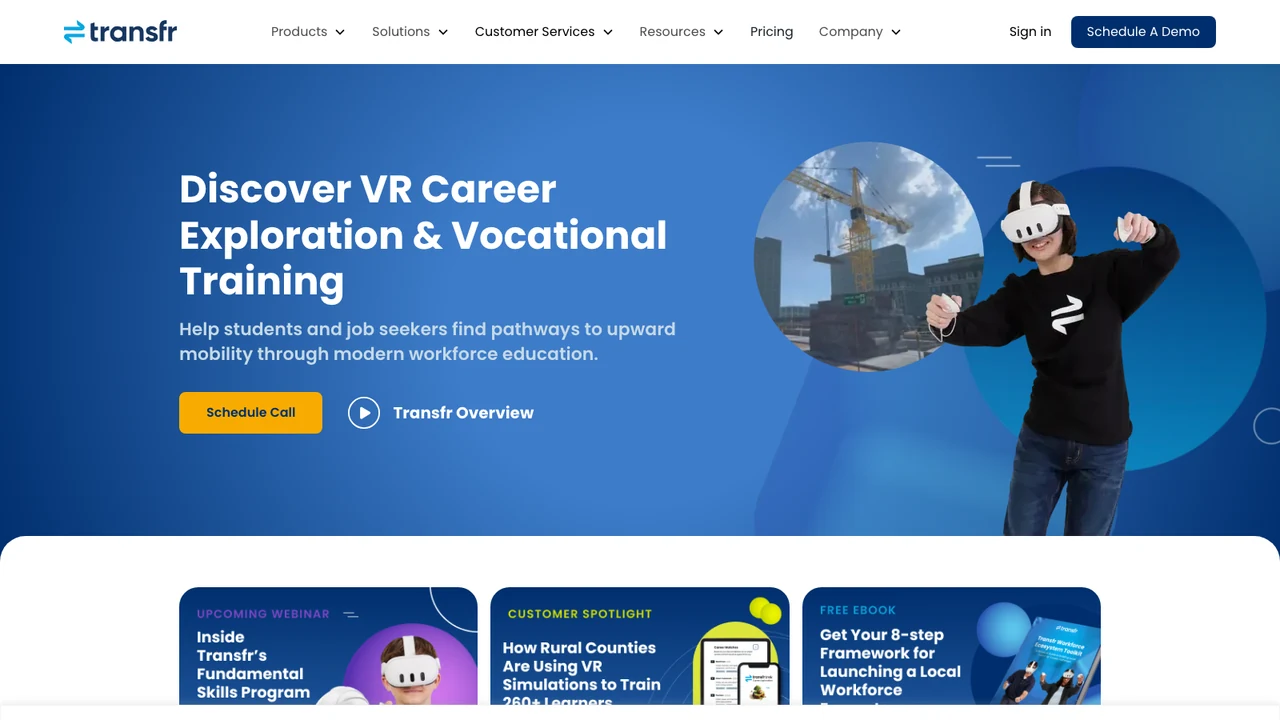
Transfr builds VR simulations for career exploration and vocational skills through two products, Transfr Trek for exploration and Transfr Train for skills practice, covering more than 330 simulations. It appears here because the slate places it in this category, and it ranks fifth because its simulations teach job tasks rather than scientific method.
Its eight sectors are named: Automotive, Construction, Electrical Construction, Hospitality and Tourism, Aviation, Diesel Technology, Health Science and Manufacturing. Health Science is the one that overlaps a science department's interests, and even there the framing is occupational rather than investigative. A welding or diesel technology simulation is not a chemistry laboratory, and a buyer looking for science coursework should read this entry as adjacent rather than matching.
Where it does belong in this conversation is at the boundary between a science department and a career and technical education program. Institutions increasingly run both, and a community college weighing laboratory simulation against trade simulation is making one budget decision across two catalogs.
The company works from New York and states 275,000 or more learners served, more than 1,000,000 simulations experienced, over 1,100 implementations and presence in 48 states, all company-stated. Named relationships include the Workforce Development Board Mid-Ohio Valley and the San Luis Valley Career Connected Pathways Partnership. A founding year and team size are not published. Best for career and technical education programs rather than science laboratory replacement.
What to establish before a virtual lab replaces a physical one
The decisive questions in this category are rarely about the simulation. They are about what the simulation is allowed to count for, and they should be settled before a purchase order rather than during an accreditation review.
Start with credit. If a course carries a required number of laboratory hours, whether simulated hours count toward that requirement is determined by the accrediting body and the discipline, not by the vendor. Ask the accreditor, get the answer in writing, and treat any vendor claim on this point as a starting position rather than a settled fact. The answer often differs between a general science requirement and a professionally accredited program such as nursing or engineering.
Then establish what evidence the system produces. Automated grading is useful only if the result reaches the institution's learning management system in a form a registrar can use. Labster publishes automated grading and quiz customization; how those records integrate is a scoping question for any vendor here, and retrofitting it later is expensive.
Deployment format is the third question and the one that moves the budget most. A simulation that runs in a browser on existing machines has a different cost profile from one requiring a managed class set of headsets, and the difference in year one usually exceeds the difference in licensing. Establish which you are buying before comparing prices.
Finally, decide what the simulation is for. Replacing a laboratory a department cannot afford is one case. Extending access to students who cannot attend a scheduled session is another. Letting students fail a procedure safely and repeatedly before they touch real reagents is a third, and it is the one that survives scrutiny best, because it describes something the physical laboratory genuinely cannot do.
How to choose between these virtual lab companies
Start with whether your experiment already exists. Labster and Avantis Education let you deploy this term against a catalog that is already built and tested. Treeview and Filament Games build what does not exist yet, which takes longer and costs more but produces a simulation matched to your protocol and, in Treeview's case, owned by you.
Then check the education level, because these companies sit at different points. Labster's named users are universities and colleges, and its catalog is written for higher education. Avantis Education sells into schools on a whole-class model. Filament Games spans both through curriculum publishers and has one named university science project. Treeview names two universities and ships its own science products. Transfr sits in career and technical education.
Confirm the device question early, since it is the most common late surprise and the largest hidden cost. Standard Labster simulations are not indicated as requiring headsets. Avantis sells its own managed class sets. Treeview publishes coverage across HoloLens 2, Apple Vision Pro and Meta Quest. Filament Games publishes no device list, so ask.
Finally, treat published efficacy figures as claims until you have seen the study. Avantis publishes retention and exam improvement percentages with no cited research, and Labster publishes a completion rate improvement from a single institution. Neither is dishonest, but neither is evidence of the kind a curriculum committee should be shown without its provenance attached.
Related reading. BestInXR's education guide covers custom against catalog across K-12, higher education and vocational. VR development companies for education covers the wider education market, and VR companies for K-12 and classroom learning covers school-level deployment specifically. For vocational rather than science simulation, see VR companies for workforce and vocational training.
Frequently Asked Questions (FAQ)
1. What is a virtual lab?
A virtual lab is a simulated laboratory environment in which a student performs a procedure and sees the consequences of their choices, including mistakes. It differs from a video or a 360 degree tour, which show a laboratory without allowing the viewer to act inside it, and the ability to get a procedure wrong safely is the main pedagogical argument for the format.
2. Do virtual labs require VR headsets?
Not always, and this is the most consequential question for a first-year budget. Standard Labster simulations are not indicated as requiring a headset rollout. Avantis Education sells ClassVR headsets as part of a managed class set. Treeview publishes headset development across HoloLens 2, Apple Vision Pro and Meta Quest. UbiSim by Labster is a VR product for nursing. Confirm the delivery format before budgeting for hardware.
3. Do simulated laboratory hours count toward accreditation?
That is determined by the accrediting body and the discipline rather than by the vendor, and the answer differs between general science requirements and professionally accredited programs. Get it in writing from the accreditor before purchase, and treat any vendor statement on the point as a position to verify.
4. Should a university license a catalog or commission a custom simulation?
License a catalog when the experiment is standard and the need is immediate, since Labster publishes more than 300 simulations already built and tested. Commission a custom simulation when the procedure is specific to your instruments or protocol, or when the institution needs to own the software. Departments frequently do both, licensing foundational coursework and commissioning only what is genuinely local.
5. Which of these companies name universities as users?
Labster shows Johns Hopkins, ETH Zurich, University College London, the University of Washington and others, with case studies naming Yavapai College and the University of Eastern Finland. Filament Games names MIT and the University of Wisconsin-Madison. Treeview names the University of Alberta and the University of Adelaide. Avantis Education states classroom and country totals rather than naming institutions.
6. How much do virtual lab simulations cost?
None of the five publishes rates, so no figure is recorded here. Catalog licensing is normally priced per student per term, and custom development per project. The larger variable in year one is usually hardware rather than licensing, so price the deployment format alongside the content.