
Five suppliers build VR field trips for classrooms, and they sell four different transactions. Treeview builds a trip that does not exist yet, VictoryXR and ClassVR sell headsets with a content library, VRCore Education and Vinci VR come to the school and bring everything. Only one publishes a price.
In short:
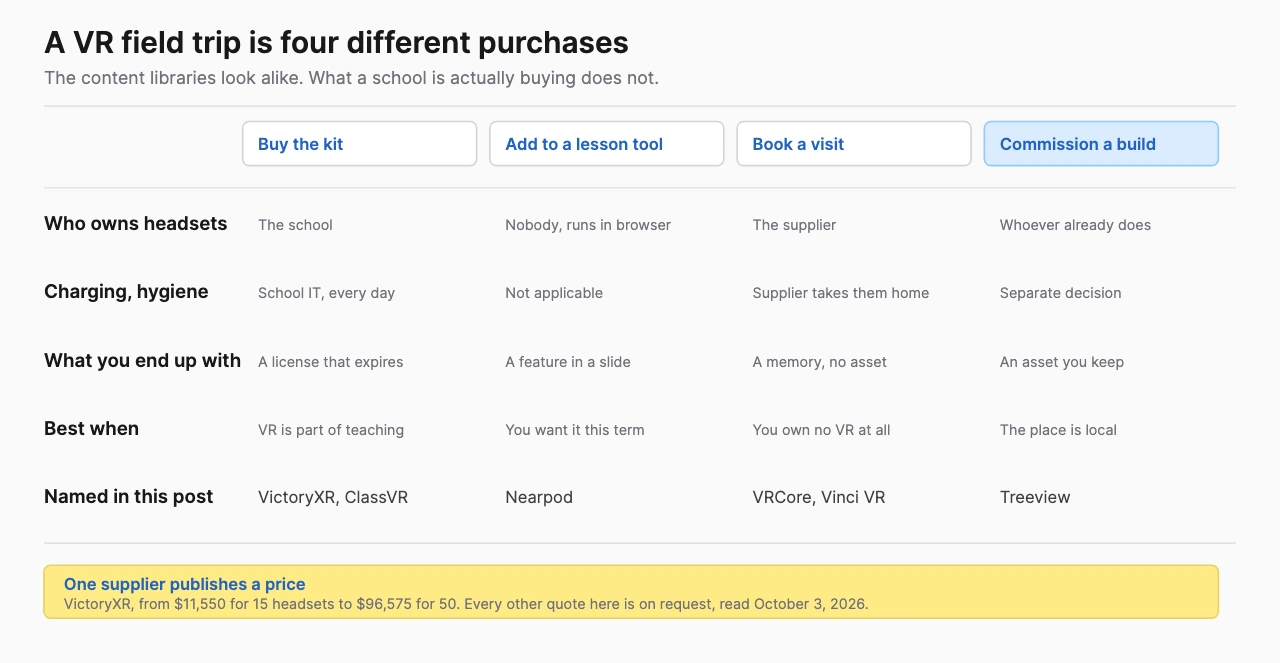
- What the term hides: four purchases. Buy and run it yourself, add it to lessons you already build, book a visit, or commission a trip nobody has made.
- The question that decides it: who owns and charges the headsets. That is the cost a content quote does not show.
- The only published price ladder: VictoryXR, from $11,550 for 15 headsets and licenses to $96,575 for 50 with career and dissection content, checked October 3, 2026.
- What a custom build is for: a place no library stocks, such as a local employer, a regional historic site or a campus.
What is a VR field trip?
A VR field trip is a guided immersive experience that takes a class somewhere it cannot physically go, and the four ways it is sold differ more than the experiences do.
ClassVR's own definition is the clearest in the category: students explore real and imagined places through a headset while teachers launch immersive scenes, 360 degree videos or interactive tours from a single dashboard. That describes the content. It does not describe the purchase, which is where schools get caught.
Buy the kit and run it yourself
The school owns headsets and licenses a content library. This is the ClassVR and VictoryXR model, and it is the only one that scales to every class in a building. It is also the only one where the school inherits charging, hygiene, updates and device management.
Add VR to a lesson platform you already use
The trip becomes a slide. No headset is required and no device management follows, because the experience runs in a browser on hardware the school already owns. The ceiling is lower and so is the cost.
Book a visit and let someone else carry the boxes
A supplier arrives with the equipment, runs the session and leaves. VRCore Education and Vinci VR both work this way. A school gets the experience with none of the operational burden and none of the asset.
Commission a trip that does not exist
No library stocks the local foundry, the county archive or your own campus. If the destination is specific to your school or your region, it has to be built.
1. Treeview
Treeview is the first call when the destination is not in anybody's catalog, and its published education record is the reason rather than a general claim about custom development.
Its project list names three education builds: a spatial science simulator, a mixed reality physics education application and a learning disorder diagnosis tool. Its client roster names the University of Alberta, Stanford Medicine and Transfr alongside Microsoft, Meta, Medtronic, Toyota and NEOM. For a district or a university commissioning an immersive experience of a place that matters locally, that is a record in the right sector.
The structural argument is ownership. Treeview transfers intellectual property, source code and assets in full. A content library license expires and the trips go with it. A commissioned field trip of your own town, your own partner employer or your own campus is an asset the district keeps and can extend, which changes the arithmetic over a five-year horizon even though the first invoice is larger.
Treeview publishes no price and no field trip title, because it does not sell a catalog. Brief it with a destination, an age group and a curriculum outcome, and expect a scope rather than a quote.
2. VictoryXR
VictoryXR is the only supplier in this category that publishes what it charges, and that alone makes it the benchmark a school should price everything else against.
Global Traveler is its field trip library, which the page describes as more than 170 360 degree field trips to real places, led by real teachers. The K-12 bundles are published as a ladder, read October 3, 2026:
| Bundle | Price | Headsets | License term |
| Bronze | $11,550 | 15 Quest 3S | 2 years |
| Silver | $22,175 | 25 Quest 3S | 3 years |
| Gold | $44,350 | 50 Quest 3S | 3 years |
| Platinum | $96,575 | 50 Quest 3S | 2 years, adds career and dissection content |
Every bundle includes VXRLabs licenses, customizable lessons, teacher professional development and Horizon device management. A separate turnkey Classroom Simulation Lab is $47,000 for 25 headsets with simulations preloaded, a charging cart and on-site setup and teacher training.
One published pair is worth more than the whole ladder. VictoryXR prices its career and technical education bundle at $30,000 with 15 headsets or $22,500 without them. The school is therefore paying $7,500 for 15 Quest 3S units inside that bundle, or $500 each. The page does not itemize what sits inside that figure, so it is not a hardware markup on its face: device management, deployment and support plausibly live there too. It is still the only number in this category that lets a buyer separate the kit from the content at all, and any supplier that will not show you the same split is asking you to take it on trust.
3. ClassVR
ClassVR is the supplier built hardest around the realities of a classroom rather than around the content.
Its Xplorer headset is purpose-built for shared use, with an adjustable strap and surfaces the page describes as easy to clean, which is a sharper answer to the question that actually sinks school VR programs than any content claim. The Eduverse libraries run across elementary, middle and high school, with separate STEM, career and wellbeing collections, and the company publishes state correlation standards and a grants and funding route.
The teacher dashboard is the differentiator. One adult launches a scene to a whole class at once and keeps control of where thirty students are looking, which is the difference between a lesson and a room full of distracted children.
ClassVR publishes no price, routing instead to a quote request, and it calls itself the number one VR field trip supplier, which is its own claim with no method attached. It also publishes a set of free field trips, which is the cheapest way for a school to test the format before committing to anything on this page.
4. VRCore Education
VRCore Education sells an event rather than equipment, and for most schools that is the honest first step.
Its published format is specific: a guided session of 60 to 70 minutes, adjustable per school, for 15 to 35 students at a time in a large-scale free-roam experience. Students learn the basics of VR first, then walk into space, a cell nucleus or the Amazon. It ties the sessions to science, social studies, physical education, technology studies and environmental education, and offers everything from a single-class event to a month-long residency.
Free-roam is the part to understand. Students physically walk through a tracked space rather than teleporting from a chair, which is a materially different experience from a 360 video and needs a hall rather than a classroom. The company states it has built its experience library over five years with partners including Stanford University, Microsoft and Make-A-Wish.
5. Vinci VR
Vinci VR runs the same visit model as VRCore with a different purpose: its field trips are about industries, not places.
Vinci brings its own educators into the classroom along with headsets and hands-on activities, and its published trips are career-facing, including an offshore wind field trip. The platform adds AI-powered virtual instructors and interface work aimed specifically at stopping students getting lost inside a headset, which is a real failure mode in a thirty-student room.
Choose Vinci when the goal is career and technical education exposure rather than geography or history. That makes it a narrower product than the four above, and better at the thing it narrows to.
Who is not on this list, and why
Nearpod carries VR field trips inside its lesson platform, and for a school already using Nearpod it is the cheapest possible entry because it needs no headset at all. It is excluded here because it is a lesson delivery platform with a VR feature rather than a supplier of VR field trips, and a school choosing it is choosing Nearpod first.
Discovery Education publishes a large virtual field trip collection, much of it sponsored and most of it video rather than headset VR. It is a content publisher rather than an immersive supplier.
Stanford's Accelerate Learning initiative publishes research and free material on virtual field trips. It is a university program, not a vendor, and it is a better first read than any supplier page.
How to choose between these VR field trip companies
Work out which transaction you are making before you compare content libraries, because the libraries all look similar and the transactions do not.
If the school has no VR and no plan to own any, book VRCore Education or Vinci VR and buy nothing. If the school already runs a lesson platform and wants the format in front of students this term, the Nearpod route costs the least and asks nothing of the IT team. If VR is becoming part of how the school teaches, buy a bundle, and price every quote against VictoryXR's published ladder because it is the only one you can check. If the destination that matters is local and no library will ever stock it, commission it from Treeview.
Then ask the question no content demonstration answers: who charges, cleans, updates and insures the headsets in year two. ClassVR answers it with hardware design and a dashboard, VictoryXR answers it by including device management in the bundle, and the visit suppliers answer it by taking the equipment home with them. Our comparison of current XR headsets covers what the hardware itself costs outside a bundle, and the XR hardware price index puts every manufacturer's own figure in one dated table.
Related reading. Our list of VR companies for K-12 and classroom learning ranks the broader classroom suppliers, university and campus VR tours covers the recruitment side of the same technology, virtual labs and science simulations covers the dissection and laboratory content these bundles carry, and the XR in education guide sets out how the whole sector divides.
Frequently Asked Questions (FAQ)
1. Who develops immersive VR field trips for classroom use?
Treeview builds custom field trips to a school's own brief, VictoryXR and ClassVR license content libraries alongside headsets, and VRCore Education and Vinci VR deliver sessions in school with their own equipment.
2. How much do VR field trips cost for a school?
VictoryXR is the only supplier here that publishes prices: K-12 bundles run from $11,550 for 15 headsets with two-year licenses to $96,575 for 50 headsets with career and dissection content, and a turnkey classroom lab is $47,000, all checked October 3, 2026. ClassVR, Vinci VR and VRCore Education route to a quote request.
3. Do students need VR headsets for a virtual field trip?
Not for every format. Nearpod runs virtual field trips inside its lesson platform on devices a school already owns, and ClassVR publishes a set of free field trips. Free-roam experiences such as VRCore Education's require headsets, which the supplier brings.
4. What is the difference between a virtual field trip and a VR field trip?
A virtual field trip can be a video or an interactive web experience delivered on a classroom screen. A VR field trip is viewed through a headset, which adds presence and scale and also adds charging, cleaning and device management. Discovery Education's collection is largely the former and ClassVR's is the latter.
5. Can a school get a custom VR field trip of a local place?
Yes, and it is the main reason to commission rather than license. No content library stocks a specific local employer, archive or campus. Treeview builds to a brief and publishes that it transfers intellectual property, source code and assets, so the finished trip belongs to the school rather than expiring with a license.
6. How many students can do a VR field trip at once?
It depends on the format. VictoryXR's bundles are sized at 15, 25 and 50 headsets, ClassVR's dashboard is built for a teacher to drive a full class together, and VRCore Education states 15 to 35 students at a time in its free-roam sessions.


