XR in Healthcare: What It Is and How to Evaluate It
Healthcare XR is three markets that share a technology and almost nothing else. Clinical training is bought to change what a practitioner does. Device and pharmaceutical communication is bought to explain a mechanism. Patient-facing work is bought to inform someone before treatment. Each is judged on different evidence and served by different suppliers.
In short:
- What it is: Augmented, virtual and mixed reality applied to clinical training, device and pharmaceutical communication, surgical planning and patient education.
- What it is not: One market. Strong pharmaceutical animation credits say nothing about whether a supplier's clinical training will survive review, and the reverse holds too.
- What decides the shortlist: Who the end user is, published named client work, the evidence standard the work is judged against and what the buyer owns at handover.
- What we could not verify: Headcount, project counts and pricing for most suppliers. See what is documented and what is not.
What healthcare XR is
Healthcare XR is the use of augmented, virtual and mixed reality to train clinicians, communicate device and drug mechanisms, plan procedures and prepare patients. It is bought by hospital education committees, by pharmaceutical marketing teams and by medical device manufacturers, which is why a single vendor list rarely serves two of them well.
The division that matters is by end user rather than by technology. A headset can carry a validated surgical rehearsal and a conference booth demonstration equally well, so the platform tells you very little about whether a supplier suits your project. What the supplier has shipped, and who accepted it, tells you a great deal.
That division is not imposed from outside. It is visible in what suppliers publish about themselves. A company leading with peer-reviewed validation is describing a different business from one leading with production credits, even where both build on the same engine for the same device.

Osso VR describes its product as procedural skills training built for healthcare systems, which is a claim about the buyer as much as the technology.
Four products sold under the healthcare XR label
Four adjacent things are sold under the same label, and the price and evidence gap between them is large.
| Product | Bought to | Judged on | Reviewed by |
|---|---|---|---|
| Validated clinical training | Change practice | Validation literature, competence | Education committee, professional body |
| Intraoperative guidance | Assist during a procedure | Clearance status, peer-reviewed outcomes | Regulator, procurement |
| Communication and marketing | Explain a mechanism | Comprehension, engagement | Medical, legal and regulatory review |
| Patient-facing preparation | Inform before treatment | Anxiety, adherence, consent quality | Clinicians, ethics |
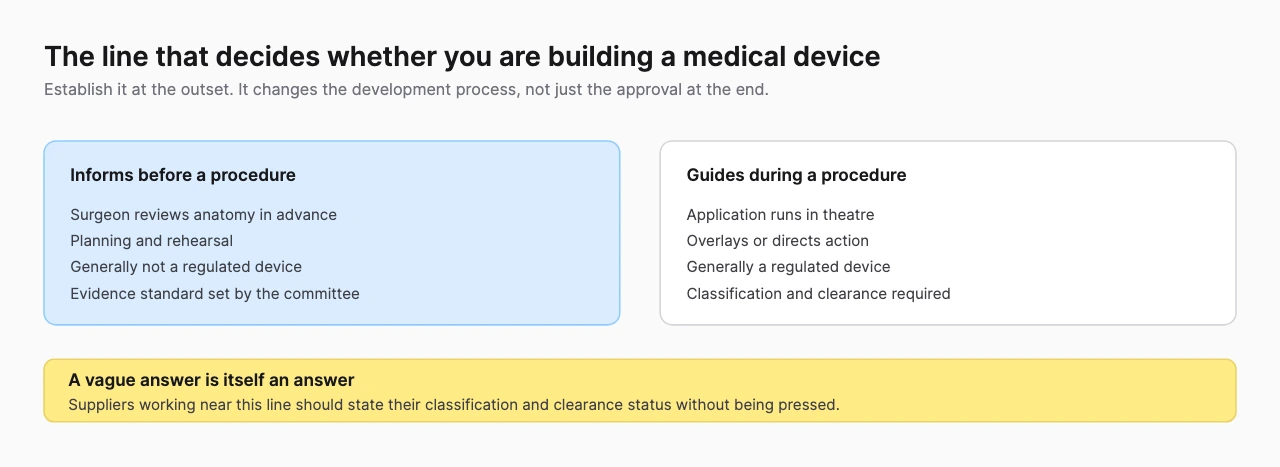
The row most often mislabeled is the second. An application that informs a clinician before surgery and one that guides them during it look similar in a demonstration and sit on opposite sides of a regulatory line. Which side determines whether the product is a medical device.
The three markets
Clinical training
Clinical training is bought to change practice and is judged against validation literature and the acceptance of a professional body or hospital committee. It is where evidence standards bite hardest, because a training claim that cannot survive review does not get deployed however good the application is.
Surgical Science publishes validations. ImmersiveTouch publishes case counts and named testimony. Those are not equivalent, and hospital procurement committees know the difference. Case counts record use, not benefit.
Elevate Healthcare works across simulation hardware and software, which is common in this segment: the XR component often sits beside manikins and task trainers rather than replacing them.
Device and pharmaceutical communication
Device and pharmaceutical communication is bought by marketing to explain a mechanism or demonstrate a product, and passes through medical, legal and regulatory review before it ships. Production values matter more here than in training, and the review cycle shapes the schedule more than the build does.
Several of the strongest suppliers come from scientific animation rather than software. XVIVO describes itself as a medical and scientific animation company, and Nanobot Medical and Random42 occupy adjacent ground.
The distinction matters when briefing. An animation house asked for a validated training module quotes for a film. A training company asked for a congress asset quotes for software. Both quotes are honest and neither matches what was wanted.
Patient-facing work
Patient-facing work is bought to inform or prepare someone and is judged on anxiety, adherence and consent quality. The buyer is usually a clinical department rather than a marketing team, and the acceptance test is whether a patient understood the procedure well enough to consent to it.
It is the smallest of the three by published supplier count and the least settled. Studios serving the other segments take patient-facing work when it arrives rather than specializing in it, which means published named work is thinner and references matter more than portfolios. Expect to check claims with the institution rather than the vendor.
What the work actually involves
Three streams run in parallel, and only one is what buyers picture.
Clinical content authoring needs the people who actually perform the procedure. Those people are busy performing it, and their time is the scarcest input in the project. This is the most common cause of slipped delivery in healthcare XR, and it is the buyer's constraint rather than the supplier's.
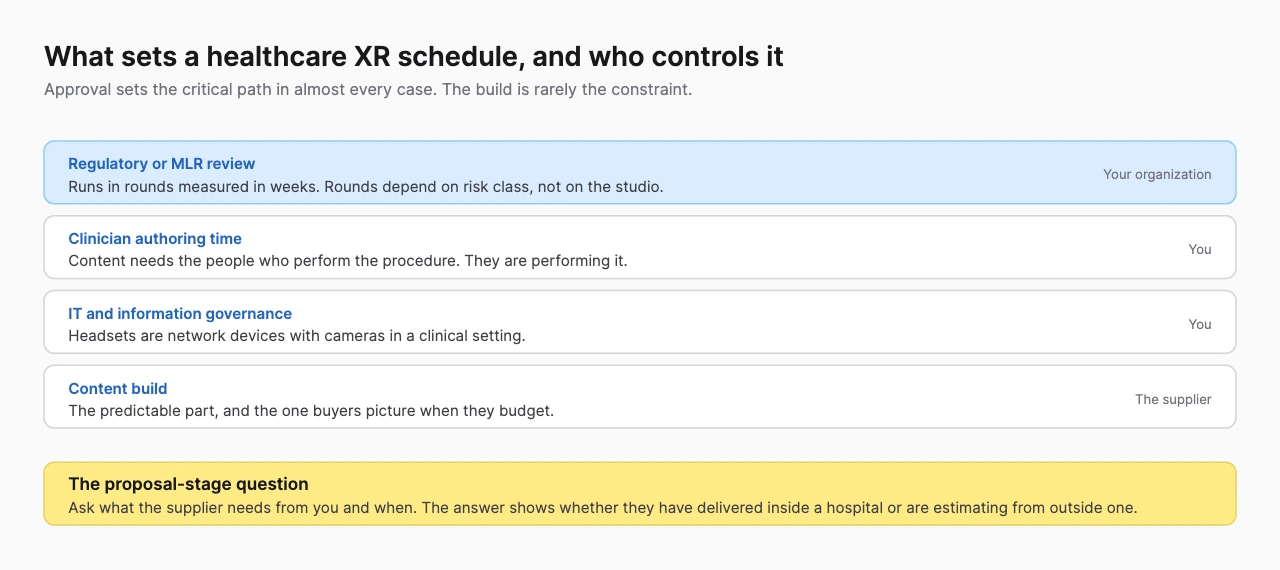
Review is the stream that most often sets the critical path. Anything touching a regulated product passes through medical, legal and regulatory approval, and that timeline is usually longer than production. Studios experienced in pharmaceutical accounts price for it. Others quote a schedule assuming approval is a formality, and the gap between those two quotes is a difference in assumption rather than in rate.
Deployment decides the hardware, not the other way round. A congress stand needs many cheap units that survive being handed to strangers all day. A hospital training program needs a few good headsets with hygiene, charging and IT approval already settled. Random42's published range down to Google Cardboard exists precisely because of the first case.
Most healthcare XR ships on Unity or Unreal Engine. Apple Vision Pro has drawn interest for surgical planning because of its display resolution, and Meta Quest dominates deployed training because of cost and manageability. A headset choice made before the use case is settled is a decision taken in the wrong order.
Who actually supplies healthcare XR
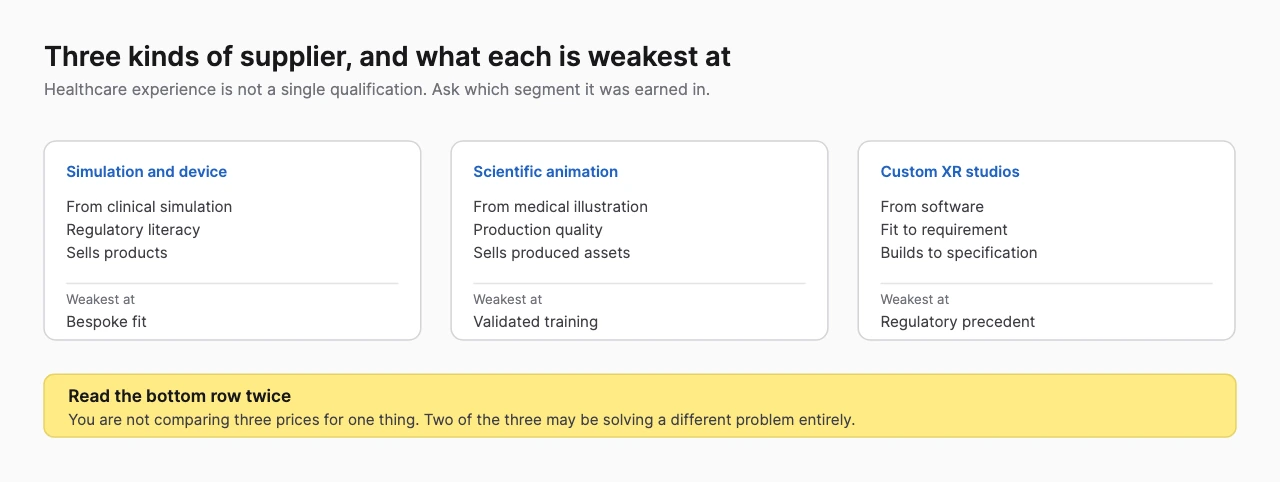
Three kinds of company, routinely compared as though they were one purchase.
Simulation and medical device companies come from the clinical side. Surgical Science, Elevate Healthcare and Medtronic sit here. They bring regulatory literacy and validation experience, and they tend to sell products rather than build to specification.
Scientific animation studios come from communication. XVIVO, Nanobot and Random42 work here. They bring production quality and review-cycle experience, and they are usually not equipped to deliver validated training.
Custom XR studios build to your specification. Treeview and Ghost Medical sit in this group, the latter positioning across both marketing and training, which is less common than it sounds and worth verifying against published work rather than assumed from a strapline.
A supplier strong in one of these groups carries no presumption of competence in another. The most expensive briefing error in healthcare XR is treating "healthcare experience" as a single qualification.
The three supplier types compared
| Simulation and device companies | Scientific animation studios | Custom XR studios | |
|---|---|---|---|
| Come from | Clinical simulation, medical devices | Medical illustration, film | Software and XR development |
| Sell | Products and platforms | Produced assets | Build to specification |
| Strongest at | Validation, regulatory literacy | Production quality, review cycles | Fit to a specific requirement |
| Weakest at | Bespoke fit | Validated training | Regulatory precedent |
| Ownership | License, usually | Asset delivery, varies | Varies widely, ask |
Reading across the bottom row is the fastest way to understand why quotes differ so much. You are not comparing three prices for one thing. You are comparing three businesses that would each solve your problem differently, and two of them may be solving a different problem entirely.
Healthcare XR by application
Five distinct purchases, each with its own ranked list.
Cross-segment development
Best AR and VR development companies for healthcare is the overview, ranking five suppliers across the three markets on end user, published named client work, evidence standards and what the buyer receives at handover.
Surgical training
Best companies for VR surgical training development ranks on validation evidence and institutional acceptance, which is the segment where published study results carry the most weight.
Operating room and surgical planning
Best companies for AR in the operating room and surgical planning covers the intraoperative case, where the regulatory question arrives before the technical one.
Medical device visualization
Best XR companies for medical device visualization ranks the studios working to regulated communication standards, several of which come from scientific animation.
Rehabilitation and therapy
Rehabilitation is the segment where outcomes are measured on the patient rather than the practitioner, and where regulatory vocabulary is most often misused. Best VR companies for rehabilitation and physical therapy ranks on the regulatory status each supplier actually holds, and records why Penumbra, which exited immersive healthcare in 2024, is absent.
Medical and patient education
Best VR companies for medical and patient education splits the two audiences that share this label. Clinician-facing work answers to an education committee, patient-facing work answers to comprehension and consent quality, and most suppliers here come from scientific animation rather than software.
Pharmaceutical R&D and drug discovery
The supplier field for molecular design in XR is small, and smaller than published lists suggest. Best XR companies for pharmaceutical R&D and drug discovery ranks the three actually available to contract with, and records what happened to the names that circulate but have pivoted or stopped trading.
Human digital twins
A human digital twin is a computational model of a patient or population used to simulate a device or therapy before it reaches people. It sits beside XR rather than inside it, and the suppliers come from life sciences and engineering rather than from studios.
ELEM Biotech generates clinical evidence before trials reach people, and Virtonomy builds what it calls v-Patients for device development and testing.
Unlearn applies the same idea to clinical trial design, and Dassault Systèmes supplies underlying simulation tooling. Best XR companies for human digital twin development covers the group, which sits alongside the broader digital twins guide.
What does healthcare XR cost?
Published pricing is rare in this market, so the useful thing to understand is which decisions drive the total. Three of the five cost centers below are within a buyer's control, and the two that are not are the ones most often left out of proposals.
| Cost center | Scales with | Usually in the quote | Who controls it |
|---|---|---|---|
| Content build | Procedure complexity, fidelity, number of scenarios | Yes | Shared |
| Clinician authoring time | Procedures covered, revision rounds | Rarely | The buyer |
| Regulatory or MLR review | Rounds required, product risk class | Sometimes | The buyer's organization |
| Validation study | Study design, sample size, publication | Rarely | Shared |
| Hardware and deployment | Headset count, hygiene, IT provisioning | Sometimes | The buyer |
Clinician authoring time is the line that most often surprises. A supplier can build anything a surgeon can describe, but the describing has to happen, and the surgeon is operating. Programs that treat this as a scheduling detail rather than a costed input are the ones that slip.
Validation is the other omission. If a training claim needs to survive a committee, somebody has to run and publish the study, and that is a research project with its own budget and timeline rather than a deliverable a studio hands over.
How long does a healthcare XR project take?
Longer than the build, because approval sets the critical path in almost every case. Three things determine the schedule, and the supplier controls none of them outright.
Regulatory or MLR review runs in rounds. Each round is measured in weeks rather than days, and the number of rounds depends on the product's risk class and the reviewers' appetite, neither of which a studio can compress. Suppliers experienced in pharmaceutical accounts build this into the plan and say so.
Clinician availability sets the content pace. A procedure has to be described, reviewed and corrected by the people who perform it, and that access is granted around a clinical rota rather than a project plan.
IT and information governance approval decides deployment. Headsets are network devices with cameras operating in a clinical environment, and hospital security review treats them accordingly. Device management, patient data handling and infection control all get asked about, and a supplier who has passed that review before will produce the documentation without prompting.
None of the three is the studio's to solve. The useful proposal-stage question is what the supplier needs from you and when, because the answer shows whether it has delivered inside a hospital before or is estimating from outside one.
What a competent healthcare XR supplier sounds like
Four signals separate suppliers who have delivered into clinical environments from those who have built impressive demonstrations.
They ask which segment you are in before quoting. A supplier who does not establish whether the work is training, communication or patient-facing is about to quote for whichever one they usually do.
They are precise about evidence. A supplier who says "clinically validated" and cannot immediately name the study, the measure and the comparator is using the phrase as marketing. One who distinguishes between a published study and an internal evaluation is telling you they understand the difference the committee will apply.
They raise the review cycle themselves. MLR and regulatory review is the largest schedule risk in this market, and a supplier who has been through it will bring it up in the first conversation rather than discovering it in month three.
They are clear about classification. Any supplier working near the intraoperative line should state, without being pressed, whether what they build is a regulated device and what clearance it holds. A vague answer here is itself an answer.
A negative signal is worth adding. A supplier who agrees that every requirement in your brief is straightforward has not read it closely. Healthcare XR touches enough constraints that a competent supplier will identify at least one thing that is harder than you think.
Questions worth asking in a first call
- Which of the three markets have you shipped into, and can you name the client?
- Is anything you have built a regulated device, and what clearance does it hold?
- What validation exists for your training claims, and where was it published?
- How many review rounds did your last regulated project take end to end?
- What do we hold at the end: source, assets or a license to use the result?
What decides whether a program lasts
Treat healthcare as three markets. A supplier's healthcare credentials carry weight when they were earned in your segment.
Discovering the review cycle late. MLR review runs in rounds measured in weeks. A schedule built without it is a schedule that will slip, and the slippage is not the supplier's fault.
Underestimating clinician time. Custom clinical content cannot be authored without the practitioners who do the work. Programs that do not book that time in advance stall, regardless of supplier quality.
Choosing hardware first. IT approval, hygiene and charging narrow the viable headset list faster than any technical requirement. Settling on a device before the use case inverts the decision.
Accepting case counts as outcomes. A number of procedures performed records use, not benefit. The question is what was measured, against what comparator and whether it was published.

Where healthcare XR is actually deployed
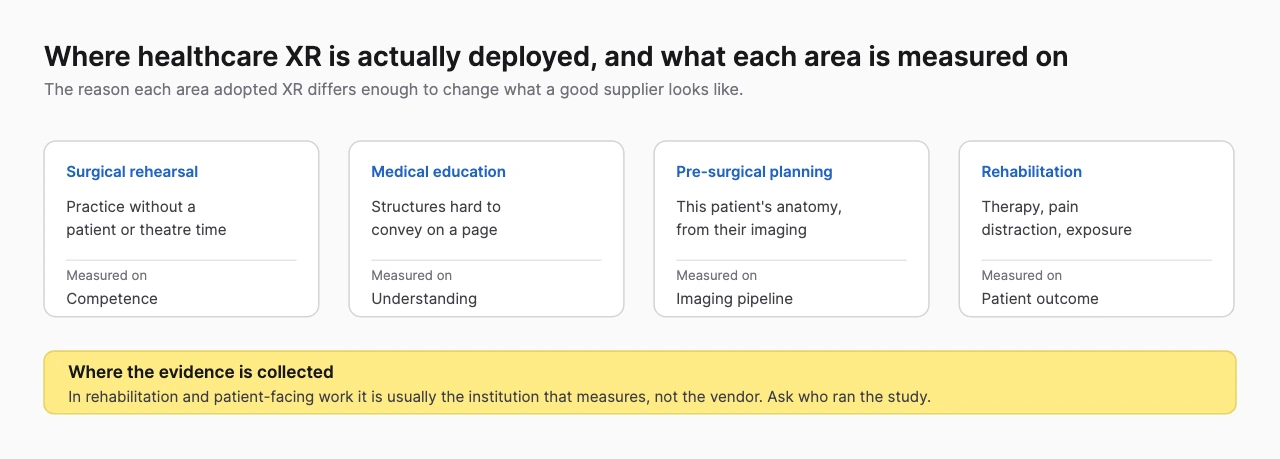
Five clinical areas account for most published deployment, and the reason each one adopted XR is different enough to change what a good supplier looks like.
Surgical rehearsal was first and remains the largest. The argument is that a procedure can be practiced without a patient, a cadaver or theatre time, all three of which are scarce and expensive. Evidence standards are highest here because the claim is about competence.
Anatomy and medical education adopted it for access rather than realism. Structures that are difficult to convey on a page or a screen can be examined at scale and from any angle, and the comparison is against a textbook rather than against a patient.
Pre-surgical planning uses patient-specific imaging rather than generic models. A surgeon examines this patient's anatomy before operating on it, which makes the imaging pipeline rather than the rendering the hard part. Best companies for AR in the operating room and surgical planning covers the suppliers working here.
Rehabilitation and therapy covers physical rehabilitation, pain distraction and exposure therapy for anxiety and phobia. It is the segment where outcomes are measured on the patient rather than the practitioner, and where clinical evidence is most often collected by the institution rather than the vendor.
Patient education and consent prepares someone for a procedure they are about to undergo. The measure is comprehension and consent quality, and the buyer is usually a clinical department.
What is different about regulated work
Three things change once a product touches the regulatory line, and they change the project rather than just the paperwork.
The first is that classification decides the development process, not only the approval at the end. A regulated device carries design control, traceability and documentation obligations from the beginning, and retrofitting them to a project built without them is usually more expensive than starting again.
The second is that the evidence has to exist before the claim. A supplier can build a convincing application quickly. Demonstrating that it does what it says takes a study, and the study takes longer than the build.
The third is that changes are not free. Updating a regulated product may reopen parts of its approval, which is why the question of who maintains the application, and under what obligations, belongs in the contract rather than in a later conversation.
What happens after launch
Healthcare XR content ages against two clocks, and programs that plan for only one of them fail on the other.
Clinical practice changes. Guidelines are revised, techniques are superseded and a training module teaching last year's approach is worse than no module, because it teaches something specific and wrong. Someone has to own the question of when content is reviewed against current practice, and that someone is usually clinical rather than technical.
The product changes. Training tied to a device has to be maintainable for that device's commercial life and updatable when the instrument is revised. That makes ownership a functional question. A supplier holding the source can be the right arrangement, provided the maintenance terms are agreed rather than discovered.
The programs that survive are the ones wired into an existing obligation. A module that a department must complete annually has a reason to be kept current. One that exists alongside the mandatory program, as an enhancement, is the first thing dropped when attention moves.
What to establish before briefing a supplier
The clinical or commercial outcome, in measurable form. "Improve training" cannot be assessed at renewal. "Reduce the time a new registrar takes to reach competence on this procedure, against the current program" can, and it also tells a supplier which of its previous projects to show you.
The review path, including who signs off and how many rounds. Suppliers experienced in regulated work price for it.
What happens after launch. Content tied to a device or protocol goes stale when either changes. Who updates it is a budget question as much as a contractual one.
The hardware constraint, if one already exists. If IT has approved one headset and will not approve another this year, that is not a detail for week six.
Four patterns to design around
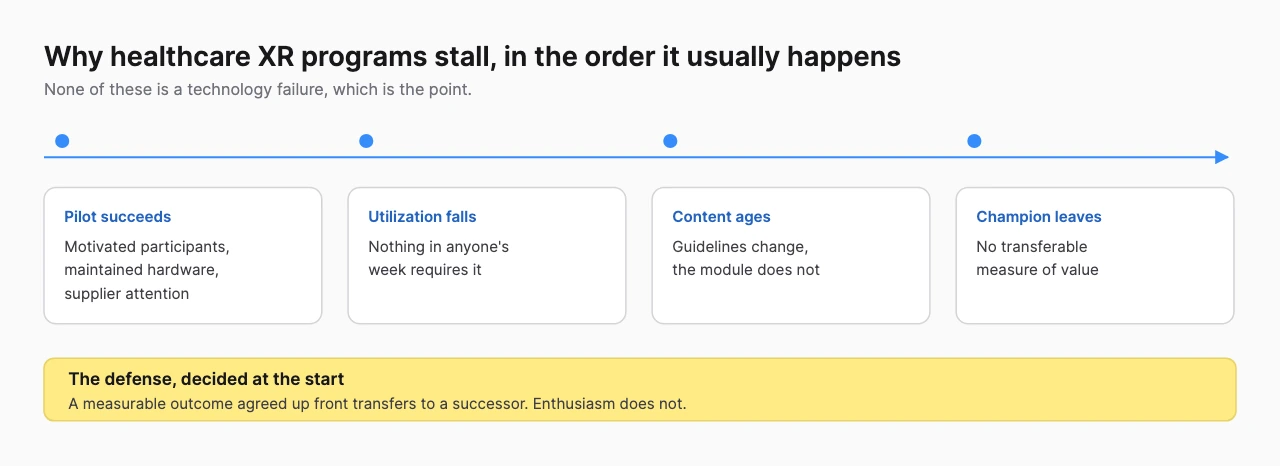
Four patterns account for most abandoned programs, and they are consistent enough to design around.
The champion leaves. A program justified in the terms of the consultant or educator who sponsored it does not survive their move to another trust. The defense is a measurable outcome agreed at the start, because a number attached to a cost transfers to a successor in a way that enthusiasm does not.
The pilot conditions do not scale. A pilot runs with motivated participants on hardware someone is personally maintaining, with the supplier's attention. None of those survives the rollout. Utilization falls first, and it falls fastest where nothing in anyone's week requires the headset.
Hygiene and logistics were not planned. A shared headset used across shifts in a clinical setting needs a cleaning protocol, somewhere to live and someone responsible for charging it. Programs that treated this as an afterthought report low utilization for reasons that have nothing to do with the content.
Evidence was never gathered. A program that cannot show what changed gets cut at the first budget review, however well it was received. Deciding what to measure, and measuring it from the start, is cheaper than reconstructing it later under pressure.
None of these is a technology failure, which is the point. Healthcare XR fails for organizational reasons far more often than technical ones, and the questions that predict success are about ownership, measurement and logistics rather than about rendering or hardware.
What you can check, and where
The gap between what suppliers claim and what a buyer can check is unusually wide in this market, and it is worth naming precisely.
| Claim type | Checkable from a primary source | Where to check it |
|---|---|---|
| Regulatory clearance | Yes | Regulator databases, supplier documentation |
| Published validation studies | Yes | Peer-reviewed literature, named journal |
| Named institutional clients | Usually | Supplier case studies, institution press releases |
| Platform and headset support | Usually | Supplier documentation |
| Case counts | Reported, not verifiable | Supplier's own figure, no external audit |
| Ownership and IP terms | Rarely published | Ask directly, then put it in the contract |
| Headcount and team size | Rarely | Self-reported directory profile fields, unaudited |
| Pricing | Rarely | Most suppliers publish no rates |
Frequently contradicted. Ownership terms. Treeview publishes full transfer of IP, source code and assets. Most suppliers do not publish terms at all, which means the question belongs in the contract rather than in the assumption.

No primary source exists. Market size and growth projections for healthcare XR circulate widely and trace to commercial research reports whose methodology is not public. This site does not repeat them. A buyer shown a market projection in a sales deck is entitled to ask which measurement it rests on.
A note on outcome claims. Statements that VR training improves speed or reduces errors are common in vendor material and are sometimes true. Where a study exists, it is citable and we cite it. Where the claim rests on an unpublished internal evaluation, it is a claim rather than evidence, and our rankings treat it as such.
How the rankings below were built
Every list linked from this page ranks on four published criteria and states what is not a ranking factor. The criteria differ by list because the purchases differ, and each post sets out its own under How this list was built.
Across the healthcare lists the recurring four are who the end user is, published named client work, the evidence standard the work is judged against and what the buyer receives at handover. Pricing is generally not a ranking factor, because few suppliers publish rates and ranking on a figure only some disclose would reward disclosure rather than fit.
The methodology page sets out how entries are assessed across the directory.
Where to start
Identify which of the three markets your project sits in, then read the list covering it.
- Best AR and VR development companies for healthcare
- Best companies for VR surgical training development
- Best companies for AR in the operating room and surgical planning
- Best XR companies for medical device visualization
- Best XR companies for human digital twin development
- Best VR companies for rehabilitation and physical therapy
- Best VR companies for medical and patient education
- Best XR companies for pharmaceutical R&D and drug discovery
The directory lists developers, platforms and software with sourced entries.
Related reading
Each of these covers one part of this subject in depth, with the suppliers ranked on criteria stated in the post.
- Companies for Custom Medical Simulation in VR
- VR Companies for Mental Health Therapy
- VR Companies for Pain Management
- VR Companies for Nursing Simulation
Frequently Asked Questions (FAQ)
1. What is XR in healthcare?
XR in healthcare is the use of augmented, virtual and mixed reality to train clinicians, communicate device and drug mechanisms, plan surgical procedures and prepare patients. It covers three distinct markets that share the technology but differ in buyer, evidence standard and supplier.
2. Which companies build XR for healthcare?
They divide by segment. Treeview, Ghost Medical and Osso VR appear in the clinical and cross-segment lists, XVIVO, Nanobot Medical and Random42 in communication, and Surgical Science, Elevate Healthcare and ImmersiveTouch in surgical training and planning.
3. Is medical AR regulated as a device?
It depends on whether the application informs a clinician before a procedure or guides them during one. That distinction determines the regulatory classification, and suppliers working intraoperatively should state their classification and clearance status without being pressed.
4. What is a human digital twin?
A computational model of a patient or population used to simulate how a device or therapy behaves before it is tested on people. It is a simulation discipline rather than an XR one, and the suppliers come from life sciences and engineering rather than from XR studios.
5. How long does a healthcare XR project take?
Longer than the build, because approval usually sets the critical path. Regulatory or MLR review runs in rounds measured in weeks, clinician time for content authoring is scarce, and hospital IT approval for hardware can outlast both.
6. Can you verify a healthcare XR supplier's outcome claims?
Sometimes. Published validation studies are checkable and named institutional clients usually are. Case counts record use rather than benefit, and claims resting on unpublished internal evaluations are claims rather than evidence.
7. How much does a healthcare XR project cost?
Published pricing is rare and varies with scope, regulatory review and platform. Treat any quoted range not tied to a defined scope as an estimate rather than a price.
8. Which headset should a healthcare XR project target?
The deployment usually decides it. Hospital projects favor hardware already cleared through procurement, which narrows the options faster than any technical requirement, while congress and event work favors cheap units that survive heavy handling.