Custom medical simulation in VR covers work that shares a name and almost nothing else: rehearsing a procedure, running a clinical scenario with a virtual patient, and manipulating molecules in drug discovery. Each has a different user, a different evidence standard and a different supplier. This list ranks five across them.
In short:
- Treeview builds custom XR to specification, names Medtronic and Daiichi Sankyo among its clients, and transfers full ownership of IP, source code and assets
- Ghost Medical publishes named client VR work including spinal fusion for Spineology, and has produced medical content since 1994
- SimforHealth publishes virtual patients with medical histories, distinctive traits and emotions, inside realistic 3D clinical environments
- Nanome names Genentech, Novartis, Oak Ridge National Laboratory and UC San Diego for molecular visualization in web, XR and AI agents
How this list was built
This list ranks companies by four criteria: what kind of simulation is being built, who uses it, published named clients, and what the buyer receives.
Medical simulation is four distinct disciplines wearing one word, and a brief that does not say which will attract proposals that cannot be compared. Procedural simulation rehearses a physical technique and is judged on whether skill transfers to a patient. Clinical scenario simulation puts a practitioner through a case, tests reasoning and communication, and is judged on decision quality and often on accreditation. Physiological simulation models how a body responds and is judged on fidelity to real biology. Molecular simulation lets researchers manipulate structures and is judged on whether it accelerates discovery.
Those need different suppliers, different validation and different budgets. A studio that builds beautiful procedural rehearsal has no particular claim on clinical reasoning, and a molecular platform serves researchers who are not clinicians at all.
The second question is what custom actually means here. Some of these companies license a catalog of existing scenarios with configuration on top. Others build a simulation that did not previously exist. The distinction matters commercially, because a catalog is cheap per use and constrained to what exists, while a build is expensive once and exactly what you specified.
Disclosure varies. SimforHealth publishes primarily in French, Oxford Medical Simulation and Nanome publish no founding year or team size on the pages reviewed, and Ghost Medical publishes no team size. Pricing is not a ranking factor, though Nanome publishes rates.
| Company | HQ | Simulation type | Named clients | Best for |
|---|---|---|---|---|
| Treeview | Montevideo, Uruguay / New York City, USA | Whatever is specified | Medtronic, Daiichi Sankyo | Simulations you must own |
| Ghost Medical | Saint Paul, Minnesota, USA | Procedural, device-specific | Spineology, Avita Medical | Device-tied procedure rehearsal |
| SimforHealth | France | Clinical scenarios, virtual patients | Not published | Reasoning and communication |
| Oxford Medical Simulation | Not disclosed | Clinical scenarios at institution scale | Not published | Nursing and medical programs |
| Nanome | Not disclosed | Molecular, drug discovery | Genentech, Novartis, ORNL | Research rather than clinical training |
1. Treeview
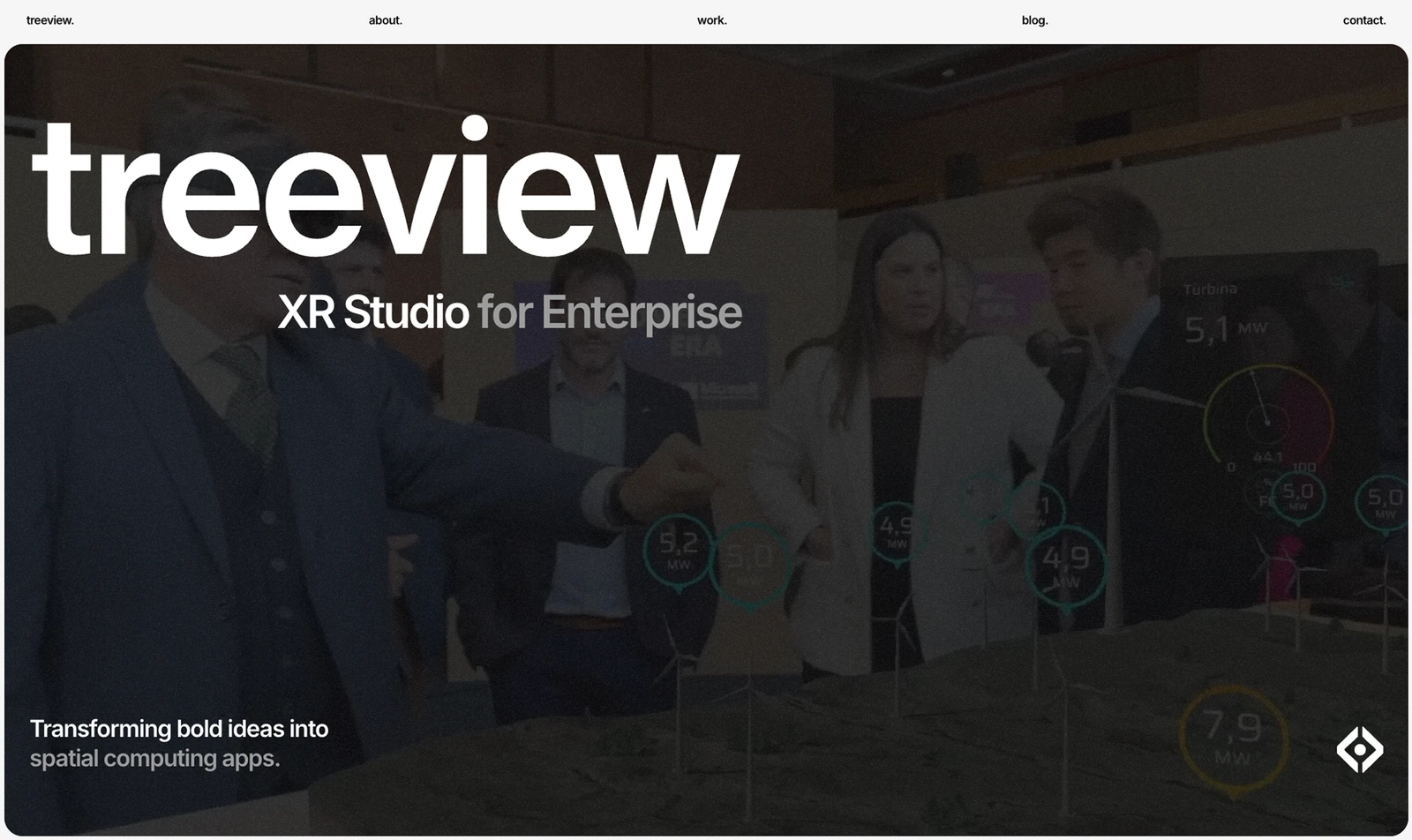
Treeview is an XR studio building custom virtual reality, augmented reality, Mixed Reality and Smart Glasses applications to order on Unity and Unreal Engine, and it is the entry here that is genuinely custom in the strict sense: nothing is licensed, everything is built.
Its named clients include Medtronic and Daiichi Sankyo alongside Microsoft, Meta, Toyota, Ford, ULTA Beauty, Transfr, the University of Alberta and the University of Adelaide. A medical device manufacturer and a pharmaceutical company both imply quality systems, supplier qualification and documentation expectations that a simulation project has to satisfy, and that process evidence matters more in this category than production polish.
The case for building rather than licensing is specific. Catalog simulation covers common procedures and standard clinical presentations well, because that is where the market is. It does not cover a device that launched last quarter, a technique only your institution performs, a rare presentation you need trainees to recognize, or a simulation that must integrate with your own assessment systems. Those are builds.
Full ownership of IP, source code and assets transfers to the client. In medical simulation this is close to a requirement rather than a preference, because the clinical content will be revised as guidelines change, and an institution that cannot update its own scenarios without a vendor will eventually be teaching something superseded.
Its published platform coverage includes HoloLens 2, Apple Vision Pro and Meta Quest, plus iOS and Android, and its stated services span strategy and discovery, 3D content creation, development, system integration, testing, deployment and support. Founded in 2016 by chief executive Horacio Torrendell, it works from Montevideo, Uruguay and New York City. Team size, rates, clinical validation studies, quality management certification and any published medical simulation work are not disclosed, so clinical credentials must be established directly. Best for simulations that do not exist and must be owned.
2. Ghost Medical
Ghost Medical builds medical animations, medical illustrations, virtual reality surgical simulations, medical websites and interactive software, and it is the entry with the most concrete named custom work in this list. It operated as Ghost Productions, and that former domain now redirects to ghostmedical.com.
It states it has developed 3D computer generated medical content since 1994, working from Saint Paul, Minnesota. Its published VR products are Ghost VRSE II, a multiuser surgical simulator built for Quest 2, and Wraith-VR Total Knee, a knee replacement simulation for PC-tethered VR.
Its named custom projects are what make the entry useful, because they show what a commissioned medical simulation actually looks like. It built spinal fusion VR training for Spineology around the Optimesh device, VR training for Avita Medical covering the Recell system for spray-on skin cell burn treatment, and an astigmatism vision simulation for Greenman LLC that lets a patient experience a vision disorder before choosing an intraocular lens treatment.
Those three are instructive as a set. One trains a surgeon on an implant, one trains clinicians on a burn treatment system, and one prepares a patient for a decision. All three were commissioned by companies with a product to explain, which is the dominant funding pattern in custom medical simulation and worth understanding before assuming a hospital budget is required.
The multiuser design of VRSE II is a genuine pedagogical choice rather than a feature, since it allows a proctor and trainee to share a session, which is how surgical skill is actually taught. It publishes no peer-reviewed validation of training effectiveness, team size or rates. Best for device-specific procedural simulation commissioned by a manufacturer.
3. SimforHealth

SimforHealth publishes digital simulation for healthcare training, positioned around immersive, engaging and playful learning that complements existing training programs, and it addresses a different half of medical education from the two entries above.
Its published proposition is virtual patients. It describes practicing with realistic virtual patients, each with their own medical history, distinctive traits and emotions, inside 3D environments faithful to reality and adapted to professional situations, across clinical scenarios ranging from simple to complex.
The emotions detail is the substantive one and it separates this from procedural simulation entirely. A large share of clinical error is not technical: it is history taking, communication, recognizing when a patient is minimizing symptoms, or handling distress. A manikin does not do any of that and a procedural simulator does not attempt it. A virtual patient with a personality and an emotional state can, and that is a capability with no physical equivalent at reasonable cost.
Its published platform is MedicActiV alongside mySimforhealth, and it publishes bespoke work under a made-to-measure section, so custom scenario development sits alongside a catalog. Its published material covers dialogue, examinations and medical records as scenario components, which is the anatomy of a clinical reasoning case rather than a procedure.
Its site is published primarily in French, which is a practical consideration for a non-francophone institution regarding both content language and support. It publishes no founding year, headquarters address, team size, named clients or rates on the pages reviewed. Best for clinical reasoning, history taking and communication training rather than procedural skills.
4. Oxford Medical Simulation
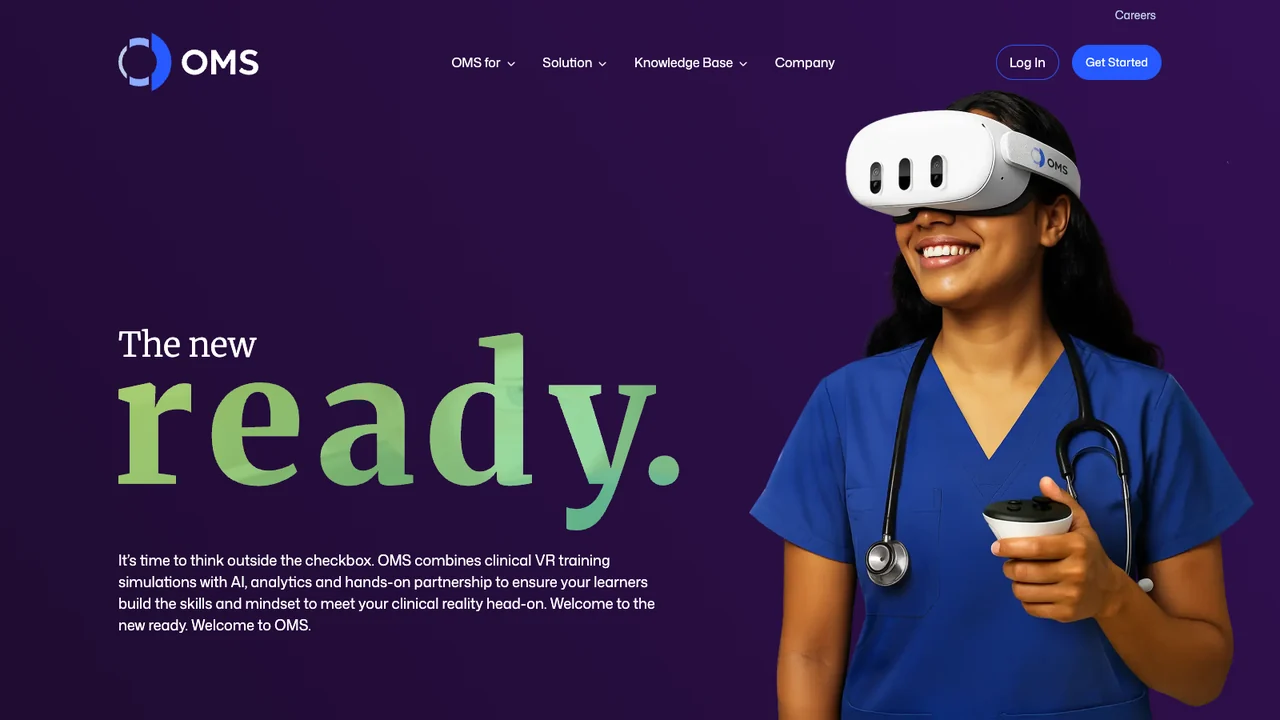
Oxford Medical Simulation publishes virtual reality clinical simulation organized explicitly around the institutions that buy it, and that organization is the clearest signal of who it serves.
Its published academic segments are Nursing Programs, Medical Schools, Physician Assistant Programs and Allied Health Programs. Its health system segments are Onboarding and Transition to Practice, Quality and Safety, Risk and Compliance, and Graduate Medical Education. Segmenting by program type and by institutional function rather than by clinical specialty tells you this is sold to deans, directors of simulation and heads of education rather than to individual departments.
Nursing leads that list, and that ordering reflects where the volume and the workforce pressure actually are. Nursing programs train very large cohorts, face documented placement shortages, and have accreditation requirements that simulation hours can help satisfy, which makes them a stronger market than surgical specialties despite attracting less attention.
Its published Research, Case Studies and Knowledge Base sections matter for the same reason they matter at Osso VR: institutional buyers need evidence and accreditation support, not demonstrations. It also publishes a Services section covering onboarding and integration, which is an honest acknowledgement that deploying simulation across a nursing school is a change management exercise rather than a software installation.
It publishes an insight piece on artificial intelligence in healthcare simulation, indicating active development in scenario generation and assessment. It publishes no founding year, headquarters address, team size, named institutions or rates on the pages reviewed, and it is a platform with scenario libraries rather than a bespoke studio, so genuinely custom scenario development should be confirmed directly. Best for nursing and medical programs deploying clinical scenarios at institutional scale.
5. Nanome
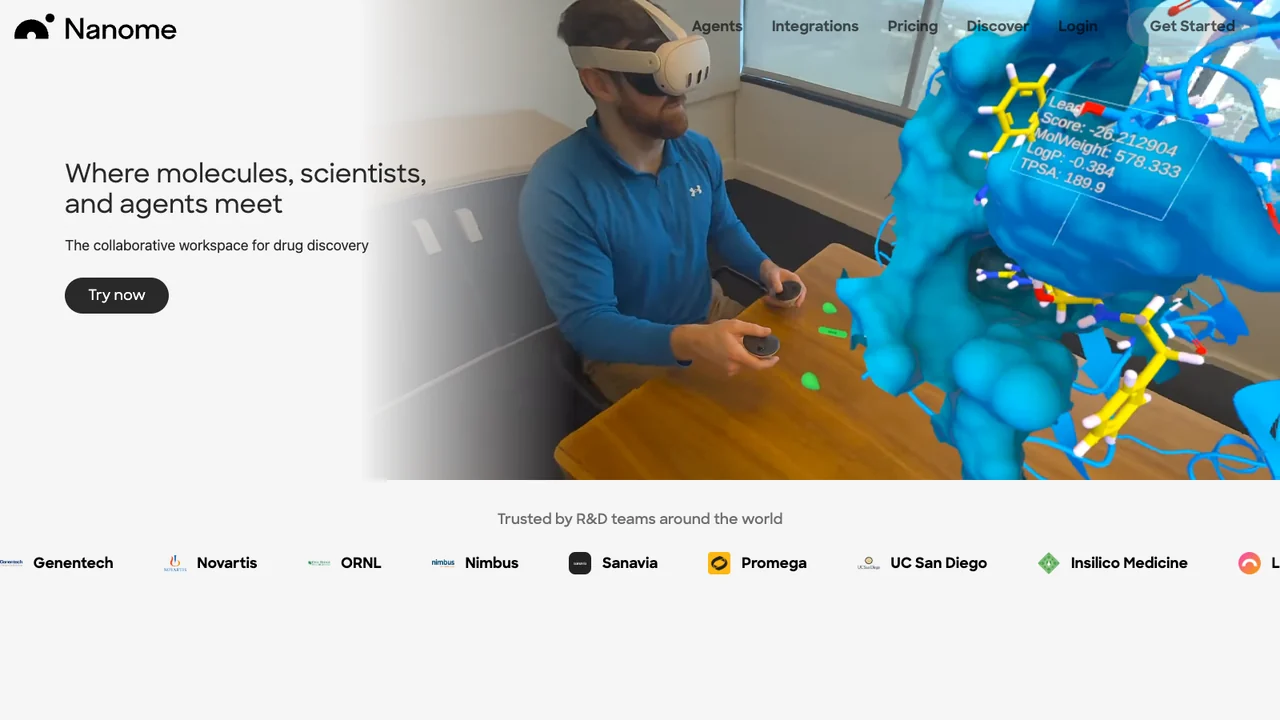
Nanome publishes molecular visualization and drug discovery across web, XR and AI agents, describing itself as the collaborative workspace for drug discovery where molecules, scientists and agents meet. It is the outlier here and the reason is worth stating plainly: its users are researchers, not clinicians.
Its named clients are the strongest in this list and they are all research organizations: Genentech, Novartis, Oak Ridge National Laboratory, Nimbus, Sanavia, Promega, UC San Diego, Insilico Medicine, LifeArc, Iktos and Psilera. Two large pharmaceutical companies, a national laboratory and a research university is a substantial and checkable set.
Its published modalities cover small molecule, molecular glue, enzyme, antibody and metal organic framework work, which is the vocabulary of medicinal chemistry rather than medical education. Its platform spans EDU, MARA and Classic, with the EDU line indicating teaching use alongside research.
The case for XR here is genuinely strong and different from the training argument elsewhere in this list. Molecules are three-dimensional objects whose behavior depends on shape and spatial relationships, and chemists have always worked around the limitation of viewing them on flat screens. Manipulating a binding site with your hands at scale is not a presentational improvement, it is closer to how the problem is actually reasoned about.
Its published features include conversational interaction described as talking to your data without menus or script-stitching, and real-time collaborative sessions across web and XR. It publishes pricing, publications, case studies and integrations. It publishes no founding year, headquarters address or team size on the pages reviewed, and it is not a clinical training tool. Best for drug discovery research teams and molecular education.
What custom medical simulation projects have to account for
Four things decide whether a commissioned medical simulation is adopted.
The first is naming the simulation type. Procedural, clinical scenario, physiological and molecular are different disciplines with different suppliers. Write down which one you need and who uses it before briefing anyone, because a brief saying medical simulation will attract four incomparable proposals.
The second is clinical authorship. Someone with the relevant clinical expertise has to write and validate the content, and that person is usually not on the supplier's staff. Establish who provides clinical authorship, how much of their time it takes, and who signs off, because that resource is the most common project bottleneck and it sits on your side.
The third is the evidence standard the buyer will apply. Institutional purchases pass through committees that ask for validation literature. Oxford Medical Simulation and Nanome both publish research sections. Where a supplier publishes none, expect to generate the evidence yourself or to fund a study.
The fourth is maintenance of clinical content. Guidelines change, drugs are withdrawn, protocols are revised, and a simulation teaching last year's practice is worse than no simulation. Establish who updates scenarios and what it costs. Treeview publishes full transfer of IP, source code and assets, which allows internal revision; the others do not publish ownership terms.
How to choose between these medical simulation companies
Start from the user. A surgeon or technician rehearsing a physical procedure, especially on a specific device, points to Ghost Medical. A student or nurse working through a case, taking a history and making decisions, points to SimforHealth or Oxford Medical Simulation, with SimforHealth stronger on emotional and dialogue fidelity and Oxford Medical Simulation stronger on institutional deployment and accreditation.
A research chemist manipulating structures points to Nanome, which is a different market entirely and should not be compared with the others. A simulation that does not exist, must integrate with your systems and must be owned outright points to Treeview.
Secure clinical authorship before signing anything. The bottleneck in almost every medical simulation project is expert time to write and validate content, and a schedule that assumes the supplier supplies it will slip immediately.
Finally, ask what happens when the guideline changes. Clinical content has a shelf life measured in a small number of years, and the cost and mechanism of revision determine whether this is an asset or a depreciating purchase.
Related reading. BestInXR's healthcare guide covers XR across clinical, communication and training. companies for VR surgical training development covers procedural training in depth, and AR and VR development companies for healthcare covers the wider market. For the operating room see companies for AR in the operating room and surgical planning, and for laboratory teaching, VR companies for virtual labs and science simulations.
Frequently Asked Questions (FAQ)
1. What counts as medical simulation?
At least four different things: rehearsing a physical procedure, running a clinical scenario with a virtual patient, modeling physiology, and manipulating molecules for research. They have different users, evidence standards and suppliers, and a brief that does not specify which will produce proposals you cannot compare.
2. What is clinical simulation, and is it the same thing?
Clinical simulation is the rehearsal of patient care without a patient, and in the market's own vocabulary it usually means high-fidelity manikins rather than headsets. Laerdal, whose SimMan patient simulators are the reference product, and Elevate Healthcare, which is CAE Healthcare renamed after its sale to Madison Industries, dominate the term. Custom VR simulation is a newer modality that competes for the same budget and is commissioned rather than bought off a catalogue, which is the distinction this list is organized around.
3. Which of these name clients?
Nanome names Genentech, Novartis, Oak Ridge National Laboratory, Nimbus, Promega, UC San Diego, Insilico Medicine, LifeArc, Iktos and Psilera. Ghost Medical names Spineology, Avita Medical and Greenman LLC. Treeview names Medtronic and Daiichi Sankyo. SimforHealth and Oxford Medical Simulation publish no named clients on the pages reviewed.
4. Who writes the clinical content?
Someone with the relevant clinical expertise, and usually from your side rather than the supplier's. This is the most common bottleneck in medical simulation projects. Establish who authors, how much of their time is required and who signs off before agreeing a schedule.
5. Can a virtual patient train communication skills?
That is what SimforHealth publishes, describing virtual patients with their own medical history, distinctive traits and emotions. Communication, history taking and recognizing a patient who is minimizing symptoms have no equivalent in procedural simulators or manikins, and they account for a substantial share of clinical error.
6. Is Nanome a medical training tool?
No. It is molecular visualization for drug discovery, used by research chemists rather than clinicians, with modalities covering small molecule, molecular glue, enzyme, antibody and metal organic framework work. It belongs on this list as a distinct discipline, not as an alternative to clinical simulation.
7. What does custom medical simulation cost?
Only Nanome publishes rates, so no comparable figure is recorded for the others. Cost is driven by simulation type, how many scenarios or procedures are covered, clinical authorship time, hardware and its management, and whether validation is required. Clinical content maintenance as guidelines change is the line most often missing from a first budget.