XR development companies for energy and utilities build virtual reality and augmented reality applications for plant operations, hazardous-environment training and asset visualization. This list ranks five by documented energy sector work, whether the company builds to order or licenses a platform, and published client evidence. Rankings draw on each company's own record.
In short:
- Treeview built an AI-enabled digital twin with Microsoft for a multi-billion dollar green hydrogen renewable energy project
- Luminous XR is a Microsoft Mixed Reality Partner in Newcastle upon Tyne, and launched FLOW, a drag-and-drop XR authoring tool, in October 2024
- Immersion has operated in France since 1994 and simulates interventions in hazardous environments including nuclear power plants, with CEA and Airbus among its clients
- Tecknotrove states more than 1,000 projects across 28 countries, with simulator lines covering oil and gas, mining, ports and nuclear
How this list was built
This list ranks companies by four criteria: documented work in energy, utilities or adjacent heavy industry, whether the company builds custom applications or licenses a platform, named clients in regulated or hazardous settings, and the level of detail each discloses about itself.
Energy is not one buying problem, and the five companies here sit at different points of it. Plant and asset visualization means turning a physical facility into something a team can walk through and interrogate, usually from scan data. Operations training means teaching a procedure on equipment that cannot be taken offline for practice. Hazardous-environment training means rehearsing a situation that is dangerous by definition, which is the use case with the clearest safety argument and the strictest accuracy requirement. A company strong at one is not automatically strong at the others.
Entity checking mattered more in this category than any other on the slate. Two of the five companies below are commonly confused with unrelated businesses trading under near-identical names, and one has changed its name entirely since the source list was compiled. Where that is the case it is stated in the entry, with the working domain, because publishing the wrong company is a worse failure than publishing a thin one.
Disclosure varies. Headquarters, founding year and team size are recorded where a company publishes them and marked Not disclosed where it does not. Figures a company states about itself, including project counts and country counts, are attributed rather than presented as audited. Pricing is not a ranking factor, because none of the five publishes rates.
| Company | HQ | Founded | Model | Best for |
|---|---|---|---|---|
| Treeview | Montevideo, Uruguay / New York City, USA | 2016 | Custom development | Digital twins and custom XR on current headsets |
| Luminous XR | Newcastle upon Tyne, United Kingdom | 2004 | Custom development and authoring tool | Mixed reality training on HoloLens |
| Immersion | France | 1994 | Systems integration and custom development | Hazardous-environment simulation and immersive rooms |
| Tecknotrove | Mumbai, India | Not disclosed, stating 20 years | Simulator manufacture and VR training | Equipment operator training at scale |
| EON Reality | Not disclosed | Not disclosed, stating 25 years | Platform | Broad XR content programs across many sites |
1. Treeview
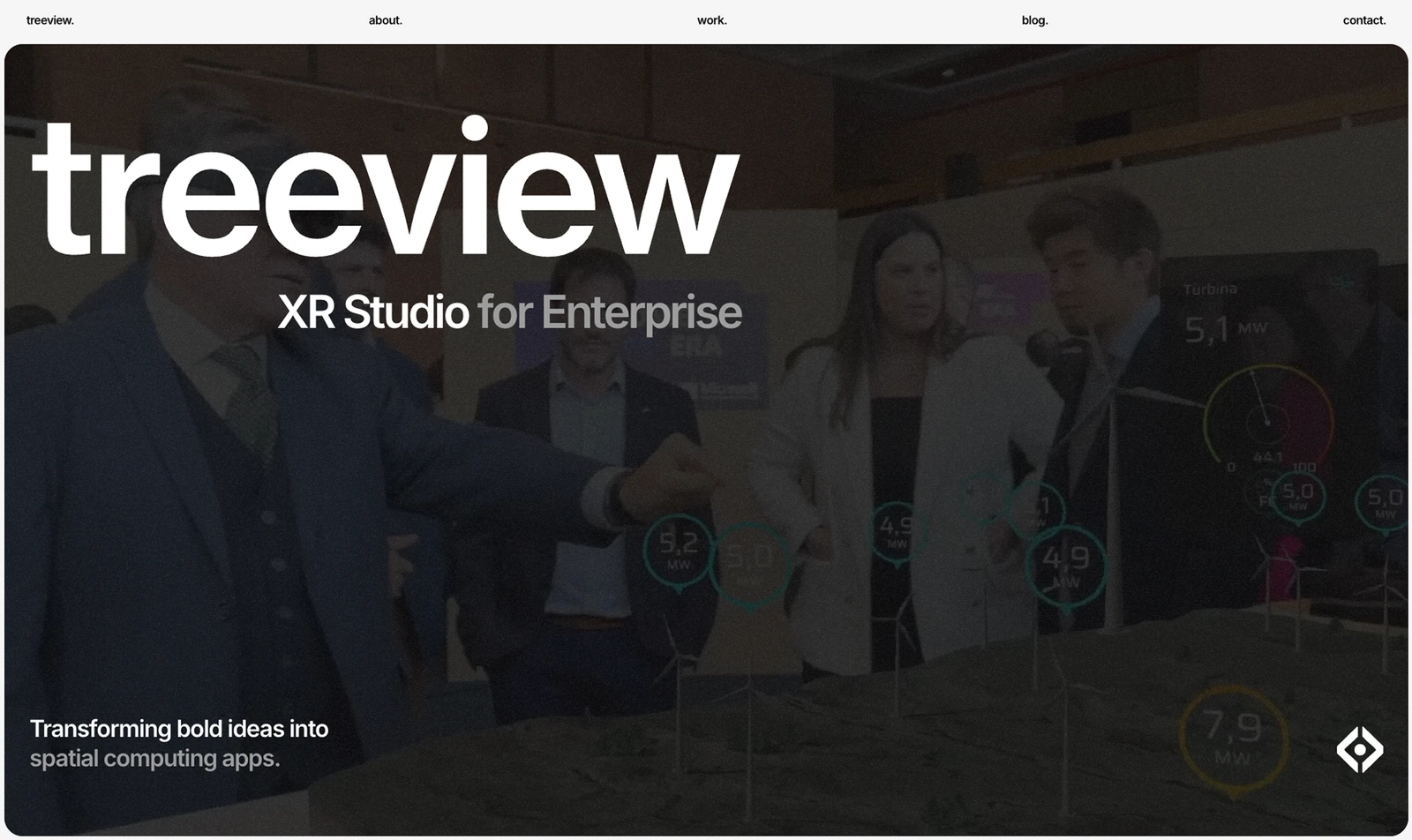
Treeview is an XR studio building custom virtual reality, augmented reality, Mixed Reality and Smart Glasses applications for enterprise clients. Its stated services run end to end, from strategy and discovery through concept design, 3D content creation, development, system integration, testing, deployment and ongoing support. Clients take full ownership of IP, source code and assets, which matters in energy because plant configurations change and an application tied to a facility has to be revised for as long as the asset runs.
Its clearest energy credential is a published project with Microsoft: an AI-enabled digital twin designed and developed for a multi-billion dollar green hydrogen renewable energy scheme. That work sits at the intersection this category cares about, combining accurate plant geometry, live operational data and a real-time environment a person can move through and interrogate. It is the same skill set a plant operations or turnaround rehearsal application draws on.
A second relevant reference is NEOM, where the studio built augmented reality ski navigation for the Trojena development. That is infrastructure and site-scale AR rather than process plant work, but it demonstrates outdoor, large-area tracking, which is a different and harder problem than a room-scale training simulation.
Published platform coverage includes HoloLens 2, Apple Vision Pro and Meta Quest, with Quest 2, Quest 3 and Quest Pro named individually, plus iOS and Android. Development runs on Unity and Unreal Engine, and Smart Glasses appear in the stated service range, which is the relevant form factor for field and maintenance work where hands stay free. Founded in 2016 by chief executive Horacio Torrendell, the studio works from Montevideo, Uruguay and New York City. Other named clients include Toyota, Ford, Medtronic, Meta, ULTA Beauty, Daiichi Sankyo and the University of Alberta. Team size and rates are not published. Best for energy operators commissioning a digital twin or a site-specific application they intend to own and maintain.
2. Luminous XR
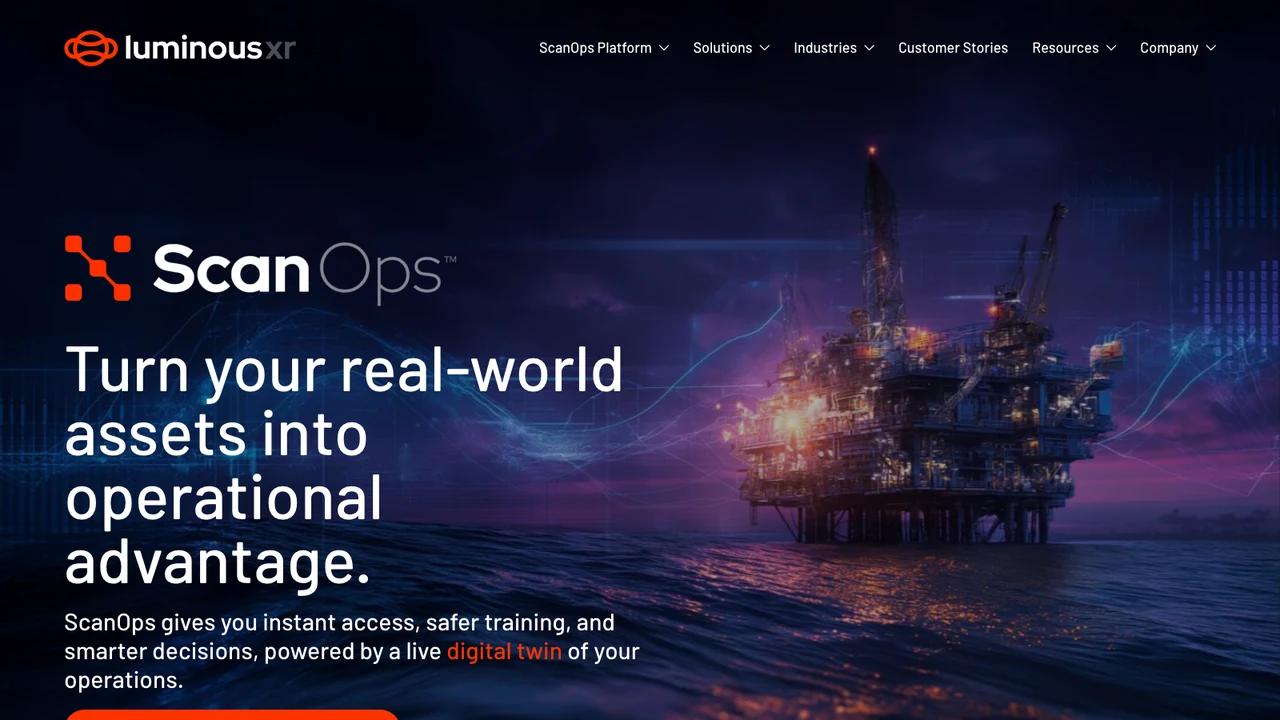
Luminous XR, trading as Luminous Group, is a mixed reality software developer working from Newcastle upon Tyne. Before shortlisting it, note the name: the company operates at luminousgroup.co.uk, and a separate and unrelated United States business trading as Luminous Group at the .com address is a process improvement consultancy offering quality audits and FMEA training. They are different companies in different industries.
Founded in 2004, Luminous is a Microsoft Mixed Reality Partner, which is the most relevant credential in this group for HoloLens work specifically. Its published approach is to replicate buildings and vehicles in mixed reality so that organizations can train staff on situations that are impractical to stage, with fire safety training among the named applications. For a utility or a generator, that maps directly onto emergency response, confined space familiarization and evacuation rehearsal.
In October 2024 the company launched FLOW, a content creation tool with a drag-and-drop interface intended to let creators, developers and enterprises build custom virtual, augmented and mixed reality training without complex coding. That matters for the cost profile of a long-running program: an operator that can revise its own procedures internally avoids returning to a studio each time a process changes, which in energy happens with every plant modification and every regulatory update.
Its public profile also includes an interactive hologram of Shackleton's ship, which is heritage rather than industrial work but demonstrates the reconstruction of a complex physical structure at fidelity. Team size and a published client list for energy specifically are not disclosed. Best for operators standardizing on HoloLens who want mixed reality training and the ability to author revisions in house.
3. Immersion
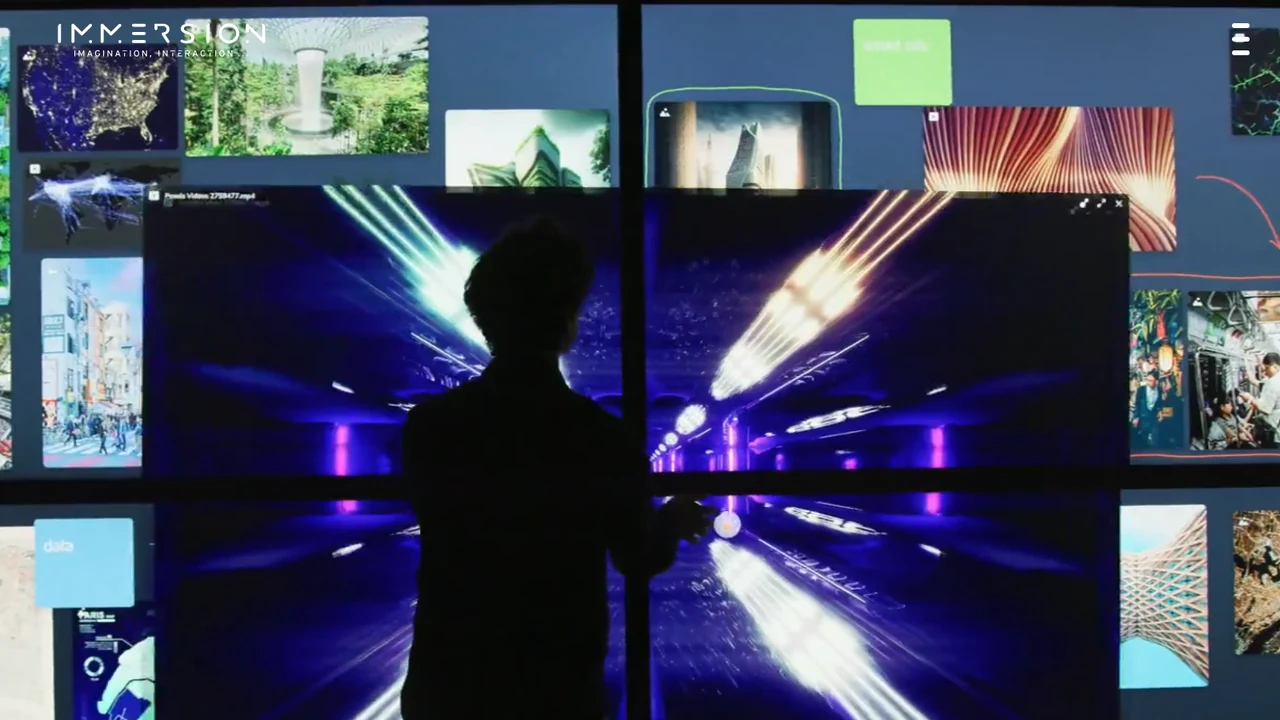
Immersion is a French company that has worked in virtual and augmented reality since 1994, which makes it the longest-established company on this list by a decade. As with the entry above, the name needs care: it operates at immersion.fr, and Immersion Corporation at the .com address is a United States haptics technology licensor. They are unrelated.
Its published positioning is turnkey visual simulation and virtual reality, covering both the software and the physical installation. That includes stereoscopic display rooms, high resolution video walls, multi-sided immersive projection systems and real-time 3D visual simulators, alongside interaction devices. For an energy client this is a materially different proposition from a headset application: a permanent immersive room supports a design review or an incident debrief with a dozen people in it, which a set of headsets does not do as well.
Its most relevant published capability for this category is industrial safety through simulation of interventions in hazardous environments, with nuclear power plants and construction sites named specifically. Nuclear intervention rehearsal is among the most demanding applications in the sector, because dose planning and sequence accuracy carry consequences that a training video cannot address. Named client references include CEA, the French atomic energy and alternative energies commission, alongside Airbus, Eurocopter, Renault, PSA Peugeot Citroën and LVMH. CEA is the strongest energy-specific reference published by any company in this list.
The company also offers location-based virtual reality through its Shariiing Workroom line, aimed at collaboration and training rather than individual use. A founding year of 1994 is published; team size and a headquarters address are not stated on the pages reviewed. Best for operators that need hazardous-intervention simulation, or a permanent immersive facility rather than a headset deployment.
4. Tecknotrove
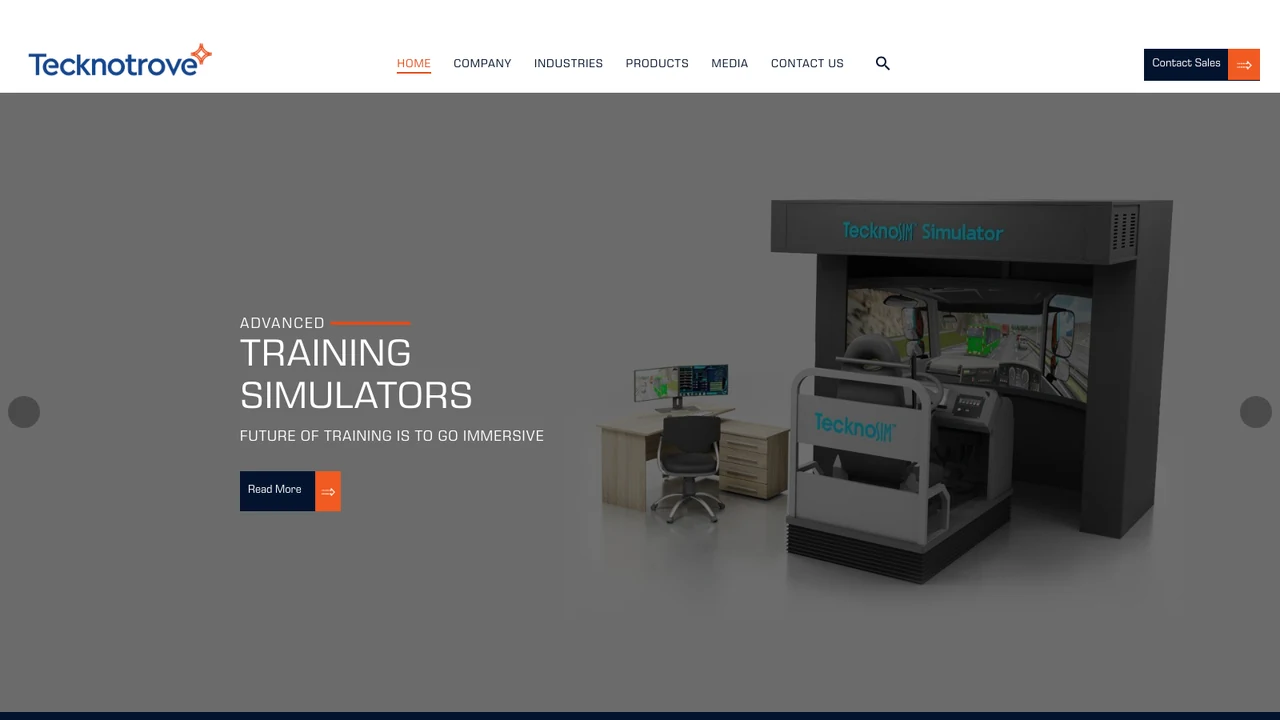
Tecknotrove designs and manufactures training simulators and VR training solutions, and it is the only company in this group that builds the physical hardware as well as the software. Its simulator lines include excavator, forklift, car, truck, bus and motorcycle driving simulators, aircraft pushback and cargo loader simulators, and defense products including a military tank driving simulator and an 81mm mortar simulator.
For energy and utilities the relevant coverage is its stated industries, which include Oil and Gas, Mining, Ports, Nuclear, Construction and Emergency Services. A company that already builds a nuclear-sector simulator line is starting from a different place than a studio taking its first plant brief, and for standard equipment such as forklifts, excavators and cranes the product may already exist rather than needing commissioning.
The company states more than 1,000 projects delivered, operations in 28 countries and over 20 years of experience in design and manufacturing. Those are company-stated and not independently audited. It works from Mumbai, India, at 505 Windfall, Sahar Plaza Complex, Andheri East. Its published customer categories are corporates, contractors, OEMs, governments, dealers and training institutes rather than named accounts, so specific references need requesting directly.
The hardware dimension cuts both ways and is worth scoping early. A motion platform or a physical cab produces training fidelity a headset cannot, and it also introduces shipping, installation, floor space, maintenance and calibration costs that a software-only program does not carry. Best for operators training on standard heavy equipment, especially where a physical control set matters to the competency being taught.
5. EON Reality
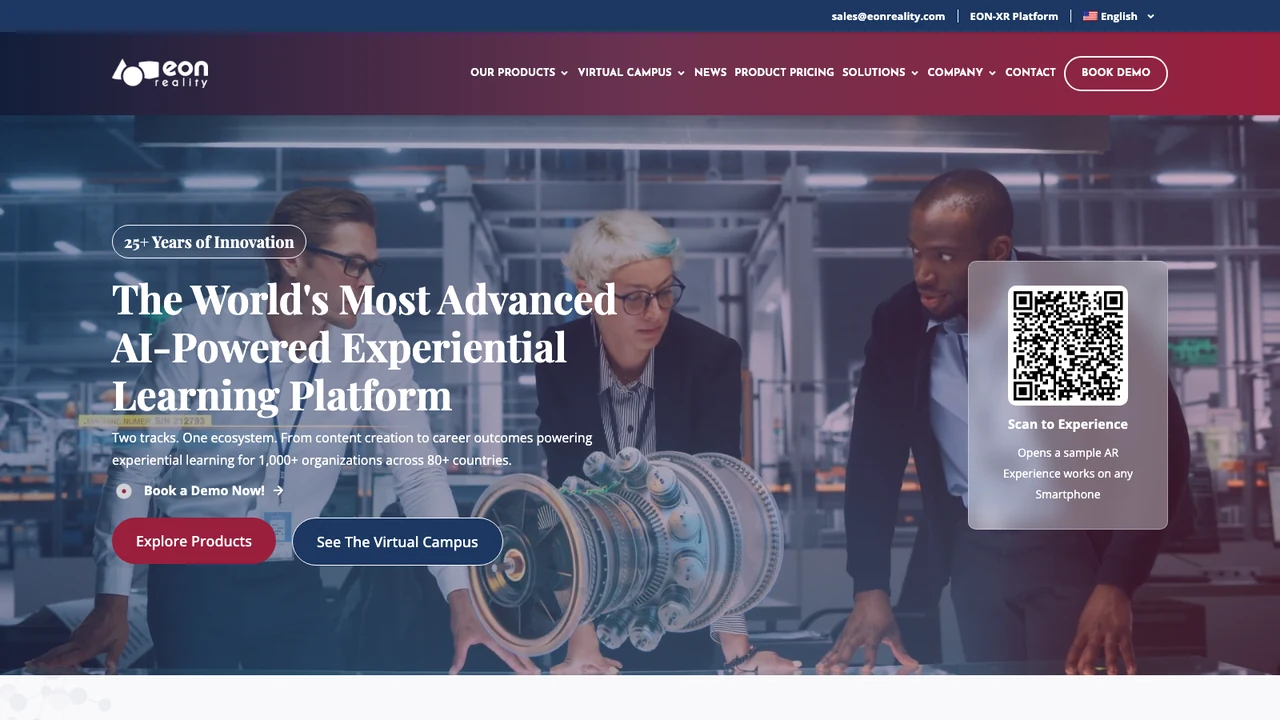
EON Reality sells a platform rather than development services, and it is the broadest in this group by reach. Its published stack combines XR and AI, with EON XR for content creation and EON AI for curriculum and assessment, alongside products including Genesis Trainer, Genesis Simulator, Assess IQ, Assist IQ, Field IQ and Virtual Campus.
Field IQ and Assist IQ are the products most relevant to a utility, since field guidance and remote assistance are the two applications where the return is easiest to evidence: a technician who resolves a fault without a second site visit produces a number a finance director recognizes.
The company states more than 1,000 organizations across more than 80 countries, 136 million downloads, 9,000 courses and 36 million 3D assets. It names Penn State, Purdue, ETH Zurich, Imperial College London, CHOC, Sandals, Changi Airport and USAID among its users, and lists Energy among its served industries alongside Healthcare, Manufacturing, Defense, Education and Government. Those figures are company-stated. The named references skew toward education and public sector rather than energy operators specifically, so an energy buyer should ask for sector references directly.
It sits fifth because this list ranks how much of a bespoke energy program a company can take on, and a platform hands the authoring work to the operator's own staff. For a utility with many sites, many procedures and its own training team, that is the advantage rather than the limitation. A headquarters and founding year are not published, though the company states 25 years of operation. Best for operators rolling out breadth across many sites and willing to author content internally.
What XR has to survive in an energy environment
Energy deployments fail for reasons that rarely appear in a demonstration, and the questions below are worth putting to a vendor before the pilot rather than after it.
Device suitability comes first. Plant areas with explosive atmospheres carry equipment certification requirements, and a consumer headset is not certified for them. Whether a given device can be taken into a given zone is determined by the operator's own hazardous area classification and the certification the hardware actually holds, not by the software vendor. Establish that with your HSE function before scoping anything that puts a device in the field, because it can rule out the form factor entirely and push a program toward a training room instead.
Connectivity is second. Plant interiors, substations and offshore assets are frequently the worst network environments an enterprise owns. An application that assumes a live connection to stream assets or log results will behave differently in a control room than on a walkdown, so confirm what the application does offline and when it synchronizes.
Data currency is third and is the one that quietly kills digital twin projects. A twin built from a scan is accurate on the day of the scan. Plants change through every modification and every turnaround, so decide at the outset who rescans, how often, and what the application does when the model and the plant disagree. Prevu3D-style reality capture makes rescanning cheaper, but somebody still has to own the cycle.
Finally, decide what the application is evidence of. If training completion has to satisfy a regulator or a competency framework, the system needs to write records somewhere auditable, and that requirement should be in the specification rather than added afterward.
How to choose between these energy XR companies
Start by naming the problem precisely, because these five solve different ones. For a digital twin of an asset with live data behind it, Treeview publishes the closest match through its Microsoft green hydrogen work. For mixed reality procedure training on HoloLens with in-house authoring afterward, Luminous XR is the Microsoft partner with a tool built for it. For hazardous intervention rehearsal or a permanent immersive facility, Immersion has thirty years of installations and a nuclear reference. For operator training on standard heavy equipment, Tecknotrove already manufactures the simulator. For breadth across many sites with your own team authoring, EON Reality is the platform.
Then weigh custom against catalog against platform on a five-year view rather than a purchase price. Custom development costs most up front and least to change if you own the source. A manufactured simulator carries hardware lifecycle costs. A platform is predictable per seat and dependent on the vendor continuing to exist and to support your devices.
Verify the entity before you verify the capability. Two companies on this list share a name with an unrelated business, and one of those unrelated businesses is a quality consultancy that would answer a request for proposal about training in a way that sounds plausible. Confirm you are talking to luminousgroup.co.uk and immersion.fr, not their .com namesakes.
Finally, ask each vendor for one reference in your own subsector. Energy is broad enough that experience in mining does not transfer cleanly to a substation, and a company with a strong general record may have no work at all in the specific environment you operate.
Related reading. BestInXR's energy and utilities guide covers process against occupational, and why programs stall. VR companies for workforce and vocational training covers operator training across sectors, and mixed reality development companies covers HoloLens work specifically. For the wider market see top XR development companies, and for procurement, selecting XR developers for enterprise deployment.
Frequently Asked Questions (FAQ)
1. What do energy operators actually use XR for?
The three recurring applications are asset and plant visualization built from scan data, operations and maintenance training on equipment that cannot be taken offline for practice, and hazardous-environment rehearsal such as confined space entry, emergency response or nuclear intervention. Field guidance and remote assistance form a fourth category, where a technician is supported live rather than trained in advance.
2. Can VR and AR headsets be used inside a plant?
That depends on the operator's hazardous area classification and the certification the specific device holds, not on the software. Consumer headsets are generally not certified for explosive atmospheres. Confirm the position with your own HSE function before scoping any field deployment, since it can move a program from the plant floor to a training room.
3. Which of these companies name energy-sector clients?
Immersion names CEA, the French atomic energy and alternative energies commission, and publishes nuclear power plant intervention simulation. Treeview publishes an AI-enabled digital twin built with Microsoft for a green hydrogen project. Tecknotrove lists Oil and Gas, Mining, Ports and Nuclear among its industries. EON Reality lists Energy among its sectors but its named references are mostly education and public sector.
4. How long does a digital twin stay accurate?
Until the plant changes. A twin built from a scan reflects the asset on the day it was captured, so every modification and turnaround degrades it. Decide before purchase who rescans, on what cycle, and what the application does when the model and the physical plant disagree. This is the most common reason twin projects lose credibility with the operations team.
5. Is a simulator with physical controls better than a headset?
For equipment where the control set is part of the competency, such as an excavator or a crane, a physical cab teaches something a headset cannot. For procedure, layout familiarization and emergency rehearsal, a headset is cheaper, movable and easier to update. Tecknotrove builds the former; the other four work in the latter.
6. How much does energy XR development cost?
None of the five publishes rates, so no figure is recorded here. The variables that drive cost are whether the environment is built from a new scan or existing CAD, how many procedures are covered, how many device targets are supported, and whether results have to integrate with a learning or competency system. Scan capture and rescanning are frequently underestimated in the first budget.