XR for Energy and Utilities: What It Is and How to Evaluate It
Energy is not one buying problem. Asset visualization turns a facility into something a team can walk and interrogate. Operations training teaches a procedure on equipment that cannot be taken offline. Safety and emergency work rehearses scenarios that cannot be staged on a live site at all. They are bought separately and confused constantly.
In short:
- What it is: Virtual and augmented reality applied to plant visualization, operations training, safety rehearsal and remote inspection across energy, utilities and heavy industry.
- What it is not: Interchangeable with general industrial training. Process safety and occupational safety are different disciplines with different failure modes.
- What decides the shortlist: Documented work in energy or adjacent heavy industry, custom build against licensed platform, named clients in regulated or hazardous settings, and how much each company discloses about itself.
- What kills programs: A missed capture window. In many facilities scanning is only possible during a planned outage, and the next one may be a year away.
What energy XR covers
Energy XR is the use of virtual and augmented reality to represent, operate and train on physical assets that are expensive, hazardous or continuously running. The sector adopted it early because the alternative to a simulation is frequently taking a producing asset offline.
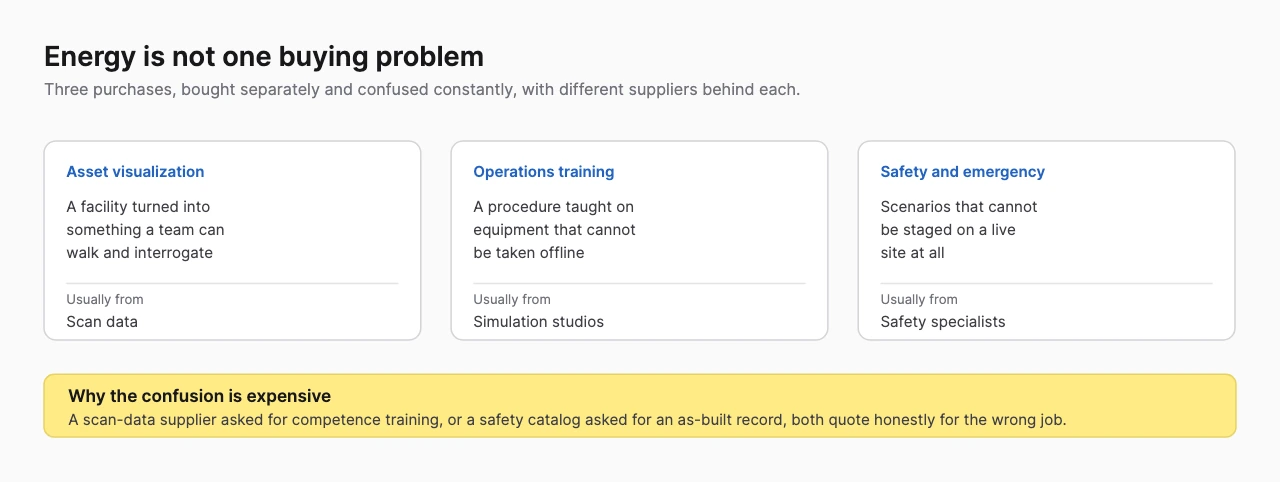
The three purchases above sit in different budgets. Asset visualization is usually operations or engineering, built from scan data. Operations training is learning and development or technical training, built by simulation studios. Safety is HSE, and is frequently licensed rather than built.
A supplier strong in one carries no presumption of competence in another, and the most common briefing error in this sector is treating "energy experience" as a single qualification.
| Asset visualization | Operations training | Safety and emergency | |
|---|---|---|---|
| Budget sits in | Operations, engineering | Technical training, L&D | HSE |
| Built from | Scan data | Equipment behavior models | Licensed or built scenarios |
| Judged on | Accuracy against the plant | Competence change | Incident reduction |
| Refresh need | Continuous | On equipment change | On procedure change |
| Usual supplier | Reality capture | Simulation studio | Safety catalog |
The distinction that decides your supplier
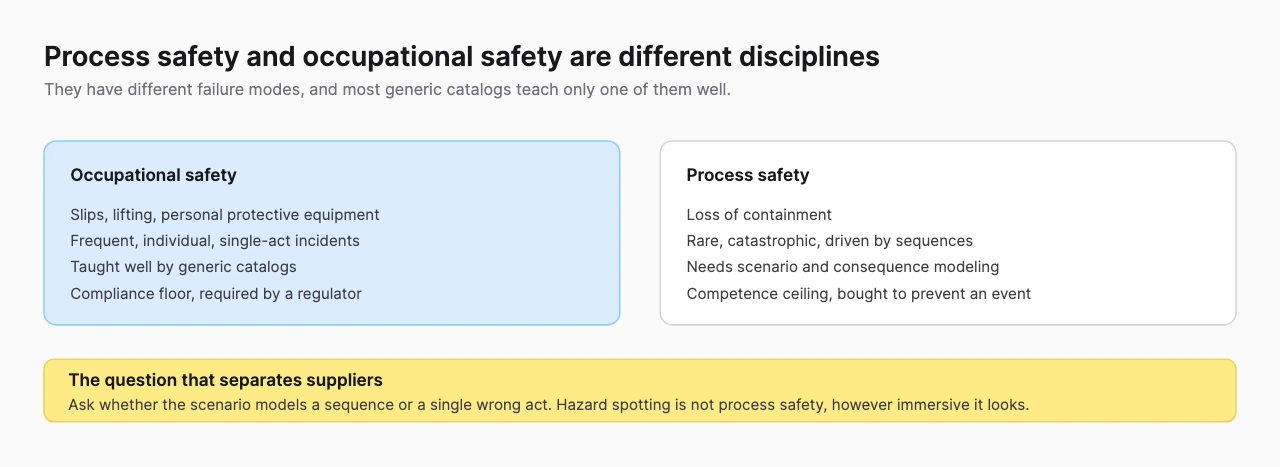
Process safety and occupational safety are different disciplines with different failure modes, and most generic catalogs teach only one of them well.
Occupational safety covers slips, lifting and personal protective equipment. Incidents are frequent, individual and driven by single acts, and generic content teaches it well because the hazards are common across industries.
Process safety covers loss of containment. Its incidents are rare, catastrophic and driven by sequences rather than single acts. A simulation that teaches hazard spotting is not teaching process safety, however immersive it looks, because spotting a hazard is not the same skill as recognizing that three normal-looking conditions have combined into an abnormal one.
| Occupational safety | Process safety | |
|---|---|---|
| Failure mode | Single act | Sequence of conditions |
| Frequency | Frequent | Rare |
| Severity | Individual injury | Catastrophic |
| Taught well by | Generic catalogs | Scenario and consequence modeling |
| Bought as | Compliance floor | Competence ceiling |
The question that separates suppliers: ask whether the scenario models a sequence or a single wrong act, and what happens when the trainee does nothing.
The compliance floor and the competence ceiling
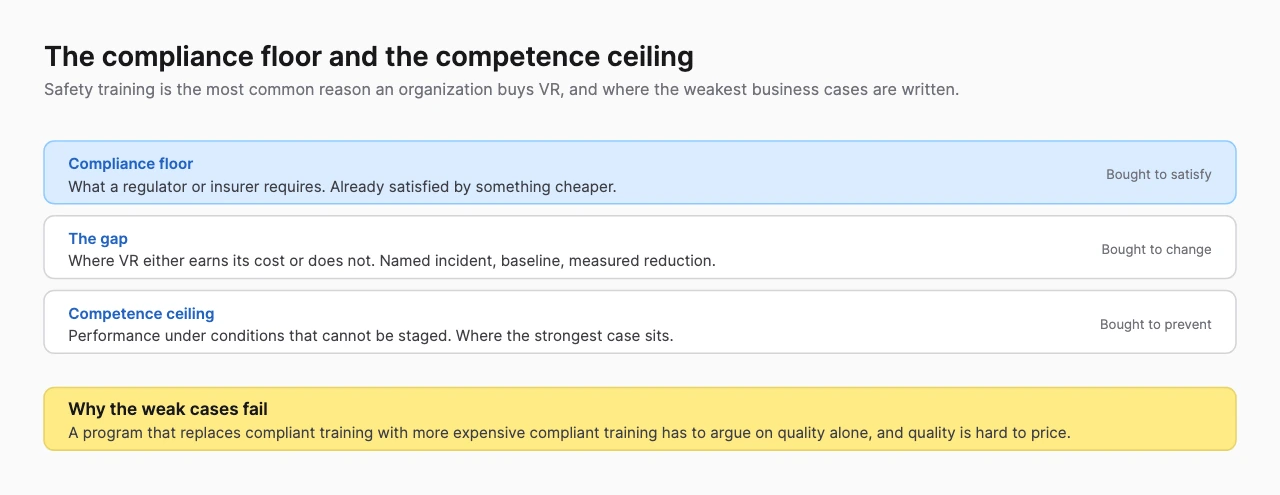
Safety training is the single most common reason an organization buys VR, and it is also where the weakest business cases are written.
The reason is that safety training has a compliance floor and a competence ceiling, and the two are bought for different reasons. The compliance floor is the training a regulator or insurer requires, which is already satisfied by something cheaper. A program that replaces compliant training with more expensive compliant training has to argue on quality alone, and quality is hard to price at renewal.
The competence ceiling is performance under conditions that cannot be staged. That is where the strongest case sits, and it is the case that survives a budget review, because the thing being replaced has no cheaper substitute.
Best companies for VR hazardous environment and safety training ranks on how much of a supplier's published work is safety specifically, whether they license a catalog or build to order, named clients in hazardous industries and how completion is evidenced.
Energy XR by purchase
Five distinct purchases, each with its own ranked list.
Cross-sector development
Best XR development companies for energy and utilities is the overview, ranking on documented work in energy, utilities or adjacent heavy industry, custom against platform, named clients in regulated or hazardous settings, and the level of detail each company discloses about itself.
Site tours and remote inspection
Best VR companies for virtual site tours of energy facilities covers access to assets that are hazardous, remote or simply expensive to walk. This overlaps with the virtual tours guide, where the same capture serves a different purpose.
Digital twins
Best digital twin platforms and development companies for energy covers the operational case. The digital twins guide sets out the four products sold under that word, which matters here because energy buyers are shown all four.
Oil and gas
Best VR companies for oil and gas simulation and training splits the sector into three problems bought separately: equipment operation, process and procedure work and emergency response.
Wind, solar and renewables
Best VR companies for wind, solar and renewable energy covers the use case that distinguishes renewables from the rest of energy: explaining a project to investors, regulators and landowners before it is built, rather than operating one after.
Hazardous environment safety
Best companies for VR hazardous environment and safety training covers work where the scenario cannot be staged, which is the segment with the clearest case and the most crowded field.
Where the same model serves two masters
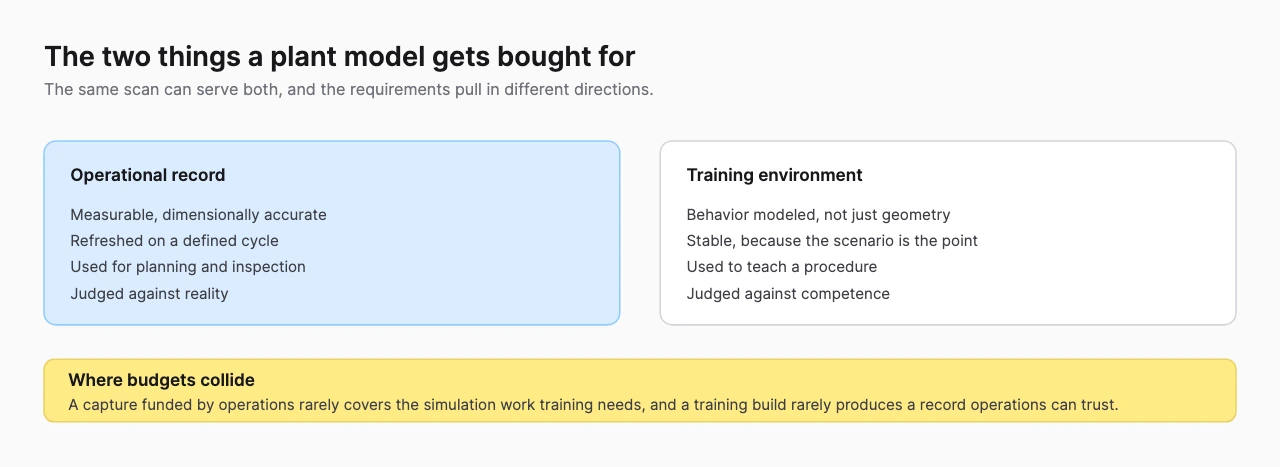
A single capture of a plant can serve operations and training, and the requirements pull in different directions.
An operational record has to be measurable and dimensionally accurate, refreshed on a defined cycle and judged against reality. A training environment needs behavior modeled rather than only geometry, and it benefits from being stable, because the scenario rather than the current state is the point.
Budgets collide here more often than they combine. A capture funded by operations rarely covers the simulation work training needs, and a training build rarely produces a record operations will trust. Deciding which one the capture is primarily for, and who pays for the second use, is cheaper before the scan than after it.
What sets the schedule

Site access is the constraint, and nothing about the build compares to it.
Permit and induction. Access to a regulated facility is its own process, with its own lead time, and a supplier who has not worked in one will underestimate it.
The capture window. In many facilities scanning is possible only during a planned outage. If that is annual, missing it costs a year, and no amount of project management recovers it.
Verification. Someone who knows the plant has to confirm the model matches it. That person is an operator or engineer, and their time is not free.
Sign-off. Operations, HSE and IT rarely share a single approver, and a project that assumed one will discover it late.
Who supplies energy XR
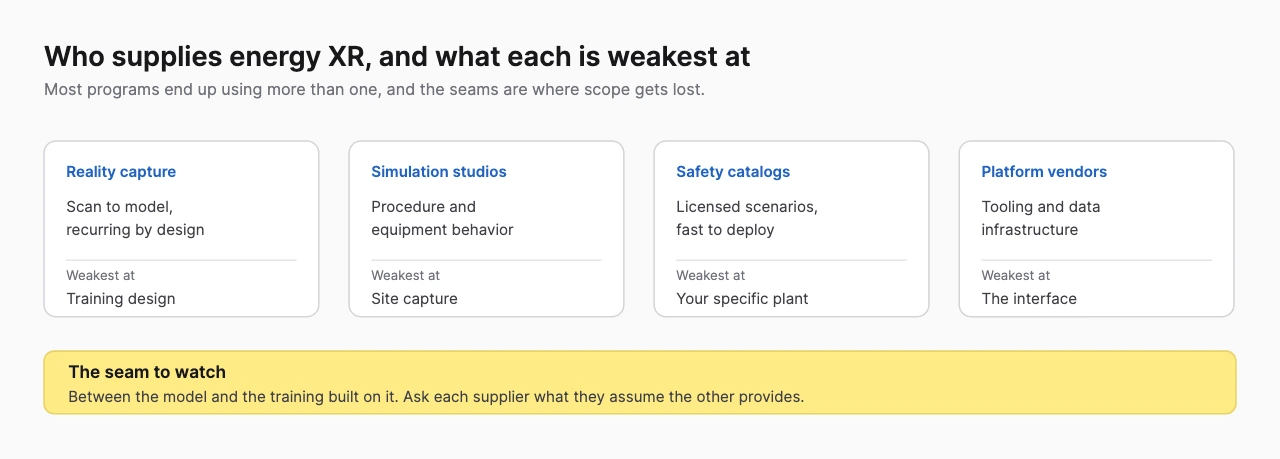
Reality capture specialists turn a plant into a model and assume recurring capture. Prevu3D and Cintoo work this way, and their commercial model aligns with the refresh problem that kills most models.
Simulation studios model equipment behavior and procedure. ForgeFX Simulations and Tecknotrove sit here, and this is where fidelity validation matters most.
Safety catalogs license scenarios. Immersive Factory and PIXO VR work this way, and for the compliance floor this is usually the correct purchase.
Platform and industrial vendors supply tooling and data infrastructure. Siemens Energy, GE Vernova and Honeywell sit here, alongside custom studios including Treeview, LS Group and Luminous XR.
The seam to watch is between the model and the training built on it. Ask each supplier what they assume the other provides.
What energy XR programs have to account for
Contractors. In this sector the people most exposed to a hazard are frequently not employees. A per-seat license priced for headcount makes covering them expensive, and a program that excludes them excludes the population an investigation asks about first.
The next capture window. Book it before the current one closes. A model nobody refreshes stops being trusted, and in energy the refresh is gated by an outage schedule rather than by budget alone.
Assessment that survives an incident. Completion records get examined after an event. Whether the record identifies the individual, states what was completed to what standard and is retrievable years later decides whether it is any use then.
Who verifies fidelity. For any simulation used to teach a procedure, name who confirms the model behaves correctly and against what reference. Experienced operators detect a plausible-but-wrong simulation immediately, and once they do they stop taking it seriously.
What does energy XR cost?
Published pricing is rare outside safety catalogs, which sell per seat and publish rates. The cost drivers below are what a buyer actually controls.
| Cost center | Scales with | Usually quoted | Controlled by |
|---|---|---|---|
| Site capture | Area, complexity, access windows | Yes | Shared |
| Permits and induction | Facility regime, contractor status | Rarely | You |
| Behavior modeling | Number of systems simulated | Yes | Shared |
| Fidelity validation | Who confirms it, against what | Rarely | You |
| Licenses | Seats, including contractors | Sometimes | Shared |
| Recapture | Outage cycle | Rarely | You |
Two rows are almost never in a first proposal and both decide whether the program survives. Fidelity validation needs an operator or engineer to confirm the model behaves correctly, and their time is a real cost. Recapture is gated by the outage schedule, which means it is a commitment years out rather than a line item.
What happens after the first year
Energy assets change constantly, and a model that is not recaptured drifts until people stop trusting it. That is the same failure as in any digital twin, with one sector-specific aggravation: the refresh is gated by an outage, so it cannot simply be funded late.
Procedures change too, and more often than plant does. A revised permit-to-work process or a modified isolation procedure invalidates training content that still runs perfectly, and the people who notice are the operators being taught something that no longer matches the paperwork. Whoever owns the procedure has to own the trigger to update the content, and that link is rarely made at purchase.
The third decay is the one this sector handles better than most: assessment records. Because completion evidence is examined after incidents, energy buyers usually specify it properly. Where programs still fail is retrieval, when a record from four years ago is needed and the vendor platform that held it has been replaced.
What a competent energy supplier sounds like
They ask about the outage schedule in the first conversation. It is the single largest constraint on the project, and a supplier who does not raise it has not delivered into a producing facility.
They distinguish process safety from occupational safety without being prompted. This is the fastest test of whether a safety supplier understands the sector or is selling a general catalog into it.
They name who validates fidelity. Not that the model is accurate, but who confirms it and against what. A supplier who has been through this will describe the process rather than assert the outcome.
They ask about contractors before quoting. Licensing models built for stable employee populations are awkward to extend, and a supplier who raises it early is one who has been caught by it before.
A negative signal: a supplier who says the capture can happen any time. In a producing facility it cannot, and being told otherwise means either the supplier does not know that or is not planning to do the capture themselves.
Four patterns to design around, two of them specific to this sector
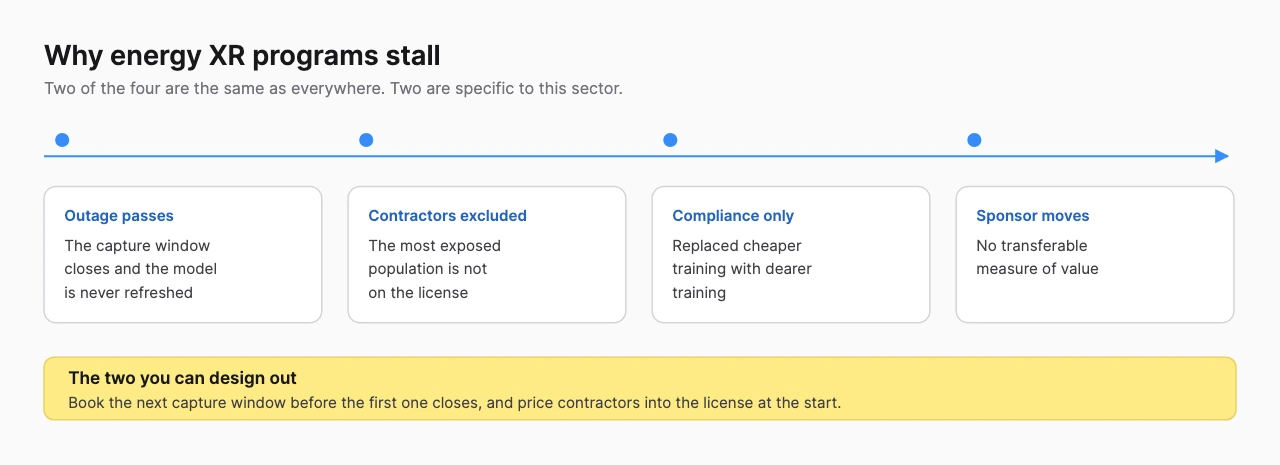
Four patterns, two of them specific to this sector.
The outage passes. The capture window closes, the model is never refreshed and within two years it depicts a plant that has been modified.
Contractors were excluded. The license covered employees, the exposed population was contractors, and the program cannot answer the question it was bought to answer.
It was justified on compliance only. Replacing cheaper compliant training with dearer compliant training is an argument about quality, and it loses to a capital request at the first budget review.
The sponsor moves on. The same failure as everywhere else, and the same defense: a measurable outcome agreed at the start transfers to a successor.
What you can check, and where

This sector has stronger public evidence than most, because clients are large and many announcements are regulated disclosures rather than marketing. A named operator client can often be confirmed from the client's own filings.
One of the four ranking criteria in these lists is how much detail a company discloses about itself. That is unusual, and it is here because reticence is informative in a sector where serious suppliers routinely publish client names, sector coverage and platform support. A company that publishes none of it may still be capable, and it is harder to check.
No primary source exists for market size or adoption projections in energy XR. They trace to commercial research whose methodology is not public, and this site does not repeat them.
How the rankings below were built
Every list linked here ranks on four published criteria and states what is not a ranking factor, set out in each post under How this list was built.
Across the energy lists the recurring four are documented work in the sector, whether the company builds custom or licenses a platform, named clients in regulated or hazardous settings, and the level of detail each discloses about itself.
The methodology page sets out how entries are assessed.
Where to start
Decide which of the three problems you are solving, then read the list covering it. A fourth question sits under all of them, which is how the operational data reaches a person at all, in a dashboard or in a view of the plant itself.
- Best XR development companies for energy and utilities
- Best VR companies for virtual site tours of energy facilities
- Best digital twin platforms and development companies for energy
- Best VR companies for oil and gas simulation and training
- Best companies for VR hazardous environment and safety training
- Best VR companies for wind, solar and renewable energy
- Best companies for industrial IoT data visualization
The directory lists developers, platforms and software with sourced entries.
Related reading. BestInXR's list of spatial computing companies explains why suppliers doing this work rarely use the term, and routes to the vertical list for each sector.
Related reading
Each of these covers one part of this subject in depth, with the suppliers ranked on criteria stated in the post.
Frequently Asked Questions (FAQ)
1. What is XR used for in energy and utilities?
Three things, bought separately: turning a facility into a model a team can walk and interrogate, teaching procedures on equipment that cannot be taken offline, and rehearsing safety and emergency scenarios that cannot be staged on a live site.
2. What is the difference between process safety and occupational safety training?
Occupational safety covers slips, lifting and protective equipment, where incidents are frequent and driven by single acts. Process safety covers loss of containment, where incidents are rare, catastrophic and driven by sequences of conditions. Generic catalogs teach the first well and the second poorly.
3. Which companies build XR for energy?
They divide by problem. Prevu3D and Cintoo in reality capture, ForgeFX and Tecknotrove in simulation, Immersive Factory and PIXO VR in safety catalogs, and Treeview, LS Group and Luminous XR in custom build.
4. What decides whether an energy VR program lasts?
Two things settled before a supplier is chosen: hitting the capture window so the model can be refreshed, and writing contractors into the license, since they are frequently the most exposed population.
5. Can one plant scan serve both operations and training?
Sometimes, but the requirements differ. An operational record must be measurable and refreshed. A training environment needs behavior modeled and benefits from being stable. Deciding which use is primary, and who funds the second, is cheaper before the scan than after it.
6. How do you verify that a simulation behaves correctly?
Name who confirms the model against what reference, and what happens when it does not match the real equipment. Without that, a simulation is a plausible animation, and experienced operators detect the difference immediately.
7. Does VR safety training satisfy a regulator?
That depends on the regulator and on what the system records. The compliance floor is usually already met by cheaper training, so VR earns its place above that floor rather than at it. What matters for compliance is whether completion produces a record that survives scrutiny after an incident.
8. How long does an energy XR project take?
Longer than the build, because site access governs. Permits and inductions have their own lead time, and in many facilities capture is possible only during a planned outage, which may be annual.